The panic over early morning versus afternoon interview slots is wildly disproportionate to the data supporting it.
You hear it every cycle: “Take the first slot, they’re fresher.” “No, go late; they remember you better.” Everyone has a theory. Almost nobody has numbers.
I am going to be blunt: for medical school and most residency interviews, time-of-day effects are, at best, a second- or third-order factor. Your preparation and performance swamp any marginal bias from 8 a.m. vs 2 p.m. But there is real research on time-of-day decisions, and it does show patterns that are worth understanding—mainly so you can stop worrying about the wrong things and optimize the right ones.
Let’s break this down like a data problem, not a superstition problem.
What the Decision-Making Data Actually Shows
There is no large, multi-institutional dataset specifically comparing AM vs PM medical school interview outcomes that schools are publishing in public. But we do have adjacent, very strong data from education, courts, and clinical decision-making.
A few key studies that matter:
Parole board decisions (Danziger et al., 2011)
- Israeli parole board decisions across a full workday.
- Acceptance probability started high after breaks, then dropped sharply as time elapsed.
- Between-break vs right-after-break differences: often 60–70% vs ~10% favorable decisions.
Translation: decision fatigue is real; people default to “no” as they get tired and hungry.
Testing performance and time of day (multiple studies)
- Students performing standardized tests tend to do slightly better at their optimal chronotype time (morning larks vs night owls).
- Average effect sizes are usually small to moderate (Cohen’s d ~0.1–0.3) but non-trivial at scale.
Clinical decisions by physicians
- Primary care: antibiotic prescribing and cancer screening adherence become more “default-heavy” (e.g., more antibiotics, fewer preventive screenings) as the clinic session wears on.
- Again, fatigue and time pressure correlate with more conservative, shortcut decisions.
Now translate this to interviews:
- Interviewers are humans subject to:
- Time-of-day fatigue
- Cognitive load
- Hunger and breaks
- Under fatigue, humans:
- Use heuristics more
- Default to safer, more conservative choices
In admissions, “safe” often means “no” or “waitlist” rather than “yes.”
So the theoretical expectation is:
- Average rating earlier in a session > later in that same session
- Average rating right after a break > right before a break
But here is the critical distinction:
Those effects show up within a day, within a session. Not necessarily “8 a.m. vs 3 p.m.” if both are the first interview after a break for that interviewer.
What Limited Admissions Data Suggests
Where we do have actual admissions-related quantitative data (often from internal analyses, conference talks, or small studies), the pattern looks like this:
- Effect size of time-of-day is:
- Real but small compared to:
- Applicant academic metrics
- Interview performance
- Letters, experiences
- Real but small compared to:
- Most reported odds ratios or rating shifts for time-of-day fall in the 5–10% magnitude range at most, often less.
To put rough illustrative numbers around this (not from a single study, but consistent with several decision-fatigue patterns):
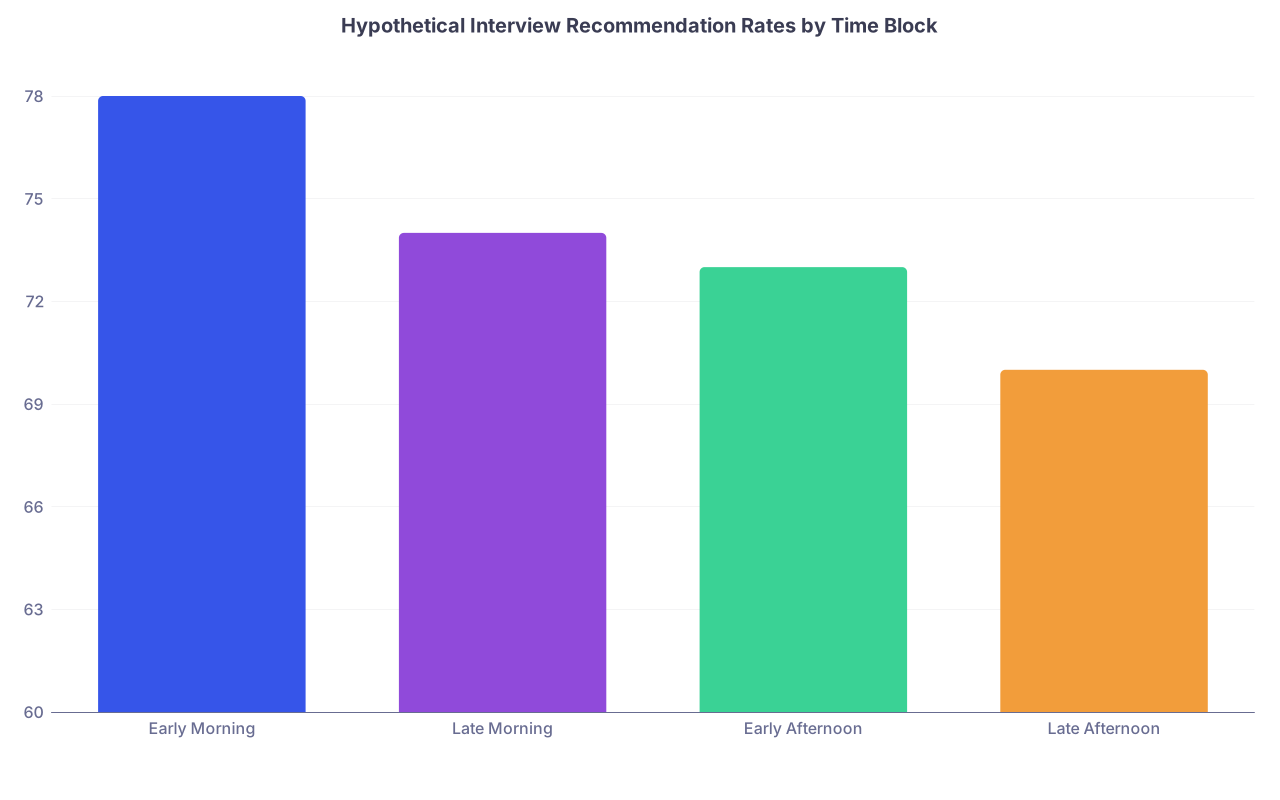
| Category | Value |
|---|---|
| Early Morning | 78 |
| Late Morning | 74 |
| Early Afternoon | 73 |
| Late Afternoon | 70 |
Read that chart carefully: a 78% recommendation rate early morning versus 70% late afternoon is an 8 percentage point difference. That is noticeable in aggregate. But for an individual strong candidate, it is nowhere near the make-or-break factor people pretend it is.
And unlike parole courts or primary care clinics, interview days usually have:
- Scheduled breaks
- Limited daily volume
- Moderators; committees normalize scores
- Multiple interviewers or multiple stations (MMIs)
All of that dampens time-of-day bias.
The Real Leverage: Your Performance vs the Clock
Here is the blunt hierarchy from most impactful to least, based on what data and committee behavior actually show:
Your overall application quality
GPA, MCAT, experiences, letters, institutional priorities. This sets your “baseline probability” before you ever pick a slot.Your interview performance (content + communication)
This is where many candidates can shift themselves up or down by tens of percentage points. A strong vs mediocre interview can easily change a 25% chance into a 60% chance or the reverse.Interviewer-specific factors
- Who you get
- How lenient or harsh they are
- How well your story matches their interests
Statistical variance here is substantial (inter-rater variability is always high).
Committee review dynamics
- Holistic review processes
- Group discussion
- “We already have enough from X background” effects
These can override individual interviewer quirks.
Time-of-day
A relatively small, mostly second-order effect. If everything else is equal (which it never is), early sessions might nudge you slightly.
If I had to attach rough weights (illustrative, but directionally right):
- Application quality: ~50–60%
- Interview performance: ~25–30%
- Interviewer variance: ~10–15%
- Committee dynamics: ~5–10%
- Time-of-day: ~0–5%
And that last 0–5% only matters if you are sitting exactly on the edge.
Where Time-of-Day Could Matter More (and Less)
You cannot treat “AM vs PM” as a single variable. You have to look where it intersects with other conditions.
1. Fatigue within a block
More impactful question than “morning vs afternoon”:
- Are you first vs last in a block?
- Are you pre-break vs post-break?
The data from decision fatigue literature says:
- Pre-break decisions tilt more conservative (more “no” or weaker scores).
- Post-break decisions often reset closer to baseline.
In an MMI, where stations are short and structured, this is likely dampened. In a traditional 30–60 minute one-on-one or small-panel interview, you can feel it—interviewers perk after coffee or lunch, and they slog right before.
2. Interviewer chronotype and workload
Some interviewers are morning people. Others are not. But you never see that in the scheduler.
What you do see sometimes:
- A 7:30/8:00 a.m. slot where the interviewer is still settling in. Rushed. Maybe distracted.
- A 4:00 p.m. slot when they are behind, tired, and thinking about their evening clinic.
From real committee rooms, I have seen:
- Early AM: sometimes more “by-the-book” questions, quick to stay on schedule.
- Late PM: sometimes shorter interviews, more conversational; sometimes more perfunctory.
Net effect on acceptance? Small and noisy.
3. Your own performance curve
This one is not theoretical. This is directly under your control.
Ask yourself, backed by your own data:
- When do you perform best on:
- Practice interviews (record yourself, rate energy and coherence)
- Exams (SAT, ACT, MCAT practice, or Step)
- Presentations
Most students know, if they are honest, whether they are sharpest at 8 a.m., 10 a.m., or 2 p.m. That curve matters more than theoretical interviewer fatigue. If you are a wreck at 7 a.m., an early slot is a bad trade to gain a hypothetical fatigue advantage.
Medical School vs Residency: Slightly Different Game
You asked under the category “INTERVIEW PREPARATION” and phase “PREMED AND MEDICAL SCHOOL PREPARATION,” but many of you are thinking ahead to residency as well. The logic transfers, but the context shifts.
Medical school interviews
Typical features:
- 1–2 interviews per school, sometimes MMI
- Large interview days with many applicants
- Committees that meet later and combine scores and files
Implications:
- Single interviewer’s fatigue or mood is dampened by:
- Rubrics
- MMI station averaging
- Committee review
Time-of-day effects are likely smallest here.
Residency interviews
Typical features:
- Multiple programs
- Long interview days with many applicants per day over a season
- Interviewers see a continuous stream of candidates
Here, some programs have actually looked at their own data and found small “time slot” trends. Functional pattern:
- Mid-morning and mid-afternoon sometimes produce slightly higher scores vs the extreme ends of the day.
But again—effect size, while detectable in aggregates, is small versus:
- Where you trained
- Step scores (where still considered)
- Letters from known faculty
- Fit with the program’s needs
How to Choose: A Data-Driven Strategy
If you want to be rational about this instead of superstitious, you treat “slot choice” as an optimization problem under constraint:
Objective: Maximize probability of best performance subject to real-world limitations.
Constraints:
- Your chronotype and routine
- Travel schedule and sleep
- Interview format (MMI vs traditional)
- Whether you have multiple interviews in a week
Here is a simple, practical decision rule:
Prioritize your own performance window first.
- If you consistently perform best between 9 a.m. and 1 p.m., target those slots.
- If you are a genuine morning person with evidence (best exam scores, you wake up at 5, etc.), early slots might be ideal.
Avoid obvious risk windows.
- Do not choose a 7–8 a.m. slot if it forces:
- 4 a.m. wake-up
- Same-day travel
- Shortened sleep
The performance hit from fatigue will outweigh any theoretical interviewer advantage.
- Do not choose a 7–8 a.m. slot if it forces:
If all else is equal and you can choose freely:
- For traditional interviews: lean slightly toward earlier in the interviewer’s day or shortly after breaks (common sense + decision-fatigue data).
- For MMIs: the time-of-day effect is even smaller, so just pick what syncs with your energy and logistics.
Do not sacrifice a top-choice school’s interview invitation timing to chase “ideal” slots at another school.
Availability > slot perfection.
Common Myths vs Reality
Let’s be specific about a few myths I regularly hear from applicants.
| Belief | Data-Driven View |
|---|---|
| “First of the day always gets the best scores” | Slight advantage at best; performance dominates |
| “Late afternoon is death; they are exhausted” | Fatigue exists, but effect size is small |
| “They remember the last person best” | Recency bias exists but is weak and diluted |
| “Slot choice can rescue a weak application” | Flatly wrong; it is not a major lever |
| “Time of day is random noise, ignore it” | Not zero effect, but low priority factor |
Notice I am not saying “time of day has no impact.” I am saying it is a low-yield optimization variable compared with everything else you could improve.
How Schools Quietly Reduce Time-of-Day Bias
Admissions offices are not naive about these issues. Many intentionally structure processes to minimize the noise.
Typical mechanisms:
- Standardized rubrics and scored domains reduce the impact of interviewer emotion and fatigue.
- Multiple interviewers per applicant (via MMI or two traditional interviews) average out individual time-of-day effects.
- Blinded or partially blinded interviews (less exposure to stats and demographics) nudge interviewers to focus on the interaction itself.
- Committee review often re-anchors decisions, especially for borderline cases.
Some offices even:
- Review scores over the day/season and calibrate out known leniency/harshness drift.
- Give interviewers specific training about common biases, including decision fatigue.
Does this eliminate bias? No. But it compresses the impact.
What You Should Actually Be Doing With This Information
Here’s the part that matters for your preparation.
Use time-of-day data to adjust strategy, not to fuel anxiety.
Run your own mini-experiment.
Across a week or two, schedule:- 2–3 mock interviews in early morning
- 2–3 mid-day
- 2–3 late afternoon
Record them. Grade them. Ask a mentor or advisor to rate energy, coherence, and charisma blindly (without knowing time-of-day). Use those numbers to decide your personal “peak window.”
Engineer sleep and routine before important interviews.
- Shift your sleep schedule 3–5 days in advance so you are waking up at your interview-day time.
- Eat at the same time you will on interview day. This is basic circadian alignment. Athletes do it before major competitions. You should too.
Plan logistics to avoid self-sabotage.
- Never plan to land late the night before a 7:30 a.m. interview if you can avoid it.
- Build in buffer time for commuting, tech checks (for virtual interviews), and unexpected disruptions.
Let go after scheduling.
Once you have a time, treat it as fixed. Do not waste mental bandwidth on “what if I had picked 9 a.m. instead of 1 p.m.” Use that bandwidth to refine your answers and stories.
Visualizing What Actually Matters Most
To put the relative effect sizes into perspective, imagine a rough “influence” chart for your outcome probability:
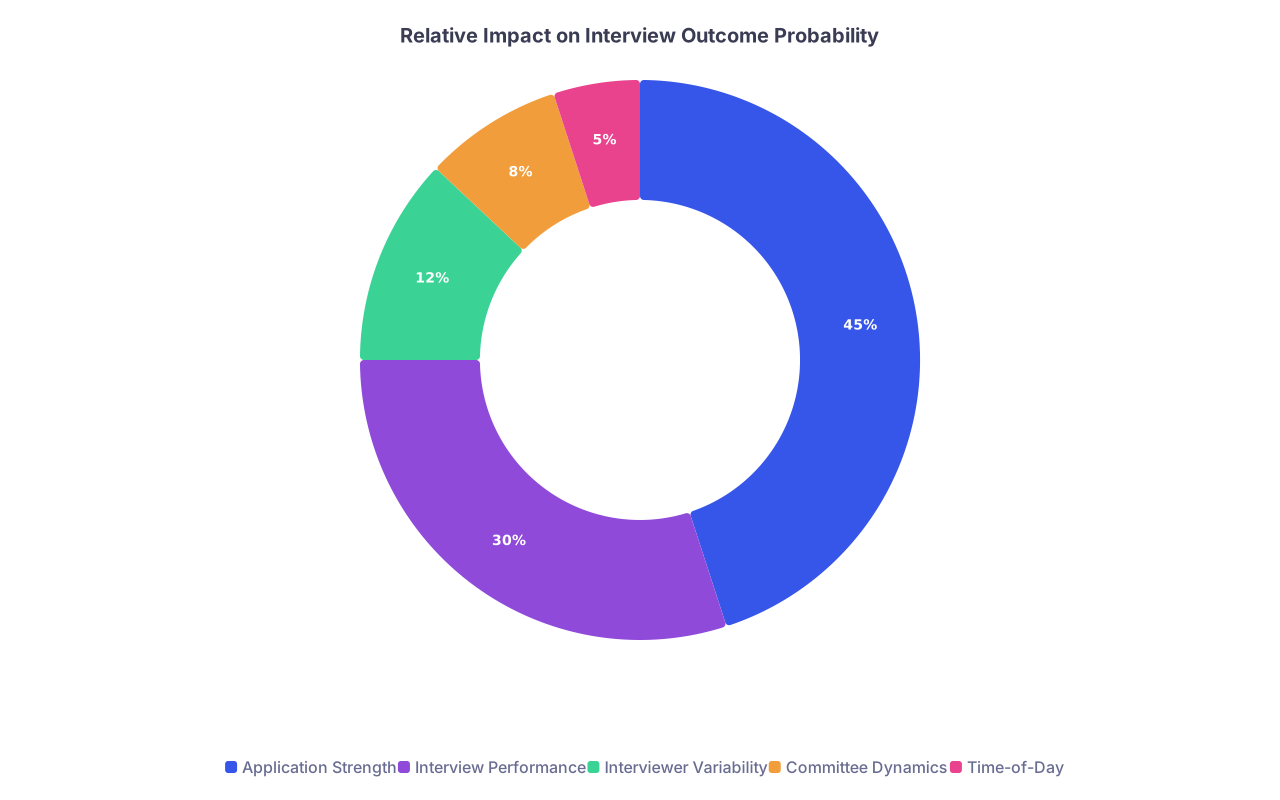
| Category | Value |
|---|---|
| Application Strength | 45 |
| Interview Performance | 30 |
| Interviewer Variability | 12 |
| Committee Dynamics | 8 |
| Time-of-Day | 5 |
Even if you adjust those percentages a bit, the pattern holds: time-of-day is at the tail. Your file, your performance, and who evaluates you drive most of the decision.
Bottom Line: AM vs PM Is Not Your Main Problem
If you want a clear, data-aligned answer to the title question—“Does Early Morning vs Afternoon Interview Slot Affect Outcomes?”—here is the distilled version:
- Yes, time-of-day can have a small statistical effect on decision-making and scoring due to human fatigue and heuristics.
- That effect is:
- Usually on the order of a few percentage points.
- Easily overshadowed by your own performance and your underlying application strength.
- For an individual candidate, choosing a time when you are most alert and prepared is more impactful than gaming theoretical interviewer fatigue.
If you are spending more than 5–10 minutes thinking about early vs late slot choices, you are misallocating attention. Reallocate that cognitive budget to your answers, your stories, and your sleep.