
The idea that “more interviewers means a fairer evaluation” is only half true. The data shows that multiple interviewers reduce random noise, but they also introduce new biases if you design the system badly.
Let me walk through what actually happens to your score when you face one interviewer versus a panel, using numbers instead of folklore.
The core problem: interview scores are noisy data
Interview ratings are not precise measurements. They are messy, human, and statistically noisy.
Most studies that have looked at traditional medical school or residency interviews find three hard numbers that matter:
- Inter-rater reliability (how much interviewers agree with each other) is often low to moderate.
- A single interviewer’s score correlates only modestly with eventual performance (correlations in the 0.2–0.3 range at best).
- Individual interviewer “leniency/severity” effects are large and stable. Some people are always tough graders. Others inflate scores.
So the basic statistical question is simple: does using multiple interviewers give you a more reliable, less biased score?
The short answer: usually yes, but it depends on structure, independence, and how those scores are combined.
Single interviewer vs panel: the reliability math
Strip away the ceremony and you are left with a measurement problem. You are trying to measure a latent trait: “candidate suitability.” Interviewers observe you and assign a score. Each score = true signal + noise.
If we model an interviewer’s score as:
Score = True ability + Rater bias + Random error
then using one interviewer means your fate is tied heavily to that person’s bias and mood. Using several and averaging their scores shrinks the random component. The key word is averaging.
How much reliability improves with more interviewers
The statistics behind this are straightforward. If the correlation between any two interviewers’ ratings is r (often 0.3–0.5 in reasonably structured settings), the reliability of the average of k interviewers increases as you add more raters.
A simple approximation from classical test theory:
Reliability_composite ≈ (k * r) / [1 + (k − 1) * r]
Run some numbers. Assume a modest inter-rater correlation r = 0.4 (common for decently structured interviews):
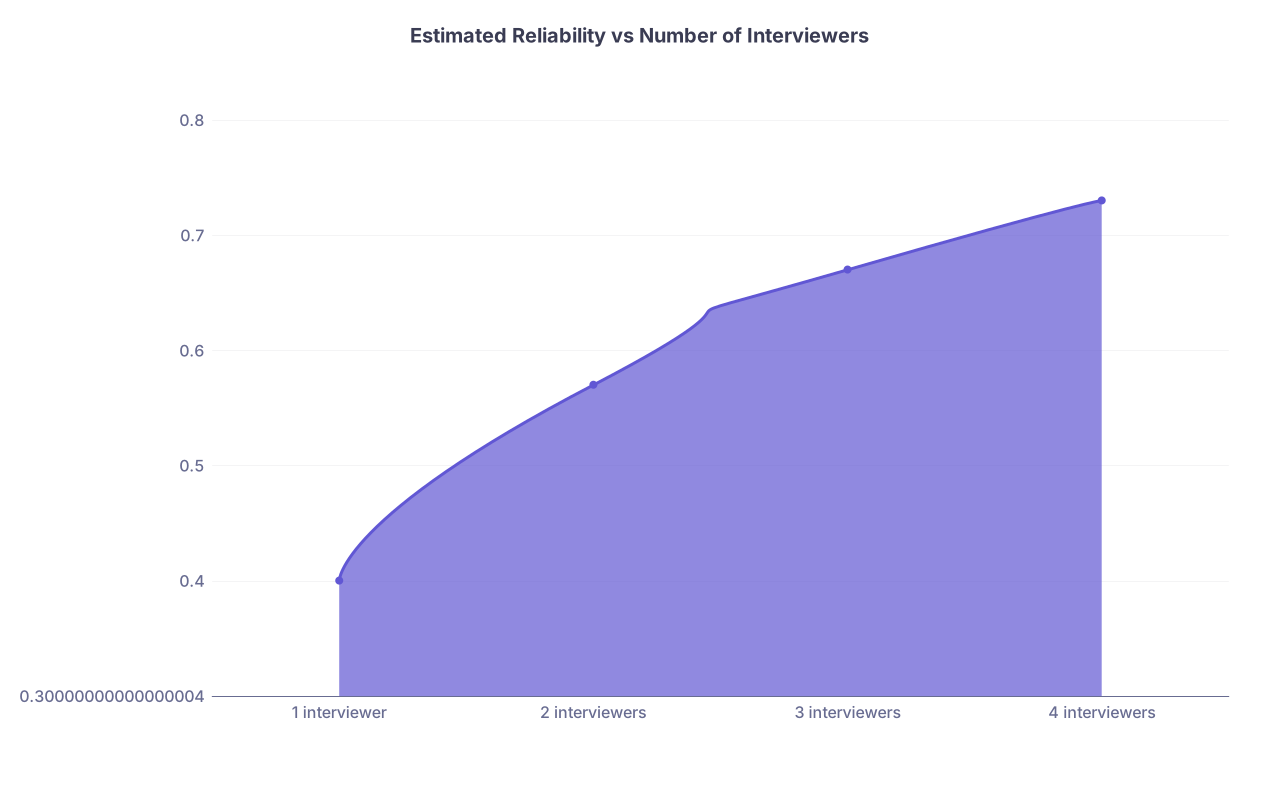
| Category | Value |
|---|---|
| 1 interviewer | 0.4 |
| 2 interviewers | 0.57 |
| 3 interviewers | 0.67 |
| 4 interviewers | 0.73 |
With r = 0.4:
- 1 interviewer → reliability ≈ 0.40
- 2 interviewers → ≈ 0.57
- 3 interviewers → ≈ 0.67
- 4 interviewers → ≈ 0.73
So going from 1 to 2 interviewers is a big jump. From 2 to 3 still helps. Beyond 4, you get diminishing returns.
Now, translate that into what you care about: ranking and decisions.
More reliability means:
- Less chance that a mediocre applicant is “accidentally” scored as excellent because one interviewer loved them.
- Less chance that a strong applicant is tanked because one interviewer was having a bad day or has a hidden dislike for a certain background or communication style.
From a statistical standpoint, using multiple interviewers and averaging their ratings is clearly fairer. The question is how you operationalize that: panel vs multiple separate interviews.
Single interviewer: what the data shows
The single-interviewer format is simple: one person, usually 25–45 minutes, one score or a small set of rubric scores.
Its main problem is variance. Not from you. From them.
You are exposed fully to:
- Rater leniency/severity: one notoriously strict surgeon might give everyone 2–3 points lower than the mean.
- Shared background bias: if you happen to have the same undergrad or research interest, your score can jump for reasons unrelated to performance.
- Demographic or implicit bias: gender, race/ethnicity, accent, non-traditional age; there is research showing these can creep in.
With a single interviewer, these biases are not averaged out. They become your reality.
Studies looking at single-rater interviews repeatedly find:
- Large between-interviewer variance. Sometimes more variance between interviewers than between applicants.
- That “which interviewer you got” can explain a non-trivial fraction of the variance in final scores—often 20–30% in unstructured formats.
That is outrageous from a measurement perspective. You would never accept a lab test where 30% of the variance in results came from which technician held the pipette.
Are there upsides to one-on-one?
A few.
- Some applicants feel more comfortable in a one-on-one conversation.
- Interviewers may feel they can build rapport more quickly.
- Logistics are easier. You only need one person’s schedule, one room.
But those advantages are anecdotal. The numbers lean heavily against relying on a single person to decide a major gate in a medical career.
Panel interviews: more eyes, less noise?
Panel interviews put you in front of 2–5 interviewers simultaneously. They each rate you, either jointly (one composite impression) or independently (individual rubric scores averaged later).
The fairness and reliability depend almost entirely on how the panel is used.
Panels with independent scoring and averaging
This is the cleanest design.
Each panelist scores you using the same rubric. After the interview, those scores are combined—usually averaged—to give your panel score. Conceptually, it is just multiple interviewers at once.
If individual inter-rater correlations are, say, 0.35, and you have 3 panelists, we can go back to the same math. Your composite reliability jumps to about 0.65–0.70. That is a huge upgrade from 0.35–0.40 for one interviewer.
Even more importantly, extreme ratings get diluted. Imagine 3 independent scores on a 1–10 scale:
- Interviewer A: 9
- Interviewer B: 6
- Interviewer C: 5
Average = 6.7
The outlier “9” still matters but does not dominate. Compare that with a single-interviewer scenario where your fate is either 9 (you look stellar) or 5 (you look weak). The panel structure compresses those extremes toward your true underlying performance.
Panels with consensus or one dominant voice
This is where panels stop being fair and become performative.
If the panel “discusses and agrees on a single score” rather than submitting independent ratings, a few things happen:
- Conformity: people anchor on whoever speaks first or has perceived higher status (program director, famous researcher).
- Social desirability: junior interviewers rarely contradict a senior faculty member in a group meeting.
- Loss of independent error: you lose the statistical benefit of independent measurements. It becomes one collective judgment, not 3–4 separate ones.
You can see this anecdotally. I have watched debriefs where someone says, “I thought she was fine, but if you both felt she was weak, I am okay rating her lower.” That is not independent scoring. That is groupthink.
So are multiple interviewers fairer? Only if they preserve independence of judgment at the scoring stage. Panel format alone does not guarantee that.
Single vs panel vs multiple mini-interviews (MMI)
You rarely see serious discussions of interview fairness omit MMIs. They are not exactly “panels,” but from a data viewpoint, they use the same principle: many independent raters, each seeing you in a standardized context.
Here is a simple comparison:
| Format | Typical Interviewers | Stations/Encounters | Reliability (approx) | Main Benefit |
|---|---|---|---|---|
| Single | 1 | 1 | 0.3–0.4 | Simple logistics |
| Panel | 2–4 | 1 | 0.5–0.7 | More eyes, less noise |
| MMI | 1 per station | 6–12 | 0.7–0.85 | Very stable scores |
MMIs routinely show higher reliability because:
- You are sampled in multiple contexts (ethical scenarios, teamwork, communication, etc.).
- Many independent raters contribute a slice of data.
- No single rater can tank you completely. A bad station hurts, but one 3/10 in a sea of 8s is survivable.
Panels are a step between single and MMI. Better than a single interviewer, worse than a well-designed MMI system.
Bias: does a panel actually reduce unfairness?
The evidence on bias is more complex.
Multiple interviewers should, in theory, reduce individual biases because:
- A single person’s idiosyncratic dislike of a demographic group or background gets diluted.
- Different panelists notice different strengths and weaknesses—clinical, academic, interpersonal.
There is data suggesting that structured interviews with multiple raters show smaller demographic score gaps than unstructured, single-interviewer formats. Numbers vary, but you often see:
- Gender or race/ethnicity gaps in unstructured single interviews of 0.2–0.4 SD (standard deviations).
- Those gaps shrinking notably in structured, multi-rater systems.
But two caveats.
First, if your panel is not diverse (e.g., three people with similar backgrounds, similar training, similar social circles), you get correlated bias. That is not independent error; it is a shared systematic bias. Three copies of the same lens.
Second, panels can reinforce power dynamics. If the most senior person displays visible enthusiasm or skepticism, others unconsciously mirror it. That shifts scores in a biased direction even without malicious intent.
Bottom line: yes, panels can reduce individual idiosyncratic bias, but only if:
- Panel members score independently before any discussion.
- Panels include diversity of perspective (discipline, training, background, sometimes gender and race/ethnicity).
- Programs monitor for systematic score gaps across groups and address them.
Without that, “panel” is just a more expensive way to run a biased process.
Variability in scores: what it feels like as an applicant
Let me put numbers into an applicant-level example.
Assume:
- True underlying “interview ability” scaled 1–10.
- Random rater noise with SD = 1.5 points.
- Rater bias component (some are +1 lenient, some −1 severe).
Single interviewer case
You meet one interviewer with bias −1 (tends to score low). Your true ability is 8.
Expected observed score:
8 (true) − 1 (rater severity) + random error (say −0.5 this day) ≈ 6.5
On a 1–10 scale, you suddenly look average. In a competitive pool, that can knock you out of consideration.
Three independent panelists case
Now, you see three people:
- Rater A: bias −1 (severe)
- Rater B: bias 0 (neutral)
- Rater C: bias +0.5 (slightly lenient)
Random errors: −0.5, +0.3, −0.1
Scores:
- A: 8 − 1 − 0.5 = 6.5
- B: 8 + 0 + 0.3 = 8.3
- C: 8 + 0.5 − 0.1 = 8.4
Average ≈ (6.5 + 8.3 + 8.4) / 3 ≈ 7.7
Your observed score is much closer to your true ability (8) because the biases and random errors partially cancel.
This is the entire argument for multiple raters in one example. Variability at the individual rater level is not the problem. It is the unaveraged variability that hurts fairness.
From the program’s side: trade-offs and design choices
Programs are not optimizing solely for fairness. They also care about:
- Faculty time
- Scheduling complexity
- Applicant experience
- Predictive validity (how well scores map to future success)
Multiple interviewers cost more faculty hours. Panels also demand careful scheduling: you need several busy people in the same room or Zoom at the same time.
Let me put rough “cost vs reliability” comparisons side by side.
Assume 30 minutes per interview encounter.
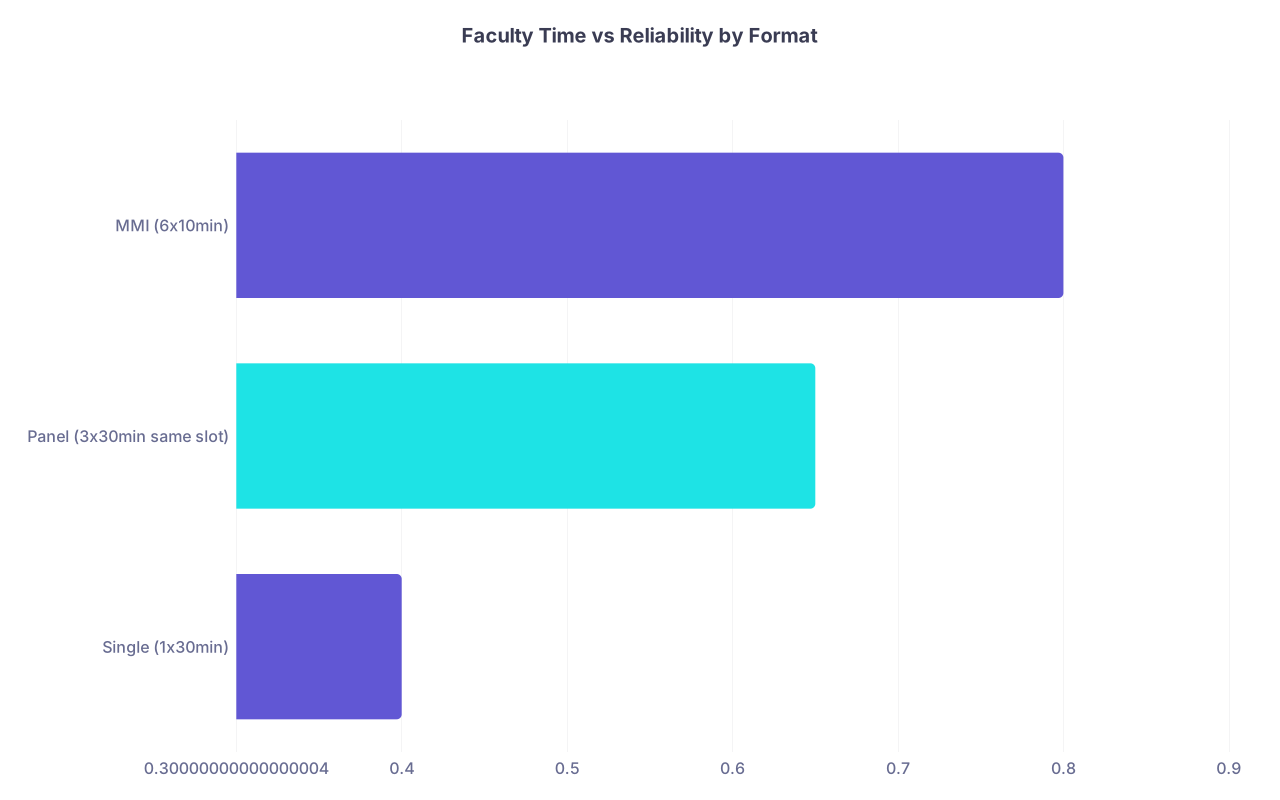
| Category | Value |
|---|---|
| Single (1x30min) | 0.4 |
| Panel (3x30min same slot) | 0.65 |
| MMI (6x10min) | 0.8 |
Interpretation:
- Single: 30 minutes of faculty time → reliability ~0.4
- Panel: 90 minutes of total faculty time (3 people, same slot) → reliability ~0.6–0.7
- MMI: 60 minutes of total faculty time (6 short stations, each 10 minutes) → reliability ~0.75–0.85
So if a program has a fixed faculty time budget, the most efficient design statistically is closer to “many short stations with different raters” (MMI-like) rather than “one long panel.”
That does not mean panels are bad. It means that a well-designed MMI system uses resources more efficiently to reduce score variability and improve fairness.
For you as an applicant: strategy for panels vs single interviews
You cannot control whether you face a single interviewer, a panel, or MMIs. You can, however, adjust how you play the game.
In a single-interviewer setting
Expect higher variance and plan for it.
- Rapport matters more. One person’s global impression dominates your score.
- Manage first impressions aggressively: appearance, greeting, initial answer to “Tell me about yourself.”
- Watch for interviewer cues. If they seem skeptical about something in your file, address it directly and calmly. You have one shot to change that narrative.
You are essentially dealing with a high-stakes “n of 1” measurement. That is fragile.
In a panel setting
The data reality: each person is scoring you separately (if the system is designed correctly), so you cannot afford to “forget” someone at the table.
Practical adjustments:
- Balance eye contact. Start your answer by orienting to the person who asked, then deliberately sweep others for a second or two. Panel members will notice if you lock onto one person and ignore the rest.
- Expect different priorities. One panelist may focus on ethics, another on academic rigor, another on communication. Your answers should be broad enough that each finds something to hang a positive score on.
- Stay consistent. Panels expose contradictions quickly. If you tell one member you dislike research and another you are “deeply passionate” about it, they compare notes. Your internal narrative needs to be coherent.
From a fairness perspective, the panel is your friend. One odd reaction from a single panelist is unlikely to destroy your aggregate score.
Mental framing
Single-interviewer interview → High variance, high sensitivity to chemistry. Treat it like a delicate one-on-one negotiation.
Panel interview → Lower variance, more robust to one awkward moment. Treat it like presenting to a small committee: clear, structured answers that respect multiple perspectives.
Where programs go wrong with panels
If you are curious why some applicants still feel panel interviews are “unfair” despite the math, the failure points are predictable:
- No structured scoring rubric. Free-form impressions instead of criteria. This kills inter-rater reliability.
- No independent scoring. Panelists talk themselves into a shared narrative before anyone records an independent rating.
- Homogeneous panels. Three versions of the same person. You reduce random noise but bake in shared biases.
- Lack of monitoring. Programs do not look at their own data: no analysis of which panelists are consistently high/low, no checking for systematic score gaps by demographics.
When those things happen, “panel” is a label, not a psychometric improvement.
Frankly, many medical schools and residencies still treat interview scoring like a social ritual instead of a measurement question. Applicants experience the resulting noise as “unfair.” Statistically, they are not wrong.
So, are multiple interviewers fairer?
If we strip it down to the essentials:
- Multiple independent interviewers, whose scores are combined quantitatively, are fairer in a statistical sense: they reduce random error and individual bias impact.
- Panel format in itself does nothing if it does not preserve independent scoring and reasonable diversity of perspective.
- From a measurement-efficiency standpoint, multiple short, structured encounters (MMI-style) outperform both single and panel interviews.
You, as an applicant, do not control the format. But you should understand the data reality behind it:
- Single interviewer = higher variance, more fragile, but sometimes more personal.
- Panel with good design = more stable scores, less risk from one bad match.
- Many raters, structured questions, and independent scoring = maximal fairness the current system can offer.
Keep those three points in mind, and you will stop taking some of the randomness personally. Much of it is just measurement error. Multiple interviewers, when used properly, are one of the few tools that actually shrink that error instead of amplifying it.