
Common Premed Buzzwords That Make Your Answers Sound Hollow
What do you actually say when the interviewer interrupts you mid-speech and asks, “Can you be more specific? I still don’t really know what you did”?
(See also: what interviewers notice in the first 60 seconds for more details.)
If that’s ever happened to you in a mock interview—or worse, in a real one—you’ve probably been leaning way too hard on premed buzzwords. And they’re killing your answers.
Let me be blunt: most premed interview answers sound exactly the same. Different faces, same script. Same words: “passionate,” “lifelong dream,” “giving back,” “holistic care,” “help people,” “teamwork,” “growth mindset.” Interviewers have heard these phrases hundreds of times. They stop listening when they hear them because 9 out of 10 times, there’s nothing underneath.
Your job is to not be the 9.
This isn’t about vocabulary. It’s about hiding behind language instead of saying something real. I’ve watched strong applicants sink themselves with generic, buzzword-heavy answers that made them sound like a brochure, not a human being.
Let’s walk through the most common premed buzzwords that make your answers sound hollow—and what to say instead.
The “I Want to Help People” Trap
If you say “I want to help people” as your main reason for medicine, you’ve already lost ground. Not because helping people is bad. It’s just useless as an answer.
Every teacher, social worker, nurse, PA, dentist, PT, respiratory therapist, and EMT could say the same thing. So when you say “help people,” you’re telling the interviewer nothing about why medicine and nothing about you.
The common hollow versions:
- “I’ve always wanted to help people.”
- “I’m passionate about helping others.”
- “I just want to give back to my community.”
These lines are so overused they’re basically white noise.
The mistake: You stop thinking once you’ve said “help people.” You treat that as an explanation when it’s actually just the starting point.
What to do instead: Force yourself to answer a sharper question:
Why this kind of helping, in this role, with this responsibility, under these conditions?
Swap the vague:
“I want to help underserved communities.”
For something with teeth:
“In clinic, I kept seeing patients who came in only after their diabetes was out of control because they’d lost trust in the system. I want to practice in a safety-net setting where I can both manage those complex medical issues and work on rebuilding that trust over years with the same patients.”
Notice the difference:
- You name a specific problem (late presentation of disease).
- You describe a setting (safety-net clinic).
- You describe your role (managing complex medical issues + rebuilding trust).
You’re still “helping people,” but now it actually means something.
“Passionate” About Everything (Which Means Nothing)
Another dead giveaway you’re faking depth: everything is your “passion.”
“I’m passionate about research.”
“I’m passionate about community service.”
“I’m passionate about global health, advocacy, and mentoring younger students.”
No you’re not. Not all of that. Not equally.
Interviewers are allergic to the word “passionate” at this point because it’s almost never backed up with choices, sacrifices, or outcomes. It’s just a label premeds slap on anything they think sounds impressive.
The mistake: Using “passion” as a shortcut instead of proving you care through your behavior.
If you’re “passionate” about research, I should see:
- You stuck with one lab for more than a semester.
- You learned enough to explain your project in English, not jargon.
- You can talk about a failure or hypothesis that did not work and what you did next.
If you’re “passionate” about community service:
- You kept going after the program requirement ended.
- You took on more responsibility over time.
- You can name a real person or situation that changed how you think.
So cut the word “passionate” by 80%. Replace it with specifics:
- “I’ve spent three years in the same Alzheimer’s lab, and the moment that hooked me was…”
- “I kept going back to the free clinic after my requirement ended because…”
You show passion. You do not declare it.
The “Lifelong Dream” and “Calling” Cliché
“I’ve wanted to be a doctor since I was 5.”
“This is my calling.”
“I’ve always known medicine was for me.”
No, you haven’t. And when you say this, you sound unexamined, not committed.
Interviewers don’t trust “always.” They know you didn’t understand what being a physician really meant at age 5, 10, or 15. So when you lean on “lifelong dream,” what they actually hear is: “I haven’t updated my childhood fantasy with adult-level insight.”
The mistake: Equating time (“I’ve wanted this forever”) with thoughtfulness (“I’ve seriously considered what this life is actually like”).
What to do instead: Talk about inflection points, not origin myths.
Better structure:
- “I first became interested in medicine when…”
- “That shifted in college when I realized…”
- “What finally convinced me I could handle this work was…”
For example:
“I used to say I wanted to be a doctor because I liked science and helping people. It wasn’t until I started scribing in the ED and watched my attending have three conversations in a row—one about bad news, one about addiction, and one about a language barrier—that I realized how much of this job is about communication under pressure. That’s when I stopped romanticizing it and started actually preparing for it.”
That sounds like someone who’s paying attention, not someone reciting a childhood script.
“Holistic,” “Patient-Centered,” and Other Empty Jargon
Premeds love to say:
- “I believe in holistic care.”
- “I want to practice patient-centered medicine.”
- “I value interdisciplinary, collaborative, team-based care.”
Those phrases are technically correct and completely useless by themselves. They’re pulled straight from mission statements and websites. Interviewers know exactly where you got them.
The mistake: You repeat institutional language but never translate it into what you’d actually do differently at the bedside.
If you want to talk about “holistic care,” say what that actually looks like.
Instead of:
“I want to care for the whole person, not just the disease.”
Try:
“Working with a patient navigator, I saw how much it mattered to ask, ‘Can you actually get to this appointment?’ or ‘Who’s going to help you at home after surgery?’ That shifted how I think about care. It’s not just about choosing the right antibiotic; it’s about making sure the plan fits the patient’s real life so they can follow it.”
Same theme. Completely different level of substance.
If you’re going to use buzzwords like “patient-centered” or “holistic,” force yourself to add:
- A specific story
- A concrete behavior you saw or did
- The conclusion you drew
No story, no behavior, no conclusion? Drop the buzzword.
Overused Virtue Words: “Resilient,” “Adaptable,” “Growth Mindset”
Telling them you’re resilient doesn’t prove you are. In fact, the more you pile on words like:
- Resilient
- Adaptable
- Hard-working
- Dedicated
- Growth mindset
…the more suspicious they get. Because real traits show up in your stories without you naming them.
The mistake: Announcing your character instead of illustrating it.
Hollow version:
“I have a strong growth mindset and I’m very resilient. In orgo, I struggled at first but I worked hard and improved my grade.”
Stronger version:
“I failed my first orgo exam. I stopped pretending I could cram, started doing 25 problems a day, and went to office hours every week. By the final, I was scoring in the 90s. That experience made me build a system for when I’m struggling instead of just panicking.”
The second answer never says “resilient” or “growth mindset.” It doesn’t need to. The interviewer can see it.
As a rule: If you can replace “I’m resilient” or “I’m adaptable” with an example and the meaning stays clear—or gets clearer—keep the example and delete the label.
“Teamwork” and “Leadership” With No Actual Conflict
Everyone claims to be a team player and a leader. Very few can describe a time they:
- Took an unpopular but necessary stance
- Dealt with a lazy teammate or a control freak
- Stepped back and let someone else lead because it was better for the goal
Hollow teamwork answer:
“I really value teamwork. In my research lab, we all worked together and communicated.”
There’s no tension. No stakes. Nothing to show how you behave when it’s not easy.
More honest version:
“On my volunteer team, one member kept missing shifts. At first, I covered for them because I didn’t want conflict. When it started impacting patient flow, I spoke with them privately, then our coordinator. It was uncomfortable, but I realized being a team player sometimes means holding people accountable, not just keeping the peace.”
That’s leadership. That’s teamwork. You didn’t have to say either word.
If your “teamwork” story doesn’t have:
- A problem
- A decision you made
- Some emotional discomfort
…it’s fluff. Fix it or pick another story.
“Giving Back” and “Underserved” Without Understanding
“Giving back” has become a standard premed line.
Common version:
“I want to give back to my community and work with underserved populations.”
The issue: You sound like you’re quoting a mission statement, not describing reality. “Underserved” is not a personality trait; it’s a structural condition. If you say the word, you should understand what’s driving it in the specific place you’re talking about.
Ask yourself:
- Which community? Where?
- In what way are they underserved? Insurance? Geography? Language? Prejudice?
- How did you see that in your experience?
Better answer:
“The free clinic where I volunteer serves mostly undocumented farmworkers who don’t qualify for insurance and work unpredictable hours. We often see people late in their disease because they can’t miss work for a ‘minor’ symptom. Watching a 42-year-old with end-stage renal disease who had avoided care for years for fear of deportation changed how I think about ‘access.’ It’s not just a clinic existing; it’s whether people feel safe enough to use it.”
No buzzword needed. It’s obvious you care about equity because you actually understand what’s happening on the ground.
“Research” Buzzwords That Make You Sound Like A Parrot
Premeds are great at memorizing phrases like:
- “Translational research”
- “Bench to bedside”
- “Cutting-edge”
- “Bridging the gap between basic science and clinical practice”
Then they fall apart when you ask, “So what was your hypothesis?” or “What did you actually do on a Tuesday?”
The mistake: Hiding behind research lingo instead of owning your actual role—however small—and your actual understanding.
Hollow version:
“I worked on translational research that aimed to bridge the gap between bench and bedside and improve patient outcomes.”
Strong version:
“In our lab, we were testing whether a specific protein pathway was involved in chemo resistance in breast cancer cells. My main job was running Western blots and maintaining cell cultures. Our early data suggested that when we blocked that pathway, the cells were more sensitive to the drug. We’re far from clinical trials, but it made me appreciate how many small steps sit behind a new treatment.”
One is buzzwords. The other is comprehension.
If you cannot explain your research in simple language without saying “novel,” “cutting-edge,” or “translational,” you don’t understand it well enough yet. Fix that before interview day.
“Shadowing” and “Scribing” Without Insight
You will absolutely be asked about shadowing or clinical exposure. Most people respond with a list of activities, not an insight.
Hollow clinical answer:
“Through shadowing and scribing, I learned a lot about the health care system and saw how doctors help patients.”
That line could come from anyone.
What interviewers listen for:
- Did you notice how physicians made decisions?
- Did you notice the emotional side, not just the technical side?
- Did anything surprise you or challenge your assumptions?
Better:
“As a scribe, I sat in on a conversation where my attending told a patient their scan showed metastatic cancer. I expected a long, dramatic talk. It lasted five minutes because the ED was overflowing. What struck me was how carefully he chose those five minutes—what to say now, what to leave for the oncologist, how to make sure the patient had a support person before he left. It made me realize that in medicine, you’re constantly balancing time pressure with humanity, not in theory but in every single shift.”
You’re not just saying “I shadowed.” You’re showing you actually watched.
How to Detox Your Answers From Buzzwords
You’re not going to remember an entire lecture on vocabulary on interview day. So here’s a simple way to clean up your answers fast.
Write out your common answers:
- Why medicine?
- Tell me about yourself.
- Biggest challenge/failure.
- Leadership experience.
- Why this school?
Circle every buzzword:
- Passionate
- Help people
- Give back
- Holistic
- Patient-centered
- Resilient
- Team player
- Lifelong dream
- Calling
- Underserved
- Growth mindset
- Leadership
- Translational / cutting-edge / innovative
For each one, force yourself to:
- Replace it with a concrete action, or
- Attach a specific story that proves it.
If you can’t do either, cut it.
Here’s a quick visual way to think about how much of your answer should be concrete vs. buzzword fluff:
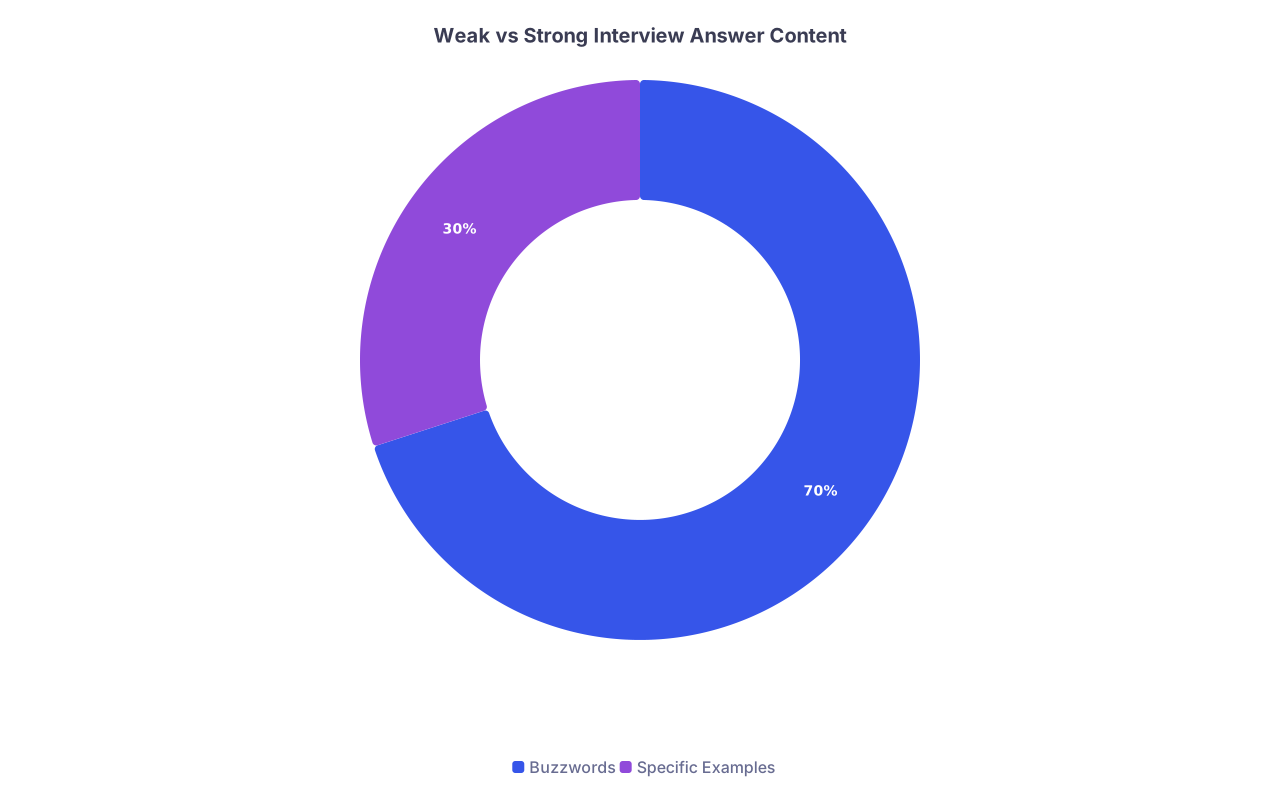
| Category | Value |
|---|---|
| Buzzwords | 70 |
| Specific Examples | 30 |
For a weak answer, buzzwords dominate. Your goal is to flip that ratio—most of your words should be about real people, real decisions, real consequences.
A Quick Reality Check Tool: The “Friend Test”
One simple test: Take any sentence from your answer and imagine saying it to a friend who knows you well.
If it sounds like something you’d never actually say in real life, it probably belongs in the buzzword trash.
Example:
“I’m deeply passionate about holistic, patient-centered care and giving back to the underserved.”
Does that sound like you? Or does it sound like your personal statement tried to join a medical school brochure?
Now try:
“I want to work in clinics like the one where I volunteer now—people come in way later than they should because they’re scared of the system or can’t miss work. I like the idea of being the person they see regularly enough to trust.”
That sounds like a human being. Keep that.
A Clean, Real Answer Beats a Fancy, Hollow One
You don’t need to sound “impressive.” You need to sound real and thoughtful.
The people interviewing you have heard every cliché. They can tell the difference between:
- “I’m passionate about serving the underserved.”
and - “I watched a mom choose between missing work to bring her kid in, or risking her job. I want to be the kind of physician who understands that context when I’m frustrated someone is ‘noncompliant.’”
Strip away the buzzwords and you’ll be forced to show your actual thinking. That’s where you stand out.
Key Takeaways
- Buzzwords like “help people,” “passionate,” “holistic,” and “lifelong dream” make your answers sound generic and shallow when they’re not backed by specific stories and behaviors.
- Replace labels (“I’m resilient,” “I value teamwork,” “I care about the underserved”) with concrete examples showing what you did, what you noticed, and what changed in how you think.
- Before interview day, rewrite your core answers, ruthlessly cut vague phrases, and anchor everything in real experiences—named settings, real people, real conflicts, and real decisions.