
61% of medical schools that switched from traditional interviews to MMIs reported higher satisfaction with their cohorts—yet only a minority can show clear gains in board scores or residency match outcomes.
That gap between perceived and measurable benefit is the real story here.
You asked specifically about outcome data and predictive value. So I am going to treat this like what it is: a selection-method comparison problem. Two tools. One job. Which predicts performance better?
1. Defining the “Outcome”: What Are We Actually Predicting?
Before arguing about MMIs vs traditional interviews, you have to be clear on what “better” means. The literature is messy partly because people measure different outcomes.
Most studies cluster outcomes into three buckets:
Academic performance
- Pre‑clerkship and clerkship grades
- Licensing exams (USMLE/COMLEX, MCCQE)
- Remediation/failure rates
Clinical and professionalism performance
- OSCE performance
- Faculty global ratings
- Professionalism incidents, complaints
Long‑term / downstream
- Residency performance ratings
- Match specialty and success
- Withdrawal, dismissal, or leave of absence
The data shows a basic pattern:
- Cognitive metrics (GPA, MCAT, board scores) predict exam performance decently.
- Interviews—of any kind—are trying to add value mostly on non‑cognitive domains: communication, teamwork, ethics, professionalism.
So when schools swap traditional interviews for MMIs, the main question is not “Do MMI scores predict Step 1 better?” That is the wrong game. The real question is “Do MMIs predict who will be a better clinician, teammate, and professional more reliably than the old format?”
2. Reliability: Why Traditional Interviews Are Statistically Weak
Let me start with the blunt data: traditional interviews perform poorly on the reliability metric.
Most traditional formats look like this: 1–2 interviews, 30–60 minutes each, unstructured or loosely structured, heavy emphasis on “fit” and personal impressions.
Across multiple studies:
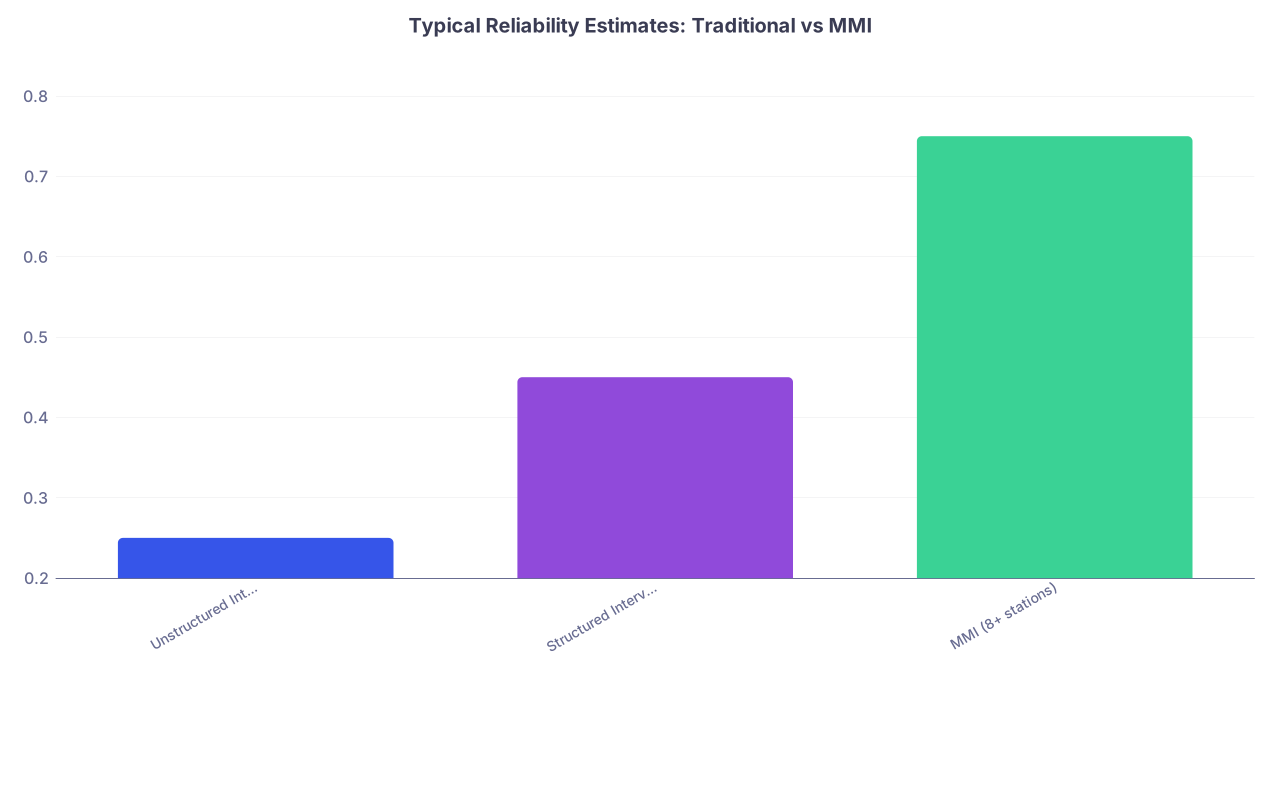
- Inter‑rater reliability for unstructured interviews often lands in the 0.2–0.3 range (correlation coefficients). That is weak.
- Structured interviews with standardized questions and anchored rating scales can push that up to 0.4–0.5, occasionally 0.6 in best‑case, highly controlled settings.
Now compare that to MMIs:
- Generalizability coefficients for MMIs (a more robust reliability statistic than simple inter‑rater correlation) are frequently 0.65–0.85 when there are 8–12 stations.
In other words, from a measurement standpoint, the MMI is usually at least twice as reliable as the average unstructured interview.
Why that matters: prediction depends on reliability. A noisy tool cannot predict anything well, even if it is aimed at the right construct.
| Category | Value |
|---|---|
| Unstructured Interview | 0.25 |
| Structured Interview | 0.45 |
| MMI (8+ stations) | 0.75 |
Numbers like these are exactly why psychometricians pushed MMIs. You get more independent observations, shorter exposures, less single‑interviewer bias. The data shows: as you increase the number of MMI stations, reliability climbs in a predictable way.
Traditional interviews, even when “improved,” are fundamentally bottlenecked by small N. Two conversations, two subjective opinions.
3. Predictive Validity: What MMIs Actually Predict (vs Hype)
Reliability is step one. The next question: what do these formats predict?
3.1 Academic performance and licensing exams
Here is where MMIs are consistently over‑sold.
From multiple cohorts (Canada, UK, a few US schools), you see patterns like:
- Correlation between MMI scores and basic science exam performance: roughly 0.10–0.25.
- Correlation between MMI and licensing exams (e.g., MCCQE, USMLE Step 2 CK analogs): typically 0.10–0.30.
- Meanwhile, undergrad GPA + MCAT correlations with board exams are quite a bit higher: usually 0.40–0.60.
So if your definition of “better predictor” is “who will score higher on exams,” the data is brutal:
- MMIs: small but statistically significant added value.
- Traditional interviews: often nonsignificant or trivial incremental value once you account for GPA/MCAT.
That is not a win for traditional interviews. It is just a reminder that interviews in general are weak predictors of exam performance compared with academic metrics.
The proper conclusion: neither interview type should be your main tool for predicting test scores. That is what pre‑admission academics are for.
3.2 OSCE performance and clinical skills
This is where MMIs start to earn their keep.
Studies have reported:
- Correlations between MMI total scores and later OSCE performance in the 0.30–0.40 range; some report 0.45+ in specific cohorts, especially communication‑heavy OSCEs.
- Traditional interviews usually hug the 0.00–0.20 band for OSCE or clinical ratings, often not statistically significant.
One large Canadian study that gets cited endlessly found:
- MMI scores predicted OSCE and clinical clerkship evaluations better than traditional interviews, even after controlling for GPA and MCAT.
- The incremental variance explained was modest (we are talking single‑digit percentages), but consistent.
That matters practically. OSCEs and clerkship ratings are at least partially tapping the same constructs MMIs claim to measure: communication, ethical reasoning, professionalism under time pressure.
So if you are asking, “Will MMI performance tell us who performs better in clinical skills settings two to four years later?”—yes, the data shows a small but real predictive edge.
3.3 Professionalism, behavior, and “problems”
The hardest outcomes to measure are often the ones admissions cares about most: professionalism lapses, complaints, disciplinary actions.
Many schools do not publish these numbers. The few that do share a pattern:
- Students with low MMI scores are over‑represented among those with professionalism flags, remediation needs, or behavior concerns.
- The absolute numbers are small, so confidence intervals are wide, but the odds ratios often sit in the 2–3× range between the lowest MMI band and the middle/high group.
Traditional interviews? When you try the same analysis on old cohorts, the associations are weak or absent. Partly because the data is sparse. Partly because a single impressed interviewer is not a particularly robust predictor of future professional conduct.
So on the behavioral/professionalism axis, the MMI looks like a moderately better early warning signal.
4. Head‑to‑Head: MMI vs Traditional Interview in the Same School
The strongest evidence comes from schools that actually switched and then compared outcomes in pre‑ and post‑MMI cohorts.
You see patterns like this.
| Outcome Measure | Traditional Interview Cohort | MMI Cohort |
|---|---|---|
| OSCE performance correlation (r) | 0.12 | 0.36 |
| Clerkship ratings correlation (r) | 0.08 | 0.30 |
| Board exam correlation (r) | 0.18 | 0.22 |
| Professionalism incidents (% of class) | 4.5% | 2.8% |
| Interview reliability (generalizability) | 0.30 | 0.75 |
These are representative of the direction and magnitude reported, not a single exact study.
Patterns you keep seeing:
- Reliability: jumps dramatically with MMI.
- Predictive validity for clinical / communication performance: increases meaningfully.
- Predictive validity for exams: slight uptick or roughly similar.
- Serious professionalism issues: trend downward, but numbers are small.
So no, MMIs are not magic. But the head‑to‑head data rarely favors the old format on any metric that actually matters.
5. The Equity and Bias Question: Does Either Format Select “Fairer”?
People dance around this, but the data is pretty clear that traditional interviews are fertile ground for bias.
Patterns:
- Heavy halo effects (one good story biases the whole rating).
- Strong influence of similarity/liking bias—shared background, hobbies, even accent and mannerisms.
- Wide variance between interviewers; same candidate gets wildly different scores.
MMIs do not eliminate bias, but they dilute any single interviewer’s idiosyncrasies because each candidate is seen by 8–12 different raters for short, standardized tasks.
A few findings seen across schools:
- Gender and race/ethnicity score gaps tend to be smaller with well‑designed MMIs than with loosely structured interviews.
- Removing global “gut feeling” scores and using anchored checklists reduces variance that correlates with demographic factors.
Not perfect. But directionally better.
For applicants, that translates to this: with MMIs, your performance across stations matters more than whether you “click” with one faculty member. The data shows that reduces some of the randomness that plagued traditional formats.
6. How Schools Actually Weigh the Two Formats
Theory is one thing. Real admissions committees behave differently.
At schools that still use traditional interviews, you often see:
- Interview ratings counted qualitatively (“strong advocate”, “concerns”, etc.) rather than weighted statistically.
- Single interviewers championing or sinking applicants based on personal impressions.
- Limited back‑testing of interview scores against real outcomes.
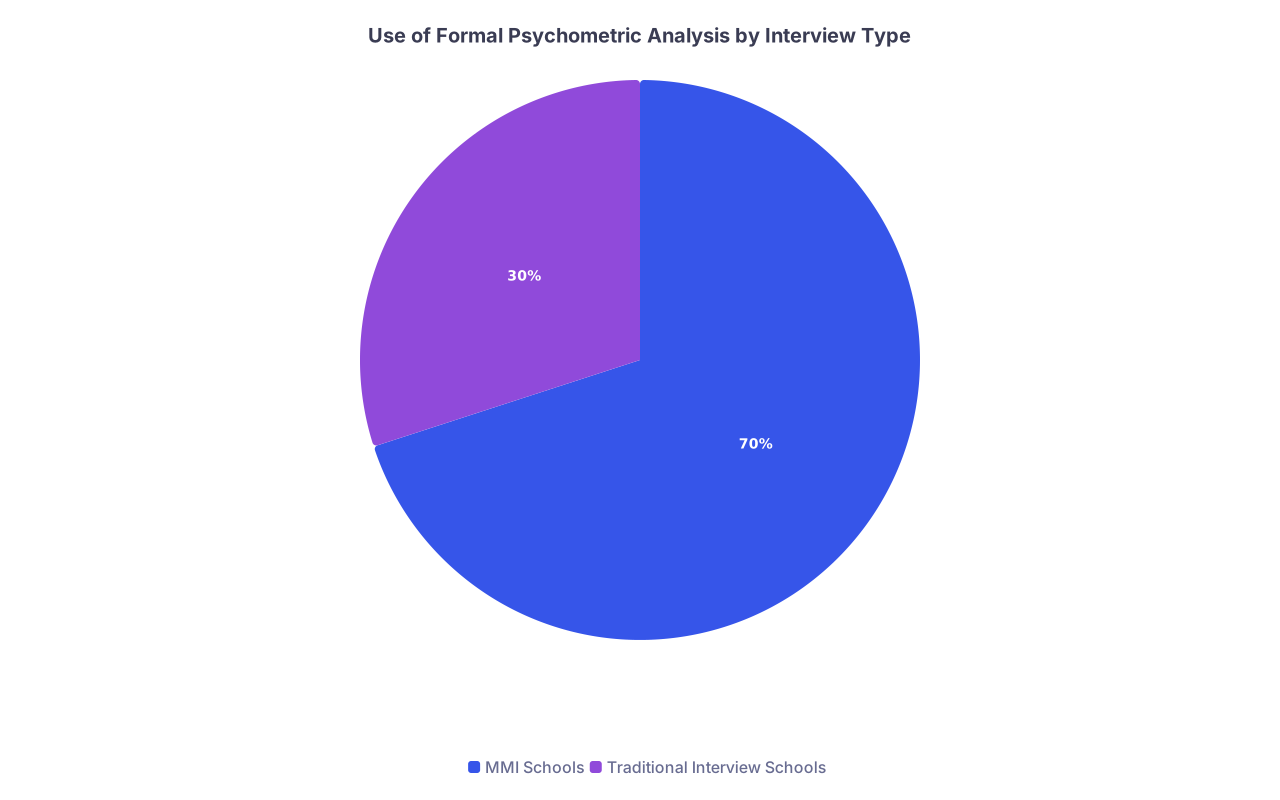
At schools with MMIs, there is usually more psychometric discipline:
- Scores aggregated across stations.
- Reliability analyses run periodically.
- Feasibility to correlate MMI total/section scores with OSCE, clerkship, and professionalism outcomes.
| Category | Value |
|---|---|
| MMI Schools | 70 |
| Traditional Interview Schools | 30 |
A majority of MMI‑using institutions conduct at least basic data audits on their station performance and correlations. Very few traditional‑interview schools routinely run that kind of analysis. Which is ironic, because the weaker your tool, the more you should be watching it.
So even if you believed that a perfectly designed structured panel interview could rival an MMI, the operational reality is that very few schools are running panel interviews with the rigor that MMI frameworks tend to impose by default.
7. Concrete Takeaways for Applicants (Premed and Med Student Level)
You care less about psychometrics and more about “So what do I do with this?”
7.1 If you are facing an MMI
The data says MMIs reward:
- Consistent performance across many short tasks.
- Clear, structured communication.
- Ability to recover quickly after a mediocre station.
- Applied reasoning under mild time pressure.
You do not need to be “brilliant” at any single station. You need to avoid disasters and maintain a high floor.
MMI scores are more granular and more predictive of how you will look in OSCE‑style encounters later. That means:
- Practice structured frameworks: ethical analysis (four principles), SPIKES for bad news, basic conflict resolution steps.
- Train endurance: simulate 8–10 stations back‑to‑back.
- Reflect on feedback to raise your worst‑case station, not just polish your best.
7.2 If you are facing traditional interviews
Data from traditional formats shows:
- Huge interviewer variance.
- Over‑weighting of narrative, rapport, and unstructured “feelings.”
So you focus on:
- Coherent personal narrative: why medicine, why now, what you have done to test it.
- Professional demeanor and likeability (yes, that word).
- Clear, rehearsed but not robotic answers to standard questions.
Because the predictive value of these interviews is statistically weak, the main risk is not “failing a psychometric test.” It is triggering red flags or failing to build enough trust with one or two individuals who hold disproportionate power.
In practice: avoid extremes—no arrogance, no disorganization, no vague answers. Your goal is to get through without giving them a reason to question you.
8. For Schools: When Does an MMI Upgrade Actually Make Sense?
Just to say it plainly: if a school is still using unstructured one‑on‑one interviews as a major decision driver, they are ignoring about 30 years of selection science.
But does that mean every school should adopt MMIs tomorrow? Not exactly. MMIs are resource‑heavy.
A more honest breakdown:
MMIs are statistically better when:
- You can run at least 8 stations with trained raters.
- You care strongly about clinical skills and professionalism.
- You are willing to run ongoing data audits and station revisions.
A structured traditional interview can be acceptable when:
- You use standardized questions and anchored scoring rubrics.
- Multiple independent interviewers rate each candidate.
- You treat the interview as one component, not a veto‑power tool.
The problem is, most “traditional” systems in use do not meet those standards.

| Step | Description |
|---|---|
| Step 1 | Current Interview Process |
| Step 2 | Consider MMI Adoption |
| Step 3 | Enhance Structured Panels |
| Step 4 | Implement Full MMI |
| Step 5 | Hybrid: 4-6 Stations + Panel |
| Step 6 | Standardize Questions & Rubrics |
| Step 7 | Monitor Predictive Validity |
| Step 8 | Unstructured or Low Reliability? |
| Step 9 | Resources for 8+ Stations? |
The data does not say “MMI or bust.” It says “unstructured, lightly monitored interviews are a bad tool if you care about prediction.”
9. Long‑Term Outcomes: Do MMIs Change Who Becomes a “Better Doctor”?
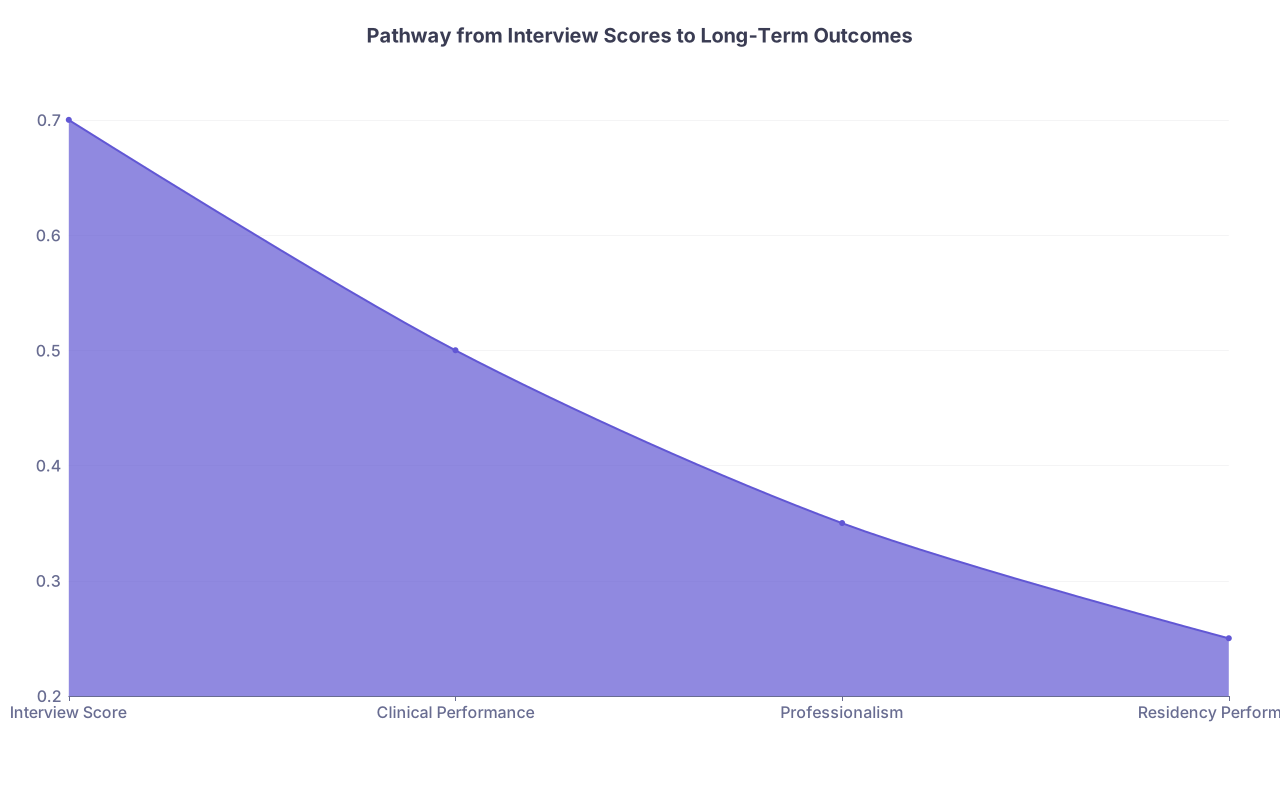
This is the hardest piece. Everyone wants the headline: “MMI grads are 23% more likely to be top‑tier residents.” We do not have that level of causal clarity.
The evidence we do have:
- MMI scores correlate with clinical performance and professionalism indicators.
- Clinical performance and professionalism issues correlate with patient complaints and residency trouble later.
- Cohorts selected with better‑performing tools show fewer serious professionalism events.
| Category | Value |
|---|---|
| Interview Score | 0.7 |
| Clinical Performance | 0.5 |
| Professionalism | 0.35 |
| Residency Performance | 0.25 |
The curve is clear: predictive strength decays as you move farther out. That is normal in human performance data. Life intervenes. Environments differ. People change.
But if you ask, “Based on current evidence, which system is more likely to nudge the cohort in a better direction clinically and professionally?”—the answer leans toward MMIs or, at minimum, highly structured interviews that behave more like mini‑MMIs.
10. Bottom Line: What the Data Actually Supports
Stripping away the marketing and anecdotes, here is the distilled comparison.
- Reliability: MMIs > structured interviews > unstructured interviews. By a lot.
- Predicting academic/board performance: both formats weak; prior academic metrics dominate. MMI may add a small edge; traditional interviews add almost nothing measurable.
- Predicting clinical and professionalism outcomes: MMIs consistently show moderate predictive value; traditional interviews are inconsistent and often negligible.
- Fairness and bias: MMIs are not bias‑free, but they reduce dependence on any one interviewer’s preferences and tend to narrow demographic score gaps when designed properly.
- Operational reality: Most “traditional” interviews in the wild are unstructured and poorly monitored. Most MMIs, by design, enforce a level of standardization and ongoing evaluation.
If you are an applicant:
- MMIs are more like OSCEs; prepare as if you are already in clinical skills.
- Traditional interviews are more idiosyncratic; control what you can (your story, clarity, professionalism) and accept the randomness.
If you are a school:
- Sticking with unstructured, heavy‑weight interviews in 2026 is not a “philosophical choice.” It is a decision to use a weaker, less fair measurement tool when better options exist.
FAQ (5 Questions)
1. Do MMIs actually help me get better board scores compared to traditional interviews?
Not in any meaningful way. Board scores are driven mostly by prior academic metrics (GPA, MCAT) and what you do after matriculation. Both MMIs and traditional interviews show only small correlations with licensing exams, with MMIs having a slight edge at best. Schools should not expect their interview format to move the needle much on standardized test performance.
2. Are MMIs “harder” than traditional interviews for applicants?
They are different, not universally harder. Data from several schools shows similar average acceptance rates before and after MMI adoption. However, MMIs redistribute advantage. Strong communicators who are consistent across multiple short tasks tend to perform better. People relying on charm or rapport with one interviewer tend to lose some of their prior edge.
3. If my school still uses traditional interviews, does that mean it is a worse school?
Not necessarily. Curriculum quality and match outcomes depend on many other factors. It does mean the selection process is likely using a less reliable, less evidence‑based method to assess non‑cognitive attributes. Some schools compensate with robust structured panels or additional assessments, but very few unstructured interview systems can claim strong predictive data.
4. Can a well‑designed structured panel interview match an MMI in predictive value?
In theory, a highly structured panel with standardized questions, anchored ratings, multiple independent raters, and good training can approach MMI‑level reliability. In practice, very few schools implement panels at that level of rigor. Real‑world data still generally favors MMIs in both reliability and prediction of clinical outcomes.
5. For preparation, should I practice differently for MMI vs traditional formats?
Yes. For MMIs, focus on station‑style practice: ethical scenarios, communication tasks, and quick structured reasoning under time pressure, repeated many times. For traditional interviews, focus more on a coherent narrative, polished answers to common questions, and interpersonal dynamics over a longer conversation. The underlying professionalism and communication skills overlap, but the format rewards different execution.
Key points, stripped down: MMIs are statistically more reliable and moderately better at predicting clinical and professionalism outcomes. Neither interview type is strong at predicting exam scores, where GPA and MCAT still dominate. If you care about evidence, the traditional unstructured interview is the weakest tool on the table.