

You are sitting in a small conference room at 3:10 p.m. Your second medical school interview of the day. The faculty member glances at the clock, smiles politely, and says the line you have been waiting for:
“Do you have any questions for me?”
Your heart jumps. You know you are supposed to ask something. You flip through your mental list. You latch onto one: “Yeah, actually, I do…”
And then you ask the wrong question.
You will not know it in the moment. The interviewer will nod, give a bland answer, maybe say, “That’s a good question,” and move on. But you just told them — clearly — that you do not understand how this process works, or you have not prepared, or you are thinking about the wrong things.
I have watched strong applicants sink themselves in the last five minutes of an otherwise solid interview. Not with their first questions. With their follow-up ones. The “by the way,” “just curious,” “one more thing” landmines. That is what you need to avoid.
This is your protection manual.
The Biggest, Loudest Red Flag: Follow-Up Questions About Acceptance Odds
You know this instinct: you want some reassurance. Some signal. Some hint that you are “in good shape.” That is normal. It is also the fastest way to look naïve or self-centered.
The mistake versions sound like this:
- “So… what are my chances of getting in here?”
- “Do you think I’d be a competitive applicant for this program?”
- “Based on what you’ve heard, would you recommend I rank this school highly if I get multiple offers?”
- “Are there any red flags in my application that would prevent me from being accepted here?”
These questions scream three things you do not want to scream:
- You do not understand the admissions process (individual interviewers usually do not decide alone).
- You are focused on outcome instead of fit or training.
- You are asking them to violate boundaries they take very seriously.
| Type of Question | Bad Example (Avoid) | Better Direction (Safer) |
|---|---|---|
| Odds of admission | "What are my chances here?" | "How would you describe the qualities of students who thrive here?" |
| Competitiveness | "Do you think I’m competitive for this school?" | "What characteristics do you see in your strongest students?" |
| Ranking advice | "Should I rank you over [other school]?" | "What do students here say they appreciate most about this program?" |
| Red flags | "Any red flags that would block my acceptance?" | "What challenges do your students commonly face, and how do you support them?" |
Do not try to “soften” these questions either:
- “Off the record, do you think…”
- “I know you might not be able to answer, but…”
That only adds another problem: now you are asking them to break professionalism “off the record.” You are putting them in an uncomfortable position and signaling you do not fully respect the boundaries of the process. That is exactly the opposite of what you want to show as a future physician.
The safe mindset shift
You should be asking: “What can I learn to decide if I want to be here?” Not: “How likely am I to get in?”
Different question. Completely different impression.
Compensation and Lifestyle: The Wrong Follow-Up Angle
You are absolutely allowed to care about work–life balance, burnout, debt, and future income. You would be foolish not to. But there is a smart way to show you have that awareness — and a very dumb, very common way.
These are the follow-up questions that go badly:
- “How much do graduates from this school usually make?”
- “Do you think being at this school would put me in a better position for higher-paying specialties?”
- After talking about wellness: “So realistically, what’s the vacation like? How many weeks do students actually get off?”
- “Do students here have time to work a side job or do something on the side to supplement income?”
Here is why this lands poorly:
- It makes medicine look like a financial strategy, not a calling plus career.
- It suggests you are already trying to game the system for money or free time.
- It is tone-deaf in a setting where patients and professionalism are supposed to matter most.
Does it matter where you train? Of course. But asking a faculty interviewer to connect their program to your future income is the wrong move.
A better angle is to frame your concern around support, not cash:
- Wrong follow-up: “Will I be able to graduate with minimal loans from here?”
- Better: “What kind of financial literacy or debt management support do your students receive during training?”
You are still worried about money. But now you sound like an adult managing a long-term professional life, not someone picking careers off a salary chart.
The “How Easy Is It Here?” Trap
If there is one pattern I see regularly: smart students accidentally imply they are looking for the lowest-effort path. They do not mean to. But the questions give it away.
Watch out for these:
- “Do students here ever fail out? That is not really common, right?”
- “Is the curriculum pass/fail because it’s supposed to be less stressful?”
- After hearing about flexibility: “So, is there a way to avoid the really tough rotations?”
- “Are there ways to get ‘lighter’ clinical schedules if I need them?”
When you say something like this, here is what many interviewers will think:
If you are already negotiating how to dodge difficulty before day 1, how will you handle an ICU month at 3 a.m.?
You can ask about support without sounding like you are trying to do the minimum. The distinction is in emphasis.
Compare:
- “What happens if a student is struggling academically? Are there structured supports?”
- “How do you identify and support students who are burning out during clerkships?”
These show you care about resilience and resources — not about finding shortcuts.
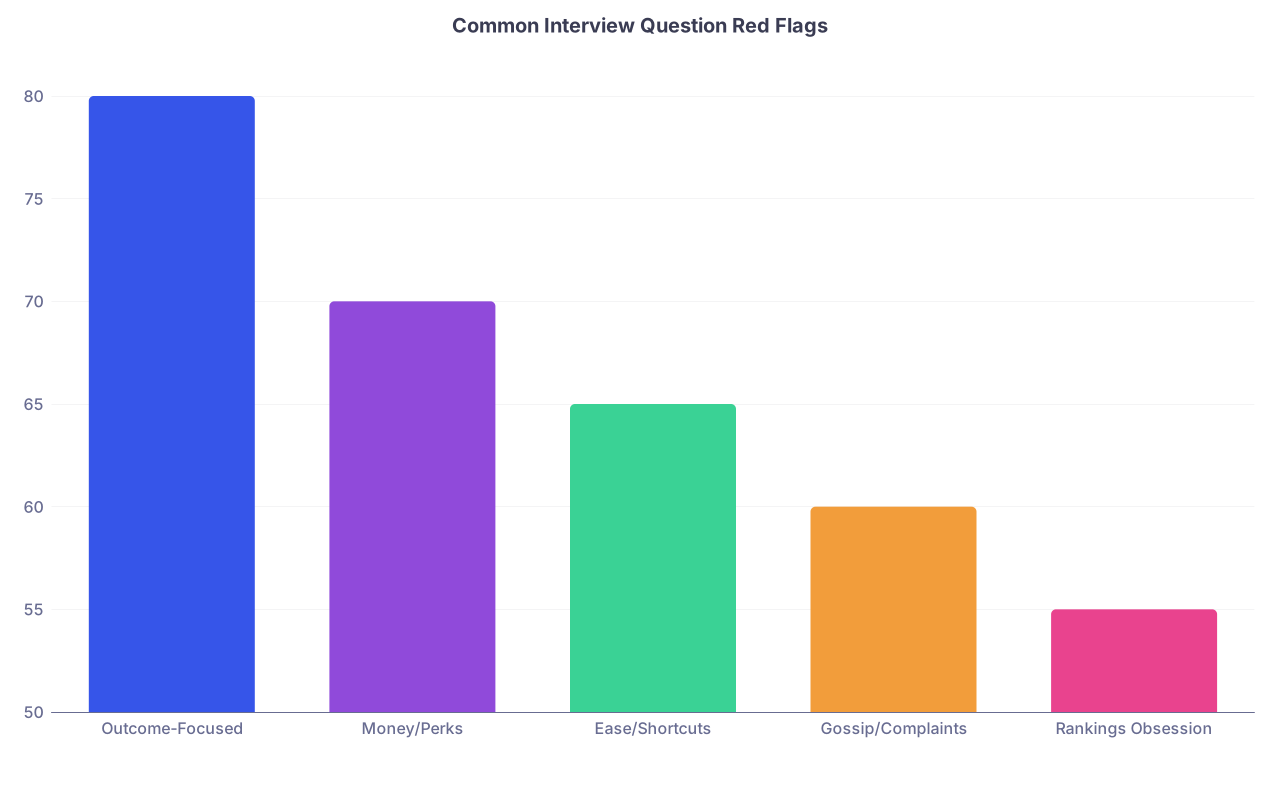
| Category | Value |
|---|---|
| Outcome-Focused | 80 |
| Money/Perks | 70 |
| Ease/Shortcuts | 65 |
| Gossip/Complaints | 60 |
| Rankings Obsession | 55 |
Ranking, Prestige, and “Where Do You Stand?” Follow-Ups
The obsession with rankings is everywhere. U.S. News, Reddit threads, group chats. If you are not careful, it bleeds straight into your interview questions.
Disastrous follow-ups include:
- “Why is your school ranked lower than [other school]?”
- “Are you worried about your position in the rankings?”
- “Do you think the reputation of this school is as strong as [big-name program]?”
- After they mention match lists: “So do you think students match at top programs despite the school’s rank, or because of it?”
These questions are insulting in a very direct way. You are telling faculty — who have dedicated their careers to that institution — that you are judging them by an external metric they do not control. And you are doing it to their face.
You can absolutely ask about outcomes. In fact, you should. But keep it student-centered, not ego-centered:
- “How would you describe the residency match outcomes for students who work hard here?”
- “If a student aims for a competitive specialty, what kind of support is available?”
You get the data you need. You do not poke the school in the eye on the way there.
Gossip, Complaints, and “I Heard…” Follow-Ups
This category sinks more interviews than you would think, especially with anxious applicants who have been reading too many anonymous reviews.
Common dangerous lines:
- “I read online that the administration doesn’t listen to students. Is that true?”
- “Some people say the clinical sites here are toxic — what do you think?”
- “I heard your Step scores went down a few years ago. What happened?”
- After a mild concern: “Yeah, a student I talked to told me the same thing, they said it was pretty bad.”
Two problems:
- You are dragging third-hand gossip into a professional space.
- You are asking the interviewer to defend the school instead of describe it.
That dynamic is terrible. Now they are on their heels. They are not thinking, “Curious, engaged applicant.” They are thinking, “Are you going to be this confrontational and rumor-driven as a student?”
You can still ask about weaknesses or changes. Do it like someone who has worked in a system before:
- “What is something the school has actively worked to improve over the last 3–5 years?”
- “Can you give an example of student feedback that led to a meaningful change in the curriculum or clinical experience?”
That shows maturity. It also indirectly addresses whether the place is responsive to concerns, which is what you actually care about.
Personal, Inappropriate, or Overly Familiar Follow-Ups
Some of you are naturally personable. Interviewers say things like, “This is more like a conversation than an interview.” That is good — to a point. The risk is that you forget where you are.
Follow-up questions that cross the line:
- “Do you have kids? How do you balance that with your job here?”
- “How much do you work clinically versus admin? Which pays more?”
- “Are you happy with your salary here, or do you ever think of going somewhere else?”
- After a story: “Wow, that sounds rough — did you ever think about quitting medicine?”
You are not their colleague yet. You are not their friend. You are a stranger asking for admission to a very serious training path. There is a boundary. Crossing it looks immature and sometimes just downright odd.
If you want to engage personally, keep it tightly professional:
- “What keeps you at this institution after so many years?”
- “What do you find most rewarding about working with students here?”
Same curiosity. None of the prying.
Fishing for Special Treatment in Follow-Ups
This one shows up more than it should. A student senses that the interview went well, the vibe is good, and they push for some edge.
Examples:
- “Is there anything you can do to advocate for my application after this?”
- “If I send you an update letter, could you add a positive note to my file?”
- “If this is my top choice, is there a way for me to tell someone so it helps my chances?”
You are essentially asking them to tilt the process in your favor. Even if you phrase it gently, the subtext is obvious.
Also dangerous:
- “If I get waitlisted, can I email you personally?”
- “Would you mind if I used you as a point of contact about my status?”
For many schools, this violates set policies. You are asking them to dodge their own rules. That does not make you look “proactive.” It makes you look like someone who will push boundaries when it suits you.
If you want to leave a strong impression, let your performance and questions do it. If you must ask about communication:
- “If I have a significant update after the interview, is there a standard way applicants should submit that?”
Process-focused. Neutral. Not grasping.
Mistaking the Interviewer for a Tour Guide or Webpage
The most boring, deadly mistake: using your follow-up time to ask things you should already know.
The questions themselves are not offensive. They just scream “I did not prepare.”
Examples:
- “So… what’s the average class size?”
- “Do students have research opportunities?”
- “Do you have any dual-degree options?”
- “Is there a simulation center?”
All of this is on the website. Or the brochure. Or the first page of Google. When you use your time with a faculty interviewer to ask basic, searchable questions, you are telling them you did not bother.
If you genuinely need clarification, build on what you presumably already read:
- “I saw on your website that you have a strong simulation program. How integrated is that into the clinical years?”
- “I read that many students do research. How early in the curriculum can students realistically start working with mentors?”
Now it sounds like you prepared and want depth, not bullet points.
Subtle Follow-Up Tone Problems That Kill You Quietly
Sometimes the content of the question is fine, but the tone or framing ruins it.
Watch out for:
Argumentative follow-ups
“You say wellness is a priority, but 80-hour weeks do not sound like wellness. How do you reconcile that?”
You might think this shows critical thinking. It often comes off as combative.Better: “How do you balance the demands of clinical training with the wellness initiatives you mentioned?”
Overly negative “devil’s advocate” questions
“What is the worst thing about this school that students complain about?”
You are pushing them toward gossip and negativity. They will resist.Better: “What aspects of the program are you still actively working to improve?”
Desperate-sounding follow-ups
“I really, really want to go here. Is there anything else I can do to improve my chances?”
Desperation does not read as passion. It reads as poor judgment.Better: “Is there anything else you would recommend I think about as I consider whether this school is a good fit for me?”
A Simple Mental Check Before Any Follow-Up Question
Before you open your mouth for that “one last question,” run it through three filters. Quickly. Silently.
Ask yourself:
Could I find this basic information online?
If yes, do not ask it. Upgrade it or drop it.Does this question center my curiosity about training and fit — or my anxiety about status, money, or odds?
If it is about odds, money, prestige, or special favors, rewrite it or skip it.Would this put the interviewer in an awkward, defensive, or unprofessional position if they answered honestly?
If yes, do not ask. You are not being “bold.” You are being inconsiderate.
If it fails any of those three, do not try to “rescue” it with a long preamble or apology. Just pick a different question. It is better to ask one thoughtful, solid question than three mediocre or harmful ones.
What Strong Follow-Up Questions Actually Sound Like
To make this concrete, here are the kinds of follow-up questions that almost never hurt you — when phrased clearly and briefly:
Clarifying how students are supported when things go wrong
“Could you walk me through what happens if a student has a serious personal or family crisis during the year?”Probing how the culture truly feels
“What do your students say they value most about the culture here, and what do they say is hardest to adjust to?”Asking about growth and change
“Is there a recent change the school has implemented that you are particularly proud of?”
You will notice something: none of those are about you personally. They are about the environment you are walking into. That is the right orientation.

| Step | Description |
|---|---|
| Step 1 | Think of question |
| Step 2 | Upgrade or drop |
| Step 3 | Reframe to training/fit |
| Step 4 | Discard |
| Step 5 | Ask confidently |
| Step 6 | Is it online? |
| Step 7 | About odds, money, rank, or favors? |
| Step 8 | Put interviewer in awkward spot? |
Bottom Line: The Follow-Up Questions That Will Sink You
If you remember nothing else, remember this:
- Do not ask about your odds, their rank, or your future income in a way that puts the interviewer on the spot. That is how you look naïve and self-centered in under ten seconds.
- Do not use follow-up time for gossip, basic website facts, or backdoor favors. Those questions reveal more about your judgment than you think.
- Use your follow-ups to show that you are evaluating fit, training, and support like an adult about to enter a difficult profession — not a shopper hunting for prestige and perks.
You get very few minutes to show who you are once the “Do you have any questions?” line hits. Do not waste them asking the questions that quietly convince them you are not ready.


