
You are sitting in a medical school interview room. You survived the ethical questions, the “tell me about yourself,” the awkward silence when you mentioned your MCAT score. You are tired but relieved. Then the interviewer smiles and says the line that has destroyed more otherwise-strong interviews than people realize:
“So… what questions do you have for me?”
You exhale. You think, “I’m done. This is the easy part.”
This is where people blow it.
They ramble. They ask lazy questions. They reveal they have not researched the school. They show entitlement. They show insecurity. They show that the polished version of themselves you just saw was an act.
Question time is not a formality. It is part of the evaluation. And if you treat it like a throwaway segment, you will quietly move yourself from “strong candidate” to “meh” or even “no” in under two minutes.
Let me walk you through the mistakes I keep seeing, and how to avoid torching your own application in the final stretch.
Mistake #1: Acting Like Question Time Does Not Count
The biggest error? Thinking the interview is over once they stop grilling you.
Interviewers are still scoring you. Many score sheets literally have a line for “Quality of questions asked.” I have seen faculty write comments like:
- “No questions. Did not seem interested.”
- “Asked something they could have easily Googled.”
- “Questions felt rehearsed and generic.”
Do not assume they are asking out of politeness. They are testing:
- How you think
- Whether you prepared
- What you actually care about
- If you are someone they want to teach for 4 years
If you say, “No, I think you covered everything,” you might as well say, “I did not care enough to think about this school beyond today.”
How to avoid this
You need:
- 3–5 school-specific questions
- 3–5 role-specific questions (for students vs faculty vs PD, etc.)
- A couple of “back pocket” questions you can use anywhere
You should walk into every interview assuming you will be judged on the questions you ask.
Mistake #2: Asking Questions You Could Have Googled in 10 Seconds
This one irritates interviewers.
Examples that scream “I did not prepare”:
- “So… where do most of your students match?”
- “Do you have research opportunities?”
- “How big is the class size?”
- “Is there a pass/fail grading system?”
- “Do you have problem-based learning?”
All of that is on their website. Sometimes on the first page. When you ask these, you are not gathering information. You are advertising laziness.
You think you are starting a conversation. The interviewer thinks you did not bother to do basic homework.
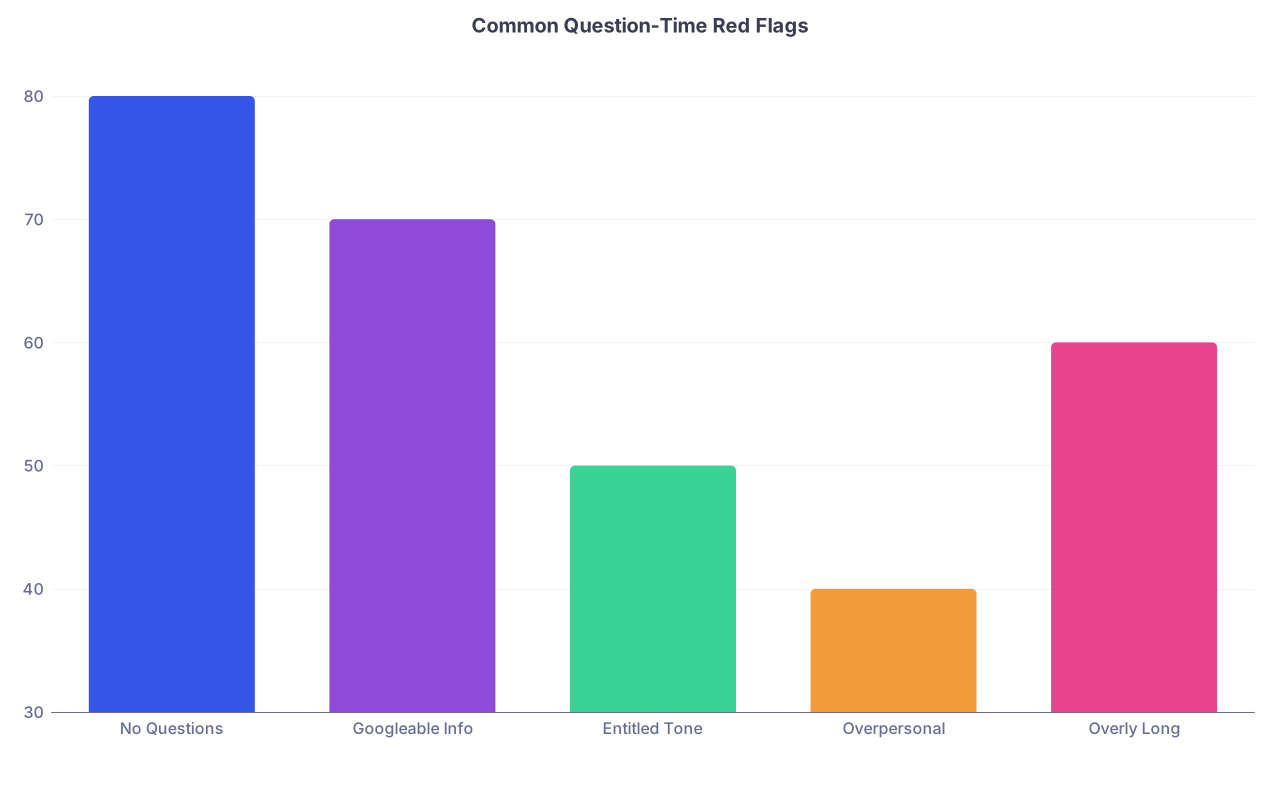
| Category | Value |
|---|---|
| No Questions | 80 |
| Googleable Info | 70 |
| Entitled Tone | 50 |
| Overpersonal | 40 |
| Overly Long | 60 |
How to fix it
Do the bare minimum research before the interview:
- Program structure (pre-clinical years, curriculum format)
- Grading system
- Match data (usually at least a summary)
- Major features heavily advertised (learning communities, global health, etc.)
Then build questions that go beyond the website:
Instead of: “Do you have research opportunities?”
Ask: “I saw there is a required scholarly project. How do students usually find mentors, and how supported do they feel in balancing that with preclinical coursework?”
Instead of: “What is your match rate?”
Ask: “I noticed your graduates match broadly across specialties. How does the advising system support students who are still undecided about specialty choice in the first two years?”
You are showing:
- You looked them up.
- You understood what you read.
- You are thinking like someone about to commit 4 years of your life.
Mistake #3: Turning Question Time into a Therapy Session
Here is a painful pattern I have watched:
The interview went fine. Then question time starts, and the applicant unloads all of their anxiety:
- “Do you think my MCAT will hurt me here?”
- “I applied last year and did not get in — does that count against me?”
- “What are my chances of getting accepted after this interview?”
Or the insecurity variants:
- “How did I do today?”
- “Do you think I’m a good fit for this school?”
- “Is there anything about my application that concerns you?”
You just turned a professional interaction into an insecure plea for reassurance. Some interviewers will feel awkward. Others will become concerned about your emotional resilience.
Medical school is stressful. They are asking themselves: can this person handle bad news? Feedback? Uncertainty? If you melt into a puddle of insecurity in the last 3 minutes, that is not a good sign.
Better approach
You can ask for constructive insight without begging for validation.
Bad: “Is there anything concerning about my application?”
Better: “From your perspective, what qualities help students thrive here, and what struggles do you see students run into that I should be realistic about?”
Bad: “What are my chances after this interview?”
Better: “For students who are ultimately successful here, what do they typically show during the interview process that makes them stand out?”
You are shifting from me, right now to students in general and how they succeed. Safer. More mature.
Mistake #4: Asking Entitled or Transactional Questions
Medical schools are not gas stations where you ask, “So what do I get for my money?”
Questions that raise red flags:
- “How many days off do we get during pre-clinical years?”
- “How easy is it to get exceptions for attendance requirements?”
- “How much can I do remotely?”
- “How soon can I start rotations in [highly competitive specialty]?”
- “How flexible are you with exam rescheduling?”
These may be genuinely important to you, but when you lead with them, you are broadcasting:
- I am focused on my convenience.
- I am trying to do the minimum.
- I see this place as a service provider, not a community I join.
Even if you care deeply about lifestyle, you must not sound like you are gaming the system.
Smarter framing
Instead of: “How often do you give time off?”
Ask: “How do students typically maintain wellness and balance during pre-clinical years? Are there any structured supports or protected times that students find particularly helpful?”
Instead of: “How much can I do remotely?”
Ask: “How has the curriculum incorporated flexible or tech-enabled learning without losing the benefits of in-person interaction and team-based learning?”
Same concern. Very different message.
Mistake #5: Monologuing Instead of Asking a Real Question
Another subtle saboteur: using question time to talk. A lot.
You know the pattern:
“I actually did a lot of research on your curriculum and I love how you have the longitudinal clinical experience, because in college I was in this long-term clinic program where I got to see patients over time and that really shaped my view of continuity of care, and so when I saw that on your website it really resonated with me, especially because I also am interested in primary care, so I was wondering if you could maybe talk more about that?”
That is not a question. That is another answer. The “question” is a tag at the end.
Interviewers are tired. When you talk for 90 seconds to ask a 6-word question, they are not impressed. They are annoyed.
The rule
- 1 short sentence of context.
- Then the actual question.
Example:
“I did a year-long clinic volunteering program and really appreciated the continuity with patients. How do students here experience continuity in their clinical training, especially in the pre-clinical years?”
Crisp. Direct. Shows your background. Then stops.
If you hear yourself winding up for a long speech, stop and ask the question sooner.
Mistake #6: Asking Overly Personal or Inappropriate Questions
You should absolutely show curiosity about the interviewer’s experience. But some questions cross a line or make them uncomfortable.
Avoid questions like:
- “What made you pick this school over better-known ones?”
- “Do you ever regret being in academic medicine?”
- “How much do you make as a faculty member?”
- “If you were me, would you actually come here?”
You are not their therapist, career coach, or financial planner. You are an applicant.
Reasonable personal questions:
- “What keeps you here? What do you value most about this institution?”
- “If you could change one thing about the curriculum or culture, what would it be?”
- “How have you seen the school change over the past few years?”
Those invite honest input without putting them on the spot or sounding disrespectful.
Mistake #7: Using the Same Questions for Everyone
Another mistake: asking the same generic question to a student, a basic science faculty member, and the dean.
You look scripted and disconnected.
Different people have different lenses. Use that.
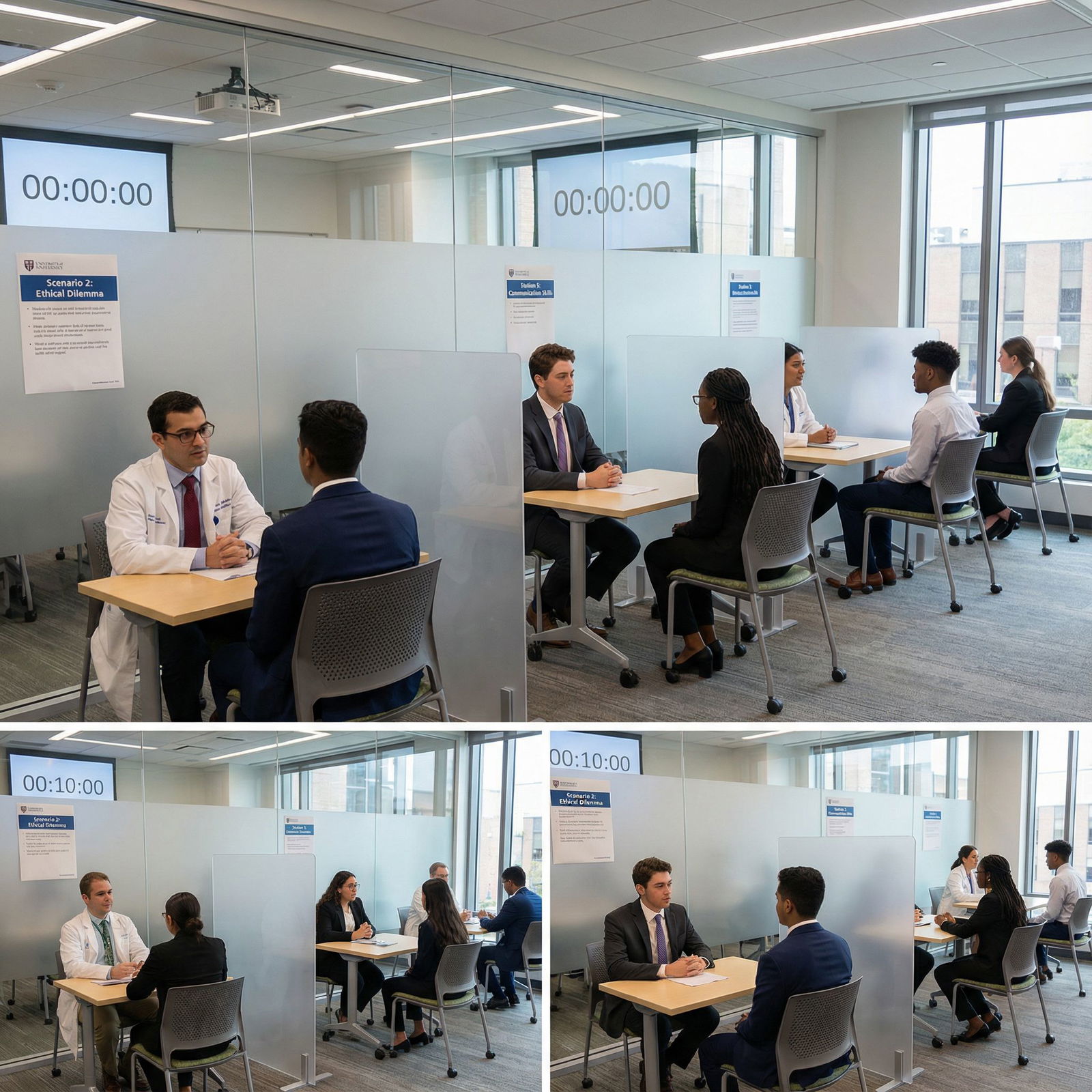
Tailor your questions
To students:
- “What do students here complain about most, and do you feel the administration listens?”
- “What surprised you about this school after you started?”
- “If you had to choose again, would you still pick this place? Why or why not?”
To faculty interviewers:
- “From your perspective as faculty, what distinguishes students from this school compared to others you have worked with?”
- “How receptive is the curriculum leadership to feedback from faculty and students?”
To administrators or deans:
- “What changes are you most excited about in the curriculum or facilities in the next 3–5 years?”
- “How does the school think about training physicians for [primary care / research / underserved care / leadership] in a changing healthcare environment?”
Asking student-level questions to a dean or policy-level questions to an M2 makes you look tone-deaf.
Mistake #8: Ending on a Flat, Forgettable Note
Question time is often your last chance to leave an impression. Many applicants squander it with:
- One weak question
- No follow-up
- A limp “Okay, that’s all I have, thank you”
You want to leave them with the sense: “This person is thoughtful, interested, and would fit here.”
Use a closing question strategically
One strong finishing move: a “perspective” question.
Examples:
- “You have known this school for a long time. What kind of student do you think thrives most here?”
- “If a student had acceptances at several comparable schools, what reasons do they usually give for choosing this one?”
Short. Respectful. It gets them talking about what makes their institution special. That emotional tone often sticks in their mind when they later rank or discuss you.
Then end clearly:
“Thank you — that was really helpful and gives me a much clearer picture of the school. I appreciate your time today.”
Not gushing. Not robotic. Just professional.
Mistake #9: Asking Tricky “Gotcha” or Hyper-Critical Questions
Some applicants try to sound smart by “challenging” the school. This usually backfires.
Red-flag questions:
- “Your Step scores are lower than [big-name school]. How do you explain that?”
- “I saw a Reddit thread where students were complaining about your administration. What is going on with that?”
- “Why is your research funding so much lower than [prestigious institution]?”
You are not a journalist trying to expose a scandal. You are someone asking to join their institution. You can ask about weaknesses, but do it with tact.
Better versions:
- “How does the school support students who may be at risk academically, especially around major exams like Step 1/Step 2?”
- “Like every school, I am sure there are areas students wish were better. What feedback have you heard from students recently, and how has the school responded?”
You still get the truth, but you do not sound combative or arrogant.
Mistake #10: Not Having a Question Strategy at All
The worst mistake is going in with no plan. Hoping “something will come to mind.” It will. But it will probably be something:
- Superficial
- Self-centered
- Redundant
- Panic-generated
You need a pre-set structure so that, even if your brain is fried, you do not say something dumb.
Here is a simple structure that works.

| Step | Description |
|---|---|
| Step 1 | Before Interview |
| Step 2 | Research Website |
| Step 3 | Prepare 3 School-Specific Questions |
| Step 4 | Prepare 3 Role-Specific Questions |
| Step 5 | Prepare 2 Back-Pocket Questions |
| Step 6 | During Interview |
| Step 7 | Listen for Clues |
| Step 8 | Adapt Questions to Conversation |
| Step 9 | Ask 2-3 Strong Questions |
| Step 10 | Finish with Closing Perspective Question |
Pre-interview prep
Have the following written (yes, actually written) in your notebook or notes app:
- Three questions specific to this school’s curriculum, culture, or features.
- Two questions for students, if you meet them.
- Two questions for faculty.
- One “closing” perspective question you like.
- One or two general “back-pocket” questions that fit anywhere, like:
- “How has this school changed in the last few years, and where do you see it going?”
- “What do you think students underestimate about medical school before they start?”
You will not ask all of them. But you will never be stuck.
A Quick Comparison: Weak vs Strong Questions
| Situation | Weak Question | Strong Question |
|---|---|---|
| Curriculum | Do you have PBL? | How do students feel about the balance between lecture and small-group learning here? |
| Research | Are there research opportunities? | How do students without prior research experience usually get involved in projects, and how supported do they feel? |
| Culture | Is the environment collaborative? | Can you give an example of how students here support each other during stressful periods like exams or clerkships? |
| Outcomes | What is your match rate? | How does the advising system help students explore and decide on specialties over time? |
| Wellness | Do you give days off? | What structures are in place to help students maintain wellness, and which ones do students actually use? |
Study that table. The weak versions are about facts. The strong versions are about experience, process, and perspective. That is what good question time looks like.
FAQ (Exactly 5 Questions)
1. Is it ever acceptable to say, “I do not have any questions”?
No. That reads as disinterest or poor preparation. You should always have at least one or two thoughtful questions ready, even if the interview day was extremely thorough. If they truly covered everything, you can still ask for their personal take: “You have shared a lot about the school today. From your own experience, what do you value most about being here?”
2. How many questions should I ask at the end of an interview?
Generally 2–3 is the sweet spot. One question looks weak. Five can feel excessive or rushed. Pay attention to time; if they say, “We have a couple of minutes left,” pick your single strongest question and use it. Depth over quantity.
3. Can I reuse the same questions for multiple schools?
You can reuse structures but not copy-paste word-for-word for every school. A generic, obviously recycled question makes you sound canned. Adapt each question to the specific school’s curriculum, mission, or features using concrete details you pulled from their website or info session.
4. What if my mind goes blank and I forget all my prepared questions?
Have them written down in a small notebook or in your portfolio. It is not unprofessional to glance briefly and say, “I jotted down a few questions before today; let me pick one that we have not already touched on.” That looks prepared, not weak. The mistake is pretending you are fine while you blurt out something half-baked.
5. Can I ask about financial aid, scholarships, or cost of attendance?
You can, but question time with an individual interviewer is usually not the best place. Most schools have separate sessions or offices for that. If you do ask, keep it mature and big-picture: “How does the school support students in understanding and managing debt and financial planning during medical school?” Avoid sounding like you are bargaining or comparing them to other schools on money alone.
Open your interview prep document right now and draft three school-specific questions for your next interview, each based on something concrete from that school’s website. If you cannot write three, you are not ready — and you are at real risk of sabotaging yourself at the end.