
The average premed massively misjudges how many interviews they need. The data shows that “a few good interviews” is not a strategy. It is a gamble.
You’re not asking a vibes question; you’re asking a probability question. That is good. Because for this question, we can actually do math.
The Core Question: What Does “Safe” Even Mean?
You cannot answer “How many interviews is safe?” until you define “safe” in numeric terms.
Most serious applicants I work with mean one of three things when they say “safe”:
- 50% chance of at least one acceptance (coin flip)
- 75% chance of at least one acceptance (you’d feel reasonably confident)
- 90%+ chance of at least one acceptance (about as safe as this process gets)
Let me be blunt: if you say “safe” and secretly mean “guaranteed,” you are in fantasy land. There is no guarantee. Not with 5 interviews. Not with 15. You can only push your probabilities.
So let’s formalize it:
Let p = your probability of converting a single interview into an acceptance
Let n = number of interviews
Then the probability you get zero acceptances from n interviews is:
(1 − p)ⁿ
The probability of at least one acceptance is:
1 − (1 − p)ⁿ
That simple expression drives the whole conversation.
Step 1: Estimate Your Per‑Interview Acceptance Rate
You cannot plug numbers into that formula without an estimate of p.
Here is the uncomfortable truth: p is not the same for everyone. A superstar applicant with a polished story and tight interviewing chops might run p ≈ 0.45–0.55. A weaker applicant at reach schools might be closer to p ≈ 0.15–0.25.
The national data gives us a ballpark.
AAMC has published that:
- Overall, about 40–45% of applicants get at least one acceptance in a cycle.
- Typical applicants who receive ≥1 interview have multiple interviews.
- At many MD schools, 10–20% of interviewed applicants are accepted; some schools are much higher, some lower.
But the raw “acceptance per interview” rate at a given school (often 5–20%) is not your personal p. Why? Because you are not a random interviewee. You only get interviews where your profile fit ranges from “borderline” to “very strong.”
From real applicant tracking I’ve seen (people who carefully log interview → decision outcomes across several cycles), the individual-level p tends to fall in three rough bands:
- Competitive / strong fit: p ≈ 0.40–0.55
- Solid / average fit: p ≈ 0.25–0.35
- Weak / stretch fit: p ≈ 0.10–0.20
Most reasonable applicants with a balanced school list and decent interview preparation sit around 0.25–0.35. I am going to work mostly with 0.25 and 0.33 as “typical” to “good” benchmarks.
If you want to be slightly more rigorous:
- Look at your LizzyM / MSAR profile.
- Compare it to matriculant data at schools where you got interviews.
- Ask yourself, for each school: are you above, near, or below their median metrics and mission fit?
- If most are “above median” with strong mission fit → lean toward p ≈ 0.35–0.45
If you’re borderline at many schools → p ≈ 0.20–0.30
You will never get a perfect p. You only need a reasonable range.
Step 2: Convert p and n to an Overall Acceptance Probability
Now the mechanics. Let’s actually calculate some probabilities.
We will use:
- p = 0.25 (conservative / average interview performance)
- p = 0.33 (better than average, strong preparation)
For each combination, we will look at the chance of at least one acceptance for various numbers of interviews.
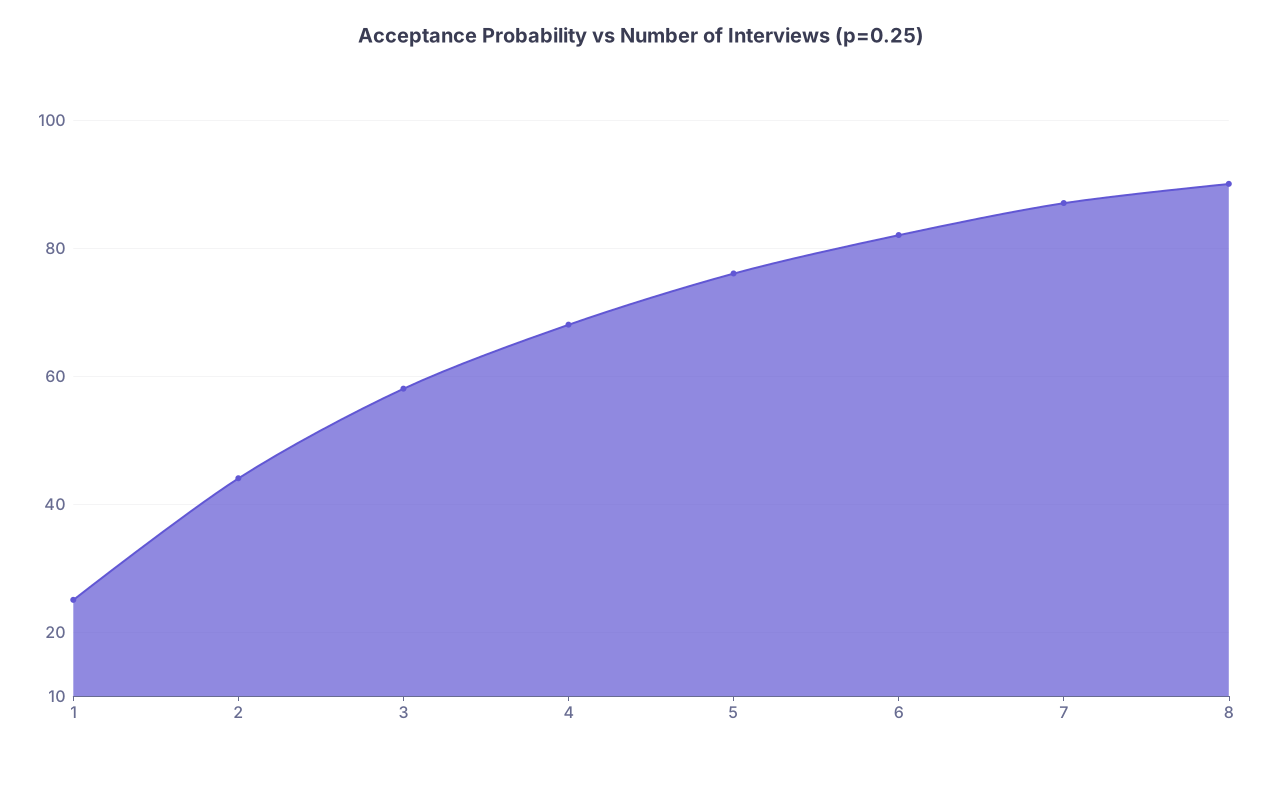
| Interviews (n) | p = 0.25 | p = 0.33 |
|---|---|---|
| 1 | 25% | 33% |
| 2 | 44% | 55% |
| 3 | 58% | 70% |
| 4 | 68% | 80% |
| 5 | 76% | 86% |
| 6 | 82% | 90% |
These are computed as 1 − (1 − p)ⁿ. For example:
- p = 0.25, n = 4 → 1 − 0.75⁴ ≈ 1 − 0.316 ≈ 68%
- p = 0.33, n = 4 → 1 − 0.67⁴ ≈ 1 − 0.201 ≈ 80%
Now let’s talk about what you actually care about: thresholds.
If you want roughly a 50% chance (coin flip)
Solve 1 − (1 − p)ⁿ ≥ 0.50.
For p = 0.25:
1 − (0.75)ⁿ ≥ 0.50 → 0.75ⁿ ≤ 0.50 → n ≥ log(0.50)/log(0.75) ≈ 2.41So you need 3 interviews.
For p = 0.33:
1 − (0.67)ⁿ ≥ 0.50 → 0.67ⁿ ≤ 0.50 → n ≥ log(0.50)/log(0.67) ≈ 1.58So you need 2 interviews.
Interpretation:
If your per-interview odds are decent (33%), 2 interviews already put you roughly at a coin flip for at least one A. If your odds are lower (25%), you need closer to 3.
If you want ~75% chance
Solve 1 − (1 − p)ⁿ ≥ 0.75.
For p = 0.25:
0.75ⁿ ≤ 0.25 → n ≥ log(0.25)/log(0.75) ≈ 4.82 → 5 interviewsFor p = 0.33:
0.67ⁿ ≤ 0.25 → n ≥ log(0.25)/log(0.67) ≈ 3.41 → 4 interviews
So:
- p ≈ 0.25 → 5 interviews ≈ 76% chance
- p ≈ 0.33 → 4 interviews ≈ 80% chance
If you want 90%+ chance
This is what most people secretly mean by “safe.” They want to be almost certain.
Solve 1 − (1 − p)ⁿ ≥ 0.90.
For p = 0.25:
0.75ⁿ ≤ 0.10 → n ≥ log(0.10)/log(0.75) ≈ 8.00 → 8 interviewsFor p = 0.33:
0.67ⁿ ≤ 0.10 → n ≥ log(0.10)/log(0.67) ≈ 5.86 → 6 interviews
So:
- Typical applicant (p ≈ 0.25): 8 interviews → ~90% chance
- Strong interviewer (p ≈ 0.33): 6 interviews → ~90% chance
This is the answer most people are looking for:
- Around 4–5 interviews feels “reasonably safe” (70–80%) for a good interviewer
- Around 6–8 interviews starts to look “statistically safe” (≈90%+) for most solid applicants
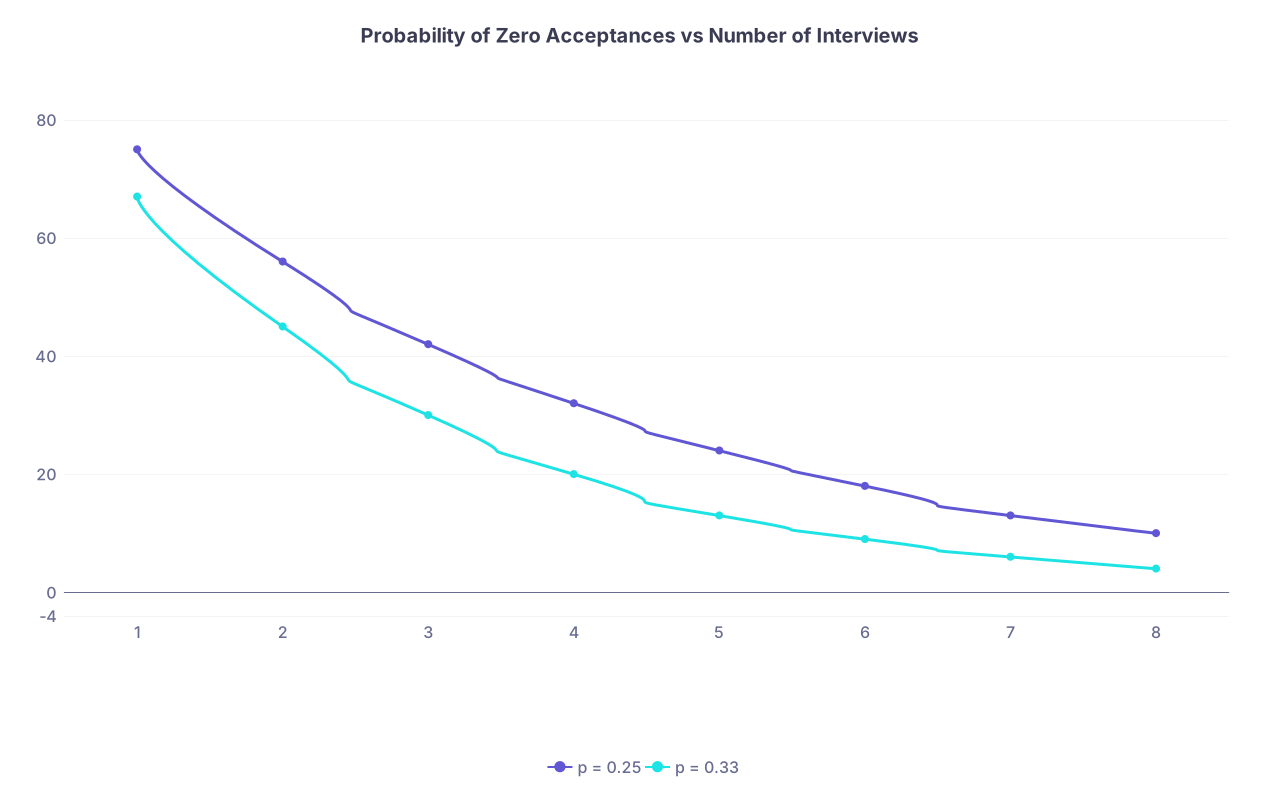
Let’s visualize how fast the risk of zero acceptances drops as interviews stack up.
| Category | p = 0.25 | p = 0.33 |
|---|---|---|
| 1 | 75 | 67 |
| 2 | 56 | 45 |
| 3 | 42 | 30 |
| 4 | 32 | 20 |
| 5 | 24 | 13 |
| 6 | 18 | 9 |
| 7 | 13 | 6 |
| 8 | 10 | 4 |
Those percentages are the chance of ending the cycle with nothing. Most people underestimate how stubbornly that probability stays non‑trivial until you get to 6–8 interviews.
Reality Check: Interview Quality Is Not Constant
All of this assumes a fixed p across interviews. Life does not work that cleanly.
Examples I have seen repeatedly:
- Applicant A bombs their first 2 interviews, then overhauls their prep (mock interviews, recording themselves, structured answers). Their later interviews convert at a much higher rate.
- Applicant B is strong on traditional interviews but performs poorly on MMI, or vice versa. So p differs by school format.
- Applicant C applies to a lot of reach schools; the early interviews are at dream programs where they are a stretch, later ones are at more aligned schools where they are statistically stronger.
Formally, instead of a single p, you actually have p₁, p₂, …, pₙ. Your probability of at least one acceptance becomes:
1 − Π (1 − pᵢ) over all i
You will not have precise pᵢ values. But you can reason qualitatively:
- If you have 3 interviews at extreme reach schools and 2 at mid‑tier schools where you are median or better, the mid‑tier ones carry far more weight.
- If you tank your first 3 interviews because you were underprepared, your effective overall probability is lower than the “naive” math above for the same n.
This is exactly why you should not treat early interviews as low‑stakes practice. They materially change your probability curve.
MD vs DO: Different Baselines, Different Targets
The school type and competitiveness also shift p.
At many DO schools (especially those with high interview-to-seat ratios), the per-interview acceptance probability can be higher for a reasonably matched applicant. The same math applies. Only p changes.
A rough, oversimplified range I have observed:
- MD: individual p for decent applicants → 0.20–0.35
- DO: individual p for decent applicants → 0.30–0.45
So if your goal is “any US MD or DO school,” and you are applying broadly, your effective overall probability will be a combination of higher and lower p’s:
- MD interviews: use something like p_MD ≈ 0.25–0.30
- DO interviews: use something like p_DO ≈ 0.35–0.40
You can approximate the overall “none” probability as:
(1 − p_MD)ⁿᴹᴰ × (1 − p_DO)ⁿᴰᴼ
Where n_MD is your number of MD interviews and n_DO your number of DO interviews.
Example: You have 3 MD interviews and 2 DO interviews.
Take p_MD = 0.25, p_DO = 0.40:
- Chance of no MD acceptance: 0.75³ ≈ 0.42
- Chance of no DO acceptance: 0.60² = 0.36
- Chance of no acceptance anywhere: 0.42 × 0.36 ≈ 0.15
- So your chance of at least one acceptance is ≈ 85%
That is a very different picture than “I only have 3 MD interviews, I’m doomed.”
Timing: When to Worry Based on Interview Count
Another question I hear every cycle: “It is October and I only have two interview invites—how bad is that?”
Let me answer like a data person, not like a cheerleader.
- Interview count matters.
- Timing matters.
- Type of schools matters.
But the math on “How many is safe?” does not care when you got them. It only cares whether you get them at all.
However, timing does give you information about your future expected n. If it is late in the cycle and you have 1 interview, the expected final n is probably low unless you applied unusually late.
I like to think in bands:
- 0 interviews by late November: Expected n likely 0–1. Statistically, your chance this cycle is very low unless you applied extremely late or very regionally. You should be planning for a reapplication.
- 1–2 interviews by late November: Expected n maybe 2–4. Your realistic acceptance probability probably lives in the 30–70% range depending on your p and whether more invites are likely. Not hopeless. Not safe.
- 3–4 interviews by late November: Expected n maybe 4–6. You are approaching that 70–90% band for many applicants, but not in “cannot fail” territory.
- 6+ interviews by late November: Statistically, you are in strong shape, especially if these are at target / safety schools, not all extreme reaches.
Here is the actual distribution many applicants experience: a big chunk of invites front-loaded (August–October), then a trickle (November–February). If you are sitting on 1 interview in early October, that is fundamentally different from 1 interview in January.
Practical Target Numbers by Applicant Profile
Let me stop handwaving and give you actual target ranges. This is obviously approximate, but it is better than the usual folklore.
Assume you care about “probability of at least one MD acceptance” and separately “any MD or DO.”
1. Very strong applicant (top-tier stats, strong story, solid prep)
Personal p (for target schools): 0.35–0.45.
Safe-ish targets:
For MD only:
- 3 interviews → likely in the 70–80%+ range
- 4–5 interviews → you are moving into 85–95% territory
For MD+DO combined:
- 3–4 total interviews with at least 1–2 DO where you are comfortably above median → extremely high probability of at least one acceptance
Translation: with your profile, if you prepare interviews seriously, 4–5 interviews is usually “statistically safe.”
2. Solid but not stellar applicant (around median MD stats, decent ECs)
Personal p: 0.25–0.33 for target MD schools.
Safe-ish targets:
MD only:
- 3 interviews → maybe 55–65%
- 4–5 interviews → 70–85%
- 6–7 interviews → pushing into 85–93%
MD+DO:
- 2–3 MD + 2–3 DO → often effectively 85–95% overall, depending on exact p’s
In plain terms: for the “classic” solid applicant, 4–6 interviews are where things start to feel safe; 6–8 if you are conservative.
3. Borderline applicant (below median stats, many reach applications)
Personal p: 0.15–0.25, especially at MD.
This is where volume matters more:
MD only:
- 2–3 interviews might still mean only 30–50%
- 5–6 interviews might give you 60–80%
- You may simply not get that many MD interviews, in which case DO becomes crucial.
MD+DO:
- Even 1–2 MD + 2–3 DO can get you into a high overall probability range, because DO interviews may be at p ≈ 0.30–0.40 for you.
I have seen borderline MD applicants end up with 1 MD and 3–4 DO interviews and still match into DO with 80–90% effective probability. The MD-only purist mindset, for them, is a mathematical liability.
Where Interview Prep Actually Changes the Math
You can treat p as destiny. Or you can move it.
I have watched applicants go from:
- First cycle: 4 interviews, 0 acceptances (p effectively ~0.0–0.10 due to weak interviewing)
- Second cycle: 4 interviews, 2 acceptances (p ~0.50) after brutal mock interviews and feedback
Same n. Completely different outcome distribution.
If you want to use the “How many interviews is safe?” math honestly, you have to admit this: A lot of people walk into their first 1–2 interviews with p far below what their application would justify.
Common patterns that crush p:
- Rambling, non-structured answers to core questions (Tell me about yourself, Why this school, Why medicine)
- Over-rehearsed, robotic delivery that makes the interviewer doubt your authenticity
- Poor handling of red flags or weaknesses (low GPA semester, gap year, MCAT retake), either over-defensive or completely vague
- Total lack of specific, school-tailored knowledge (you sound like you copied their website yesterday)
The intervention is not mysterious:
- Do multiple mock interviews with people who will not spare your feelings
- Video-record yourself; measure how long your answers actually are
- Build a small library of structured, 60–90 second stories that you can flex: clinical impact, conflict, failure, leadership, ethical challenge
You can easily move p from 0.20 to 0.30+ with focused prep. That shift cuts your “no acceptance at 4 interviews” probability from:
- With p = 0.20: (0.80)⁴ ≈ 0.41 → 41% chance of nothing
- With p = 0.30: (0.70)⁴ ≈ 0.24 → 24% chance of nothing
Same n. Massive difference.

| Step | Description |
|---|---|
| Step 1 | Raw applicant strength |
| Step 2 | Baseline p |
| Step 3 | Lower effective p |
| Step 4 | Higher effective p |
| Step 5 | More interviews needed |
| Step 6 | Fewer interviews needed for same acceptance probability |
| Step 7 | Serious interview prep? |
A Quick Sanity Tool: Back-of-the-Envelope Calculator
You do not need a statistics degree to approximate this for yourself. Do it on a sticky note.
- Pick a realistic p range for yourself (example: 0.25–0.33).
- Count your current and likely interviews (n).
- Compute two scenarios: optimistic (higher p) and conservative (lower p).
- Use: 1 − (1 − p)ⁿ.
Example:
You have 4 interviews now, probably ending with 5 total.
- Conservative p = 0.25 → 1 − 0.75⁵ ≈ 1 − 0.237 ≈ 76%
- Optimistic p = 0.33 → 1 − 0.67⁵ ≈ 1 − 0.135 ≈ 86.5%
So your realistic range is maybe 75–87% for at least one acceptance. You are not guaranteed. You are not doomed. You are in “reasonably safe, but could still hurt” territory.
If that range instead looks like 30–50% and it is late in the cycle? You start planning a reapp strategy now, not in March.
| Category | Value |
|---|---|
| 1 | 25 |
| 2 | 44 |
| 3 | 58 |
| 4 | 68 |
| 5 | 76 |
| 6 | 82 |
| 7 | 87 |
| 8 | 90 |
The Bottom Line: What the Numbers Actually Say
Strip away the anxiety and anecdotes. The math gives you three clear takeaways:
“Safe” is not one interview. Or two.
For most applicants with p in the 0.25–0.33 range, you start getting genuinely “safe” (≈90%+) only around 6–8 interviews. Fewer than that is a gradient of risk, not a guarantee.You control p more than you think.
Focused interview preparation can effectively move your per‑interview acceptance probability by 5–15 percentage points. That is the difference between needing 8 interviews and needing 5 for the same level of safety.Use probability, not vibes, to plan.
Count your interviews, estimate a plausible p, and compute 1 − (1 − p)ⁿ. If your resulting acceptance probability is not where you want it, you either need more interviews (application strategy) or a higher p (interview prep) or both. Anything else is wishful thinking dressed up as optimism.