
What if you walk out of your MMI thinking you nailed it—only for every assessor to label you “poor insight, potentially unsafe”?
That happens. A lot more than anyone tells you.
The Multiple Mini Interview isn’t just about whether you can talk. It’s about whether you come across as ethical, teachable, and safe to put in front of patients and colleagues. The fastest way to tank your application isn’t a bad GPA. It’s looking like someone who can’t be trusted with feedback or moral judgment.
I’ve seen strong applicants—520 MCAT, 3.9 GPA, great research—get quietly buried after MMIs because of a few predictable missteps. They weren’t evil. They weren’t stupid. They just walked into classic traps that made them seem rigid, arrogant, or ethically tone-deaf.
Let’s walk through those traps so you do not become their cautionary example.
The Biggest MMI Myth That Will Wreck You
The most dangerous myth: “MMIs are about arguing your side convincingly.”
That’s wrong. That mindset alone will push you into two catastrophic personas:
- The unteachable debater
- The shallow ethicist
Both will haunt your scoring sheet.
Schools use MMIs to answer three questions:
- Are you safe? (Ethics, professionalism, judgment)
- Are you coachable? (Can you adapt, reflect, accept feedback?)
- Are you tolerable to work with at 3 a.m. on call?
If you approach every station like a courtroom where you must “win,” you’ll sound:
- Overly confident about complex issues
- Defensive when challenged
- Rigid when presented with new information
None of that screams “future colleague I want to train.”
Pitfalls That Make You Seem Unethical
These aren’t theoretical. These are the patterns that make interviewers quietly write “concern” next to your name.
1. Over-simplifying messy ethical problems
Common mistake: Treating complex scenarios like simple math problems.
Example station:
“A 14-year-old refuses chemotherapy for a curable cancer. Her parents want to proceed. What do you do?”
The bad responses sound like:
- “Well, the parents are in charge, so I’d side with them.”
- “Autonomy matters most, so I’d follow the teenager’s wishes.”
- “The law says X, so that’s it.”
You know what that signals? That you think ethics is about memorizing a rule and applying it blindly.
What you need instead is to show that you see the conflict.
Safer moves:
- Acknowledge tension: parental authority vs. emerging autonomy vs. beneficence vs. non-maleficence
- Name the stakeholders: teen, parents, healthcare team, possibly courts
- Admit you’d seek help: “I’d involve the oncology team, social work, ethics, and legal if needed.”
If your answer sounds like you can solve deeply human problems in 30 seconds, you look ethically shallow. Or worse, reckless.
2. Sounding like you’d break rules “for the right reasons”
Watch for this trap in “whistleblowing,” “cheating,” and “confidentiality” scenarios.
Example:
“You see a resident repeatedly making charting errors that could harm patients. They’re clearly tired and overwhelmed. What do you do?”
The dangerous move: trying to sound loyal or “nice” by avoiding escalation at all costs.
Bad signals:
- “I’d just talk to them and not involve anyone else unless something really bad happened.”
- “I wouldn’t want to get them in trouble.”
- “I’d try to fix the charts myself quietly.”
Interviewers hear: this person prioritizes comfort over patient safety. They think they can quietly patch things instead of using the system that exists to prevent harm.
Safer framing:
- Patient safety first. Always.
- Start low: direct conversation if appropriate.
- If risk persists or is severe, escalate: supervisor, patient safety officer, or appropriate channel.
- Document and don’t alter records to “help.”
If you sound like you’d “handle things privately” instead of using formal channels when someone’s at risk, you look ethically dangerous.
3. Throwing colleagues under the bus to save face
Another classic: you see a classmate cheat, or a nurse makes a medication error. How you talk about them exposes your instincts.
Bad response type #1: The Prosecutor
“I would immediately report them because cheating is completely unacceptable and they don’t deserve to be in medicine.”
Bad response type #2: The Co-Conspirator
“I’d ignore it; it’s their problem, not mine.”
Both feel unsafe.
What schools actually want:
You protect patients and academic integrity without moral grandstanding or cruelty.
Better signals:
- Separate behavior from person: “The action is serious and must be addressed, but I’d assume they’re human and may be struggling.”
- Use appropriate support and reporting channels.
- Show empathy without minimizing risk.
If your tone is vindictive, judgmental, or weirdly gleeful about punishment? Huge red flag.
Pitfalls That Make You Seem Unteachable
If there’s one thing that gets you quietly blacklisted: looking like you can’t take feedback or change your mind.
4. Digging your heels in when the assessor pushes back
Many MMI stations are designed to push you. They’re testing whether you:
- Can reconsider
- Can accept added information
- Or cling to your first answer like it’s an identity statement
Example:
You: “I’d prioritize the older patient because…”
Assessor: “What if I told you the younger patient is the sole caregiver for two children?”
The mistake: Acting offended or treating the follow-up like an attack.
“I’d still do the same thing because I already considered all factors.”
Translation: I don’t actually listen, and I’m fragile when challenged.
Better signal: Show you can update.
“I hadn’t considered the caregiving aspect explicitly—this new information shifts things. I’d now lean toward…”
Changing your thinking when you get new information doesn’t make you weak. It makes you teachable. Failing to shift makes you look stubborn and risky to train.
5. Treating MMI like a speech, not a conversation
This is rampant in strong test-takers. They memorize frameworks and then spray them at the interviewer like a firehose.
You know the vibe:
- 7-minute monologue
- No pauses for the interviewer
- No checking in
- No adaptation when their body language clearly says “I’ve checked out”
MMIs are still human interactions. If you sound canned or robotic, interviewers assume you’ll behave the same way with patients.
Simple fix: Insert actual listening.
- Pause after your main position: “I can expand on any piece you’d like—was there a part you want me to unpack?”
- If the interviewer redirects, follow them. Don’t yank it back to your script.
If they feel like you’re performing at them rather than talking with them, you will be coded as “rigid” or “not reflective.”
The Tone Traps: How You Accidentally Sound Arrogant or Cold
You can say something technically correct and still fail because of how you say it.
6. Hiding behind “objectivity” to avoid empathy
A pattern I see: applicants over-correct for emotion. They think “professionalism” means being cold.
Example:
“Your patient refuses a life-saving surgery for religious reasons.”
Bad version:
“Well, I can’t let emotions cloud my judgment. I’d simply explain the statistics and recommend surgery.”
That sounds uncaring and naive.
You need both: empathy and clarity.
Better structure:
- Acknowledge their perspective: “I’d want to understand what this decision means to them.”
- Offer information clearly and respectfully.
- Respect autonomy if they have capacity—even if you disagree.
- Document and involve appropriate supports (chaplaincy, ethics, etc.).
If your answer never includes any version of “I’d try to understand” or “I’d explore what matters to them,” you sound like a robot with a medical degree. Nobody wants that.
7. Overcompensating with fake confidence
You’ve probably heard “be confident.” Misapplied, this becomes a disaster.
Danger signs in your answers:
- Answering instantly without thinking
- Never saying “I’m not sure”
- Never using phrases like “I’d seek guidance” or “I’d want to consult…”
Look, you’re not a physician yet. If you act like you already have all the answers, that’s not confidence. It’s arrogance.
Safer balance:
- Think for 2–3 seconds before speaking.
- Use “this is how I’d approach it based on what I know now” instead of “the correct answer is…”
- Explicitly mention seeking senior input when a scenario clearly exceeds a student’s role.
If you sound like a first-year who believes they know more than the attending, you’re done.
Classic Scenario Pitfalls That Sink Otherwise Strong Applicants
Let’s get concrete. Here are a few MMI themes and how people routinely sabotage themselves.
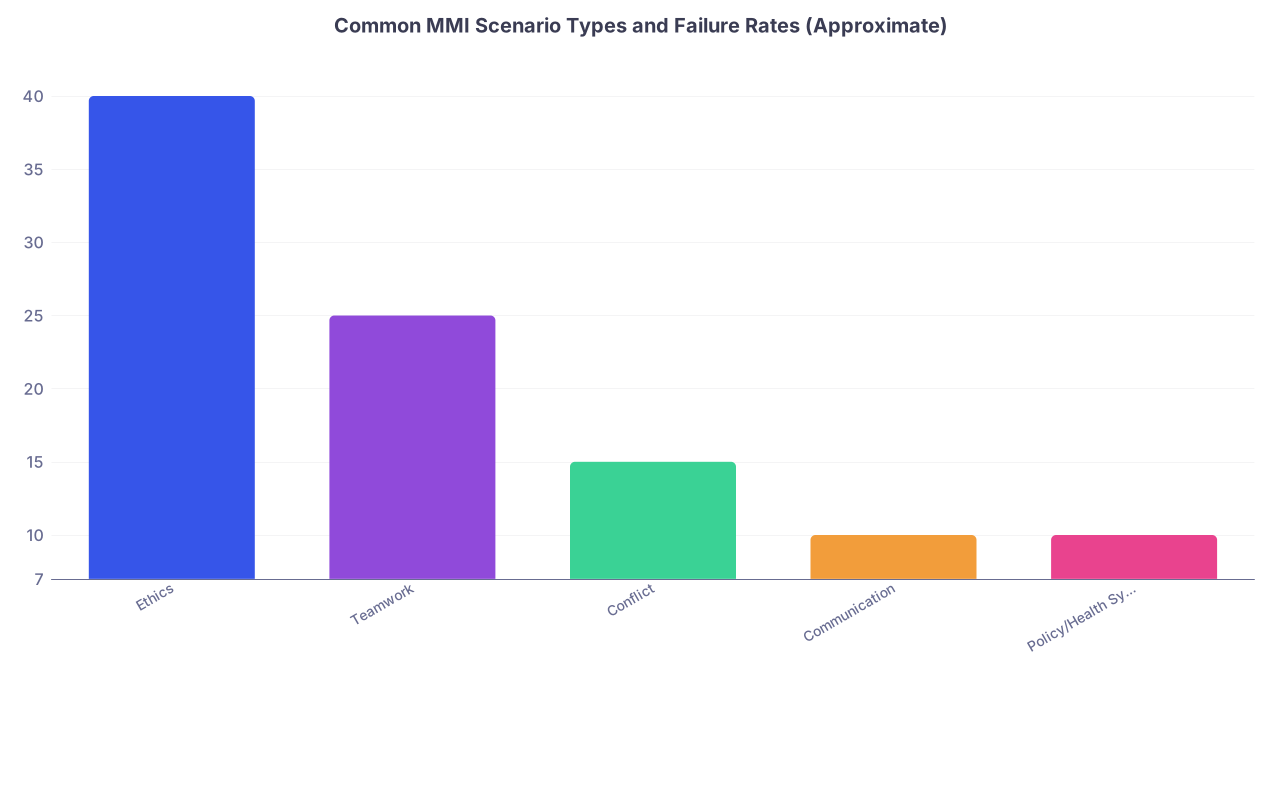
| Category | Value |
|---|---|
| Ethics | 40 |
| Teamwork | 25 |
| Conflict | 15 |
| Communication | 10 |
| Policy/Health Systems | 10 |
No, these numbers aren’t from some official database. They’re a rough breakdown of where people tend to implode based on what evaluators complain about most.
8. Teamwork stations: sounding like a dictator or a ghost
Scenario:
“You’re in a group project, and one member isn’t contributing. Deadline is approaching. What do you do?”
Two common mistakes:
- The Dictator: “I’d tell them they need to do their fair share, and if they don’t, I’d report them.”
- The Ghost: “I’d just do the work myself to avoid conflict.”
Both show poor boundaries and poor collaboration.
Better pattern:
- Start with curiosity, not accusation: “I’d ask if something’s going on.”
- Be specific about expectations and deadlines.
- Offer support without enabling.
- If nothing changes and the stakes are real, involve appropriate authority.
If you never try to understand why and you jump straight to punishment—or martyrdom—you look immature.
9. “You made a mistake” stations: dodging responsibility
Scenario:
“You realize you gave a patient incorrect information about their medication while you were shadowing. What do you do?”
The catastrophic answer:
“I’d hope the attending corrects it later and be more careful next time.”
That screams: I care more about my image than patient safety.
You must show you can:
- Own the error
- Correct it promptly
- Learn from it
Stronger response framework:
- Immediately inform the supervising physician.
- Ensure the patient gets accurate information as soon as possible.
- Reflect afterward on what led to the mistake and how to prevent it.
If you’re more focused on not getting in trouble than on fixing harm, you look unsafe and unteachable.
Subtle Red Flags Interviewers Watch For
Most applicants worry about saying something outrageous. That’s not usually the problem. It’s the small patterns that add up.
10. Never admitting uncertainty
Listen to yourself: do you ever say things like:
- “I don’t know exactly how that process works, but here’s how I’d think about it”?
- “I’d want to ask more questions before deciding.”
If your answers are all declarative certainty, you look detached from reality. Medicine lives in uncertainty. People who can’t admit it are dangerous.
11. Treating patients or colleagues like checkboxes
Another subtle signal: depersonalizing everyone in the scenario.
Example:
“In this case, I’d talk to the family, document everything clearly, and follow institutional policy.”
Fine. But if the only time a human appears in your answer is as “the family” or “the patient,” and never as a person with fears, values, or context, you sound cold.
Sprinkle in humanity:
“I’d want to understand what the family is afraid of.”
“I’d ask the patient what matters most to them in this situation.”
No, you don’t need to become a poet. Just avoid sounding like you’re managing a spreadsheet instead of a person.
12. Moral grandstanding
Big red flag: using ethical scenarios as a stage to show how pure you are.
- “I would never tolerate that.”
- “Anyone who does that shouldn’t be in medicine.”
- “There’s no excuse for that behavior.”
You’re applying to a profession where burnout, depression, substance use, and error are real. Pretending only bad people make mistakes is naïve and frankly dangerous.
Better stance:
Hold strong ethical lines while seeing others as human.
“I’d take the behavior seriously and respond through proper channels, but I’d also assume they may be struggling and need support.”
How to Practice Without Training Yourself Into These Mistakes
You can rehearse your way into these pitfalls if you’re not careful. A lot of “MMI prep” online actually encourages rigid, over-scripted answers.
Guardrails for your practice:
Stop memorizing full speeches.
Practice structures, not scripts. For instance, in ethics:- Identify the issue
- Identify stakeholders
- Weigh principles (autonomy, beneficence, etc.)
- Describe process (who you involve, how you communicate)
Get someone to interrupt you.
Have a friend or mentor play assessor and push back mid-answer. Your goal is not to defend your first answer to the death. It’s to show you can adapt without melting.Record yourself.
Yes, it’s painful. But watch for:- Monotone vs. natural tone
- Speed: are you racing?
- Zero pauses for thought—huge red flag
Practice saying three specific phrases until they feel natural:
- “Given my level of training, I’d definitely seek guidance from…”
- “I see a few competing priorities here…”
- “With that new information, I’m rethinking my initial approach…”
Those make you sound thoughtful, safe, and teachable. Not weak.
A Quick Look at How Assessors Actually Think
You’re not scored on “being right.” You’re scored on patterns.
| Dimension | What Hurts You Most |
|---|---|
| Ethical Reasoning | Blind rule-following, ignoring tradeoffs |
| Communication | Monologues, zero empathy, defensive tone |
| Self-Awareness | No reflection, no uncertainty, no growth |
| Professionalism | Minimizing risk, hiding errors, blaming others |
| Teamwork | Dictatorial or doormat behavior |
They’re asking:
- “Would I trust this person with my patients one day?”
- “Would I want to supervise this person?”
- “Can this person grow, or are they already ‘fully formed’ in their own mind?”
If the answer is no on any of those, you lose, even if your content was polished.
One Thing You Must Do Today
Open a blank document and write out your answer—without pausing—to this prompt:
“You discover a close friend in your medical school class has been copying parts of their assignments from online sources. They’re stressed, say everyone does it, and beg you not to say anything. Walk me through your thought process and what you’d do.”
Then read it and ask yourself, brutally:
- Do I sound more focused on loyalty or integrity?
- Do I acknowledge systems (support, remediation, reporting) or pretend I can fix it all privately?
- Do I sound curious about why they’re cheating, or just judgmental?
- Do I show any self-awareness, or am I just delivering a lecture?
If your answer makes you sound either ruthless or avoidant, fix it. Because that pattern will show up in every ethics and professionalism station—not just this one.