
The biggest reason applicants give bland, forgettable interview answers is simple: they do almost no real research on each school.
You cannot fake school-specific answers. Interviewers know their own programs. They know their curriculum quirks, their clinical sites, their culture. If you are just recycling “supportive environment, diverse patients, strong research” at every school, they can hear the copy‑paste.
Here is how you fix it: you build a ruthless, repeatable pre‑interview research checklist and you use it for every single school.
Not “scroll the website for 10 minutes.”
A structured, 60–90 minute deep dive that gives you:
- 3–5 concrete reasons you want that specific school
- 2–3 questions that prove you did your homework
- A set of talking points you can reuse across multiple answers
Let’s build that system.
Step 0: Create a Reusable School Research Template
Before you research even one program, set up your capture system. If you do not, you will waste time re‑finding the same information the night before interviews.
Use whatever you will actually use under stress: Google Docs, Notion, OneNote, or even a binder with printed pages.
Create a standard template that you duplicate for each school, with sections like:
- Basic Snapshot
- Curriculum & Educational Structure
- Clinical Training & Hospitals
- Research & Scholarly Opportunities
- Student Life & Support
- Mission, Values, and Community Focus
- Unique Programs & “Hooks”
- Personal Fit & Story Angles
- Smart Questions to Ask Them
For digital, I suggest one doc per school in a single folder: “Interviews – School Profiles”.
To compare schools quickly, you can also have a summary sheet like this:
| School | Curriculum Style | Primary Hospital Type | Research Emphasis | Community Focus |
|---|---|---|---|---|
| School A | Systems-based | County Hospital | High | Urban underserved |
| School B | Traditional | Academic Center | Moderate | Regional |
| School C | PBL-heavy | Community Hospitals | Low | Primary care |
| School D | Accelerated 3-year | Academic + VA | High | Rural |
You fill this small table as you go. It helps you avoid saying the wrong thing about the wrong school at 7 a.m. on Zoom.
Step 1: Lock Down the School’s Core Identity
This is your “Basic Snapshot” section. You want to be able to answer in one sentence: “What kind of school is this?” Academic powerhouse? Community-focused? Primary care factory? Research empire?
1.1 Start with the official website, but do not stop at the homepage
Go to the med school site → “About”, “Mission”, “Dean’s Message”.
Copy these into your template:
- Mission statement (exact language or key phrases)
- Any stated priorities (e.g., diversity, rural health, health equity, physician‑scientists)
- Type of institution: public vs private, state vs national focus
Then translate it into plain English for yourself:
“Translation: They care about training academic physicians who will do research and stay in this region.”
You will use this translation when answering:
- “Why our school?”
- “How do you see yourself fitting into our mission?”
- “What makes you interested in training here?”
1.2 Do a quick context snapshot
In your template, add:
- Location: City, state, urban/suburban/rural
- Class size: Rough range (e.g., ~120 students per year)
- Affiliation: Standalone, part of large university, religiously affiliated, etc.
You are not listing trivia. You are building mental context so your answers sound grounded, not generic.
Step 2: Curriculum – You Need More Than “PBL vs Traditional”
Interviewers hear “I like your early clinical exposure and pass/fail grading” 30 times per day. That is brochure talk.
You want to be able to say things like:
“I am excited about your Longitudinal Integrated Clerkship in the second year, especially at [X] community clinic, because of my work at [Y].”
2.1 Find the curriculum map
Look for:
- “Curriculum” tab
- “MD Program” → “Curriculum Overview”
- PDF curriculum guide, 4-year schedule, or “Academic Calendar”
Capture:
- Pre‑clinical length (1 year, 1.5, 2 years)
- Curriculum style: systems-based, organ-based, block, PBL-heavy
- Grading: pass/fail vs honors, especially for pre‑clinicals and clerkships
- Unique threads or longitudinal themes (e.g., “Health Equity Thread”, “Longitudinal Primary Care”, “Physician as Advocate”)
2.2 Identify 2–3 specific curricular features
Examples:
- “Longitudinal Integrated Clerkships (LIC) across multiple specialties instead of block rotations”
- “Required scholarly project with protected time in the third year”
- “Early patient contact in the first month through standardized patients and community clinics”
- “Four-year physician leadership curriculum integrated into small groups”
Write them in your template under “Curriculum – Unique Features” with one line each on why you personally care.
Not:
“LICs are cool.”
But:
“LICs match how I learn: I prefer longer-term patient relationships, like at my free clinic where I followed diabetic patients over several months.”
2.3 Connect curriculum to your story
For each curricular feature you listed, add:
- “My angle:” → 1–2 bullet points tying it to:
- Your learning style
- Your past experiences
- Your future goals (e.g., academic medicine, primary care, surgery)
You will reuse these in:
- “Why this school?”
- “What kind of curriculum do you thrive in?”
- “How do you learn best?”
Step 3: Clinical Training – Where You Actually Become a Doctor
Many applicants barely know where the school’s main hospitals are. This is a mistake.
You must know:
- Main teaching hospitals (names, type: academic, county, VA, community)
- Any special populations or reputations (safety net, trauma center, cancer center)
3.1 Pull the clinical site list
Go to “Clinical Education”, “Affiliated Hospitals”, “Clerkships”.
Capture:
- Top 2–4 main partners
- One‑liner each: “Urban county hospital, large uninsured/Medicaid population”, “VA with strong geriatrics”, “Children’s hospital with regional referral base”
3.2 Look for distinctive clinical angles
Examples of real things I have seen:
- “Only Level 1 trauma center in the state”
- “Large immigrant and refugee clinics in partnership with the city health department”
- “Extensive rural rotations with required 8‑week block at critical access hospital”
Write 1–2 that you can genuinely say interest you. Then tie them back to:
- Your volunteer work (free clinic, EMT, hospice)
- Your target specialty areas (even if tentative: surgery vs primary care vs psych)
Step 4: Research & Scholarly Work – Get Concrete or Skip It
Do not say you are “very interested in research” if you have none and hate it. Interviewers see right through that.
But if you have any interest at all:
- You must name specific structures, not vague “opportunities”.
4.1 Identify what kind of research environment they have
Look for:
- “Research” or “Departments” on the med school site
- MD/PhD or research tracks
- Required scholarly projects
Capture:
- Whether research is required or optional
- Whether there is protected time (e.g., summer after M1, dedicated blocks)
- Any formal programs: “Scholarly Concentrations”, “Clinical and Translational Research Track”, “Global Health Track”
4.2 Flag 2–3 research areas that overlap with you
You do not need exact labs. But you should know:
- Major centers: “Cancer Center”, “Center for Health Disparities”, “Neuroscience Institute”
- A couple of topics: “health services research”, “medical education”, “global surgery”
Then map your story:
“Because of my work on [X] quality improvement project, I am especially drawn to your Center for Health Services Research and the required QI project during clerkships.”
If you truly do not care about research, skip this section and invest time in community engagement and clinical training instead. Better to be honest and strong in one area.
Step 5: Student Life, Culture, and Support – The Hidden Differentiator
Most schools claim they are “collaborative” and “supportive”. That word salad means nothing until you ground it in specifics.
5.1 Use the student affairs / wellness pages
Look for:
- “Student Affairs”, “Student Life”, “Wellness”, “Support Services”
Capture specifics:
- Learning communities / colleges / “houses” system
- Formal advising structure: one advisor, small-group advising, specialty mentors
- Wellness programs: free counseling, protected wellness afternoons, formal wellness curriculum
Then ask yourself: where does this match actual concerns you have?
- Burnout
- Mental health
- Being far from family
- Coming from a non‑traditional background
Write 2–3 concrete things you can talk about.
5.2 Scan student organizations and interest groups
You are not listing 20 clubs. You just want 2–3 that match:
- Your identity (SNMA, LMSA, LGBTQ+ groups, rural/first‑gen)
- Your interests (global health, street medicine, medical education, ethics)
Capture:
- Exact names of 2–3 groups
- One line on why they matter to you
You will use these in:
- “How will you get involved here?”
- “How do you see yourself contributing to our community?”
Step 6: Mission, Community, and Service – Where You Show You Actually Bothered
Mission fit gets hand‑waved by a lot of applicants. Big mistake. Many schools care deeply about this.
6.1 Extract the mission into talking points
Revisit the mission statement you copied earlier and highlight 2–3 core phrases. For example:
- “Train physicians to serve the rural communities of [state]”
- “Advance health equity for underserved urban populations”
- “Develop leaders in academic medicine and biomedical research”
Write each as:
- “Mission emphasis: health equity / rural care / primary care / research / leadership”
Then under each, add:
- 2 past experiences that demonstrate that value
- 1–2 ways you would continue that work at their school
Example:
- Mission emphasis: health equity
- Past: free clinic serving uninsured immigrants; health education workshops
- Future here: join the [Street Medicine Initiative], work with [City Free Clinic elective]
This directly feeds “How do you embody our mission?” and “Why should we choose you?”
6.2 Identify community partnerships
Look for:
- Free clinics run by the med school
- Community outreach programs
- Pipeline programs / K–12 outreach
Capture names and short descriptions. Then connect the dots:
“This is very similar to my work with [X], and I would like to continue that here through [Y].”
Step 7: Find 1–2 “Hooks” That Almost No One Mentions
This is how you avoid sounding like everyone else.
Hooks are:
- Unique programs
- Odd but interesting traditions
- Structural quirks that show you really looked
Examples I have heard that impressed faculty:
- “I saw that you have a required fourth‑year teaching elective where students help run small groups for the M1s. I have done peer tutoring in orgo and would love to plug into that.”
- “Your partnership with the [Tribal Health System] is unusual and something I would want to engage with, given my background working with Native communities.”
Where to find hooks:
- Deep in the curriculum PDF
- 2–3 clicks into specific office pages (e.g., “Office of Global Health”)
- Student blog posts or newsletters on the school site
Write 1–2 hooks in your template with “My angle” underneath.
Step 8: Use Students and Social Media Strategically (Not Aimlessly)
Most applicants either ignore current students or spam Reddit and get overwhelmed. You want targeted intel.
8.1 Talk to real students – with purpose
If you are given contact info for student ambassadors or hosts, email or DM them with specific questions based on what you already researched. Not “so what do you like about the school?”, which is lazy and gets you brochure answers.
Ask things like:
- “On the website I saw the longitudinal preceptor program. How meaningful has that been for you?”
- “How protected is wellness time really? Do people actually use mental health resources without stigma?”
- “How spread out are the clinical sites? How bad is the commuting during clerkships?”
In your template, add a section: “Student Intel – Actual Reality”
Summarize 3–5 points with short bullets:
- “Preclinical genuinely chill, but 3rd year is very busy, especially at County Hospital”
- “Advising is good but you have to seek out research mentors early”
This gives meat to your answer when they ask: “What concerns do you have?” or “What questions do you still have?”
8.2 Use forums and social media only to clarify, not to form your entire impression
Reddit, SDN, school‑specific Facebook groups: they overrepresent extremes. Still, they can hint at real issues.
Look specifically for:
- Recurring themes (e.g., clinical sites far apart, administration slow to respond, exam style)
- Clarifications about Step prep, shelf exams, or match outcomes
Do not parrot forum gossip in your interview. Use it to refine your questions to students and faculty.
Step 9: Build Your Question Bank for That School
A surprising number of applicants have no questions at the end of an interview. That screams unprepared or uninterested.
You want a bank of 4–6 questions per school, categorized by who they fit best for:
- Faculty interviewers
- Student interviewers
- Dean / leadership sessions
Examples pulled from your research:
Faculty:
- “I saw that there is a required scholarly project in the third year. How do students typically find mentors, especially if they are interested in health services research?”
- “How do you see the new curriculum changes affecting clinical preparedness for clerkships?”
Students:
- “How does the pass/fail grading in the first 18 months shape the culture among your classmates?”
- “On your site there is a list of community clinics. Which ones are students most actively involved in, and how did you choose yours?”
Dean / leadership:
- “Your mission emphasizes training physicians to serve rural communities. How do you track whether graduates actually practice in those areas long‑term?”
You are not fishing blindly. Every question is anchored in something you already saw.
Step 10: Turn Research into Ready‑To‑Use Answers
Raw information does not help you unless you convert it into phrases you can actually say under pressure. This is the step almost everyone skips.
Pick your core high‑yield questions:
- “Why our school?”
- “How do you see yourself fitting into our community?”
- “What kind of learning environment helps you thrive?”
- “Where do you see yourself in 10 years?”
Then for each school, sketch 2–3 bullet answers using your template info.
Example: “Why our school?” structure
Use this formula:
- Mission / values alignment
- Specific curricular or clinical feature
- Community / student life fit
Concrete sample answer skeleton:
- Mission/values: “Your emphasis on health equity and serving the urban underserved aligns closely with my work at [X free clinic] and my interest in addressing barriers to care.”
- Curriculum/clinical: “I am especially drawn to your longitudinal primary care clerkship at [County Clinic], because I have seen how continuity improves diabetes management in my patients and I want that longer‑term relationship as a student.”
- Community/life: “Outside of the formal curriculum, I would like to be involved with the [Student‑Run Homeless Clinic] and the [SNMA chapter], which seem like natural extensions of what I have started in college.”
You do not memorize sentences. You memorize structure + key phrases.
Step 11: Time‑Box the Process So It Is Sustainable
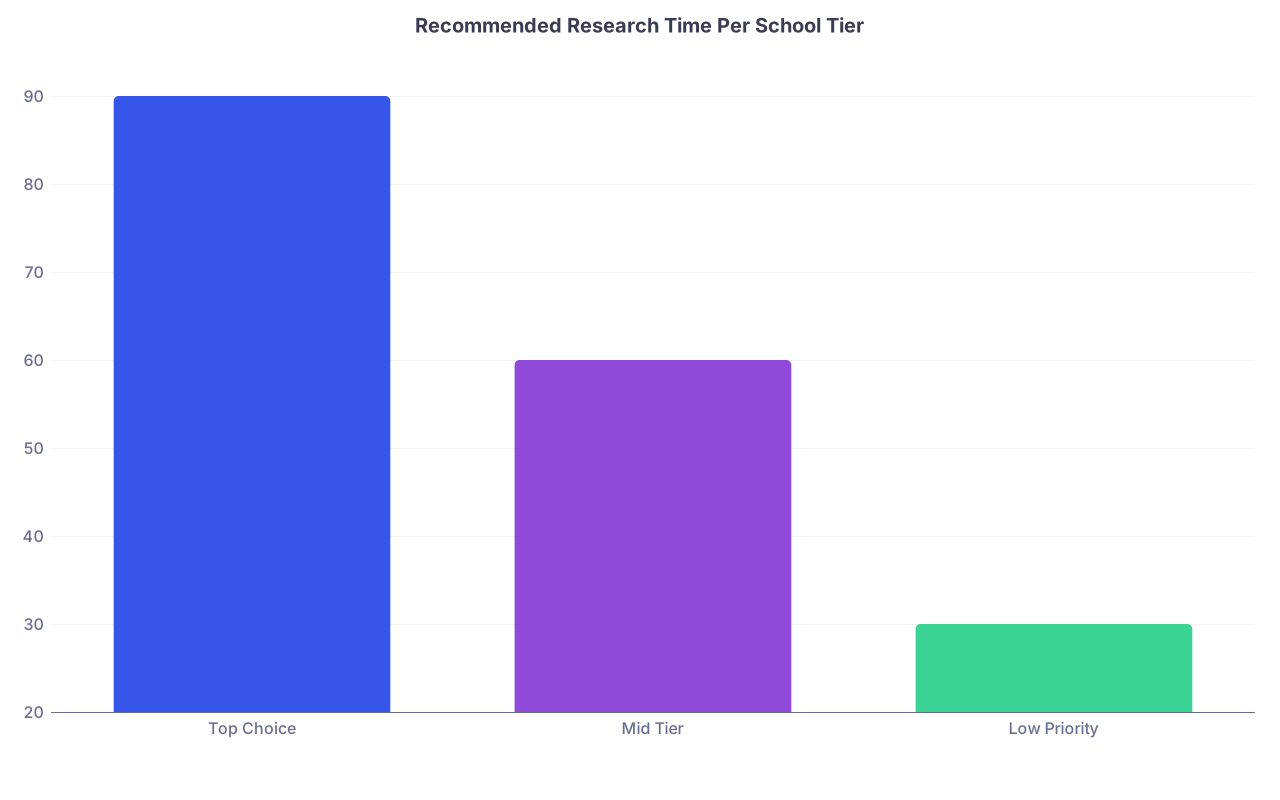
If you are interviewing at 10–20 schools, you cannot spend 5 hours on each one. You will burn out and start cutting corners.
Use a tiered approach.
| Category | Value |
|---|---|
| Top Choice | 90 |
| Mid Tier | 60 |
| Low Priority | 30 |
- Top choice / realistic reach: 75–90 minutes of research + 30 minutes review before interview day
- Middle of your list: 45–60 minutes
- Safety / low enthusiasm but still important: 25–30 focused minutes on basics + 1–2 hooks
For each tier, decide:
- How many curricular features you will identify
- How many student orgs you will dig into
- Whether you will contact current students beforehand
You are not aiming for perfection at every school. You are aiming for consistently above‑average, clearly school‑specific answers.
Step 12: Turn the Checklist into a Repeatable Workflow
Here is a clean flow you can follow each time:

| Step | Description |
|---|---|
| Step 1 | Duplicate School Template |
| Step 2 | Scan Mission & Snapshot |
| Step 3 | Review Curriculum & Clinical Sites |
| Step 4 | Identify Research & Unique Hooks |
| Step 5 | Student Life & Community Programs |
| Step 6 | Talk to 1-2 Students if Possible |
| Step 7 | Draft 4-6 School-Specific Questions |
| Step 8 | Build Bullet Answers for Key Prompts |
| Step 9 | Finalize 1-Page Interview Cheat Sheet |
That “cheat sheet” is what you review the night before and the morning of the interview. One page, front only, with:
- 3 mission / values phrases
- 3 curriculum / clinical talking points
- 2 research or scholarly items (if relevant)
- 2–3 student life / community bullets
- 3 hooks or “this is why I am excited here” lines
- 4–6 questions to ask them
This is what sits next to your laptop for virtual interviews. This is what you glance at between MMI stations.
Example: Applying the Checklist to a Hypothetical School
Let me walk through a compressed version so you see how it looks in practice.
Say you are interviewing at “Metro City School of Medicine” (fictional but realistic).
You find:
- Mission: “Train physicians to advance health equity and serve the diverse urban communities of Metro City through patient‑centered care, research, and advocacy.”
- Curriculum: 1.5‑year preclinical, systems‑based, true pass/fail; required “Community Health Longitudinal Experience” in first two years at local clinics.
- Clinical: Main sites – Metro General (county safety‑net hospital), Metro Children’s Hospital, VA.
- Research: Required scholarly project; “Center for Urban Health and Policy.”
- Student life: Learning community system; strong SNMA and LMSA chapters; student‑run free clinic and street medicine program.
Your template might yield these interview‑ready bullets:
- Mission/fit: “My work coordinating blood pressure screenings and insurance enrollment in my city mirrors your mission to advance health equity in urban communities.”
- Curriculum: “I like that your preclinical curriculum is systems‑based with early patient exposure through the Community Health Longitudinal Experience; that matches how I learn—anchoring basic science in real patients.”
- Clinical: “Training at Metro General, the primary safety‑net hospital, is a big draw for me. I have seen how complex social needs impact care and want to learn in that environment.”
- Research: “Your Center for Urban Health and Policy overlaps well with the neighborhood‑level asthma project I did in college, and I would want my scholarly project to build on that kind of work.”
- Community/organizations: “I want to plug into the Street Medicine team and the SNMA chapter, continuing the advocacy and mentorship work I started with premed students back home.”
- Questions:
- “How do students balance their time between the Community Health Longitudinal Experience and traditional coursework?”
- “What kinds of scholarly projects have students done through the Center for Urban Health and Policy that led to actual policy or system changes?”
Notice: nothing here is generic. Every phrase ties back to something specific on their site.
How to Store and Reuse This Work Across the Season
You will see patterns. Half your schools will have:
- A free clinic
- Some research center vaguely about population health
- Early clinical exposure
Do not reinvent the wheel each time.
Set up:
- A “Global Answer Bank” doc with modular pieces for:
- “Health equity interest”
- “Primary care interest”
- “Research but not hardcore bench”
- “Interest in academic medicine / teaching”
Then, for each school, you only swap:
- Names of programs, clinics, and centers
- Geography and population details
- Any unique hooks
This is efficient and still feels tailored.
Where People Screw This Up (And How You Avoid It)
Be blunt with yourself:
- If your “Why this school?” answer could be used for 5 other schools with no changes, it is weak.
- If you cannot name even one of their hospitals, you look like you do not care.
- If your questions to them could be answered by reading the homepage, you look lazy.
You avoid all that by:
- Using a structured template
- Time‑boxing your research
- Writing your notes in your own words
- Converting facts into stories and angles, not just collecting trivia
And no, you do not need to memorize everything. You need a clear mental hierarchy:
- Top 3 reasons you want to go there
- Top 2–3 ways you fit their mission and structure
- Top 4–6 genuine questions you have

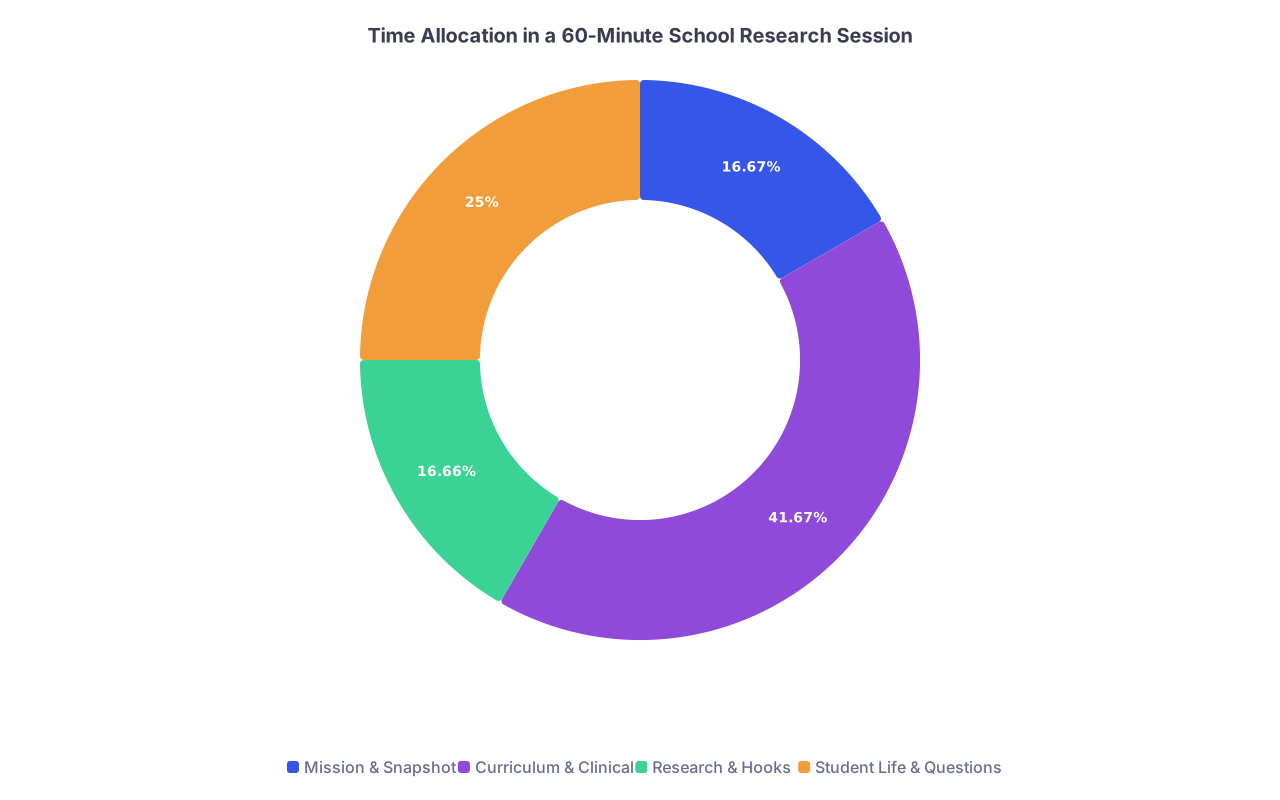
| Category | Value |
|---|---|
| Mission & Snapshot | 10 |
| Curriculum & Clinical | 25 |
| Research & Hooks | 10 |
| Student Life & Questions | 15 |
The Bottom Line
You win pre‑interview prep by doing three things:
- Use a structured template for every school. Stop “winging it” with random webpage scrolling. Capture mission, curriculum, clinical sites, research, student life, and 1–2 unique hooks.
- Translate facts into interview‑ready angles. Do not just collect information. Connect each key feature to your own experiences, learning style, and goals so your answers sound specific and believable.
- End with a sharp one‑page cheat sheet. Before each interview, review a single page that lists your top reasons for wanting that school and the questions you will ask. That is how you sound prepared without sounding scripted.