
It is 8:12 a.m. You are in a Zoom waiting room or sitting in a conference room with a bottle of water you are too anxious to open. You know your MCAT is a 504. Or your science GPA is a 3.1. Or you have a failed course and a withdrawal semester on your transcript.
You are not just thinking about the interview. You are waiting for the moment an interviewer leans back and says some version of:
“Let us talk about your numbers.”
This is where most applicants either ramble, apologize, or panic. You are not going to do that. You are going to walk into that moment with a script, a structure, and receipts.
Here is how to turn low stats from a liability into a controlled, honest, and even positive part of your interview story.
Step 1: Get Completely Clear On Your “Metrics Risk Profile”
Before you can fix something in the interview, you have to define exactly what is “low” and how it looks from the committee side. No vagueness.
Identify your specific weak spots
Pull your actual numbers in front of you:
- Cumulative GPA
- Science GPA (BCPM for AMCAS; science for AACOMAS/TMDSAS)
- MCAT (overall and section scores)
- Any F, D, withdrawals, academic probation, leaves of absence, disciplinary actions
Then classify each into one of three categories:
- Yellow flag – Slightly below average, but not catastrophic
- Orange flag – Clearly below typical matriculant range or with a visible dip
- Red flag – Very low or associated with formal concern (probation, dismissal, repeated failures)
You should know exactly which boxes you are in. If you are unsure, compare to typical ranges:
| Metric | Typical Range | Yellow Flag | Orange/Red Flag |
|---|---|---|---|
| cGPA | 3.7–3.8 | 3.3–3.6 | Below 3.3 |
| sGPA | 3.6–3.7 | 3.2–3.5 | Below 3.2 |
| MCAT total | 511–512 | 506–510 | 505 and below |
| Single F/D | None | 1 isolated, remediated | Multiple or in key prerequisites |
Are these exact? No. Do they mirror what a lot of adcoms are actually thinking? Yes, roughly.
Why this matters for interviews
Interviewers do not all read your file the same way. But they tend to have the same core questions when they see low metrics:
- Can this person handle our curriculum?
- Are their weaknesses fixed, or will we be dealing with the same problems as a student?
- Do they own their mistakes or blame everything else?
- Is there evidence of an upward trajectory?
Your task during the interview is to answer those four questions clearly, in your own words, before they mentally ask them.
Step 2: Build a Metrics Narrative – Not an Excuse Story
Most applicants with low stats either:
- Minimize it: “It was just one bad semester.”
- Over-explain it: 6-minute monologue about a roommate, a breakup, COVID, and a cat.
- Over-apologize: “I know it is terrible, I am so sorry, I was so immature.”
All three are bad. The committee does not want drama, and they do not want denial. They want a coherent academic recovery story.
Use the 4-part “Metrics Story” framework
Every time you address low stats, you stick to this structure:
- Brief context – What happened, in 1–2 sentences.
- Ownership – Your responsibility, without self-destruction.
- Concrete changes – Specific behaviors and systems you implemented.
- Evidence of improvement – Hard data and outcomes.
Let us make this real.
Example: Low early GPA, strong upward trend
Context:
“My GPA during my first two years was a 3.0, and that reflects poor study strategies and overcommitting to work and extracurriculars.”Ownership:
“I underestimated how different college-level science would be and I did not ask for help early enough. That was my mistake.”Concrete changes:
“Starting junior year, I cut back my work hours, met weekly with a learning specialist, switched to active recall and spaced repetition, and formed a consistent study group for my upper-division courses.”Evidence:
“Since then, across 50+ credits of upper-level science, I have a 3.8 science GPA, with A’s in biochemistry, physiology, and molecular biology. I treated those semesters as a test run for medical school.”
That is how you sound like someone who has actually fixed the problem.
What you must avoid saying
- “I am just not a great standardized test taker.”
- “The professor was unfair / the class average was low.”
- “I was going through a lot” with no follow-up about what you changed.
- Long emotional stories with no clear link to academic recovery.
You can mention context. You cannot hide behind it.
Step 3: Prepare Targeted Answers to the 5 Most Common Metrics Questions
If your stats are low, there are only a handful of questions you are really at risk for. You should have rehearsed but not robotic answers to each.
We will run through five, with sample structures you can adapt.
1. “Can you explain this dip in your grades here?”
This is where your 4-part framework comes in. Keep it under 90 seconds.
Structure:
- 1–2 sentences: what the dip is and when
- 1–2 sentences: your role in it
- 2–3 sentences: specific changes you made
- 2–3 sentences: concrete evidence you improved
Do not wander. Do not give your life story.
2. “Your MCAT is below our average. How should we interpret that?”
They are asking: Will you fail Step exams or our courses?
You need three pieces: acknowledgment, context, and counter-evidence.
Example structure:
Acknowledge:
“My 506 is below your typical matriculant range, and I understand why that stands out.”Context (brief):
“I was working 30 hours a week as a scribe while studying, which stretched me too thin. That was a choice I made, but it affected my score.”Counter-evidence:
“Since then, I have taken 18 credits of upper-level science with a 3.9, including intensive courses like biochemistry and physiology. I am also currently doing 40 questions a week with NBME-style resources to keep my test-taking skills sharp. My performance on those is consistently in the high 60s to low 70s percentile range. That gives me confidence that I can handle a rigorous exam-based curriculum.”
You are not trying to magically turn a 506 into a 520. You are showing you are not complacent and that your current academic functioning is at medical school level.
3. “Why should we believe this will not happen again in medical school?”
This is the “relapse” question. They want to know if your new habits are fragile.
Hit three points:
- Your system is now routine, not emergency-mode.
- You have already stress-tested it.
- You have specific strategies for when things get harder.
Example:
“I am glad you asked that, because I would be concerned too if the improvement were only one semester. The changes I made—weekly planning, structured peer study, active question-based learning—have been in place for four semesters now, including during a period when I was taking 16 credits, volunteering, and doing research.
When my schedule gets heavier, my first step is not to cut sleep or skip planning; it is to re-prioritize and say no to non-essential commitments. That is exactly what I did last spring when I was offered more shifts as a scribe—I declined to protect my study time. Those are the boundaries I did not have as a freshman, and they are not theoretical anymore.”
You are proving you have already faced the “old you” scenario and chosen differently.
4. “Walk me through this failed course / academic probation.”
Do not dodge. Do not sugarcoat. Lead with it.
Structure:
- Direct statement of what happened
- One sentence on why
- Two on what you changed
- One on the outcome
Example with an F in organic chemistry:
“In my sophomore fall, I failed organic chemistry I. I was trying to balance 20 credits with 25 work hours and I kept telling myself I could ‘catch up’ later. I ignored early warning signs and did not go to office hours.
After that semester, I met with my advisor, cut my work hours in half, and retook organic I with a focus on daily practice problems and weekly tutoring. I earned an A- the second time and followed it with an A in organic II.”
Do not dramatize it. Make it sound like a serious problem that you systematically fixed.
5. “Do you think your academic record accurately reflects your potential?”
Here you balance honesty with confidence.
Bad answer: “No, not at all, I am much smarter than my GPA.”
Better structure:
- Acknowledge that it partially reflects your early habits
- Show how your more recent performance is a better predictor
- End with a concise statement of readiness
Example:
“My overall GPA reflects both my early missteps and my later correction. If you look only at my first four semesters, you would reasonably be concerned. If you look at my last 60 credits of primarily science courses, you see a 3.75 with strong performance in courses like biochemistry and physiology that more closely resemble medical school content.
I do not want you to ignore my earlier record, but I do think my recent performance, combined with the study systems I now use, is a more accurate reflection of how I will function as a medical student.”
Step 4: Back Your Story With Data – Academic “Receipts”
Words are nice. Data is better. Your goal: convert a subjective defense (“I am better now”) into an evidence-based argument.
Here is what you should have written down and ready before interviews:
- Credit-based trends
- Last 30, 45, and 60 credit GPAs
- Science GPA for upper-division courses only
- Course-specific wins
- Grades in “med-school-adjacent” classes: biochem, physiology, cell biology, anatomy, pharmacology, statistics
- MCAT section breakdowns (if helpful)
- Maybe your CP and BB are strong, CARS is lower. Or vice versa.
- Post-bac or SMP performance (if applicable)
- Total credits and GPA, especially in hard sciences
If you want to actually see how powerful a visible upward trend can be:
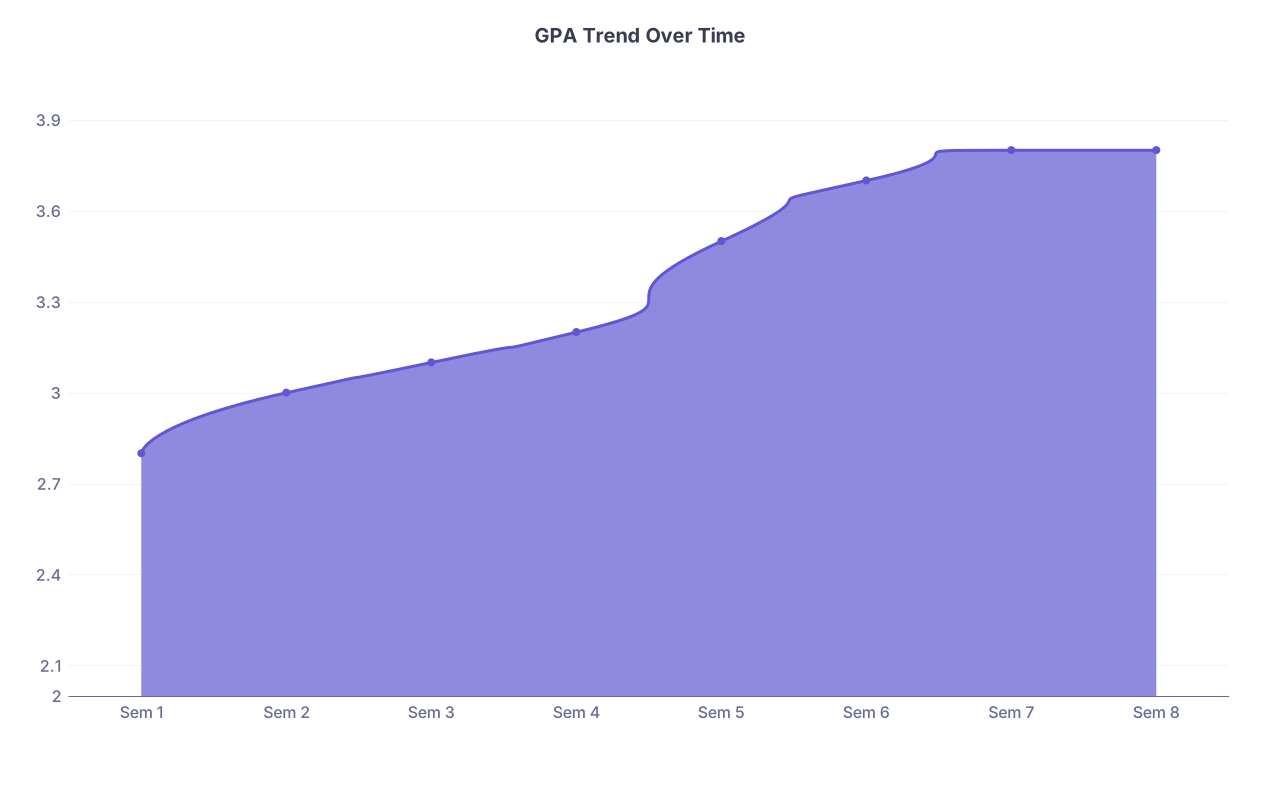
| Category | Value |
|---|---|
| Sem 1 | 2.8 |
| Sem 2 | 3 |
| Sem 3 | 3.1 |
| Sem 4 | 3.2 |
| Sem 5 | 3.5 |
| Sem 6 | 3.7 |
| Sem 7 | 3.8 |
| Sem 8 | 3.8 |
If your chart looks anything like that in real life, you are not a “low GPA applicant.” You are a strong finisher who started poorly. That is a different story entirely.
How to weave data naturally into answers
You do not bring printouts and spreadsheets. You casually embed numbers into your sentences.
Example:
“In my last 45 credits of science, I have a 3.78, and that includes biochemistry, physiology, and genetics. I treat that segment as my ‘trial run’ for medical school.”
or
“My MCAT is a 505 overall, but my BB and CP sections are both 127. My weakest area was CARS, which I continue to work on with weekly passage practice.”
That sounds like someone who actually knows their academic profile and has reflected on it.
Step 5: Fix Your Nonverbal and Emotional Response About Your Stats
I have seen strong applicants lose ground not because of their numbers, but because of how they emotionally react when asked about them.
Here is what interviewers notice:
- Do you visibly tense up, slump, or overcompensate?
- Do you start talking faster, apologizing, or rambling?
- Do you look like you are still ashamed of this part of your story?
Your goal is calm, factual, and matter-of-fact. Think: “This is one chapter in my academic story, not my entire identity.”
How to practice this
Say your weak points out loud.
Literally stand in front of a mirror and say:- “I have a 3.1 science GPA.”
- “I scored a 503 on my MCAT.”
- “I failed organic chemistry the first time.”
Repeat until the emotional charge drops and it sounds like you are reading a weather report.
Record mock interviews focused only on metrics.
Have a friend or advisor grill you for 20 minutes on:- Every dip on your transcript
- Each low section score
- That one ugly semester
Your task is not to sound perfect. It is to stay consistent: same structure, same calm tone.
Script your first sentence for each known weak spot.
The first sentence is where most people freeze. Script it, rehearse it.Examples:
- “You are right to notice my GPA dipped my sophomore year. That semester reflects poor time management and overcommitment on my part.”
- “Yes, my MCAT is below your median, and I understand why that raises questions. Let me explain what I learned from that and how I have addressed it.”
Once the first sentence is automatic, the rest follows more easily.
Step 6: Rebalance the Interview – Do Not Let Metrics Dominate
One mistake I see low-stats applicants make: they anchor their entire identity on their weakness. They spend 80% of the interview justifying their numbers and 20% showing who they actually are as a future physician.
You need the opposite. You address metrics decisively, then you pivot to your strengths and your fit for the profession.
Use the “Answer → Bridge → Strength” pattern
When a metrics question comes:
- Answer directly with your structured response.
- Bridge out with a brief connecting phrase.
- Highlight a related strength or experience.
Example:
“Your MCAT is below our average. How should we interpret that?”
Answer:
“My 505 is below your typical range, and I understand that concern. At the time, I was balancing full-time work and studying, and I did not structure my preparation as efficiently as I should have.”Concrete fix + evidence:
“Since then, I have completed 24 credits of upper-level science with a 3.85 GPA, in courses that are very test-heavy. I implemented weekly spaced-repetition review, practice questions, and regular meetings with a study group. That has stabilized my exam performance.”Bridge and strength:
“That experience also shaped how I approach challenges more broadly. For example, on my clinical research team, I took the same methodical approach to learning a new data analysis platform, which allowed me to design and lead our chart review project rather than avoiding the steep learning curve.”
You do not sit in your weakness. You acknowledge it, show it is under control, and then show them why you are valuable.
Step 7: Special Situations – How to Handle Tougher Red Flags
Let us address a few particularly ugly scenarios head-on.
Academic probation or dismissal
You cannot spin this. You can only own it and prove you are different now.
Framework:
- One sentence: what happened (probation/dismissal, when).
- One sentence: what led there (your responsibility).
- Two to three: what you did in response (academic, personal, structural changes).
- One to two: concrete outcomes since.
Example:
“During my sophomore year, I was placed on academic probation after earning below a 2.0 GPA for the semester. I was trying to juggle full-time work, family responsibilities, and a full course load without asking for help, and my academics suffered.
After that, I met with academic advising, cut back my work hours, and began weekly sessions with a learning specialist. I overhauled my study strategies, structured my schedule, and used campus tutoring regularly. Since then, for the past five semesters, my GPA each term has been above 3.5, including in upper-division science courses.
That experience forced me to confront my limits and build sustainable systems instead of trying to push through on willpower alone.”
If you sound like that, you sound like someone who is not going to repeat history.
Very low MCAT with retake
If you materially improved, emphasize the process difference, not just the score difference.
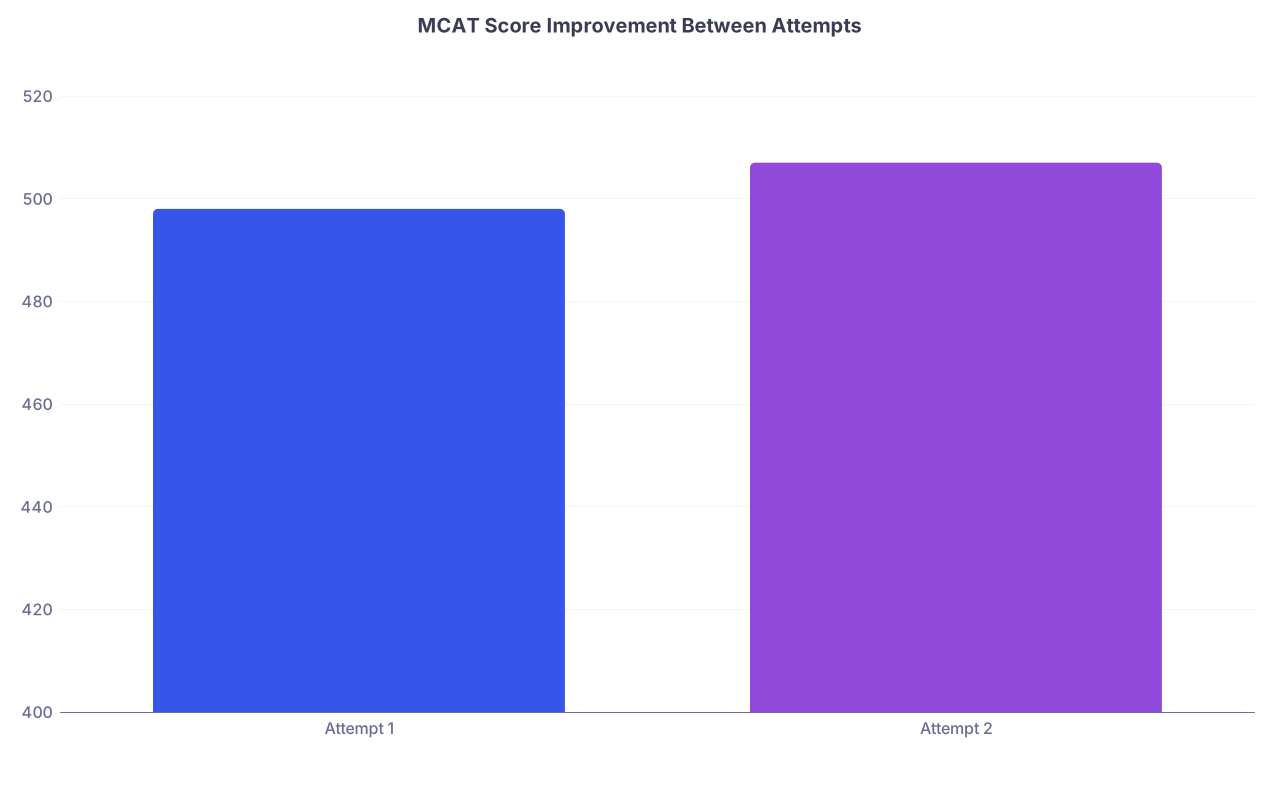
| Category | Value |
|---|---|
| Attempt 1 | 498 |
| Attempt 2 | 507 |
Example narrative:
“On my first attempt, I scored a 498. I studied alone, relied heavily on passive review, and did not track my progress with full-length practice tests.
For my retake, I treated it like a part-time job. I built a 12-week schedule focused on question-based learning, took six full-length exams, and met weekly with a tutor to review missed questions. I also adjusted my work schedule to minimize fatigue.
That led to a 507 on my second attempt, with my biggest gains in CP and BB. While I know 507 is still not elite, the improvement reflects significant changes in how I prepare for high-stakes exams. Those same systems are what I would carry into Step preparation.”
You are selling process maturity, not just a higher number.
Step 8: Do a “Metrics-Only” Mock Interview Before the Real Thing
If you walk into a real interview and the first time you hear, “Explain your GPA” is from an actual faculty member, you have already screwed up.
Do one focused prep session where the only agenda is:
- Every semester dip
- Every low course
- Every MCAT concern
- Any withdrawals, leaves, or disciplinary marks
Have your mock interviewer (advisor, mentor, friend) be brutally direct:
- “Why did you not withdraw earlier?”
- “Why should we believe you can handle 25 credits of science at once?”
- “What would you say to a committee member who thinks your MCAT is too low?”
Record the session. Then:
- Write down your first sentence answer to each question you stumbled on.
- Rehearse those first sentences out loud until they are clean and confident.
- Re-run the same questions a few days later.
You are not trying to erase your weak spots. You are training yourself so that nothing they ask about your metrics is new to you.

| Step | Description |
|---|---|
| Step 1 | Identify Weak Metrics |
| Step 2 | Build Metrics Narrative |
| Step 3 | Collect Academic Data |
| Step 4 | Practice Answers Out Loud |
| Step 5 | Mock Metrics-Only Interview |
| Step 6 | Refine Scripts and Delivery |
| Step 7 | Actual Interview |
FAQ (Exactly 2 Questions)
Q1: Should I bring up my low stats proactively if the interviewer does not mention them?
If your metrics are borderline but not catastrophic and they do not ask, you do not need to force it into every answer. However, if there is a major red flag (academic probation, dismissal, an F in a prerequisite, very low MCAT with retake), it is usually better to address it once, clearly, when you talk about growth or resilience. You might say: “One of the most important periods of growth for me was after I was placed on academic probation…” and then use your structured narrative. The key is to address it once, cleanly, not repeatedly drag the conversation back to your weakness.
Q2: How do I know when low stats are “dealbreakers” versus “explainable”?
A single low semester with a strong upward trend, a mid-500s MCAT, or one remediated course is explainable at many schools, especially if your experiences and personal attributes are strong. Multiple failing grades, a pattern of poor performance without a clear fix, or MCAT scores consistently below 500 are much closer to dealbreaker territory for MD programs and may push you toward DO, post-bac, or SMP routes. If you are already interviewing, though, you are in the “explainable” category by definition. Your job is to convince them that your weak numbers are an old version of you, not a preview of you as their student.
Key points to keep:
- Do not improvise your way through questions about GPA or MCAT. Script the structure, rehearse out loud, and back it with data.
- Own your mistakes without self-destruction, then show exactly how you fixed them and what your results have been since.
- Address the weakness decisively, then pivot to your strengths and who you are now. Metrics are one chapter, not your whole story—if you present them that way.