The fastest way to sink an otherwise strong interview is to stumble when they ask, “Can you explain this gap/withdrawal/repeat on your transcript?”
You are not being “screened for perfection.” You are being tested for honesty, accountability, and growth. If you understand that, you can turn every blemish into a strength.
Let me walk you through exactly how to do that.
The Real Test Behind “Red Flag” Questions
Interviewers are not obsessed with your transcript. They are obsessed with risk.
They are asking themselves:
- Will this person crumble under the pressure of medical training?
- Will they take responsibility when things go wrong?
- Will they repeat the same errors on my service, with my patients?
Every question about:
- An academic gap (semester/year off, time between degrees)
- Withdrawals (single W or multiple)
- Repeated courses (C → A, or multiple retakes)
- Institutional actions (probation, suspension)
…is a proxy for four things:
- Insight – Do you understand what actually went wrong?
- Accountability – Do you own your part without drama or excuses?
- Change – Did you change your behavior, not just your story?
- Durability – Is this problem solved, or is it going to resurface in M2 or residency?
Your job is to answer those four questions clearly, in about 60–90 seconds, without sounding rehearsed or defensive.
A Universal 4-Step Script You Can Use For Any “Red Flag”
I am going to give you the structure first. Then we will adapt it to gaps, withdrawals, and repeats.
Use this for almost any difficult question about your record:
Label it briefly
One sentence. Factual. No soap opera.- “During my sophomore fall, I withdrew from Organic Chemistry I.”
- “There is a one-year gap between my second and third years.”
- “I repeated two prerequisite courses early in college.”
Give the root cause, not the drama
One or two sentences. Specific, honest, but controlled.- “At the time, I was working 30 hours a week and did not adjust my study strategies from high school.”
- “I was dealing with untreated depression and did not have good coping mechanisms.”
Describe concrete corrective actions
This is the heart. Actions, not feelings.- “I met with academic support, cut my work hours, and built a weekly study schedule that I have used since.”
- “I saw a therapist, started medication, and learned to set boundaries around commitments.”
Prove the change with evidence
Show it worked. Show it is durable.- “Since then, I have taken 45 science credits with A/A- grades while maintaining my research and volunteering.”
- “In post-bac, I carried 14 credits of upper-division science and improved to a 3.8.”
That is your spine. Everything else is customization.
Step Zero: Map Your Own Transcript Risks
Before we get tactical by type, you need a simple risk map. Do this before interview season.
Print your transcript and ask yourself, like an admissions committee:
- Where are the obvious conversation starters?
- Where would I ask a follow-up?
Circle:
- Semesters where GPA drops sharply
- Gaps of 4+ months not explained elsewhere
- Any “W,” “WF,” “I,” “NP,” or “F”
- Courses with repeats (especially prerequisites)
- Any notation about academic or conduct issues
Now write, next to each circle, one sentence:
- “What actually happened?”
- “What did I change?”
- “How can I prove it is fixed?”
You are building a cheat sheet: problem → cause → fix → evidence.
Keep this next to you while you practice.
Handling Gaps: Time Off Without Looking Checked Out
Not all gaps are bad. But unexplained gaps are.
Types of gaps that trigger questions
- Gap between high school and college
- Gap semester/year during college
- Gap(s) of several months between college and application
- Multiple “mini-gaps” in employment/activities
Interviewers are trying to figure out:
- Were you avoiding academics?
- Were there serious health/family/disciplinary issues?
- Did you use the time constructively or just drift?
How to frame an academic gap year/semester
Use the 4-step structure:
Label
“There is a one-year gap between my second and third years of college.”Root cause
- Acceptable: “My father was diagnosed with cancer, and I became a primary caregiver while managing the logistics at home. I could not sustain full-time coursework responsibly.”
- Also acceptable: “I was unsure about my direction, burnt out, and not performing to my potential. I decided to step back intentionally rather than accumulate poor grades.”
Corrective actions / use of time
Be specific:- “I worked full time as a medical assistant in a primary care clinic.”
- “I completed a community college EMT certification and volunteered 15 hours per week.”
- “I engaged in weekly therapy, developed consistent sleep and exercise habits, and returned with a structured weekly schedule.”
Evidence the issue is resolved
- “Since returning, I completed 60 credits with a 3.7 GPA while working 10 hours a week in the same clinic.”
- “In my post-bac after the gap, I enrolled full time and maintained A/A- grades in upper-level sciences.”
Weak answer: “I just needed a break.”
Strong answer: “I hit a wall, recognized it, stepped back deliberately, got help, rebuilt systems, and my later record proves I can now handle full-time demands.”
Gaps between college and application
These are common. They only hurt you when they look accidental or lazy.
You need:
- A clear organizing story (“I worked to improve my academic foundation and gain clinical exposure”)
- Concrete roles with dates, hours, and responsibilities
- A connection to why you are now more prepared for medical training
Example framework:
- “After graduating in 2021, I took two years before applying.”
- “I knew my academic record in early college did not reflect my current capabilities.”
- “I completed a formal post-bac, working 20 hours per week as a scribe and 5 hours in a free clinic.”
- “Those two years solidified my study strategies and confirmed that I want a career in longitudinal patient care.”
If you have scattered months of unemployment, do not hide them. Explain:
- Job search challenges
- Family responsibilities
- Self-study, informal caregiving, or structured volunteering
The key is intentionality. Drifting is a red flag. Deliberate regrouping is not.
Withdrawals: When a “W” Does and Does Not Matter
One W in an otherwise clean record is noise. Three Ws in core sciences in one year is a pattern.
Schools look for:
- Academic judgment (withdrawing appropriately vs. failing)
- Self-awareness (knowing when to cut losses)
- Whether the underlying problem was fixed
Single, isolated withdrawal
You can handle this in under 45 seconds.
Example:
“In my junior fall, I withdrew from Organic Chemistry II. I had taken on a heavier load and a new lab position while commuting home on weekends to support family responsibilities. Mid-semester, I realized I could not give the course the attention it required and chose to withdraw rather than earn a poor grade. The next semester, I re-took it as my primary focus, adjusted my schedule, and earned an A-. The rest of my upper-level science coursework reflects those improved time-management decisions.”
No over-sharing. No dramatic detail. Clear cause, clear fix, strong outcome.
Multiple withdrawals or pattern of Ws
Now you must acknowledge a systemic issue, not a one-off.
Possible root causes:
- Overcommitting and poor time management
- Health (physical or mental) crises
- Family or financial emergencies
- Wrong major / misalignment with interests
The structure stays the same, but with more emphasis on pattern recognition:
Label
“You will notice I have three withdrawals over my sophomore and junior years.”Root cause (pattern-level)
“At that time, I had a habit of overcommitting—taking 18 credits while working 25 hours a week and starting a new research position. I underestimated the demands and delayed asking for help.”Corrective actions (system re-design)
- “With my advisor, I set a hard limit of 14–15 credits while working.”
- “I started using a weekly calendar with fixed study blocks.”
- “I checked in with professors early if I started falling behind rather than hoping it would resolve.”
Evidence
- “Since instituting those changes, I have completed 50 credits, including Biochem, Genetics, and Physiology, with no withdrawals and primarily A/A- grades.”
If health or mental health was the major factor, you must show:
- Diagnosis or clear recognition of the problem
- Treatment or structured support
- Functional stability over time (not just “I feel better now”)
Example:
“Two of those withdrawals occurred during a period of untreated depression. I was not sleeping, my concentration was poor, and I was ashamed to ask for help. After a crisis appointment through campus counseling, I began regular therapy and, with my physician, started medication. Over the last two years, I have maintained treatment, built a consistent schedule around sleep and exercise, and completed my post-bac full time with a 3.8 GPA and no withdrawals. This was a turning point in learning to seek support early, and my recent academic performance reflects that.”
Notice the emphasis: not on suffering, but on system-level solutions.
Repeated Courses: Turning “I Struggled” Into “I Learned How To Learn”
Repeated courses are not uncommon. How you explain them separates the mature from the excuse-makers.
Interviewers want to know:
- Did you simply retake for a higher grade, or did you fundamentally improve how you learn?
- Is this a one-time adjustment, or do you chronically struggle in science?
- Does your upward trend look convincing?
Single repeated course, clear improvement
If you have one early C in, say, General Chemistry I followed by an A on repeat and strong later sciences, this is low risk—but you must not be defensive.
Example:
“In my first semester, I earned a C in General Chemistry I, which I later repeated for an A. This was my wake-up call that high school habits—cramming before exams and passive rereading—would not work in college-level science. Before repeating the course, I met with learning support, adopted active recall and spaced repetition, and committed to structured weekly problem sets. Those strategies carried forward; you can see the impact in my A-range grades in Organic Chemistry, Biochemistry, and Physics.”
Key move: you are not just saying “I tried harder.” You are saying “I changed how I study.”
Multiple repeats or repeated failures
Now you must prove that:
- You diagnosed the learning problem
- You implemented a reliable study system
- The system works across multiple courses
Let’s say you failed Organic I once, then got a B on repeat, and later did well in Biochem.
Framework:
Label
“I repeated two core science courses: Organic Chemistry I and Physics I.”Root cause (academic)
“In both, I relied on passive strategies and avoided practice problems because they exposed my gaps. I also did not attend office hours or seek feedback early.”Corrective actions (skills)
- “I shifted to daily mixed problem sets rather than last-minute practice.”
- “I used Anki for mechanisms and formulas.”
- “I formed a small study group and forced myself to teach concepts to others weekly.”
- “I scheduled standing office hours check-ins during weeks 2–5.”
Evidence
- “When I repeated the courses, I earned a B+ in Organic I and an A- in Physics I.”
- “In later coursework that built on those concepts—Biochemistry, Physical Chemistry—I earned A/A- grades, and you can see I have had no further repeats.”
If your early performance was tangled up with life chaos (work, family, health), you can briefly note it, but do not hide behind it. You still have to show skill growth, not just “less stress.”
The One Thing That Will Destroy Your Answer: Excuses
You must walk a narrow line:
- On one side: over-sharing, self-pity, or dramatizing
- On the other: minimization, defensiveness, or blaming others
Common weak moves (avoid these phrases):
- “The professor was not good.”
- “The exam was unfair.”
- “I was just unlucky that semester.”
- “Everyone struggled in that class.”
- “It was only a W, so I didn’t think it mattered.”
Instead, lean into:
- “I misjudged…”
- “I delayed asking for help…”
- “I did not yet have the study skills/structure I needed…”
- “I overestimated my capacity to juggle work and school…”
Blame is cheap. Accountability is rare. Interviewers notice.
Practice Protocol: How To Make Your Answers Automatic (But Not Robotic)
You cannot wing this. If you try, you will ramble or sound defensive.
Here is a simple 4-step practice protocol.
1. Write a 120-word “ugly draft” for each issue
For each gap, W, or repeat:
- Write out the full story, unfiltered.
- Then highlight:
- 1–2 phrases that clearly state the cause
- 2–3 concrete actions you took
- 1–2 sentences that show evidence of improvement
Now cut it down to ~80–100 words following the 4-step structure.
2. Record yourself answering on video
Use your phone. Sit at a desk. Pretend you are in front of an MMI station.
Prompt yourself out loud:
- “Can you explain this year-long gap?”
- “I see you withdrew from Organic Chemistry II. What happened there?”
- “You repeated two major prerequisite courses. Why?”
Answer, then re-watch with three questions in mind:
- Did I sound defensive at any point?
- Did I ramble about details that do not matter?
- Did I clearly land on what I changed and how that shows up later?
Edit your wording slightly until you can answer smoothly in 60–90 seconds.
3. Get a ruthless outside perspective
Ask:
- A prehealth advisor
- A mentor who has seen admissions from the inside
- Or at least a brutally honest friend
Have them rate each answer from 1–5 on:
- Clarity (Do they understand what actually happened?)
- Ownership (Do you sound accountable or excuse-heavy?)
- Evidence (Do they feel reassured that it will not recur?)
| Criterion | 1–2 (Weak) | 3 (Mixed) | 4–5 (Strong) |
|---|---|---|---|
| Clarity | Vague, confusing, too long | Understandable but wordy | Concise, specific, easy to follow |
| Ownership | Blaming or minimizing | Some ownership, some excuses | Clear responsibility without self-bashing |
| Evidence | No proof of change | Mentions change, weak specifics | Concrete grades, activities, or timelines |
You want mostly 4–5s before interview day.
4. Stress-test with curveball follow-ups
Good interviewers will push:
- “How do I know this will not happen again in medical school?”
- “Why should I believe that the underlying issue is resolved?”
- “If you were in that situation again, what would you do differently now?”
Prepare 1–2 sentences for each of those.
Example:
“The biggest difference now is that I no longer wait until I am in crisis to adjust my commitments. In the last two years, I have proactively scaled back work hours before exam-heavy weeks and communicated early with supervisors. My consistent performance in upper-division courses while working part time is the strongest evidence I can offer that I have learned how to manage my limits.”
Advanced Layer: Matching Your Story to Their Concerns
Different “red flags” trigger different worst-case fears in an interviewer’s mind.
You can address those fears directly if you know what they are.
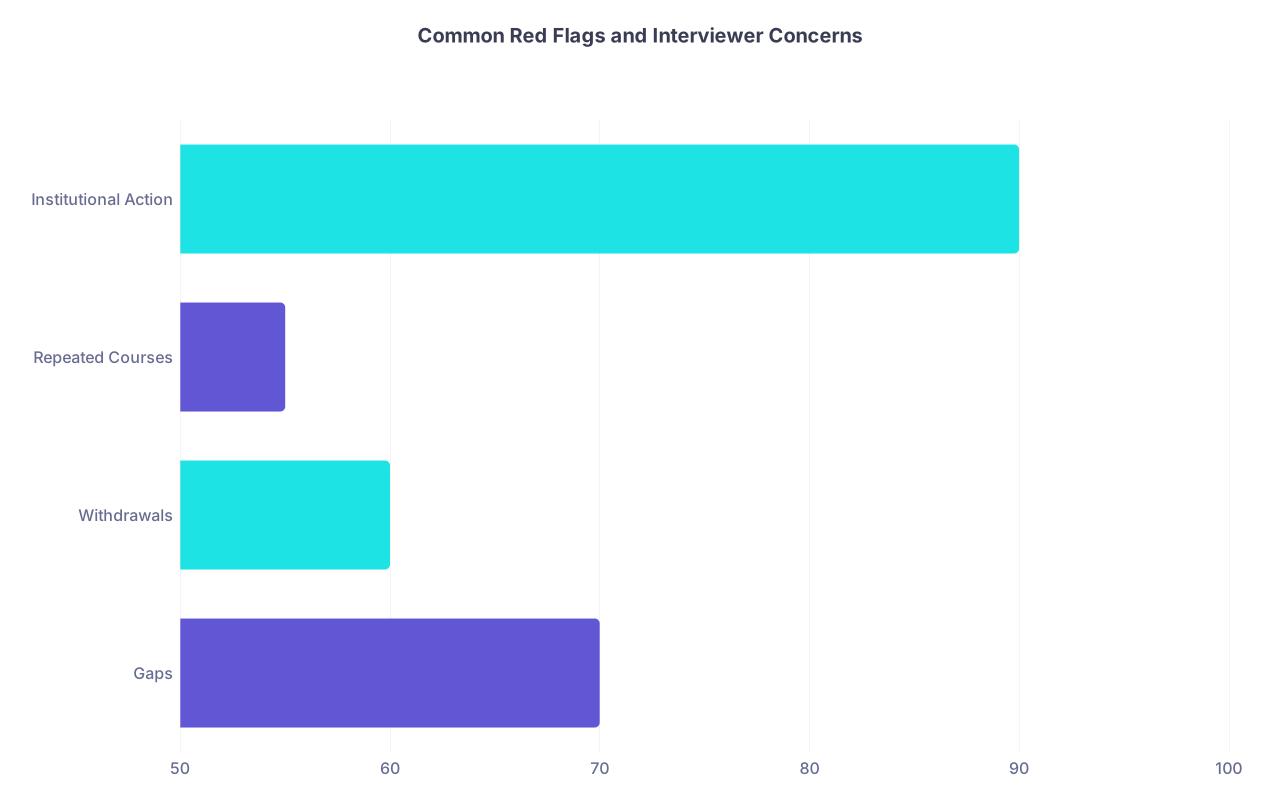
| Category | Value |
|---|---|
| Gaps | 70 |
| Withdrawals | 60 |
| Repeated Courses | 55 |
| Institutional Action | 90 |
Roughly:
- Gaps → fear of low motivation, lack of follow-through
- Withdrawals → fear of poor judgment under pressure
- Repeated courses → fear of limited academic ability
- Institutional action → fear of professionalism or conduct issues
You do not have to guess their thoughts. You can answer them explicitly:
- “I understand that a year-long gap can raise questions about commitment. For me, that year clarified that I want medicine for the long term. Working full time in a clinic showed me the realities of the job, and I chose to re-enter academics with that in mind.”
- “Multiple withdrawals in a short span reasonably raise concerns about my judgment. What has changed is how early I now assess my capacity and ask for help. My record since then—with full semesters, no Ws, and solid grades—reflects that I apply those lessons consistently.”
Name the concern. Address it. Move on.
Special Case: When the Gap/Withdrawal Is About Health or Trauma
You are not required to disclose personal medical details. But being completely vague (“personal reasons”) often backfires.
The middle ground:
- Name the category (e.g., “a significant mental health challenge,” “a family health crisis”) without graphic detail
- Emphasize treatment, support, and functional stability
- Provide a multi-semester track record of success
Example, mental health:
“During that semester, I experienced a major depressive episode. My sleep and concentration deteriorated, and I eventually withdrew from two courses. That experience forced me to re-evaluate how I handle stress. I sought treatment with a psychiatrist and therapist, and I have remained in care for the last three years. Functionally, that has meant regular sleep, exercise, and earlier communication with supervisors. The best evidence I can offer you is my last four semesters: full course loads including upper-division sciences, with no withdrawals and a GPA of 3.7.”
Example, family crisis:
“That gap corresponds to a period when my younger sibling was critically ill. I became a central caregiver and advocate, attending hospital visits and managing their home care. I stepped away from formal coursework to be fully present. When their condition stabilized, I returned to school full time and have maintained a strong academic performance since. That period reinforced my desire to be on the other side of that hospital bed, supporting families going through similar crises.”
Do not center the trauma. Center your function and growth after it.
Example Transformations: From Messy to Tight
Let me show you three quick before/after examples.
1. Weak answer about a gap
Messy version:
“So I kind of took a year off because I was burnt out and I did not really know what I wanted to do, and my grades were not good, and then COVID happened, and I just stayed home and thought about things, and then later I decided to go back and now I am here.”
Tight version:
“Between my sophomore and junior years, I took a year off. I was academically underperforming and unsure of my direction, and I realized continuing in that state would only compound the problem. During that year, I worked as a CNA in a skilled nursing facility and enrolled in two community college courses to rebuild my study habits. That experience clarified that I want a career in patient care, and since returning, I have completed 50 credits with a 3.6 GPA and consistent A-range grades in upper-level sciences.”
2. Weak answer about a withdrawal
Messy version:
“The professor was really disorganized, and the class average was terrible, so I just decided it was not worth it and dropped it.”
Tight version:
“I withdrew from that course after realizing mid-semester that my current workload and commitments did not allow me to master the material. Rather than stay enrolled and earn a poor grade, I chose to withdraw, adjust my schedule, and re-take it the following semester with a lighter load. I used more structured study strategies and office hours, and I earned an A-. The rest of my transcript since then shows that I learned to plan my course loads more realistically.”
3. Weak answer about repeated courses
Messy version:
“I have always been bad at science, but I tried my best and eventually I did okay. Those classes were just really hard.”
Tight version:
“Early on, I struggled in General Chemistry and Physics and repeated both. My approach was the problem—I relied on last-minute cramming and avoided practice questions that exposed gaps. Before repeating, I worked with a learning specialist to shift to daily problem sets, spaced repetition, and regular office hours. When I retook them, my grades improved to B+/A-, and, more importantly, those same strategies carried into Biochemistry and Physiology, where I earned A-range grades without needing any repeats.”
Final Calibration: Nonverbal Delivery
Content is 70%. Delivery is 30%. If you sound ashamed or irritated, they will feel it.
Aim for:
- Calm tone – neither overly apologetic nor flippant
- Steady eye contact – especially when you say “I made mistakes” or “I changed”
- Neutral facial expression – not smiling through a serious topic, not visibly shrinking
- Confident ending – finish on your evidence, not on your failure
If needed, script your final line for each issue, so you land in the right place:
- “Overall, that period forced me to develop the systems that now support my consistent performance.”
- “I am confident that the strategies I built through that experience will help me manage the demands of medical school.”
Your Next Step Today
Do this right now:
- Print your transcript.
- Circle every gap, withdrawal, or repeated course.
- For each, write a 4-sentence answer: label → root cause → actions → evidence.
Then open your phone camera, hit record, and practice saying each answer out loud once. No editing. No perfection.
You will know exactly where you stumble. Fix those spots before an interviewer sees them.