The reason your interview answers ramble is not nerves. It is lack of structure.
Once you have a clean structure, everything else gets easier: you talk less, say more, and sound like someone programs can trust with patients and colleagues.
Let me walk you through a simple, repeatable framework to fix rambling answers for medical and premed interviews—MMIs, traditional, virtual, all of it.
The Real Problem: You Are Thinking Out Loud
Most applicants do this:
- Hear the question.
- Start talking immediately.
- Try to “find” the answer while speaking.
- Panic partway through because they realize they have not actually answered the question.
- Add more detail. More backstory. More side notes.
- End with: “So yeah… that is basically it.”
That is thinking out loud. Interviewers hate it. Not because you are nervous, but because you sound disorganized and unfocused. In medicine, that is a red flag.
Here is what I have seen repeatedly across years of mock interviews:
- Strong applicants with great stories drown them in context.
- They repeat the same point three times in different words.
- They do not know how to stop talking without sounding abrupt.
- They try to squeeze their entire CV into every answer.
You fix this by changing how you construct answers, not by “trying to be more concise.”
Let us build that structure.
The 4-Step Framework: Q–ONE–TWO–STOP
You do not need ten different frameworks. You need one you can use 80% of the time.
Use this for almost every behavioral or traditional interview question:
Q–ONE–TWO–STOP
Q – Question first
- Repeat or paraphrase the question in 1 sentence.
- This acts as a “thesis statement” and pins your brain to the target.
ONE – One core point
- Decide the single main idea you want them to remember.
- State it clearly before launching into detail.
TWO – Two supporting pieces
- Give exactly two supporting elements:
- 2 brief examples or
- 1 example + 1 reflection or
- 1 example + 1 takeaway skill/lesson
- That is it. Not five. Two.
- Give exactly two supporting elements:
STOP – Stop on purpose
- End with a short, clean closing line that:
- ties back to the question, and
- signals you are done.
- End with a short, clean closing line that:
This keeps your answers in the 60–90 second range for simple questions and 2–3 minutes for complex scenarios. Which is exactly where you want to be.
Let us break each part down and then run real med-school-style examples.
Step 1: Q – Anchor Yourself to the Question
Rambling usually starts at second 3.
You hear: “Tell me about a time you handled conflict.”
You respond: “So in undergrad, I was part of this organization, and we did a lot of work in the community, and there was this big project where…”
You are already off the rails.
Instead: start by pinning the question.
You do that by repeating or reframing the question in one clean line, such as:
- “A key example of how I handled conflict was during a group research project last year.”
- “One situation that really shaped how I deal with conflict happened in my role as a teaching assistant.”
Why this works:
- It buys you 2–3 seconds to think.
- It locks your brain onto a specific story.
- It shows the interviewer you understood the question.
Do not overdo this. You are not writing a thesis. Just:
- “To answer your question about… [brief hook into your example].”
Use this especially for:
- “Tell me about a time when…”
- “Describe a situation where…”
- “Can you give an example of…”
For opinion or motivation questions (“Why medicine?” “Why this school?”), the same concept applies:
- “There are three main reasons I am drawn to medicine, but the core one is…”
- “The main reason I am particularly interested in this school is…”
One line. Then move.
Step 2: ONE – Choose a Single Core Point
Your biggest mistake is trying to prove everything at once.
Question: “What makes you a strong candidate for medical school?”
Your brain: “Empathy! Work ethic! Research! Leadership! Shadowing! Resilience! Cultural competence! Teamwork!”
Result: Disorganized monologue that sounds like your AMCAS activities list read out loud.
You must pick one main point per answer. Think of it as the headline.
Examples:
- “What makes me a strong candidate is that I am consistent under pressure.”
- “The main thread through my experiences is that I actively seek and respond to feedback.”
- “What differentiates me is my sustained commitment to underserved communities.”
That does not mean you ignore everything else. You just organize it under a single theme.
Here is a bad version versus a fixed one.
Question: “Tell me about a strength.”
Rambling version:
“I think one of my strengths is that I am hardworking. For example, in college I took a heavy course load and I also worked part-time and did research. And then in my volunteer clinic, I also showed a lot of dedication over the years, and my supervisor would say I was very reliable, and I think that shows that I am also organized and good with time management and also very resilient because…”
Structured version:
“One of my key strengths is reliability under pressure.
In my second year, I was taking a full science course load, working 15 hours a week, and coordinating volunteers for our free clinic. There was a week when two volunteers quit before a major event. I reorganized the schedule, took extra shifts, and worked with the clinic director to streamline intake so patients were not turned away. We ended up seeing 20% more patients than the previous event.
More recently, during my hospital volunteering, I consistently took the evening shifts that others avoided. The nurses started assigning me more complex tasks because they knew I would show up and follow through.
Those experiences reflect how I approach responsibility in general: if I commit, I follow through, especially when it matters most.”
One theme. Two supporting pieces. Clean.
Step 3: TWO – Limit Yourself to Two Supports
Here is where you kill rambling.
You impose an artificial but extremely useful rule on yourself:
I am allowed two supports. No more.
Supports can be:
- Two discrete examples
- One example + one reflection/lesson
- One example + one “now and future” application
- Two facets of the same example (situation + result, then reflection)
You are not in a courtroom. You do not need ten exhibits. Two clear, well-chosen supports make you sound confident and deliberate.
Example 1: Classic behavioral question
Question: “Tell me about a time you made a mistake.”
Q – Question:
“One meaningful example of a mistake I made was during my role as a chemistry lab TA.”
ONE – Core point:
“The core issue was that I communicated unclearly, which led to confusion for the students.”
TWO – Two supports:
Example:
“Early in the semester, I changed the pre-lab quiz format to make it more application based. I announced it at the end of a lab session, but I did not post anything on the course page. The next week, half the students were unprepared and frustrated. That was my fault—I had not given them a clear, written heads-up.”Reflection / Fix:
“I apologized to the group, posted detailed expectations online, and created a standard template for every pre-lab announcement. I also asked for anonymous feedback after two more sessions to confirm the change was working. Since then, in every role—from research to volunteering—I assume that if people are confused, I probably communicated badly and need to adjust the system, not blame the group.”
STOP – Closing line:
“That mistake made me much more intentional about clear, redundant communication, especially when others are depending on me.”
Simple. Direct. Short.
Example 2: “Why this school?”
Most people ramble for 5 minutes on this one with a list of everything on the website.
Use Q–ONE–TWO–STOP.
Q – Question:
“The main reasons I am especially interested in your school are the longitudinal clinical exposure and the emphasis on serving this specific community.”
ONE – Core point:
“What draws me here is the alignment between my past work in underserved settings and your school’s sustained, structured approach to community engagement.”
TWO – Two supports:
Concrete program match:
“During college, I volunteered for three years at a student-run clinic serving uninsured patients. What I liked most was the longitudinal aspect—seeing some patients multiple times and understanding social context. Your community health track, especially the continuity clinic starting in first year, mirrors that structure in a much deeper way.”Location / population match with specifics:
“I grew up in a medically underserved area and saw relatives delay care for years. Your partnerships with local FQHCs and the required service-learning projects with immigrant populations match the kind of work I want to keep doing—building trust with communities that are understandably skeptical of the system.”
STOP – Closing line:
“So it is the combination of early, longitudinal clinical exposure and your specific community partnerships that makes this school feel like the right fit for how I want to train.”
Two reasons. Both specific. No ten-minute speech.
Step 4: STOP – Learn to Land the Plane
Rambling usually dies 30 seconds after it should.
You feel like you need a “big finish,” so you keep looping: “And that really taught me a lot about teamwork, communication, and leadership and just overall becoming a better person…”
The fix: design short, stock closing lines you can use to land answers cleanly.
Patterns that work:
- “That experience really solidified [lesson], which I carry into [current role / future training].”
- “So that is a key example of how I [handled conflict / managed stress / approached leadership].”
- “That situation is a good summary of how I try to [core behavior].”
Why this matters:
- It signals to the interviewer: I am done.
- It prevents you from re-explaining your point.
- It lets them move on to the next question smoothly.
Practice literally saying “That is a good example of…” and then shutting up. It feels abrupt at first. It is not. It is professional.
A Simple Time Protocol for Answers
You need some timing discipline. You are not freestyling.
Use this rough protocol during prep:
- Basic behavioral / opinion question:
Aim for 60–90 seconds. - Complex scenario / ethical question:
Aim for 2–3 minutes. - Very rarely should you cross 3 minutes unless it is a prompt like “Tell me about yourself,” and even then, 2–3 minutes is ideal.
During practice:
- Record your answers on your phone.
- Look at the timestamps.
- Notice where you start repeating yourself. That is the exact second you should have stopped.
If you want numbers:
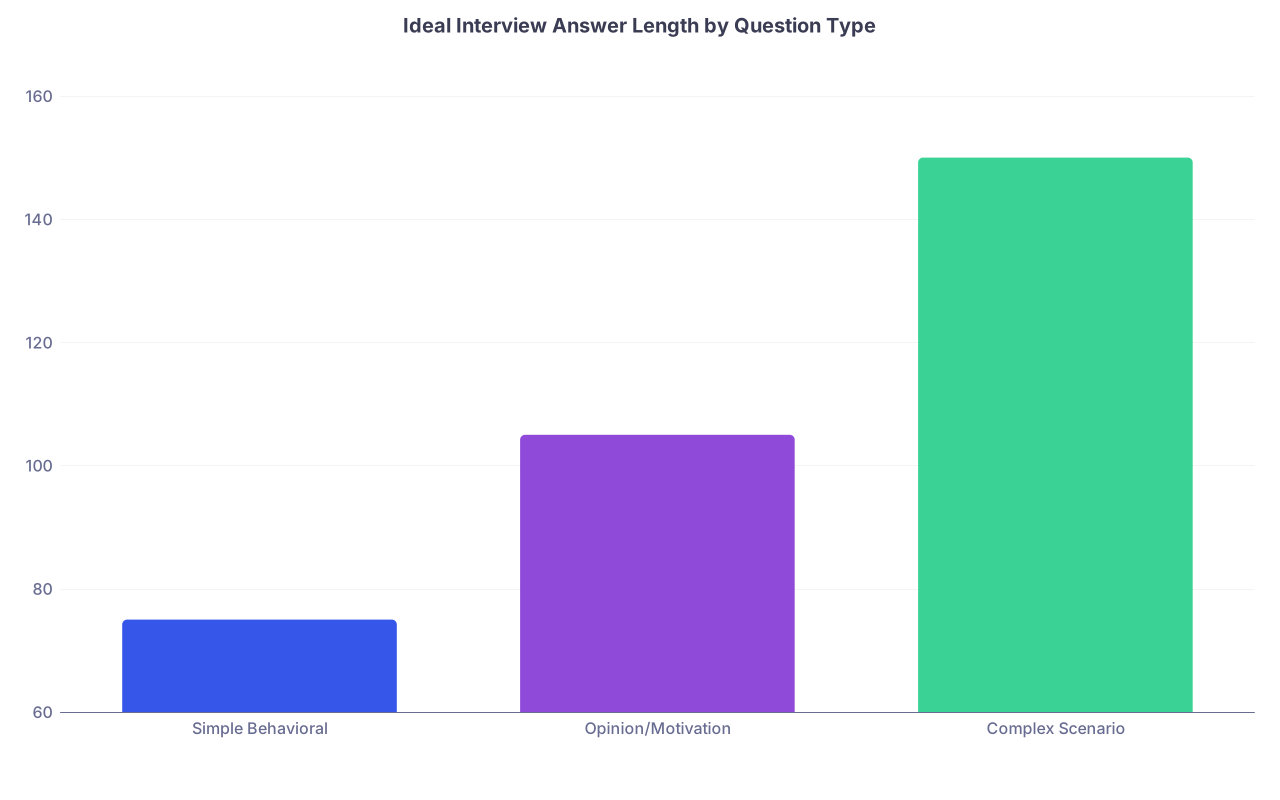
| Category | Value |
|---|---|
| Simple Behavioral | 75 |
| Opinion/Motivation | 105 |
| Complex Scenario | 150 |
Values are seconds. Your targets.
Converting a Rambling Answer Using Q–ONE–TWO–STOP
Let us take a classic messy answer and fix it.
Question: “Tell me about a time you had to work with a difficult team member.”
Typical ramble (I have heard versions of this dozens of times):
“So, um, I guess one time was during my junior year. I was in this group for a biology lab project and we had to design an experiment, and there was this guy in our group who was just very difficult to work with. He would always show up late, and sometimes he would not show up at all, and when he did show up, he would sort of criticize people’s ideas but not really contribute his own. And this was really frustrating because the project was a big part of our grade and we all wanted to do well, and I had other commitments like volunteering and working in a lab, so it was stressful. So we tried a few things, like sending reminder texts and stuff, and we also tried dividing the work differently, but that did not really help because he still would not do his part. So eventually I decided to talk to him outside of the group setting and I kind of asked him what was going on, and he said he was really overwhelmed with his own schedule and some family things. I tried to be understanding but also told him we needed him to contribute. And then after that it got a little better; he was not perfect, but he did show up more often. So I think I learned a lot about communication and compromise from that situation.”
Problems:
- No clear structure.
- Backstory > action.
- No defined takeaway.
- Almost 2.5 minutes long and feels mushy.
Now the same story with Q–ONE–TWO–STOP:
“A good example of working with a difficult team member was a group biology lab project in my junior year.
The core challenge was that one member was consistently disengaged and missing deadlines, which put our whole project at risk.
Initially, we tried logistical fixes—sending reminders and reassigning smaller tasks—but nothing changed. I realized we were just treating symptoms. I asked him to meet one-on-one, away from the group. In that conversation, I learned he was dealing with a heavy course load and a family situation he had not mentioned. I acknowledged that but also set clear expectations about what we needed from him and proposed specific, smaller deliverables that fit his schedule.
After that, his participation improved; he met the new deadlines, and we completed the project on time with a strong grade. More importantly, I learned that with difficult teammates, it is often a communication and context problem, not pure laziness. Now, when someone seems disengaged—whether in the lab or at the clinic—I try to understand what is behind it and then set clear, realistic expectations.
That situation shaped how I approach conflict: private, direct, and focused on both empathy and accountability.”
Same story. Much sharper. Controlled length. Memorable.
Adapting the Framework for Ethical and MMI Questions
MMI and ethical scenarios tend to cause even more rambling because people feel pressure to cover “every angle.” They start lawyering instead of answering.
Use a modified version:
Q–ONE–TWO–STOP–CHECK
- Q: Briefly restate the dilemma.
- ONE: State your position or priority (e.g., “patient autonomy comes first here”).
- TWO:
- Step 1: What you would do now.
- Step 2: How you would communicate / follow up / reflect.
- STOP: Close with 1–2 sentence summary.
- CHECK (only if interactive MMI): Ask if they would like more detail on any part.
Quick example.
MMI Scenario: “You are a medical student and notice a resident writing a note on a patient they have not seen. What do you do?”
“This scenario raises concerns about accuracy in documentation and patient safety.
My main priority would be to protect the patient while also addressing the professionalism issue.
First, I would clarify what I am seeing. I might say to the resident, privately, ‘I noticed the note mentions findings from today—did you have a chance to see the patient earlier?’ It is possible I missed something, and I want to avoid jumping to conclusions. If it is clear they are documenting without seeing the patient, I would express my discomfort and ask whether we could see the patient together to confirm the findings before finalizing the note, framing it as wanting to learn and ensure accuracy.
If they refused or this pattern continued, I would escalate the concern to a supervising physician or appropriate channel, focusing on the specific behavior and potential impact on patient safety, not on attacking the resident personally. I would document for myself what I observed, in case I am asked later.
Overall, I would aim to address it at the lowest appropriate level first, but I would not ignore it, because accurate documentation is central to safe patient care.”
Two steps. Clear stance. Done.
How to Practice This So It Actually Sticks
You cannot think your way out of rambling. You have to train it out.
Here is a practical 7-day protocol you can actually follow.

| Step | Description |
|---|---|
| Step 1 | Day 1: Baseline Recording |
| Step 2 | Day 2: Learn Q–ONE–TWO–STOP |
| Step 3 | Day 3: Simple Behavioral Questions |
| Step 4 | Day 4: Motivation & Why Questions |
| Step 5 | Day 5: Difficult/Conflict Questions |
| Step 6 | Day 6: MMI/Ethical Scenarios |
| Step 7 | Day 7: Mixed Timed Practice |
Day 1: Baseline
Record yourself answering 5 common questions, no structure:
- Tell me about yourself.
- Why medicine?
- Tell me about a time you failed.
- Tell me about a time you worked on a team.
- What is one of your weaknesses?
Do not time yourself during recording.
Then watch and write down the timestamps where each answer:
- Starts to repeat
- Drifts off-topic
- Ends awkwardly
You will immediately see your patterns. Good. That is what you are fixing.
Day 2: Learn and Script Closings
Write 3–4 generic closing lines you like. Examples:
- “That experience really shaped how I approach [X], and I carry that into [current setting].”
- “So that is a good summary of how I [key trait].”
- “Overall, that situation taught me [lesson], which is central to how I want to practice medicine.”
Practice saying them out loud after a random sentence until they sound natural.
Days 3–6: Focused Drills
Each day, pick one type of question.
- Day 3: Basic behavioral (teamwork, leadership, failure).
- Day 4: Motivation and “Why” questions (Why medicine, Why this school, Why this specialty).
- Day 5: Difficult situations (conflict, mistakes, stress).
- Day 6: MMI / ethical scenarios.
For each:
- Pick 3–5 questions.
- For each question:
- Pause 5–10 seconds.
- Mentally outline: Q–ONE–TWO–STOP.
- Answer out loud, aiming for the target time.
- Record only one answer per question. No second takes.
This mimics actual interview conditions.
Day 7: Mixed, Timed, Slightly Uncomfortable
- Have a friend / mentor / advisor (or even a list randomizer) throw 8–10 mixed questions at you.
- Use a visible timer.
- Force yourself to:
- Start within 5 seconds.
- Keep most answers under 2 minutes.
- Use a deliberate closing line each time.
Afterwards, choose 2–3 answers to re-do with tighter Q–ONE–TWO–STOP structure. Not all of them. Just the worst offenders.
Common Traps And How To Avoid Them
You will fall into these. Here are quick fixes.

Trap 1: Over-Contexting
You spend 60 seconds on background and 30 seconds on the actual answer.
Fix:
- Background max: 2–3 sentences.
- Ask yourself: “What is the minimum they need to understand the situation?” Say only that.
Trap 2: Cramming Your Resume
You treat each question as a chance to show everything you have done.
Fix:
- One core theme. Two supports.
- If you have a fantastic experience you really want in, save it for a question that fits better or “Is there anything else you want us to know?”
Trap 3: Ending Weakly
You trail off or say, “So yeah, that is basically it.”
Fix:
- Memorize your 3–4 closing lines.
- Use them mechanically at first. It will feel scripted for a week, then natural.
Trap 4: Sounding Over-Rehearsed
You turn Q–ONE–TWO–STOP into a memorized monologue.
Fix:
- Practice outlines, not scripts.
- Bullet points only:
- Q: “clinic conflict with volunteer”
- ONE: “I prioritize direct, private conversation”
- TWO: “1) specific issue; 2) checking understanding + plan”
- STOP: “lesson: direct + respectful conflict resolution”
You want structure, not theater.
Quick Reference: Framework vs. Old Habits
| Aspect | Old Habit (Rambling) | New Habit (Q–ONE–TWO–STOP) |
|---|---|---|
| Start of answer | Vague story opening | Clear restatement of question |
| Main idea | Multiple, unfocused | One core point |
| Number of examples | 3–5 half-developed | 1–2 well-chosen |
| Length | 3–6 minutes | 1–3 minutes |
| Ending | Trailing, apologetic | Deliberate closing line |
| Interviewer impression | Disorganized, anxious | Clear, concise, professional |
Final Thoughts: What Actually Matters
If you strip away all the fluff, interviewers are listening for three things:
Can you answer a question directly?
Q–ONE–TWO–STOP forces you to.Can you select what matters and leave the rest?
Two supports only. That discipline is exactly what you need for patient handoffs, consult calls, and progress notes.Do you sound like someone I would trust in a busy clinic?
Focused, concise, reflective. Not rushed. Not performative. Just clear.
Use the framework. Record yourself. Watch it back. Fix the spots where you wander.
You do not need to be more “interesting.” You need to be more organized.
That is what gets people to stop tuning out and start thinking: “I could see this person as a colleague.”