
Eye contact is the most overhyped, misunderstood piece of interview advice in premed culture.
You’ve probably heard some version of: “Look them in the eyes, firm handshake, smile, you’re golden.” That’s not how this works. That’s not how any of this works.
If “good eye contact” were as decisive as everyone claims, then socially anxious but brilliant applicants wouldn’t match at all. And yet they do. Every year. At top programs.
Let me pull this apart and show you what actually matters.
The Eye Contact Myth (And Why It Won’t Save You)
Here’s the myth in its lazy, Instagram-quote form:
“Strong eye contact = confidence = good impression = acceptance.”
It sounds plausible. It’s also wrong in three key ways:
- Eye contact is culturally and individually variable.
- Beyond a basic threshold, more eye contact doesn’t reliably improve ratings.
- Evaluators care far more about clarity, content, and warmth than stare intensity.
There is communication research on gaze behavior, and it does show that completely avoiding eye contact can be read as anxiety, disinterest, or evasiveness. But those are edge cases. We’re talking about near-zero gaze, eyes on the floor, never looking up. That’s not what most applicants do.
When you look at actual interview research (medical and non-medical), a different pattern shows up:
- Verbal content quality
- Vocal qualities (pace, tone, fluency)
- Nonverbal warmth (smiling, nodding, open posture)
- Overall coherence and structure of answers
…consistently matter more than whether you held someone’s gaze for 60% vs 75% of the time.
There’s also a dark side: overfixating on eye contact hurts weaker communicators. They spend so much cognitive bandwidth thinking, “Am I staring enough? Oh no, look back up,” that their answers get choppy, their stories fall apart, and they look more anxious, not less.
I’ve watched applicants walk out of an MMI room saying, “I think I blew it, I forgot to maintain eye contact,” when their actual issue was that they never answered the ethical question in front of them.
The obsession is misdirected.
What Eye Contact Actually Signals (And What It Doesn’t)
Let’s be precise. Eye contact does a few useful things:
- Signals you’re engaged and listening
- Helps regulate turn-taking in conversation
- Can make you seem more open or trustworthy—to some people
But it does not:
- Magically convert mediocre answers into strong ones
- Override red flags in professionalism or judgment
- Turn awkward content into “authenticity”
Here’s the nuance the bumper-sticker advice skips:
- In some cultures, direct, prolonged eye contact is considered rude or confrontational.
- Some neurodivergent applicants experience eye contact as painful or distracting.
- Some examiners themselves are low-gaze people—they’ll look at their paper or computer a lot.
There’s no secret “correct” percentage of time you must be looking into someone’s pupils to match into internal medicine at UCSF. That’s not how these decisions are made.
Most faculty unconsciously use a very crude filter:
Is this person engaged and connecting with me enough that I can imagine them in front of patients and colleagues?
That’s a threshold issue, not a precision metric.
You need to clear “appropriate, engaged human,” not “Navy SEAL of eye contact.”
What Interviewers Actually Care About: The Short List
Let’s cut through the noise. When evaluators debrief after interview days—especially in medicine—they talk about things that have nothing to do with whether you blinked too much.
Common phrases I’ve literally heard in ranking meetings:
- “They were thoughtful and had really clear examples.”
- “I could see them working well with nurses and staff.”
- “Felt a bit rehearsed and robotic.”
- “Genuine, easy to talk to.”
- “I’m not sure they really answered the question.”
- “Strong experiences, but I didn’t get a sense of who they are.”
Notice what’s missing?
“Great eye contact” or “Their gaze ratio was a 10/10.”
What actually drives interview presence:
Clarity and structure of answers
Can you answer the question, stay on track, and land the plane?Sense of self and reflection
Do you understand your own motivations, strengths, limits, and mistakes?Warmth and collegiality
Would people want to work with you at 3 a.m. on call?Professionalism and judgment
How you think about ethics, conflict, feedback, and responsibility.Basic nonverbal coherence
You look like your words, tone, and body language belong to the same person.
Eye contact fits in that last bucket as one small piece. Not the headline act.
The Real Nonverbal Hierarchy: What Matters More Than Gaze
Let’s rank nonverbal behaviors by how much they generally affect perceived presence in interviews. This is a simplification, but it tracks the communication literature and what faculty actually notice.
| Nonverbal Factor | Typical Impact Level |
|---|---|
| Vocal tone & pacing | High |
| Facial expression/warmth | High |
| Posture & orientation | Medium-High |
| Gestures & movement | Medium |
| Eye contact | Medium-Low (beyond threshold) |
1. Vocal tone and pacing
If I could fix one thing for most anxious applicants, it wouldn’t be eye contact. It would be this.
Monotone, rushed, or halting speech kills presence faster than looking at the desk for two seconds. Interviewers will say you seem unsure, unenthusiastic, or unprepared—even if your content is good.
You want:
- A moderate, varied pace (not bullet-train fast, not funeral slow)
- Clear enunciation
- Occasional intentional pauses so your points can land
This is why mock interviews over Zoom can be painful but revealing. Record one, listen with your eyes closed, and ask: “If this were a podcast, would I keep listening?” If the answer is no, fix that before you obsess over gaze.
2. Facial expression and warmth
You don’t need to grin like a politician, but a neutral, flat expression paired with perfect eye contact is not “confident,” it’s unsettling.
Genuine micro-smiles when you talk about things you care about, a slight softening around the eyes when you mention a challenging patient, a quick nod when the interviewer talks—these carry more weight than whether your gaze is 1 second longer or shorter.
3. Posture and orientation
Two simple things:
- Sit upright but not rigid. Think “engaged,” not “military inspection.”
- Angle your body toward the interviewer, not away.
Slouching deeply, leaning so far back you look checked out, or curling in on yourself while trying to maintain eye contact is exactly the kind of mismatch that reads as anxiety or defensiveness.
4. Gestures and movement
Hands locked to the chair, face, or hair? That’s what evaluators notice, not the angle of your eye contact.
Natural hand gestures that follow your speech are good. Fidgeting with pens, jewelry, badge clips, or constantly touching your face is not. If you know you’re a fidgeter, take away objects you can’t resist playing with.
Then—once those are clean—you can worry about looking up regularly.
How Much Eye Contact Is “Enough”?
Let’s be practical. You don’t need a stopwatch, but you do need a floor.
For medical school and residency interviews, “enough” usually looks like:
- You look up when you start your answer.
- You glance away occasionally while thinking.
- You return your gaze to the interviewer for key points and when they respond.
- You don’t stare at the floor, ceiling, or desk for entire answers.
If you like percentages: many conversation studies land around 40–60% gaze as “typical” in Western contexts. You don’t need to measure this. If you’re vaguely in that range and you’re not obviously avoiding their face, you’re fine.
There are two extremes to avoid:
- Near-zero gaze – you never look up, or only in quick flashes. This reads as very anxious, uncomfortable, or disinterested.
- Predatory stare – you lock on and barely blink or glance away. This reads as aggressive or uncanny, not confident.
Most people are nowhere near either extreme. If strangers and classmates don’t comment on your eye contact in real life, you’re probably not special in this domain. And that’s good. It means you can stop micromanaging it.
Special Cases: Anxiety, Neurodivergence, and Virtual Interviews
Here’s where the generic “just make strong eye contact” advice completely falls apart.
If you have social anxiety
Fixating on eye contact is like telling someone with a sprained ankle to focus on running form.
Your priority is:
- Slowing your speech
- Breathing between sentences
- Having a few practiced frameworks for common questions (so your brain isn’t blank)
For gaze, aim for simple anchors:
- Look at their eyes or the bridge of their nose when you start talking.
- Let your eyes drift briefly to neutral spaces (table, wall) when you’re thinking.
- Bring them back toward the interviewer for your conclusion.
That’s it. If you hit those three beats, you’re over the bar.
If you’re autistic or eye contact is literally painful
Forcing painful eye contact usually makes everything else worse—your working memory, your emotional regulation, your fluency.
You have options:
- Look at the interviewer’s forehead, eyebrows, or nose. They’ll read it as eye contact.
- Use short, intentional moments of direct gaze at the beginning/end of answers, and let yourself look away while thinking.
- For schools/programs that actually care about inclusion, you can disclose in a low-key way if you wish: “I sometimes look away when I’m thinking, but I’m fully engaged.” Then prove it with your content and tone.
I’ve seen applicants with limited eye contact but excellent insight and communication match into highly competitive specialties. Their actual substance carried them.
Virtual interviews: the eye contact trap
On Zoom, “eye contact” is a rigged game. To look like you’re making eye contact on their screen, you have to stare at the camera, which means you’re not looking at their face.
Don’t chase perfect simulated eye contact. Prioritize:
- Camera at eye level
- Looking at the screen most of the time so you can read their cues
- Glancing at the camera occasionally when you’re making key points
If you’re speaking clearly, framed well, and not staring off to a second monitor, your presence will read as strong even if you’re not camera-perfect.
What To Practice Instead Of Obsessive Eye Contact
If you have limited time and energy—and you do—spend it on things with higher ROI than fine-tuning your gaze percentage.
Here’s a sane practice hierarchy:
Story reps
Practice 8–12 core stories: a time you failed, resolved conflict, led a team, handled stress, helped a patient, etc. Make them specific, compact, and reflective.Answer structure
Use simple, repeatable frameworks:- Situation → Action → Result → Reflection
- Problem → What I considered → What I did → What I learned
Vocal delivery drills
Record 3–4 answers. Play them back:- Are you rushing?
- Are you dropping your voice at the end of sentences so they’re inaudible?
- Do you sound like you care about what you’re saying?
Nonverbal clean-up
Once your answers exist, then you refine:- Sit on a stable chair, feet on the floor, nothing in your hands.
- Practice with a friend and tell them: “Ignore my eye contact. Watch for fidgeting, weird posture, or distracting tics.” Fix those first.
Basic gaze rhythm
Only after all that, layer in: occasionally look at the other human.
A Quick Reality Check From Admissions Behavior
If you still think eye contact is crucial, compare it to the things schools and programs actually formalize:
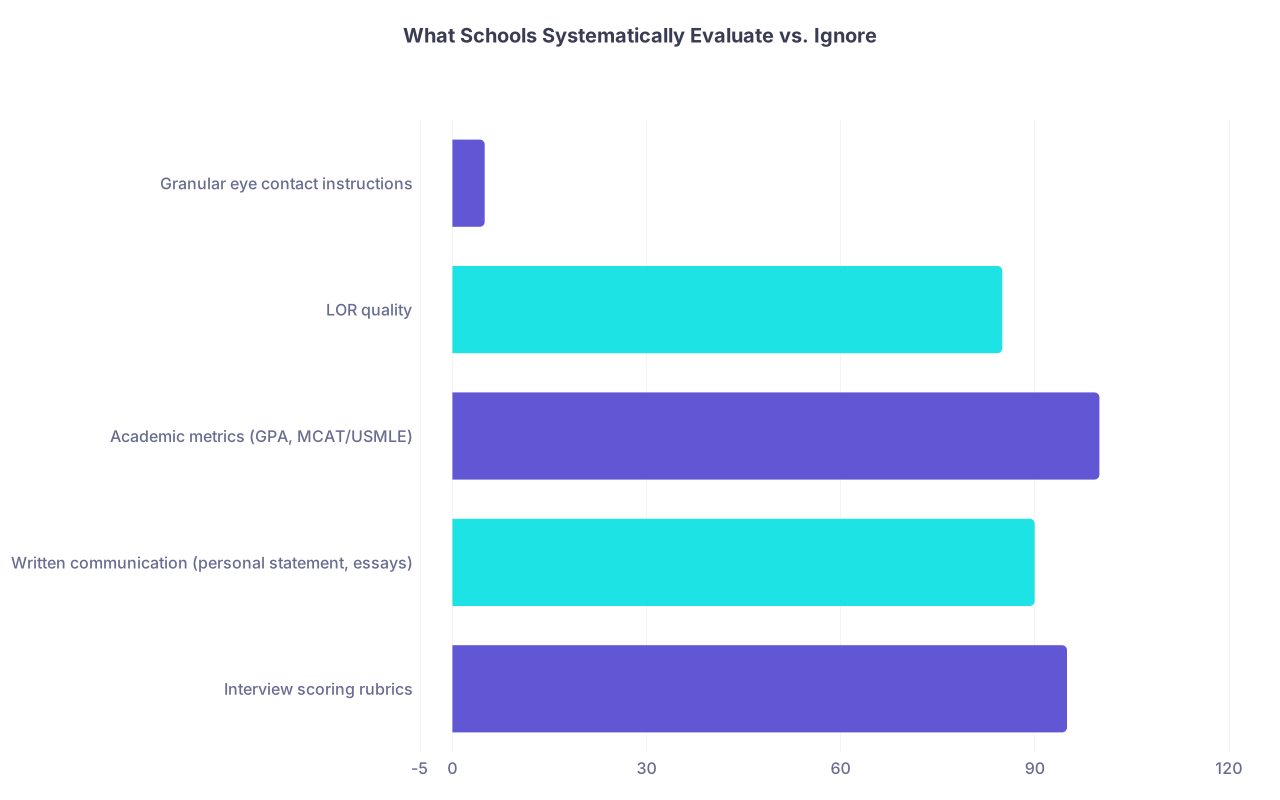
| Category | Value |
|---|---|
| Interview scoring rubrics | 95 |
| Written communication (personal statement, essays) | 90 |
| Academic metrics (GPA, MCAT/USMLE) | 100 |
| LOR quality | 85 |
| Granular eye contact instructions | 5 |
Admissions and residency committees:
- Have structured scoring rubrics for communication, professionalism, and thought process.
- Train faculty on bias, behaviorally anchored ratings, and sometimes even MMI station norms.
- Obsess over test scores, transcripts, narrative comments, and letters.
What they do not have: “Applicant must maintain >70% direct eye contact to be ranked A.” It doesn’t exist.
Does eye contact affect overall impression on an intuitive level? Yes. But so do dozens of other soft factors that are not individually decisive.
The committees lean heavily on holistic impressions and documented behavior, not micro-analysis of gaze.
The Bottom Line: Presence Over Staring
Let me be blunt: if your premed advisor or a random YouTube coach made you believe eye contact is a top-3 determinant of your interview outcome, you were sold a shallow version of reality.
Here’s what actually matters:
Eye contact is a threshold, not a tiebreaker.
You need to show basic engagement, not hit some mystical percentage. As long as you occasionally look at your interviewer and aren’t obviously avoiding their face, you’re almost certainly fine.Presence is built mostly from voice, content, and coherence.
Strong structure, clear examples, natural pacing, and authentic warmth move the needle far more than laser-focused staring. Fix your answers and delivery before you start counting seconds of gaze.Overfixating on eye contact backfires.
For anxious or neurodivergent applicants, chasing perfect eye contact usually degrades everything else. Protect your cognitive bandwidth. Use simple, sustainable gaze habits and pour the rest of your energy into what you say and how you say it.
Stop trying to “win” the eyelock Olympics. Build a version of interview presence you can actually sustain under stress—one that looks like a competent, reflective future physician, not a robot who memorized eye contact tips on TikTok.

| Step | Description |
|---|---|
| Step 1 | Start Prep |
| Step 2 | Content & Stories |
| Step 3 | Vocal Delivery |
| Step 4 | Nonverbal Basics |
| Step 5 | Simple Gaze Rhythm |
| Step 6 | Authentic, Sustainable Presence |