
One bad interview day does not automatically kill your chances. The belief that “I blew this one interview, so my cycle is over” is more folklore than fact.
You feel it because interviews are visceral. You remember the awkward pause, the dumb joke, the ethical question you butchered, the station where you said, “That’s a great question” and then absolutely did not have a great answer. But admissions committees don’t experience your day the way you do. And the data from actual selection processes—premed, med school, residency—tells a much less dramatic story.
Let me walk you through what actually happens behind those closed doors and what historical patterns show about “bad” interviews.
Myth: “One Bad Interview = Automatic Rejection”
This myth comes from a very human place: interviews feel like high-stakes theater. You’re on stage, they’re judging, the stakes feel existential. But the selection mechanics are not “perfect interview or bust.”
Across med school and residency, interview scores are one variable in a multifactor evaluation. For example, NRMP data for residency (where we have real survey data) repeatedly shows that:
- Programs rank applicants based on a mix of interview, academic metrics, letters, and perceived “fit.”
- No single component dominates every decision in every case.
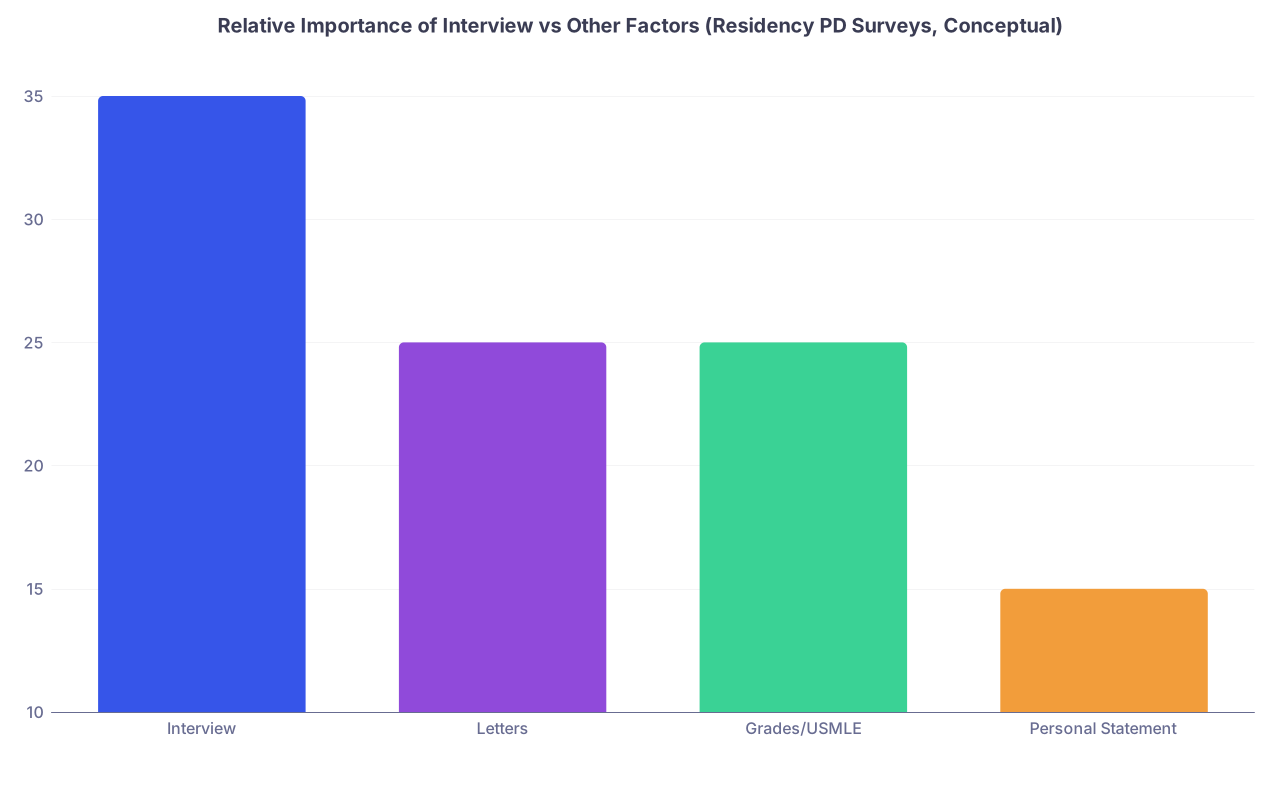
| Category | Value |
|---|---|
| Interview | 35 |
| Letters | 25 |
| Grades/USMLE | 25 |
| Personal Statement | 15 |
That chart isn’t exact percentages from one specific survey, but it reflects the ballpark breakdown programs themselves report: the interview is heavily weighted, but it is not 100%. And med schools operate very similarly.
Here’s the piece almost nobody tells you: committees expect variability.
Humans have off days. Committees know that. Faculty interviewers have seen brilliant applicants stumble on a question. They’ve also seen slick, rehearsed, shallow applicants crush the performance. That is exactly why most schools:
- Use multiple interviewers, or
- Use MMI with many stations, or
- Use panel interviews with scoring rubrics
to dilute the noise from any one interaction.
So if you’re picturing some monolithic panel screaming “REJECT” because you blanked on one question—no. That is not how this works.
What Actually Happens Behind Closed Doors
Let’s talk about the mechanics you never see.
At most MD schools, the process looks something like this (details vary, but this is the spine):
You’re pre-screened.
Before you even get invited, your academics, MCAT, activities, and letters have usually passed multiple filters. You’re already in the “viable candidate” bucket.Interviewers score you.
They don’t just say “I liked them.” They usually rate you on several domains: communication, maturity, motivation, professionalism, etc., often 1–5 or 1–7 scales.Scores get normalized.
Interviewers have different baselines. Some give 4s to everyone, some give 2s. Committees know this. They often standardize scores or look at patterns across interviewers.Your file is reviewed in context.
This is the step you never see. A committee member says things like:- “Her MMI scores are average, but her research and longitudinal community work are outstanding, and her letters are glowing.”
- “He interviewed very well, but his track record raises some red flags.”
- “One interviewer didn’t like his response to the conflict question, but the other two rated him highly.”
Final decision is composite.
Slightly “meh” interview + strong file → can still be an acceptance.
Great interview + mediocre file → can still be a waitlist or rejection.
The point: the interview is part of a pattern, not a single pass/fail switch.
The Single Day vs. The Whole Season
Here’s where people confuse things badly: you aren’t doing one interview. You’re doing a season. For med school, that might be 4–15 interviews. For residency, 12–20+.
One bad day? That’s 5–10% of your sample size.
I’ve watched this play out year after year with applicants:
- Student A walks out of School X convinced they bombed. Later they get an acceptance. Why? Their “bad” was a 7/10, not a 3/10.
- Student B thinks they nailed Program Y. “That was my best interview!” Result: waitlist or rejection. Because they didn’t see the comparison pool.
- Student C has one truly awful interview—awkward vibe, off answers. They still get multiple acceptances elsewhere. Because that single datapoint gets drowned in the larger pattern.
You are not graded against your own perfect version. You are graded against the entire applicant pool. That’s the part people ignore.
Historical Patterns: What Actually Correlates With Rejection?
Let’s look at what really sinks or saves applicants across cycles.
Consistently poor interviewing
If multiple schools flag the same issues—arrogant vibe, inability to answer basic “why medicine” coherently, ethical blind spots—that pattern does hurt you. It’s not “one bad day.” It’s who you are presenting as, repeatedly.
That’s why some applicants get 10+ interviews and then somehow zero acceptances. Not bad luck. That’s usually a systemic interviewing problem.
Red flags, not awkwardness
What terrifies committees is not “nervous” or “stumbled on a question.” What scares them is:
- Dishonesty or evasiveness about your record
- Inability to take responsibility for mistakes
- Blaming everyone else for problems
- Disrespectful or dismissive comments about patients, nurses, or peers
- Questionable ethics on scenarios that should be layups
One obviously problematic answer can hurt you more than ten stumbles. Because red flags suggest future professionalism issues. And nobody wants to be the school that ignored them.
Awkward silence? Forgettable.
Ethical arrogance? Memorable—in the wrong way.
A bad fit more than a bad day
Sometimes what you think is a bad interview is actually a mismatch in values.
You lean primary care, underserved patients, continuity of care. They’re obsessed with NIH funding and subspecialty placements. The conversation feels flat. They might rate you fine but not see you as “their” type of student.
Historically, that mismatch shows up in patterns: applicants with your profile do better at different kinds of schools. Not worse overall.
The Data Angle: Why Committees Don’t Worship One Score
You want numbers. Unfortunately, med schools aren’t publishing “correlation of individual interview-day self-perception vs. admissions outcome.” But we do have good analogs.
Residency selection gives us actual self-reported program director data. Year after year, NRMP Program Director Surveys show:
- The interview (often called “interactions with faculty and residents”) is the most important factor in final ranking.
- But it’s still just one of many factors; programs use it to discriminate among already-qualified candidates.
And the entire system is built around reliability. Which is why they use:
- Multiple interviews (MMI is literally designed to reduce the randomness of any one station)
- Structured questions and rating scales
- Multiple evaluators
The psychometrics are clear: more stations, more interviewers = more reliable measure. Which automatically means any given conversation carries less power than you think.
If one station or one day were decisive, they wouldn’t need this complexity.
What a “Bad Day” Usually Looks Like From the Committee Side
Let’s contrast how you experience the day vs how they experience it.
You:
“I blanked on that healthcare policy question. I rambled about insurance and then contradicted myself. I’m mortified.”
Them:
“Applicant was a bit unclear on that policy question but open to thinking it through. Overall seemed thoughtful and teachable. Solid candidate.”
Or:
You:
“I talked too much. I didn’t ask enough questions. That one joke didn’t land. They must have hated me.”
Them:
“Good communication, slightly anxious, but motivated and kind. Fine.”
Or the honest harsh version:
You:
“I think it went okay.”
Them:
“Generic. Not memorable. Scores in the middle of the pack.”
Notice what’s missing from their internal narrative?
The drama.
They are not replaying your stumble in their head at 2 a.m. You are.
One Exception: True Catastrophic Interviews
Now, I’m not going to pretend there’s no such thing as an interview that tanks your shot at that specific school. There is. I’ve seen it.
A catastrophic interview looks like:
- You are openly rude or dismissive to staff or other applicants.
- You argue with your interviewer in a way that’s defensive, not intellectually engaged.
- You double down on an obviously unethical stance even when given a chance to correct course.
- You say something explicitly biased, prejudiced, or offensive.
Those are the interviews that end in phrases like, “I cannot recommend this applicant” or “Serious professionalism concerns.”
But even then—this usually affects that school, not your entire cycle. That comment doesn’t get faxed to all other programs in the country.
So yes, you can absolutely destroy your chances at one place in thirty minutes. That’s real. You do not, however, destroy your entire future in medicine that way unless you make a habit of it.
The Real Risk of Believing the Myth
The belief that “one bad interview ruins everything” is not just wrong; it’s dangerous. Because it changes your behavior in ways that actually hurt you.
I’ve watched applicants:
- Give up on the rest of the cycle mentally after one early interview they thought went poorly.
- Walk into the next interview defeated, broadcasting low energy and self-doubt.
- Obsess so much over “fixing” every small misstep that they show up robotic and over-rehearsed.
That’s the irony. The myth about one bad day being fatal makes you more likely to create a pattern of bad days.
A healthier, historically accurate frame is:
One interview is one datapoint.
You’re playing a season, not a single game.
How To Recover After a “Bad” Interview Day
No, you don’t send a four-page apology letter. You also don’t pretend nothing happened. You do three things.
1. Do a cold, unsentimental post-mortem
Not, “I’m terrible, this is over.” That’s useless.
Ask yourself:
- Which questions actually went badly? Name them.
- Did I show any red-flag behavior (defensiveness, disrespect, evasiveness)?
- Were my problems content (I didn’t know what to say) or delivery (I was nervous and jumbled)?
If you can’t answer this alone, do a debrief with someone who knows interviews: premed advisor, mentor, or frankly, a peer who’s blunt and not invested in coddling you.
2. Target the pattern, not the pain
If you struggled with:
- Ethical questions → you need practice frameworks, not memorized answers.
- “Tell me about yourself” style prompts → you need a clearer narrative, not longer rehearsals.
- Being concise → you need timed practice and forced 60–90 second caps.
You’re not fixing “the bad day.” You’re tightening the weak links so the next several days are better.
3. Protect your mindset going forward
This isn’t fluff; it’s strategic.
If you walk into the next interview thinking, “That last one ruined everything,” you’ll broadcast that. Lower eye contact. Lower energy. Less warmth. More second-guessing.
If instead you tell yourself, “That was one rep. I’m still in the game. I’m learning,” you loosen up just enough to be more likeable and coherent.
Committees don’t need perfection. They need a believable future colleague.
A Quick Reality Check With Numbers
Let’s make this concrete.
Say you apply to 20 schools. You get 8 interviews.
You have:
- 2 interviews you feel great about
- 3 you feel “fine, I guess” about
- 2 you feel shaky about
- 1 you feel like you completely blew
Historically, many applicants with that profile end up with 1–3 acceptances. Not zero. That one “disaster” typically just goes into the “probably not that school” bucket.
Here’s how that sort of spread might actually translate conceptually:
| Your Perception | True Committee View | Common Outcome |
|---|---|---|
| “Nailed it” | Strong, top quartile | Accept / high waitlist |
| “Fine” | Average, middle of pack | Waitlist / mixed |
| “Shaky” | Slightly below average | Waitlist / reject |
| “Disaster” | Below average at that school | Likely reject there |
And that’s just one school each time. The rest of your interviews still count.
What History Actually Shows
Across cycles, across programs, across specialties, the pattern is consistent:
- One mediocre or bad interview at one place is normal.
- Applicants who treat it as catastrophic often sabotage themselves later.
- Applicants who treat it as feedback and noise usually do just fine overall.
You won’t hear this in Reddit meltdown posts or group chats where everyone is dramatizing their worst 30 seconds as if the dean was personally offended. But if you sit with people who’ve watched many cycles—advisors, former adcom members, PDs—you hear the same refrain:
One day doesn’t define you. The pattern does.
The Bottom Line
Let’s strip it down to the essentials:
- One bad interview day usually hurts you at that school, not across your entire cycle. Committees use multiple data points and know humans have off days.
- Red flags and consistent patterns—not awkwardness—are what ruin chances. Being nervous is fine. Being unethical, arrogant, or dishonest is not.
- Your reaction to a “bad” interview matters more than the day itself. Learn what you can, adjust your approach, and move on. You’re playing the long game, not a single performance.
You’re allowed a bad day. Just do not turn it into a bad season.