
MMI Myths: No, There’s Not One ‘Right’ Answer to Ethical Scenarios
What if you picked the “wrong” side in an MMI ethical station… and it didn’t actually matter?
That idea makes a lot of applicants visibly uncomfortable. I’ve watched people walk out of an ethics station convinced they tanked it because they didn’t say “patient autonomy” fast enough, or because they chose to report a colleague instead of “supporting the team.” Then I’ve watched those same applicants match into very competitive programs.
So let’s tear this apart properly.
What MMIs Are Actually Designed to Measure
The multiple mini interview wasn’t created to reward the person who memorized the most buzzwords from Beauchamp and Childress.
Look at what the research and the designers themselves say. Admissions committees use the MMI because:
- It increases reliability: many short samples > one long conversation.
- It focuses on how you think, not what you’ve been coached to say.
- It predicts professionalism and performance reasonably well.
And yes, there’s data. Programs that adopted MMIs have shown:
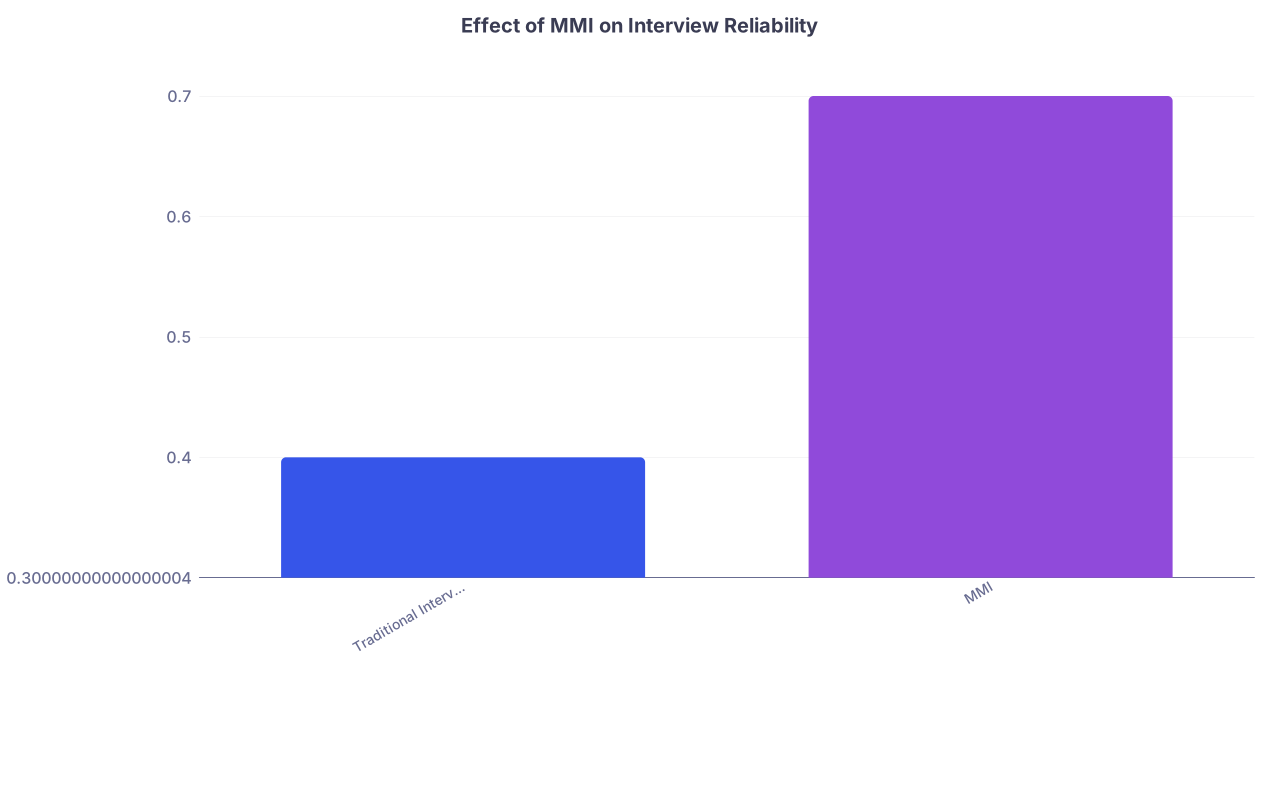
| Category | Value |
|---|---|
| Traditional Interview | 0.4 |
| MMI | 0.7 |
That’s an approximation of reported inter-rater reliability (often around 0.4 for traditional, 0.7+ for MMI) from multiple studies. Rough translation: with an MMI, your score depends less on which random interviewer you get and more on how you actually perform across stations.
Here’s the core myth:
You think they’re scoring which conclusion you pick.
They’re mostly scoring how you reason your way there.
I’ve sat in rooms where two raters gave equally high scores to applicants who took opposite positions on the same ethical case. One argued strongly against mandatory vaccination for a particular scenario; the other argued for it. Both got 9/10.
Why? Because the rubric didn’t say: “Agree with public health position = 10, disagree = 5.”
It said things like:
- Identifies key stakeholders and competing interests
- Recognizes ethical principles in conflict
- Considers short- and long-term consequences
- Communicates reasoning clearly and professionally
Notice what’s missing: “Picks the officially correct answer.”
The Big Misconception: “But Ethics Has Right and Wrong”
The most common premed mistake with MMI ethics questions is treating them like a disguised MCAT passage. As if each scenario has one correct solution and every other path is a trap.
This is… not how real ethics works. Or real medicine.
Take a classic scenario:
You’re a junior trainee. You suspect an attending may be impaired at work. What do you do?
I’ve heard these “model answers” thrown around in prep courses:
- “Always report immediately to the appropriate authority.”
- “Always talk to the attending first privately.”
- “Always prioritize patient safety above all else, even if it means going over your supervisor’s head.”
“Always” is doing a lot of heavy lifting there.
In real life, context rules. Is the attending actually impaired or just tired? Is patient care currently unsafe? Is there an institutional process? Are you building your story on vague suspicion or specific behaviors you’ve witnessed?
Programs know this. So good MMIs are written so that multiple responses can be defended.
The question isn’t “Do you know the rule?”
It’s “Can you show that you understand the tensions here, and respond in a way that’s thoughtful, proportional, and not reckless?”
If you go in thinking, “I must guess the key,” you start playing the wrong game. You stop thinking and start performing. Interviewers can see that shift.
What the Rubrics Really Reward
Let me be transparent: most applicants never see an actual MMI scoring sheet. So they guess. They imagine something like: “Mention beneficence, autonomy, justice, non-maleficence = full marks.”
What rubrics actually look like is closer to this:
| Domain | What They’re Looking For |
|---|---|
| Problem recognition | Spots the real conflict, not just surface details |
| Stakeholder awareness | Sees perspectives of patient, team, system, society |
| Ethical reasoning | Balances principles; avoids rigid, simplistic answers |
| Practicality & feasibility | Proposes realistic next steps, not fantasy solutions |
| Communication & demeanor | Calm, respectful, organized, not defensive or dogmatic |
Notice that “quotes correct principle” isn’t a domain. And “agrees with the school’s political stance” isn’t on there either.
I’ve watched someone say something I strongly disagreed with in an ethics station—about resource allocation, very loaded topic—and still give them a high score. Why? Because they:
- Recognized that their stance disadvantaged a particular group.
- Didn’t try to spin or hide that.
- Thought carefully about mitigating harms.
- Stayed open when I pushed back: “What would you say to a patient who feels this policy targets them?”
They didn’t crumble or get defensive. They adjusted: “You’re right, this is the biggest weakness in my position. Here’s how I’d try to reduce that harm, and here’s why I still think the policy does more good than harm overall.”
That’s the kind of mindset you want in a future physician. Not someone frantically trying to discover the “answer key.”
Why Opposite Answers Can Both Score High
Let’s use an actual-type scenario (details changed):
You’re a resident on a rotation. A patient with capacity refuses a blood transfusion despite life-threatening anemia. Their family begs you to “do everything.” What do you do?
One strong answer could lean hard on autonomy:
- Confirm decision-making capacity carefully.
- Ensure the patient is informed, free from coercion.
- Document the refusal thoroughly.
- Support the family emotionally but don’t override the patient.
Another answer might put more weight on beneficence and family interests, within legal limits:
- Re-evaluate capacity, involve psychiatry or ethics if there’s any doubt.
- Explore whether values-based alternatives exist that respect the patient’s beliefs but modify the plan.
- Involve spiritual care or community leaders.
- Examine whether the refusal is truly informed or based on misunderstanding.
Same scenario. Different emphasis. Both defensible, if your reasoning is coherent, nuanced, and grounded in real-world constraints.
You lose points not for picking one side but for doing any of this:
- Ignoring a major stakeholder (“The family doesn’t matter; only the patient does” with zero empathy or explanation).
- Oversimplifying (e.g., “Autonomy always wins, end of story,” as if ethics was a single-axiom game).
- Going full fantasy (“I’d spend hours with the patient until they changed their mind,” when you’re in a busy ICU and that’s not happening).
- Getting combative when challenged.
The MMI is less “What would you do?” and more “Show me you understand the problem lives in the gray zone, not the black-and-white.”
How Over-Coaching Makes You Sound Worse
There’s an ugly side effect of the “one right answer” myth: it trains people to sound fake.
I hear the same scripted moves over and over:
- “First, I would acknowledge the patient’s autonomy, but also weigh beneficence and non-maleficence.”
- “I would approach this using a shared decision-making model.”
These phrases aren’t bad on their own. The problem is when they’re recited like spells. No actual engagement with the scenario, just a checklist.
I’ve literally heard applicants say, “I would start by validating the patient’s emotions” to a prompt about an institutional policy memo. There is no patient. They just learned that “validate emotions” is in the right-answer script and tried to plug it in.
Here’s what trained interviewers pick up on:
- You’re using phrases disconnected from the details of the case.
- Your answer sounds the same regardless of the prompt.
- You jump to principle words before you show you actually understand the facts.
You don’t get extra credit for saying “justice” or “non-maleficence.” You get credit for, “So here, there’s a real risk that by prioritizing this one patient’s needs, we might be unfairly diverting resources from others who are similarly ill. That’s the fairness piece I’m wrestling with.”
See the difference? One is vocabulary. The other is thinking.
What the Data Says About “Right Answers” and Outcomes
Let’s connect this to outcomes. Programs that use MMIs and then track students notice something:
- Strong MMI performance correlates with professionalism, communication skills, and often with OSCE performance.
- It does not hinge on alignment with any single doctrinal stance.
If MMI success were about parroting one institutionally “correct” ethical line, it wouldn’t predict who performs well in complex, real clinical settings where guidelines shift, context matters, and competing priorities clash daily.
Also: MMIs are often staffed by a mix of faculty, residents, community members, even standardized patients. Hint: these people do not all agree on every ethical question. At all.
So the fantasy that there’s one hidden correct take that all your interviewers secretly share? Not supported by how these things are actually run.
How to Approach Ethical MMIs Like an Adult, Not a Test-Taker
Let me be very concrete about how to act on this.
First, the mindset shift:
- Stop asking: “What do they want me to say?”
- Start asking: “Can I show them I can think like a responsible junior member of a healthcare team?”
From there, your process for any ethical prompt should look more like a mini-clinical reasoning exercise.
Something like:
- Clarify the scenario in your own words.
Show that you caught the key tension. “So the conflict here seems to be between respecting the patient’s autonomous decision and our obligation to prevent serious harm, especially since their choice could also impact…” - Name the stakeholders and what’s at stake for each.
Not just “patient vs doctor,” but maybe family, other patients, institution, trainees, society. - Acknowledge the main principles pulling against each other.
Autonomy vs beneficence, individual vs public health, honesty vs non-maleficence, etc. - Propose a reasonable next step, not a grand solution.
“My first step would be…” is usually better than “The best solution is…” because it shows you understand complexity and hierarchy. - Stay open when pushed.
If the interviewer challenges you, do not double down blindly. Show you can adjust your plan when new info or a valid critique appears.
You’ll notice this workflow works whether you end up saying “I would report” or “I would first speak to them privately.”
The “magic” is not in the conclusion. It’s in the reasoning you expose along the way.
A Quick Reality Check on “Controversial” Views
Some of you are worried: “What if my genuine view is unpopular or politically incorrect? Am I doomed?”
Blunt answer: If your view is discriminatory, demeaning, or outright contradicts core professional values (e.g., you think certain patients deserve less care), yes, that’ll hurt you. And it should.
But there’s a huge difference between that and:
- Taking a more conservative or more progressive position on a health policy.
- Questioning aspects of MAiD, abortion, vaccination mandates, or resource rationing from a thoughtful place.
- Raising concerns about systemic issues but also recognizing practical constraints.
Most interviewers can tell the difference between:
“I think people like this are the problem and we shouldn’t waste resources on them.”
versus
“I support this in principle, but I’m worried about how it might be misused for vulnerable patients without strong advocacy. Here’s how I’d try to safeguard them.”
One is a red flag. The other is exactly the kind of thinking you want on ethics committees.
If you’re reasoning is careful, evidence-aware, and compassionate, you can absolutely take a minority position and still do well.
The One “Right Answer” That Does Exist
So is there truly no right answer at all?
There is one:
Treat the scenario like you’re already a junior professional, not a student guessing on a test.
That means:
- You don’t pretend you have unlimited power or time.
- You don’t ignore laws, policies, or hierarchies.
- You don’t sacrifice patient safety for the sake of being “nice.”
- You don’t bulldoze patient autonomy in the name of “knowing better.”
- You avoid rigid “always/never” answers in obviously gray situations.
MMI ethics stations are stress tests of your judgment. Not your ability to reverse-engineer the committee’s politics.
Key takeaways:
- Ethical MMI stations are not hunting for one “correct” conclusion; they’re evaluating your reasoning, stakeholder awareness, and professionalism.
- Strong, high-scoring answers can take opposite positions—as long as they’re thoughtful, realistic, and open to challenge.
- Drop the script-hunting mindset. Think like a junior clinician facing a gray-zone problem, and show your process, not just your final verdict.