
Interview length is one of the most overrated “signals” premeds obsess about—and the data simply do not support the mythology around it.
You know the stories. “My interview was only 15 minutes, so I’m definitely rejected.” Or, “We talked for an hour, I’m basically in.” I have watched applicants walk out of the same building on the same day: one in tears because the interviewer “cut it short,” the other euphoric because theirs “ran long.” Both convinced the clock told their fate.
Reality: most of what people think interview length means is noise. Not signal.
Let’s dismantle this properly.
What Schools Actually Use Interviews For
Before you can interpret length, you need to understand function. Schools are not using interviews to see how long they can tolerate you. They’re trying to answer a small number of specific questions that their file review could not.
Typically, the interview is designed to:
- Confirm you’re a normal, workable human being (professional, not bizarre, can hold a conversation).
- Assess your fit with the school’s mission or culture.
- Clarify any red/yellow flags: academic trends, gaps, career changes, disciplinary issues.
- Evaluate core competencies: communication, ethical reasoning, maturity, insight.
Nowhere in any admissions committee handbook is there a line that says: “Accept anyone we talk to for more than 40 minutes.”
In fact, many schools intentionally standardize timing precisely to avoid this kind of nonsense signal creeping in.
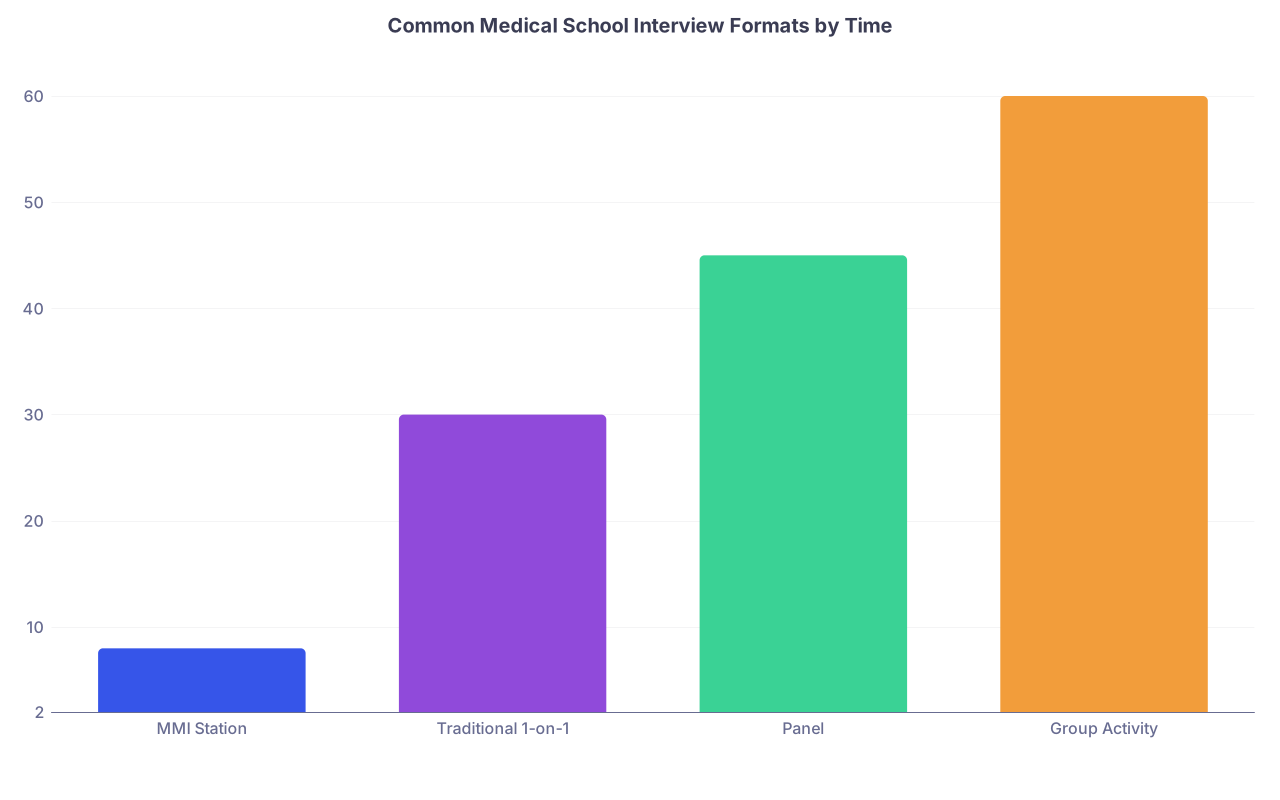
| Category | Value |
|---|---|
| MMI Station | 8 |
| Traditional 1-on-1 | 30 |
| Panel | 45 |
| Group Activity | 60 |
That chart isn’t magical. But it gets one thing across: format drives duration more than your “performance” does.
The Myth: Longer Interview = Higher Acceptance Chance
Let me call this what it is: survivor bias mixed with anxiety.
People who get accepted and had long, chatty interviews love to tell that story. They don’t mention the thousands of rejected applicants who also had long interviews. Because those people are not in your premed group chat bragging, they’re quietly refreshing their emails.
Here’s what we actually see across schools and formats:
- Many schools schedule fixed interview blocks (e.g., 30 minutes). The interviewer has a calendar. They aren’t free to just “run long” for everyone they like.
- In MMI formats, stations are hard-timed. Seven minutes. Eight minutes. Whatever. Bell rings, you move. Your “length” is literally a stopwatch, not a judgment.
- In some traditional interviews, you’ll see variation of ±5–10 minutes. Often because of:
- The interviewer’s schedule (clinic, meeting, pager going off).
- Technical issues (Zoom lag, audio problems).
- Applicant talking too much or too little.
- Interviewer personality (some are concise, some ramble).
None of those things reliably predict acceptance.
I’ve seen this exact pattern with one school: same day, same interviewers.
- Applicant A: 22-minute interview, felt “polite but short.” Accepted.
- Applicant B: 42-minute interview, they “connected” about a shared hobby. Rejected pre-waitlist.
- Applicant C: 29-minute interview, mid-level, nothing dramatic. Waitlisted then accepted in May.
Their only meaningful differences? File strength, school priorities, and how multiple interviewers ranked them—not how long anyone talked.
What the Limited Evidence and Patterns Actually Suggest
There isn’t a big multi-center RCT on “interview minutes vs acceptance odds.” Admissions committees don’t publish that kind of granular data.
But we do have:
- Published descriptions of interview structures.
- Survey data on interview formats.
- Internal anecdotes from faculty and committee members.
- Patterns from programs that use structured scoring.
Let me boil that down:
1. Structured processes care about content, not minutes
Schools moving to structured interviews (behavioral questions, standardized rubrics, MMI) do it to improve reliability and fairness. These designs push against using unstructured cues like “I liked them so we chatted for an hour.”
- Stations/questions are pre-defined.
- Competencies are scored on anchored scales.
- Interviewers are trained to avoid over-weighting their “gut.”
In that environment, duration differences mean almost nothing, as long as the core questions were covered.
2. Extremely short interviews can be bad—but for specific reasons
Now, there is a pattern where length might matter: when an interview is much shorter than the scheduled block, and clearly cut off.
Examples:
- A 30-minute Zoom block ends at minute 12 with, “That’s all I have. Do you have any questions?” and the interviewer clearly looks like they’re done.
- An in‑person interview that was supposed to be 45 minutes is wrapped at 20 with no apparent time pressure (no pager, no emergency, no explanation).
That can correlate with:
- Strong negative impression (professionalism issue, poor communication, concerning attitude).
- The interviewer deciding quickly they wouldn’t endorse you and not investing more time.
- You giving very short, closed answers, leaving little to ask.
But even here, be careful. I’ve seen:
- A resident interviewer cut short because they were called to a rapid response. Applicant panicked. Ended up accepted.
- A faculty member who always finished in 20–25 minutes because they were chronically efficient and hated small talk. Their acceptance rate of interviewees: average.
So yes, an abruptly short conversation may be a mild negative signal. But you usually can’t disentangle that from all the other noise in real time.
3. Very long interviews are not inherently good
On the other end, the marathon 60–90 minute “we just vibed” sessions. These can mean:
- The interviewer likes to talk. About themselves. About the school. About their research. You were just there.
- The interviewer is lonely, bored between cases, or uses interviews as networking conversations.
- You and the interviewer share some random common interest (same hometown, same sport team, same instrument) and drift into chit‑chat.
Sometimes yes, this reflects strong rapport and high enthusiasm. Many interviewers will rank someone higher if they enjoyed the conversation. Humans are biased.
But two problems:
- That ranking is just one data point in a committee discussion.
- Rapport doesn’t always equal alignment with mission or overall candidate strength.
I’ve watched committees say, “Dr. X loved this applicant, but they’re mediocre on academics and had lukewarm second interview scores.” The long, friendly chat did not rescue them.
The Real Predictors Admissions Use (That Aren’t Time on the Clock)
If you want to know what matters, stop watching the seconds and start thinking like an interviewer with a scoring sheet in front of you. Because that’s often what’s actually happening.
Here’s the kind of rubric categories that drive their decisions:
| Category | What They’re Really Asking |
|---|---|
| Communication Skills | Clear, organized, appropriate depth? |
| Motivation for Medicine | Coherent, realistic reasons beyond clichés? |
| Insight & Reflection | Do they learn from experiences or just list them? |
| Interpersonal Skills | Warmth, respect, ease of interaction? |
| Ethical Reasoning | Thoughtful handling of dilemmas, not rigid? |
| Professionalism | Mature, reliable, understands boundaries? |
Those categories can be scored in 20 minutes or 50 minutes. Length doesn’t automatically improve your score.
What does move the needle:
- Specificity in your stories, not vague “I love helping people.”
- Evidence you understand the realities of medicine, not a Hallmark version.
- Emotional regulation under mild pressure.
- Ability to disagree or think critically without being arrogant.
The interview is more like a sampling procedure than a marathon: they’re tasting who you are, not trying to finish the whole meal.
Where Applicants Misinterpret Interview Length
I’ve seen the same distorted thinking patterns repeat every cycle. If you recognize yourself here, good—that means you can stop.
Error 1: Equating talk time with talk quality
“I talked for the whole 45 minutes, they barely said anything, so that’s good.”
Not necessarily. I’ve sat in on those. The interviewer leaves saying, “They don’t know when to stop. That’ll be exhausting on a team.”
Concise, thoughtful, back-and-forth conversation often takes less time than rambling monologues.
Error 2: Over-reading “we didn’t talk about X”
“I’m doomed. We never talked about my main research.” Or “We didn’t even cover why this school.”
Often, the interviewer has already read your file and doesn’t need to rehash it. They might be focusing on other aspects: your gap year, your family background, your clinical exposure.
The fact they didn’t ask about your favorite talking point doesn’t say much. The depth and coherence of what you did discuss matters far more than whether they hit every topic on your blog checklist.
Error 3: Using other applicants’ timelines as proof
You will always find someone saying, “My 15‑minute interview = rejection” and someone else saying, “My 15‑minute interview = acceptance.”
You don’t see their whole application, letters, second interview scores, institutional priorities, or diversity considerations. You’re comparing one noisy, visible variable (length) and building a mythology around it.
That’s how urban legends are born.
How to Actually Use Interview Time (Regardless of Length)
Stop trying to mind-read the interviewer and start controlling what you can control.
Here’s a more rational approach:
Aim for complete, not long answers.
Most behavioral/fit questions can be answered in 2–3 minutes using a structured story (situation, what you did, what you learned). If your answers routinely run past 4–5 minutes, you’re probably rambling.Match your energy to the interviewer.
Some are all-business. Some are chatty. Read the room and adapt. That doesn’t mean become fake; it means respect their style and time while staying yourself.Use questions wisely at the end.
If they ask “Any questions?” have 1–3 thoughtful, specific questions ready. Not “What’s your Step 1 average?” Something that shows you’ve actually thought about fit.Don’t fill silence with panic talking.
Short pauses happen. The interviewer looks at their notes. You sip water. Silence ≠ doom.If it’s obviously cut short by schedule, don’t catastrophize.
If they say, “I’m so sorry, I’m being called back to clinic,” believe them. They aren’t staging an elaborate rejection performance.
What to Pay Attention To Instead of the Clock
The qualitative stuff you can actually remember after the fact is more informative than whether it was 24 or 32 minutes.
Look back and ask:
- Did I answer questions directly, or dance around them?
- Did I show self-awareness—owning mistakes and growth—or just list achievements?
- Did I demonstrate understanding of this school specifically, or give generic answers?
- Did I treat everyone (students, staff, other applicants) with respect?
If those went well, a slightly short interview isn’t fatal. If those went badly, a 60-minute interview won’t save you.

| Step | Description |
|---|---|
| Step 1 | Interview Day |
| Step 2 | Applicant Performance |
| Step 3 | Interviewer Bias/Style |
| Step 4 | School Priorities |
| Step 5 | Interview Score |
| Step 6 | Final Committee Decision |
Notice what’s not in that flowchart: “Clock time” driving the outcome.
Quick Reality Check Scenarios
Let me run through a few realistic cases and what they probably mean.
30-minute slot, ends at 28 minutes, cordial, time for 1–2 questions.
This is normal. This tells you nothing special.45-minute slot, ends at 17 minutes, no obvious time pressure, interviewer looks done.
Mildly concerning. Could reflect poor fit, weak answers, or an interview who always runs short. But not an automatic rejection sentence.30-minute slot, goes to 50 minutes, tons of small talk about hobbies, interviewer overshares about their life.
May indicate they liked you personally. But committee outcome will still depend on file strength and other evaluations.MMI: each station exactly 7 minutes with a buzzer.
Congratulations. You are in an environment where length literally tells you nothing.
FAQs
1. My interview was much shorter than other applicants’ that day. Am I definitely rejected?
No. A noticeably short interview can be a mild negative signal, but it’s not deterministic. It might reflect interviewer style, scheduling constraints, or your answer length rather than a categorical “no.” Admissions decisions come from the whole application plus all interviews, not a stopwatch.
2. My interviewer talked most of the time and barely asked me questions. Is that bad?
Not automatically. Some interviewers treat the session more like a conversation or a sales pitch for the school. As long as you answered the questions you were asked clearly and professionally, you’re fine. You’re judged on the content of your responses, not the percentage of airtime.
3. I didn’t get to talk about my biggest achievement because we ran out of time. Did I blow it?
Probably not. Interviewers see your application and usually know your major highlights already. They don’t need to cover every bullet point. If your other answers demonstrated maturity, insight, and fit, missing one story isn’t fatal.
4. Should I try to “extend” the interview by asking lots of questions so it runs long?
No. That backfires fast. Forced stretching looks needy and disrespectful of their time. Ask 1–3 thoughtful, relevant questions, then let them close on schedule. Your goal is substance and rapport, not hitting a magic minute mark.
Key takeaways:
- Interview length is a noisy, mostly useless metric; structure, content, and fit drive decisions—not minutes.
- Extremely short, clearly cut-off interviews can be a weak negative signal, but even then they’re just one factor among many.
- Spend your energy improving the quality of your answers and your understanding of the school, not reading tea leaves from the clock.