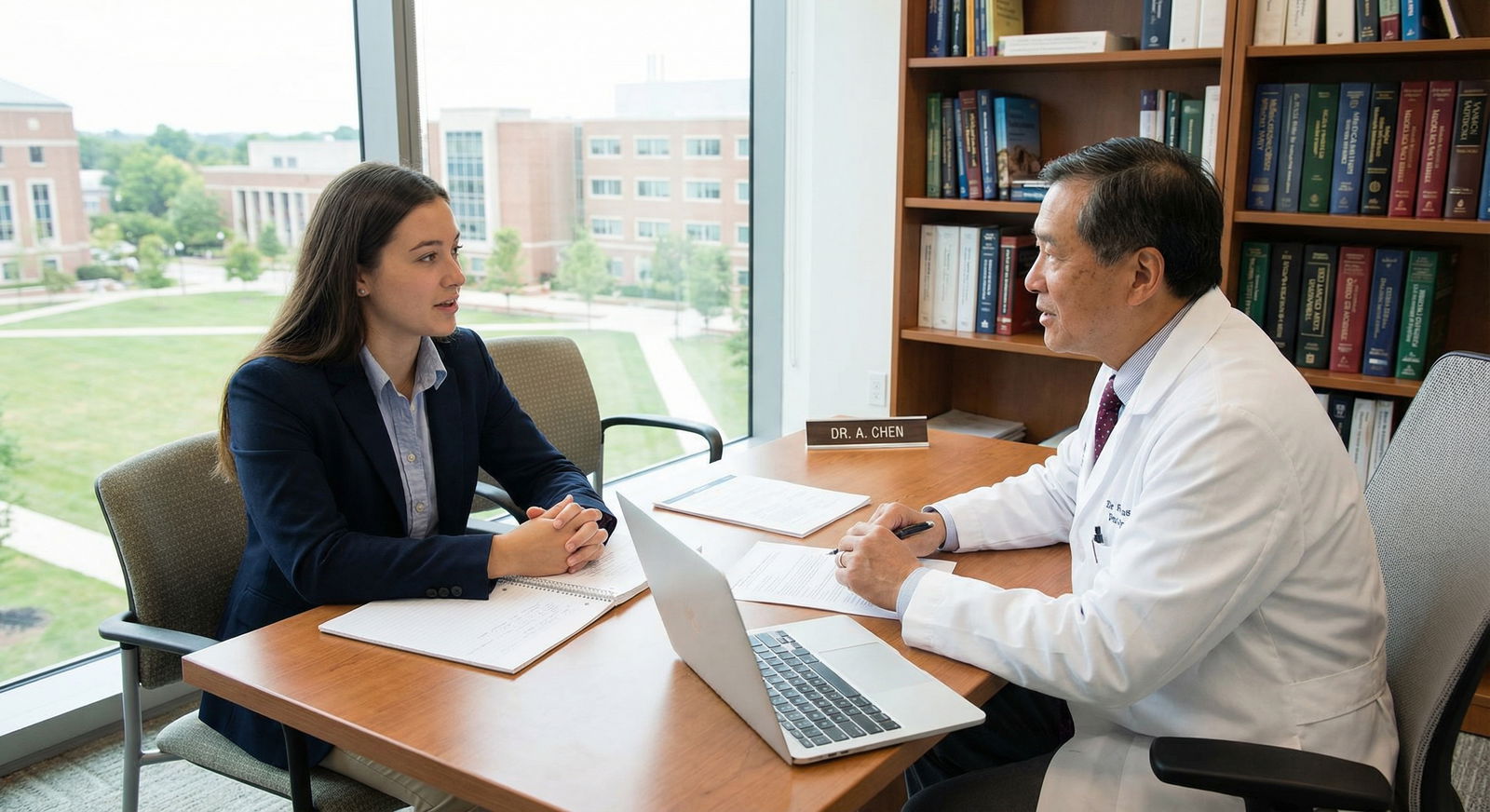
Most applicants are wildly wrong about how much the interviewer knows about them walking into the room. The belief that “they’ve carefully reviewed my entire file” is more fantasy than fact.
Let me be blunt: a significant chunk of faculty interviewers either skim your file for a few minutes, only see a partial summary, or in some cases walk in totally cold. Not everywhere. Not always. But far more often than premed forums will admit.
You are not walking into a courtroom where the judge has memorized your case. You are walking into clinic on a busy day, and you are one more chart in the stack.
Let’s break the mythology and look at what actually happens.
The Big Myth: “My Interviewer Knows My Whole Application”
Here’s the story applicants tell themselves:
Admissions meticulously assigns each file. Faculty block off an hour to read every line of your AMCAS, every activity description, every letter. They highlight your essays. They ponder your narrative. Then they meet you.
Reality is messier.
Across medical schools and residency programs, I’ve seen four common interview setups:
- Fully open file – interviewer has your complete application.
- Partially open – they see a summary, sometimes with grades/scores hidden.
- Strictly closed file – they’re told very little before walking in.
- Functionally closed – they technically can read your file but don’t, or only skim a one-page printout in the hallway.
Schools love to write in their brochures: “Our interviewers have carefully reviewed your file.” It sounds good. It sounds holistic. It is not consistently true.
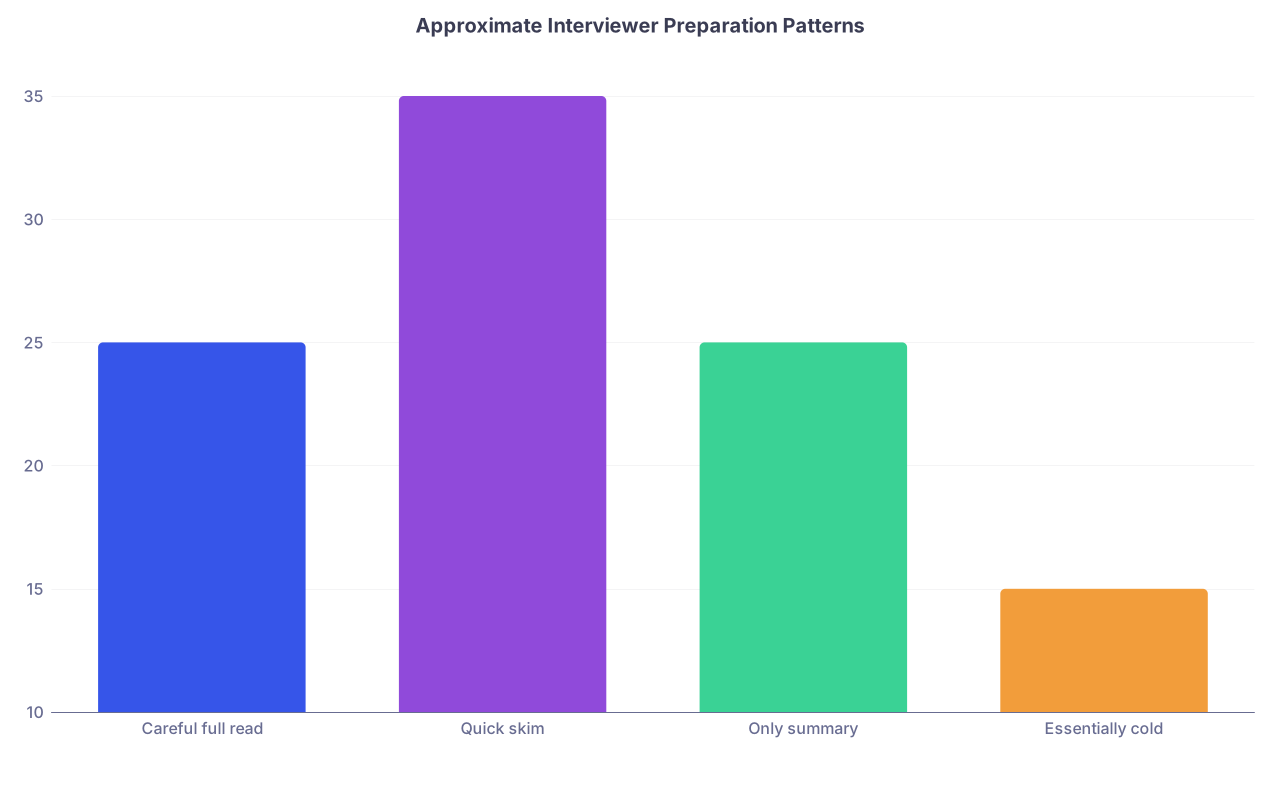
To anchor this in something concrete, here’s the typical spread I see reported and observed across US MD schools and residency programs.
| Category | Value |
|---|---|
| Careful full read | 25 |
| Quick skim | 35 |
| Only summary | 25 |
| Essentially cold | 15 |
Are these exact percentages from a controlled trial? No. But they match what you hear if you talk honestly with 20+ faculty interviewers across multiple institutions instead of believing official marketing blurbs.
The reality: you should assume some knowledge of your file, but not deep familiarity. And you should be ready for the possibility they know essentially nothing specific about you.
How Interviewer Type Changes File Reading Behavior
The biggest determinant of whether your file actually gets read carefully is not the school’s mission statement. It is who is interviewing you and how overbooked they are.
Let’s split the world into four types of interviewers.
1. Core admissions committee faculty
These are the people who live and breathe admissions. They sit in committee meetings. They’ve seen hundreds of files this cycle.
They are the most likely group to have actually read your application in detail, including:
- Personal statement
- Activities and leadership
- Academic metrics
- Sometimes even your letters (or at least selected excerpts)
When they interview you, they’ll often reference specifics:
“I was interested in your work with the free clinic in your junior year. Can you tell me more about that?”
This is the scenario everyone imagines. It does happen. Just not for everyone and not at every school.
2. Regular clinical faculty “helping out”
These are attendings who agreed—sometimes reluctantly—to do interviews between clinic, research, and family life.
Here’s what I’ve heard them say in real life, standing outside the conference room:
“Who am I talking to again?”
“Can I see their summary page?”
“I’ll just ask them some general stuff.”
They frequently get:
- A one-page or half-page summary
- Maybe your personal statement
- Maybe your MCAT/GPA, depending on school policy
- Sometimes just your name, undergrad, and intended interest
And how long do they look at it? Often 2–5 minutes. Sometimes literally in the hallway while the previous interview ends.
These are the people who generate that common applicant experience: “I’m pretty sure they hadn’t read my file.” You’re not imagining it.
3. Student interviewers
Students vary a lot. Some over-prepare and read everything accessible. Others are drowning in exams and took this shift for the free lunch.
Many schools only give students a stripped-down view for confidentiality reasons—basic background and essays, not full letters and scores. Some schools have true closed-file student interviews.
I’ve watched student interviewers walking in with your essay printed out with two or three lines highlighted. That usually means: they read quickly, circled two talking points, and the rest they’ll figure out in the room.
4. “Special guest” interviewers
These are big-name researchers, department chairs, or dean-level people. They get scheduled because it looks impressive and occasionally because they genuinely care.
Two patterns here:
- Some are meticulous and insist on your full file. They actually read it.
- Others are so busy you’re basically a 30-minute meeting titled “Applicant – John Smith.”
Do not confuse title or seniority with preparation. Some of the sloppiest interview prep I’ve seen came from very senior people.
Open-File vs Closed-File: What That Really Means in Practice
Premeds are oddly dogmatic about preferring one or the other—usually without understanding how they function in the real world.
Here’s the standard story you hear online:
- Open-file: “Better, because they can ask specific questions about your experiences.”
- Closed-file: “Better, because they judge you just on the interview and not your stats.”
Both versions are half true at best.

Open-file interviews
At an open-file school, the policy is that interviewers can see your full application. But what they actually read depends on time and personality.
Common patterns I’ve seen:
- They read the personal statement and a summary page. Stop there.
- They scan your activities, focusing on research or service that matches their interests.
- They completely skip sections they don’t care about or don’t understand.
- They read your file only after your interview, before going to committee.
So yes, open-file usually means some pre-interview familiarity. But not a book-club-level reading.
Closed-file interviews
Here’s the surprising twist: “closed file” often does not mean totally blind.
Many closed-file setups still give interviewers:
- Your name
- Undergrad institution
- Sometimes your home state or country
- Sometimes a short blurb written by the committee (“Strong in service; research focus; nontrad”)
What they do not see are usually your grades, MCAT, and sometimes letters. But they may well be given a high-level narrative about why you were invited.
So they’re blind to metrics, not to the fact that you’re a plausible, screened applicant.
How Often Do They Actually Read Your File?
Let’s put this together in a more structured way.
| Interviewer Type | Full Careful Read | Quick Skim | Summary Only | Essentially Cold |
|---|---|---|---|---|
| Admissions Committee MD | Common | Common | Occasional | Rare |
| Regular Clinical Faculty | Occasional | Common | Common | Occasional |
| Student Interviewers | Occasional | Common | Common | Occasional |
| Senior/Guest Interviewer | Rare | Common | Common | Occasional |
Again: not lab-grade precision, but this matches what you’ll hear if you stop asking PR offices and start asking people who actually do the interviews.
The punchline: you cannot safely assume they’ve read more than a page or two about you. Sometimes much less. Sometimes nothing at all.
That has consequences for how you prepare.
What This Means for How You Should Prepare
Most applicants prepare for the fantasy version of the interview: someone who’s read their entire application and wants to “go deeper.” Then they get thrown when the opening line is:
You hear that and think, “Did you not read anything?”
Sometimes: no. Sometimes: they did, but they still want to see how you frame your own story.
You should prepare like this:
Assume variable knowledge.
Do not say, “As you know from my application…” Assume they might not. Say, “One of the most important experiences for me was…” and give enough context that it makes sense even if they’re hearing it for the first time.Be able to re-introduce your greatest hits out loud.
Your personal statement, your biggest service experience, your key research project—these cannot live only on paper. Practice telling each one from scratch to someone who knows nothing about you.Do not rely on them to connect the dots.
“My nontraditional path, as you saw, explains my interest in…” No. Spell it out in the interview. Show the throughline yourself, explicitly.Have “file-agnostic” answers ready.
Good answers do not depend on them having read your essays. If they have, fine—you’ll sound consistent. If they haven’t, you just filled them in without embarrassing them.
How Schools Actually Use the Interview (Not How They Say They Do)
Another uncomfortable truth: for many schools, the interview isn’t designed to test how well your file holds up. It’s designed to test two things:
- Are you normal enough to put in front of patients and colleagues?
- Do you align with what this school thinks it wants (service, research, leadership, etc.)?
Reading your file helps, but it’s not essential to screen those two things. You can get a decent sense of professionalism, communication, maturity, and basic motivation from a 30-minute conversation with almost no prior knowledge.
That is why the system tolerates poorly prepared interviewers. Because from the school’s point of view, an unprepared but reasonably perceptive faculty member can still classify you pretty effectively into:
- “Definitely admit”
- “Probably admit”
- “Neutral”
- “No way”
This is not ideal. But it is reality.

| Step | Description |
|---|---|
| Step 1 | Your File |
| Step 2 | Screened for Invitation |
| Step 3 | Interviewer Type & Prep |
| Step 4 | Conversation Focus |
| Step 5 | Interviewer Rating |
| Step 6 | Committee Discussion |
| Step 7 | Final Decision |
Notice what’s missing from that flowchart: “Thorough re-reading of entire application by every interviewer.” It does not happen.
Reading the Room: Clues About How Much They Know
You can usually tell, within 3–5 minutes, how much your interviewer has read.
Common signs they have read your file:
- They reference a specific experience with detail: “You mentioned working with refugee populations in X city—what surprised you the most?”
- They ask about a particular transition in your life: “You took two years off after college—what drove that decision?”
- They say something like: “I really enjoyed your essay about [topic].”
Signs they’ve skimmed or are cold:
- Opening with: “So, walk me through your path to medicine.”
- Questions that are completely generic and could be asked of any applicant.
- No reference to anything concrete from your file until you bring it up.
What you should not do is call this out or act offended. Just adjust.
If they clearly have not read your file in depth, think: “Okay, I need to rebuild my narrative from zero in this room.” That’s it.
How to Exploit This Reality Instead of Being Burned by It
Here’s the upside no one talks about: partial or absent file-reading can sometimes help you.
For example:
- If your writing is much weaker than your speaking, a more “blind” interviewer is your friend.
- If your personal statement was fine but not compelling, you get a second chance to tell your story better.
- If you’ve grown a lot since submitting, you can present a more updated, coherent narrative without being boxed in by what you wrote 6–12 months ago.
The students who benefit the most from this are the ones who stop treating the interview as a quiz on their own file and start treating it as a fresh opportunity to persuade a skeptical but curious stranger.
Because that’s what it usually is.

Key Takeaways
- Do not assume your faculty interviewer has read your whole file. Many have only skimmed, seen a summary, or nothing at all.
- Prepare to re-tell your own story from scratch in the room, in a way that stands alone without them having read a single word of your application.
- Treat the interview as a fresh test of communication and professionalism, not a detailed oral exam on your AMCAS.