
“Just be yourself” is terrible interview advice if you take it literally.
You hear it from advisors, older students, even physicians who should know better. Then you walk into a high‑stakes interview for medical school or a competitive premed program, “be yourself” on repeat in your head, and you wonder why it feels fake, confusing, and not remotely helpful.
Here’s the uncomfortable reality: the applicants who do best are not the ones who “just” show up as their unfiltered, everyday selves. They are the ones who know which parts of themselves to amplify, which to dial down, and how to align their story with what the committee actually cares about—without turning into a robot.
That’s not in the brochure. But it is what’s happening.
Let’s dismantle the myths and get to what “being yourself” should mean if you actually want an acceptance letter.
Myth #1: “Being Yourself” Means Being Unfiltered
The common fantasy goes like this: you walk into the room, crack a spontaneous joke, answer from the heart, ignore structure, and they fall in love with your authenticity.
Reality: interviews are a professional selection exercise, not therapy and not a first date.
When a dean of admissions tells you “we just want you to be yourself,” here’s the translation:
“We want to see the real person who will show up in our classrooms and on our wards, at their best, under pressure, and within professional norms.”
That’s not unfiltered you. That’s calibrated you.
Think about clinical behavior. If you’re exhausted at 3 a.m. on call and a patient is rude, “being yourself” in the raw sense might mean snapping back. But a competent physician filters that reaction and chooses a response that fits the role: calm, focused, still human, but controlled.
Interview behavior is the same. You’re allowed to have nerves, humor, opinions. You’re not allowed to be sloppy, defensive, or overshare “because that’s just who I am.”
When “being yourself” becomes an excuse for:
- Rambling because “I’m more of a talker”
- Oversharing trauma in graphic detail because “I’m being real”
- Making edgy jokes because “that’s my sense of humor”
- Dismissing other specialties or careers because “I’m brutally honest”
…you’re not being authentic. You’re being unprofessional.
Authenticity in this context means your answers actually reflect your values, motivations, and experiences. Professionalism means you present those in a structured, concise, and respectful way.
You need both. One without the other will not get you far.
Myth #2: “If I Prepare Too Much, I Won’t Sound Like Myself”
This one is everywhere. Students tell me, “I don’t want to practice too much; I’ll sound rehearsed.” Then they show up, “wing it,” and sound exactly like everyone else who also tried to wing it: vague, repetitive, and forgettable.
Look at the data. Interviewers rate applicants higher on:
- Organization and clarity of thought
- Ability to reflect on experiences
- Professionalism and communication skills
Those are skills. Skills require practice. There’s nothing inherently “fake” about not wasting an interviewer’s time with scattered thoughts.
What actually makes you sound fake is memorized scripts you don’t understand. Not preparation itself.
If your answer to “Why medicine?” begins with the same cliché phrase you’ve seen on Reddit or Student Doctor Network (“I’ve always wanted to help people…” followed by nothing specific), that’s not you. That’s a composite of every generic answer you’ve ever absorbed.
The fix isn’t to stop preparing. It’s to prepare smarter:
- Bullet the ideas, not the exact sentences.
- Practice out loud with variance. Same structure, different words.
- Focus on stories that only you can tell—specific patients, specific mentors, specific turning points.
The more you do this, the more like yourself you’ll sound. Because you’re finally saying what you actually think, instead of fumbling for filler.
Preparation done right does not erase your personality. It clears away the verbal clutter so your real personality isn’t buried under “uhh… I guess… like… yeah.”
Myth #3: “Being Yourself” Means You Should ‘Just Relax’ About Impression Management
This is the part almost nobody says plainly: interviews are heavily about impression management. And pretending otherwise is naive.
No, this doesn’t mean lying or inventing a persona. It means understanding what behaviors signal “this person will be a safe, reliable physician in front of patients and colleagues.”
You are being evaluated on traits like:
- Reliability and maturity
- Empathy and perspective-taking
- Response to stress and ambiguity
- Respect for others, especially under disagreement
- Insight into your own strengths and weaknesses
Those are not abstract buzzwords. People actually get rejected because they look defensive, arrogant, or emotionally brittle when lightly challenged.
I’ve watched applicants blow an otherwise solid interview because, the second someone pushed back (“Some would argue shadowing is limited—what did you actually learn?”), they got prickly. Or they tried to “joke” their way out of a serious ethics question because “that’s just my style.”
Your “style” is not immune from judgment. If your natural mode under stress is sarcasm, rambling, or shutting down, you don’t get to say “but that’s me” and expect a pass. You get to recognize it, manage it, and show you can operate like a future physician, not a stressed-out undergrad.
Being yourself does not mean ignoring how you come across. It means being honest about your default tendencies and then deliberately choosing better ones in the room.
That’s called growth. Committees like that.
What “Being Yourself” Should Actually Mean
Let’s rebuild this phrase into something useful.
When advisors say “be yourself,” the healthy version should mean:
- Tell the truth about your motivations and experiences.
- Use your own words and your actual voice, not borrowed jargon.
- Own your actual story—even the parts that are messy—but filter for professionalism.
- Align how you present yourself with the role you’re stepping into: future medical student, future physician.
Think of it as “being your best professional self, on purpose.”
You’re not required to morph into a bland, smiling robot. If you’re naturally more serious and analytical, you don’t need to force bubbly energy. If you’re warm and expressive, you don’t have to suppress that completely.
But you do need to shape it.
The serious, analytical applicant still needs to show empathy and warmth somewhere. The warm, talkative applicant still needs to show concision, boundaries, and respect for time.
In other words: you stretch, but you do not distort.
The Evidence: What Actually Predicts Interview Success
There’s decent research on situational judgment tests, MMI performance, and interview ratings. The patterns are boringly consistent.
Interviewers rate people higher when they:
- Demonstrate self-awareness: Can name a real weakness, describe how they’re working on it, and not crumble while doing so.
- Use specific examples: “During my hospice volunteering, one patient…” rather than “I learned empathy.”
- Show perspective-taking: Can see more than one side of an ethical or interpersonal problem.
- Communicate with structure: Clear beginning, middle, and end to answers; not talking in circles.
- Maintain composure under mild stress: Asked a challenging or unexpected question and still respond calmly.
None of that requires you to pretend to be someone else. It does require you to be a more disciplined version of yourself.
Here’s where the myth collapses: raw, untrained behavior under pressure usually looks worse than people think. You overestimate how charming your spontaneity is. Interviewers see chaos, not charisma.
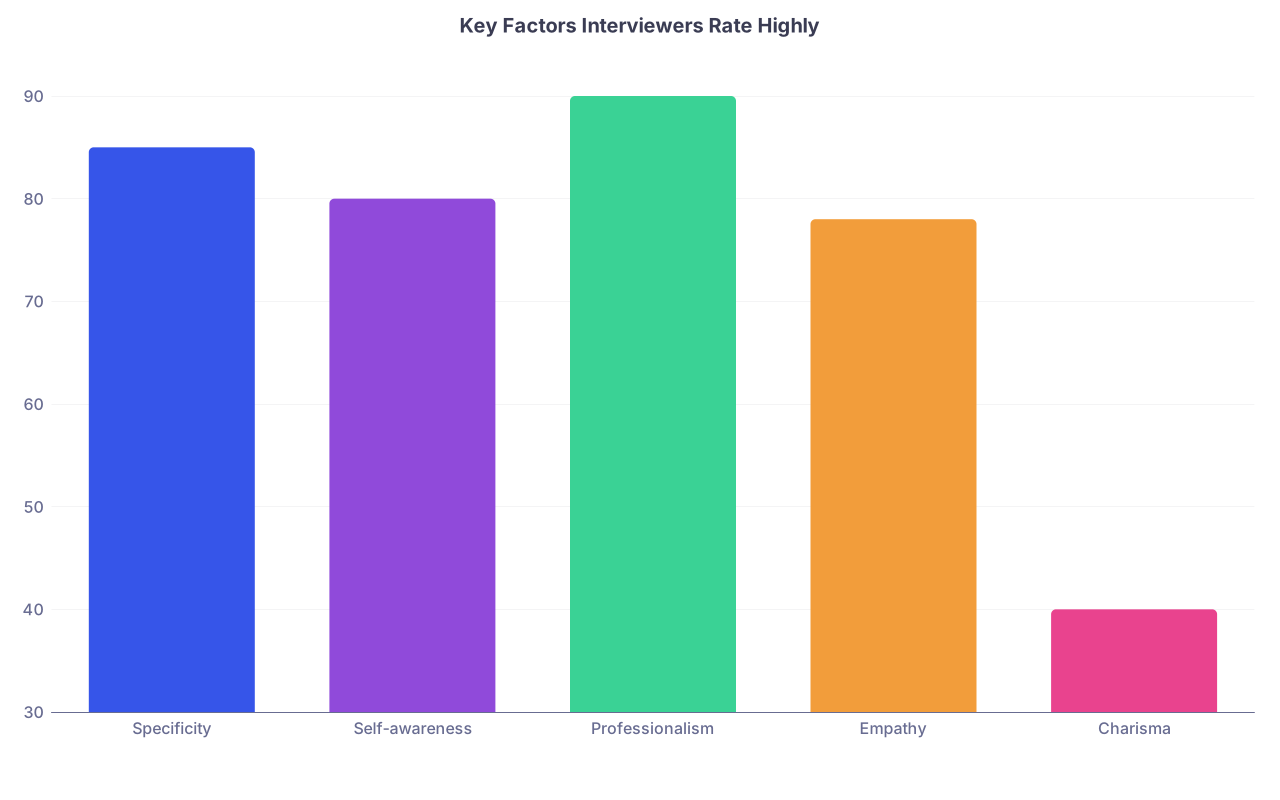
| Category | Value |
|---|---|
| Specificity | 85 |
| Self-awareness | 80 |
| Professionalism | 90 |
| Empathy | 78 |
| Charisma | 40 |
Charisma helps. But it’s not the main driver. Specificity, self-awareness, and professionalism carry more weight than people want to believe.
How to Practice “Real” Authenticity (Instead of Performance Art)
If you want to “be yourself” in a way that actually reads as authentic and competent, you have to do a particular kind of prep. Not just memorizing answers. Not just reading MMI question banks like a script.
This is the work that most people avoid because it’s uncomfortable.
First, you interrogate your own story.
Why are you pursuing medicine, beneath the socially acceptable surface? If your first answer is “I want to help people,” dig again. Why medicine and not nursing, social work, public health, or research? What specific moments pushed you in this direction—and what moments made you doubt it?
Second, you identify the real weaknesses and failures you’d rather hide.
Not the fake ones: “I care too much,” “I work too hard,” “I’m a perfectionist.” The actual stuff.
Failed an exam because you procrastinated and thought you were smarter than the material. Struggled with time management in a lab and frustrated your PI. Avoided feedback for years because it made you feel stupid.
You do not need to drag every skeleton out in front of the committee. But you do need one or two honest examples you can talk about calmly, with clear reflection and growth.
That—ironically—is what makes you look strong. Not polished invincibility.
Third, you practice telling these stories out loud until the emotional charge drops. That’s the moment they start to sound like you, instead of like something you’re performing. The content is true, the reflection is real, and your delivery stops shaking.
This is what people actually mean when they say “be yourself.” They seldom explain the work required to get there.
The Line Between Authentic and Unprofessional
Let me draw a boundary clearly, because people keep tripping over it.
Appropriate honesty:
- “I struggled a lot my first year with imposter syndrome. I’d over-study out of anxiety, then still feel like an imposter. Working with a mentor and setting specific goals helped me stabilize.”
Inappropriate “honesty”:
- “First year was a disaster, I was depressed, everything sucked, I still don’t really know how to handle stress, but I’m hoping med school will give me structure.”
Appropriate personality:
- Light, brief humor that doesn’t punch down.
- Expressing enthusiasm (“I loved that lab”) without sounding manic.
- Admitting uncertainty while still taking a position: “I see strong arguments on both sides; I lean toward X because…”
Inappropriate personality:
- Sarcastic comments about “dumb” premed requirements or “easy” specialties.
- Oversharing your dating life, family drama, or financial rage in unfiltered form.
- Using slang or profanity because “that’s just how I talk.”
Yes, some of this is unfair. You’re being judged not only on who you are, but on how well you can function inside a fairly rigid professional culture. That’s medicine. Complaining about it in the interview is not going to reform the system. It’s going to get you rejected.
So you make a choice: learn the rules, then decide how much you’re willing to adapt. If the answer is “not at all,” medical training is going to be rougher than it has to be.
How Interviewers Actually Experience “You”
Most applicants forget this: interviewers see a parade of you.
You are the fifth “authentic” person they’ve seen that day. The twelfth this week. After a while, certain patterns blur together.
The ones who stand out are not the loudest. They’re the ones who:
- Know who they are and can explain it clearly.
- Show real curiosity about patients, systems, and colleagues.
- Handle disagreement or pushback without melting down or pandering.
- Have done the internal work so they’re not performing a LinkedIn version of themselves.
I once heard an interviewer in a hallway say, “That kid knew exactly what they were about. No fluff.” The applicant wasn’t flashy. Their answers were simple, specific, and deeply consistent with their application. That’s what stuck.
Authenticity, to an interviewer, looks like consistency plus reflection. Your personal statement, activities, and interview persona all match. Same values, same kind of stories, same tone.
If your application reads like a thoughtful, grounded person and you show up as a hyper-polished TED Talk, they notice. If your essays are full of vulnerable reflection and in person you dodge every real question with jokes, they notice that too.

| Step | Description |
|---|---|
| Step 1 | Raw self |
| Step 2 | Self-awareness work |
| Step 3 | Professional filter |
| Step 4 | Structured stories |
| Step 5 | Interview self |
You’re not changing your core. You’re changing how you present it.
So What Should You Actually Do?
Strip away all the motivational posters and you’re left with this:
- Stop using “be yourself” as permission to avoid preparation.
- Study your own life as seriously as you study physiology. Know your stories and what they demonstrate.
- Decide in advance which parts of yourself you’re going to amplify (curiosity, persistence, compassion) and which you’re going to regulate (defensiveness, rambling, sarcasm).
- Practice out loud until you sound like a clear, grounded version of you—not a Reddit thread in human form.
That is what “being yourself” in interviews really looks like.
Key takeaways
- “Just be yourself” is a lazy half-truth; you need your best professional self, not your unfiltered everyday self.
- Authenticity without structure and professionalism reads as sloppy, not real; preparation makes you more authentically you, not less.
- The applicants who win are the ones who know their own story, manage their rough edges, and present a consistent, reflective version of who they already are.