
Some applicants are being tested. Others are being confirmed. The entire tone of your interview depends on which one you are.
You’ve probably noticed this pattern in stories from friends: one person gets an easy, conversational interview about hobbies and motivations; another gets pummeled about ethics, healthcare policy, grades, and research design. Same school. Same interview day. Totally different experience.
That’s not random. It’s deliberate. And once you understand how interviewers actually think about you before you walk in the room, you can predict which side you’re likely to land on—and what to do about it.
Let me walk you through what program directors, adcoms, and faculty will never put in writing but absolutely talk about behind closed doors.
The Core Truth: Your Interview Type Is Mostly Decided Before You Sit Down
Here’s the part nobody tells you: by the time you’re on the schedule, most interviewers do not see themselves as “deciding if you’re good enough.” They see themselves as doing one of two things:
- Confirming that a strong applicant is not secretly a problem.
- Probing whether a borderline applicant is worth the risk.
That distinction drives whether you get softballs or get grilled.
On the morning of interviews, I’ve sat in rooms where faculty literally sort people into mental buckets:
- “This one’s a superstar. Just make sure she’s normal.”
- “I have questions about his judgment. Push him on ethics.”
- “Not sure why we’re interviewing this GPA… see if there’s more to the story.”
- “High stats, low service. Test the ‘I love working with people’ claim.”
No one says, “Let’s treat everyone the same.” Because they don’t. They triage.
The Mental Buckets You’re Placed In
Before your interview, you’ve already been quietly labeled something like:
- Presumed Admit – barring major red flags, they want you.
- High-Potential but Question Mark – big strengths, specific concerns.
- Borderline – something in your file is carrying you; they want to see if the rest catches up.
- Wildcard – nontraditional, odd trajectory, or mixed signals.
Soft-pitch interviews usually go to Presumed Admit and certain High-Potential candidates where the committee already likes you and mainly wants reassurance.
Aggressive, grilling interviews usually hit the Borderline and Question Mark groups, especially if the concern is about professionalism, maturity, or judgment.
What Interviewers See Before They Meet You (That You Don’t See)
You see your primary, your secondary, and the confirmation email. They see a lot more.
At minimum, before walking in, most faculty or adcom interviewers have:
- Your primary and secondary.
- Your letters (at least the summary or key quotes).
- Your metrics (GPA trends, MCAT, school rigor).
- A quick note from whoever screened you for interview.
- Sometimes a short “talking points + concerns” list from the committee.
And some schools, especially at the med school and residency level, will get flagged summaries like:
- “Concern: professionalism issue M2 year, ask.”
- “Strength: leadership; president of XYZ.”
- “Note: went from 2.9 → 3.8 GPA trend; ask about early struggles.”
- “Multiple gap years, unclear reasons; clarify.”
This is where the tone is set.
If your file reads like a coherent story with no red flags, your interviewer’s unconscious goal becomes: “Spend 25 minutes confirming this person is likable and safe.” That produces a softer, more conversational style.
If your file is compelling but messy, the goal becomes: “Figure out whether this concern is fixable or fatal.” That produces grilling.
Profiles That Invite Softballs vs. Profiles That Invite Grilling
Let’s be blunt. Certain applicant profiles make faculty relax. Others make them sharpen the knives.
Profiles That Usually Get Soft-Pitched
I’ve seen this pattern for years. The “soft interview” profiles often look like:
High stats + sustained service + clean professionalism record.
Think: 515–522 MCAT, strong GPA, multiple years in the same clinic or community org, no academic or conduct issues.“Our type of student” profile.
For state schools: strong in-state ties, attended a known undergrad, letters from faculty the committee trusts, mission fit that screams local retention.Super coherent story with no contradictions.
Their personal statement, activities, and letters all tell the same narrative: teaching → tutoring → patient education; or family illness → longitudinal volunteering → related research. No weird left turns.Internal pipeline candidates.
Home institution students, early assurance, or known quantities from a long-term feeder program. Faculty have often heard about you from colleagues before they ever see your application.
With these candidates, questions drift toward:
- “Tell me more about your work with X population.”
- “What do you enjoy doing outside of school?”
- “What about our curriculum appeals to you?”
- “How do you balance stress?”
You’re being checked for fit and normalcy. Not for survival under fire.
Profiles That Usually Get Grilled
Here’s who tends to get hammered:
Big mismatch between stats and story.
Example: low clinical exposure but grand statements about patient care. Or heavy research but claiming, “I don’t really like research,” while your entire application is a research CV.Jagged transcript or test history without a clean explanation.
Several withdrawals. Repeated courses. Step-style exam failures. Or bouncing between majors without a narrative that makes sense.Documented professionalism or conduct issues.
These get flagged. Every. Single. Time. If there’s an institutional action, note, or a “concern about reliability” hidden in a letter, you will not get a soft-pitch day.Over-packaged, consultant-polished applications.
Committees are not stupid. They spot the “every sentence is perfect but nothing feels real” file. Those people often get pushed harder to see if the in-person persona matches the slick writing.Overconfident, prestige-chasing vibe.
Multiple people emphasizing “top tier,” “name recognition,” etc., or a pattern of behavior that smells like, “I think medicine is my next achievement badge.” Those candidates get humility tests.
For these, expect things like:
- “Tell me about a time you made a serious mistake and how you addressed it.” (And then: “That’s it? Any real mistakes?”)
- “Why did you get a C- in organic chemistry and a B- in physiology? Walk me through that semester in detail.”
- “You say you’re passionate about underserved care. Name three structural barriers your patients faced and what you did about them.”
- “What do you say to a colleague who thinks your path was unfairly privileged?”
The content isn’t random. It’s targeted to your perceived weak points.
How Interviewers Decide: Confirm vs. Challenge
Let me show you how this actually plays out with two fictional but very typical files.
Applicant A – The Confirm
- 3.87 GPA from a solid state school.
- 517 MCAT.
- Four years volunteering at a free clinic, doing progressively more complex roles.
- One research project, modest productivity, realistic description.
- Letters that all say some version of: “Extremely reliable, humble, good with patients.”
Committee vibe during pre-interview meeting:
- “She’s exactly who we want. Just make sure she’s as genuine as she sounds.”
- “Her story is very consistent.”
- “If the interview is fine, I’m ranking her high.”
Interviewer mindset walking into the room:
- “I’m expecting to like her. I’m listening for any weirdness, ego, or lack of insight.”
What happens? The interview feels like a conversation. They’re confirming there’s no hidden toxicity. They’re not trying to “break” her.
Applicant B – The Probe
- 3.45 GPA with a rough first two years, then a steep upward trend.
- 509 MCAT, retake from 503.
- A mix of brief volunteering stints, one 3-month hospital gig, and a long gap with no clear activities.
- Personal statement heavy on “lifelong dream” language but thin on specific clinical moments.
- One letter that quietly mentions “time management growth over the past year.”
Committee vibe:
- “There’s potential here, but major questions about consistency.”
- “We need to know if this is real maturation or just temporary patching.”
- “Ask hard questions about gaps, responsibility, and reliability.”
Interviewer mindset:
- “My job is to see whether the red flags are explainable or if we’re looking at future problem behavior.”
This interview feels very different. It can be fair and professional but still intense. Long follow-ups. Pushing past surface answers. Testing if excuses or ownership come out.
The Unspoken Factors: Bias, Halo Effects, and Risk Tolerance
Now we get to the uncomfortable part. Even the best committees are still human beings with biases.
The “He Looks Like Our Students” Effect
I’ve watched senior faculty say this out loud, not even trying to hide it: “He reminds me of our typical student.” Translation: appearance, speech patterns, background, school attended, and personality all fit their mental template of “safe.”
Those candidates often get more relaxed interviews. The interviewer unconsciously sees less risk and is searching for confirmation of their positive first impression.
Applicants who fall outside that mental template—by race, accent, socioeconomic background, age, or just style—are more likely to be put through a “prove it” interaction unless the file is overpoweringly strong and coherent.
Is that fair? No. Is it happening? Every cycle.
Prestige Halo
If you’re from Harvard / Stanford / flagship state honors / known feeder programs, some faculty give you the benefit of the doubt. Their internal monologue is, “If they got through that system, they’re probably competent.”
That doesn’t mean you’ll automatically get softballs, but it does mean your weaknesses may be forgiven faster, and the tone may stay more collegial even when you’re challenged.
Meanwhile, someone from an unknown community college–to–regional university path might get identical stats and experience but will be grilled harder “to be sure.”
Risk Tolerance of the Interviewer
Some interviewers are naturally “screeners”: they see their job as protecting the class from bad fits. They grill almost everyone. Others are “recruiters”: they see their job as selling the program and confirming awesomeness.
If you end up with a hard-core screener and you’re already in the Question Mark bucket, prepare for impact.
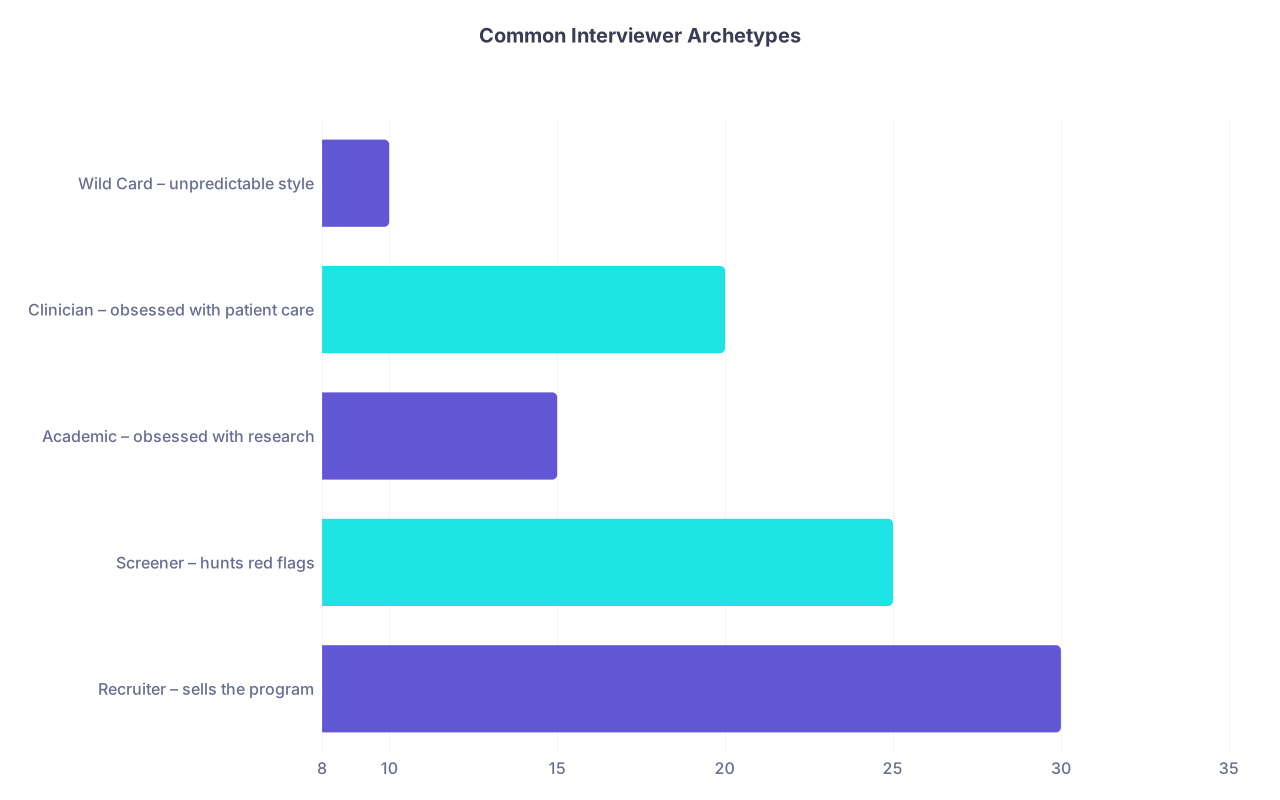
| Category | Value |
|---|---|
| Recruiter – sells the program | 30 |
| Screener – hunts red flags | 25 |
| Academic – obsessed with research | 15 |
| Clinician – obsessed with patient care | 20 |
| Wild Card – unpredictable style | 10 |
How Your Behavior Can Flip the Script Mid-Interview
Here’s the twist: your performance in the first 3–5 minutes can shift you from “confirm” to “challenge” or the other way around.
Ways People Accidentally Trigger the Grill
I’ve seen this happen in real time.
Over-polished, robotic answers.
When every response sounds like it was memorized from a Reddit script, interviewers start pushing. They want to crack through the veneer.Evasive answers about weaknesses.
If you dance around a low grade, an IA, or a gap with vague phrases like “some personal circumstances” and never own specifics, expect follow-up. And then more follow-up.Blaming everyone else.
The fastest path from “softball confirm” to “cross-examination” is blaming professors, group members, or “the system” for every setback. That screams future professionalism problems.Grand statements with zero substance.
“I’m passionate about health equity” followed by no concrete examples of what you’ve done, seen, or read? You just activated challenge mode.
Interviewers think, “Either this person is shallow, or they’re BS-ing me.” And then the questions get sharper.
Ways to Soften a Potential Grill
You can also disarm intensity if you handle early questions well:
Preemptive ownership.
“My early grades are not where they should have been. I overcommitted, and I did not know how to study at that level. Here’s exactly what I changed…”
Answer like that and the interviewer relaxes. They’re hearing insight and accountability instead of excuses.Specific, grounded examples.
If you talk about clinical work and immediately give clear stories of patients (de-identified), tasks, and reflections, it tells the interviewer, “This is real, not premed theater.”Humility with competence.
Confident but not cocky. “There’s a lot I still do not know, but here’s what I’ve learned so far.” That tone turns some would-be grills into thoughtful conversations.
What You Can Do Before Interview Day To Land In The “Soft-Pitch” Zone
You can’t control everything, but you’re not powerless. Half the battle is how your pre-interview file looks to a skeptical faculty member.
Clean Up the Inconsistencies
If your application has:
- Abrupt switches in interests.
- Short bursts of activities with no continuity.
- A giant “research person” image but zero clinical reflection.
Then your job in secondaries and updates is to connect those dots into a coherent story. Don’t lie. Frame. Explain. Make the trajectory make sense.
Address Red Flags Early – On Your Terms
If you have an IA, poor early grades, or big gaps, own them in your primary or secondaries with clarity. That way, when the interviewer sees it, they already have your thoughtful explanation in mind, not just a giant question mark.
A file that says, “I screwed this up, I learned, here’s the proof in my later performance” gets a softer tone than one where the committee feels something is hidden.
Make the Letters Work For You
This part is badly understood. Letters aren’t just about praise; they’re about risk reduction.
Interviewers love seeing: “This student can handle a high clinical workload and is extremely reliable,” or “She is one of the most ethical and honest students I’ve worked with.”
Those phrases push you into the “confirm” category. Vague letters (“hard-working, pleasant, attended meetings”) don’t protect you from grilling.
If you can choose letter writers, pick the ones who have actually seen you struggle, grow, and interact with patients or teams—not the biggest names with the weakest knowledge of you.
| Application Feature | Likely Interpretation by Interviewers |
|---|---|
| Long-term, consistent roles | Reliability → softer, confirmatory questions |
| Clear upward GPA trend | Growth/insight → moderate probing, not hostile |
| Vague or generic letters | Unknown risk → more testing of professionalism |
| Unexplained gaps/IA | Hidden issues → targeted, grilling questions |
| Realistic, coherent story | Lower risk profile → conversational interview |
How To Prepare For Both: Softballs And Cross-Examination
Here’s the mistake a lot of strong applicants make: they only practice for friendly, open-ended questions. Then they get one faculty member who interrogates them and they fall apart because they think, “I must be bombing.”
No. Sometimes that’s just the interviewer’s style or their assigned role for you.
You need two skill sets:
Storytelling for confirm-mode interviews.
Being able to talk clearly about your path, values, and interests in a way that sounds like you, not a script.Composure and structure under pressure.
Handling “Why did you…?” and “What were you thinking when…?” without defensiveness, rambling, or panic.
Practice Handling the “Why You?” and the “Why Should We Believe You?” Layers
For every major claim in your application, you should be able to answer two versions:
- Soft version: “Tell me more about your work with X.”
- Hard version: “Lots of people say that. Why should I believe you really care about X?”
If your answer to the second one is just a louder, more emotional version of the first, you’re not ready. You need concrete, behavior-based examples. Specific actions. Real tradeoffs you made.
What Really Happens After Your Interview Style Is Chosen
Let’s jump to what you never see: the post-interview debrief.
Here’s how it often goes.
In a committee meeting, an interviewer might say about a soft-pitch candidate:
- “She was exactly what we expected. Very grounded, thoughtful, consistent with her file.”
- “No concerns, I’d be happy to work with her.”
- “She’s clearly a fit for our mission.”
They’re confirming to the group: “You were right to like her.”
For grilled candidates, the report might sound like:
- “I pushed him hard on the IA and he took responsibility. I think he’s grown.”
- “I asked clarity questions about his motivation. He stayed consistent.”
- Or: “When challenged, he got defensive and evasive. That worries me.”
Your performance under grilling becomes data for the “is this risk acceptable?” discussion.

| Step | Description |
|---|---|
| Step 1 | Pre-Interview File Review |
| Step 2 | Confirmatory Interview |
| Step 3 | Probing Interview |
| Step 4 | Report: Fits Expectations? |
| Step 5 | Report: Risk Improved or Worsened? |
| Step 6 | Final Committee Discussion |
| Step 7 | Rank/Accept |
| Step 8 | Hold/Reject |
| Step 9 | Risk Level Assigned |
The One Thing You Must Remember Walking In
If you get softballs, it doesn’t mean you’re mediocre or “not taken seriously.” It often means the opposite: they like you on paper and just want to make sure you’re human.
If you get grilled, it doesn’t automatically mean you’re doomed. It means there’s a question about you they actually care enough to answer. Nobody wastes time grilling a sure rejection.
Your job is not to chase a specific interview “feel.” Your job is to:
- Make your file as coherent and honest as possible beforehand.
- Be ready to prove you’re the same person in person that you claimed to be on paper.
- Stay composed whether you’re getting soft-pitched or cross-examined.
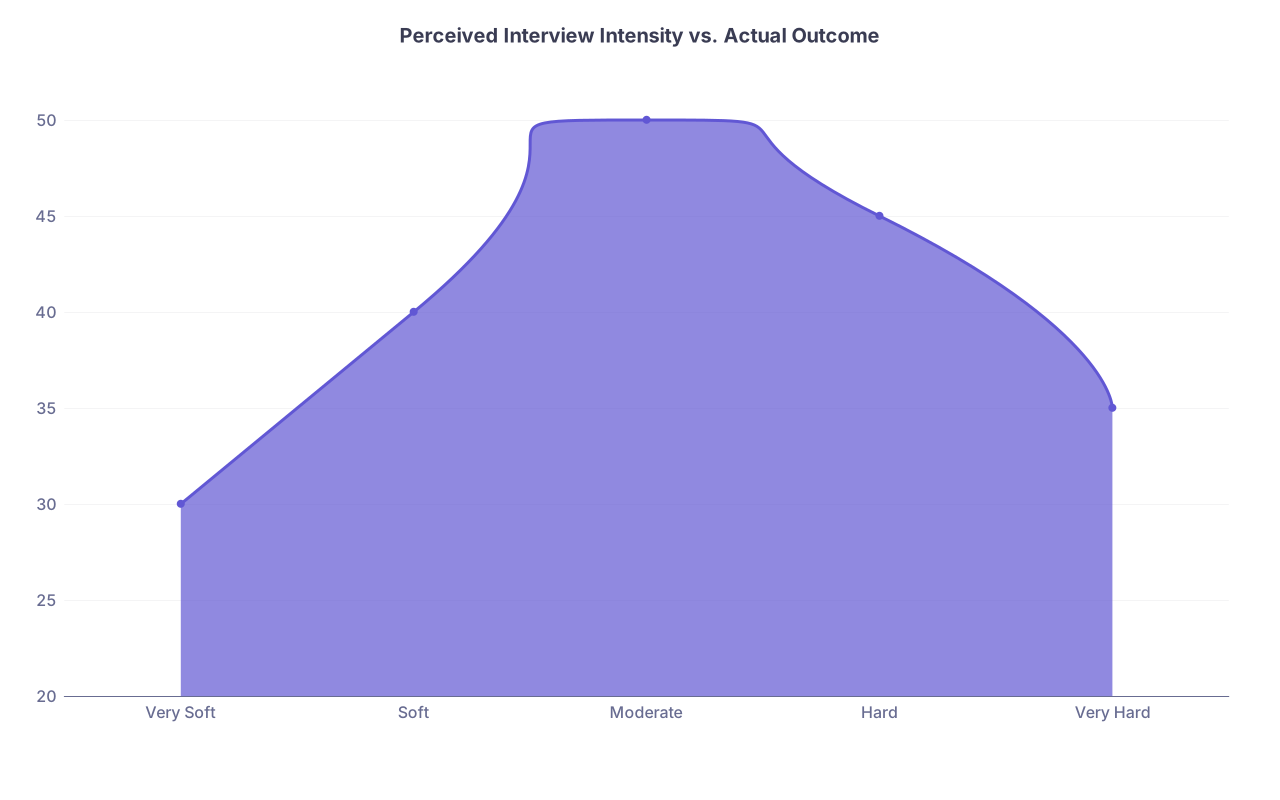
| Category | Value |
|---|---|
| Very Soft | 30 |
| Soft | 40 |
| Moderate | 50 |
| Hard | 45 |
| Very Hard | 35 |
(That’s the reality: outcomes don’t correlate nearly as neatly with “how it felt” as applicants think.)
FAQs
1. If I got an easy, conversational interview, does that mean I’m basically in?
No. It means your file probably landed you in a lower-risk category where they were mostly trying to confirm fit and sanity. You can still knock yourself out of contention with arrogance, lack of insight, or clear mismatch with the school’s mission. But generally, a genuinely easy, positive interview is a good sign that the committee already liked what they saw and didn’t discover any new problems.
2. I got absolutely grilled. Should I assume I’m rejected?
Not necessarily. Some of the strongest eventual admits I’ve seen walked out of interviews convinced they’d failed because they were pushed so hard. The key question is: did you stay honest, specific, and accountable when challenged? If you did, that grilling may have actually rescued your file by reassuring the committee that your red flags are past, not future. The perceived “hardness” of the interview is not a reliable predictor of outcome.
3. Can I change how I’m treated once the interview starts, or is it all predetermined?
You can’t erase the risk category your file puts you in, but you can shift how the interviewer experiences you. If your early answers are grounded, concise, and self-aware—especially around known weaknesses—you often soften their stance and move from “prove you’re not a problem” toward “I think this person is safe.” Faking confidence or dodging hard topics does the opposite. You don’t control who you get or their style; you do control whether you confirm their worst fears or their best hopes.
Key takeaways: Your interview tone is heavily shaped by how risky or coherent you look on paper, long before you walk into the room. Softballs usually mean they’re confirming a positive impression; grilling means they’re testing whether concerns are real. Your best move is not to chase an “easy” interview, but to build an honest, consistent application and be ready to answer both friendly and hostile questions with the same thing: specific, grounded truth.