The belief that “charisma beats content” in interviews is wrong—and dangerously comforting.
For premeds and med students, that myth becomes an excuse: “I’m just not charismatic” or “I’ll be fine, I can talk my way through anything.” Both are lies. The data and real-world outcomes say something a lot less sexy: you need enough content to clear a threshold, and enough interpersonal skill to not set it on fire. Neither alone saves you.
Let me walk through what actually happens in medical school and residency interviews, not the Reddit version.
What Programs Actually Score: The Rubric You Never See
Most applicants imagine some fuzzy “vibe” score. In reality, most schools and residency programs use structured rating forms. They do not all look identical, but they rhyme.
Typical domains you’ll see on faculty score sheets:
- Academic / intellectual ability
- Motivation for medicine / specialty
- Knowledge of their program / fit
- Communication skills
- Professionalism / maturity
- Teamwork / interpersonal skills
- Overall impression / rank recommendation
Notice what is not there: “Charisma.” Because that is not a real construct they can defend to an accreditation body.
Programs are forced (by LCME, ACGME, and their own faculty committees) to pretend to be systematic. That means boxes, numbers, and comments. When you are interviewed, your performance becomes a row in a spreadsheet.
Here is roughly how it plays out.
| Domain | What Interviewers Look For |
|---|---|
| Motivation for Medicine | Specific, credible reasons; sustained effort |
| Knowledge of Program / Fit | Concrete understanding; realistic goals |
| Communication Skills | Clarity, structure, listening |
| Professionalism / Maturity | Judgment, boundaries, humility |
| Teamwork / Interpersonal | Collaboration, empathy, not toxic |
| [Overall Recommendation](https://residencyadvisor.com/resources/med-school-interview-tips/what-faculty-discuss-in-post-interview-huddles-and-how-you-can-shape-it) | Strength of advocacy to the committee |
Charisma, the way applicants use that word—being likable, energetic, memorable—shows up mostly under “Communication skills,” “Interpersonal,” and “Overall impression.”
So is charisma more important than content? Not quite. Think “multipliers,” not “either-or.”
Content (your actual ideas, experiences, and reasoning) feeds:
- Motivation for medicine
- Program fit
- Professionalism/maturity
- Often the overall recommendation
Charisma-like traits (warmth, presence, ease):
- Raise or drop your communication and interpersonal scores
- Color the overall recommendation—especially in borderline cases
When committees sit down with a list of 200 scored applicants, the people who had only charisma and no real substance rarely survive the final cut. The reverse—high substance, low warmth—gets more complex and honestly more interesting.
What the Data Actually Shows About “Charisma”
Let’s get specific. There’s decent literature on interviews in medical selection.
A few consistent findings across studies:
Structured interviews outperform “gut feel.”
When you force interviewers to ask similar questions and rate specific dimensions, reliability and predictive validity go up. In those systems, surface charm matters less because raters are nudged to anchor on what you said, not just how you said it.Communication skills do predict performance—but not in the way most people think.
Meta-analyses show that interpersonal and communication ratings in interviews weakly to moderately predict later clinical performance. But we’re talking correlations in the 0.2–0.3 ballpark, not destiny. Communication is one variable in a noisy equation.Personality extremes hurt more than charm helps.
Being clearly arrogant, dismissive, or socially off-putting harms you much more dramatically than being extra-“charismatic” helps you. Interviewers will tolerate shy-but-prepared. They will not tolerate slick-but-empty in large numbers.
Look at how selection committees are constrained: they already have your numbers (GPA, MCAT, Step scores), letters, research history, service work. Interviews are one of the few chances to test:
- Are you actually the person your application implies?
- Can you function around humans?
- Do you understand what you’re getting into?
That’s content plus interpersonal skill, not charisma in isolation.
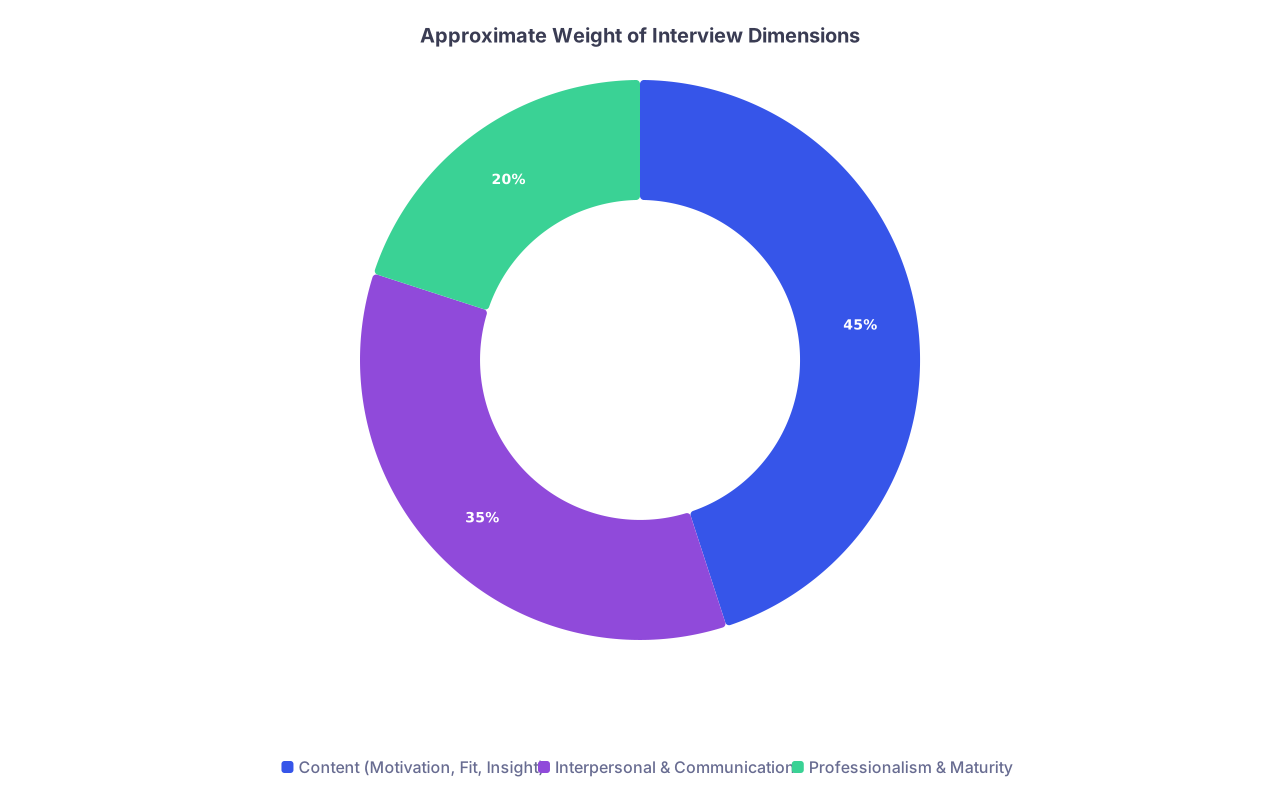
To make this less abstract, think of a simplified weighting in a real committee discussion. A lot of programs end up effectively doing something like:
| Category | Value |
|---|---|
| Content (Motivation, Fit, Insight) | 45 |
| Interpersonal & Communication | 35 |
| Professionalism & Maturity | 20 |
Is this exact? Of course not. But it’s directionally accurate for many medical schools and residencies. The story in the room is usually: “Is this a thoughtful, appropriate person we’d trust with our residents/patients?” not “Who had the best TED Talk cadence?”
Case Studies: Who Actually Wins in Interview Rooms
Let me translate this into the real archetypes I’ve seen.
1. The Polished Emptiness Candidate
Looks the part. Great suit. Flawless handshake. Answers like:
- “My greatest weakness is I care too much.”
- “I just want to help people and give back.”
- “Every specialty is great; I’d be happy anywhere.”
High surface charisma, zero content. When asked about a specific patient, they give vague “I shadowed and it was inspiring” with no details, no reflection, no real struggle.
How do they score?
- Motivation for medicine: middling. Too generic.
- Knowledge of program: low. They clearly did not prepare.
- Communication: high. Smooth, fluent, makes eye contact.
- Professionalism: fine.
- Overall: “Not a problem, but not compelling.”
On a rank list, they’re filler. Better than the obviously problematic, but below anyone who actually said something real.
2. The Sharp but Stiff Candidate
This is the classic “not charismatic” student who thinks they’re doomed.
They sit a bit rigid. They’re anxious and you can tell. But when you ask, “Tell me about a time you made a mistake with a patient or colleague,” they give a concrete situation:
They miscommunicated a lab follow-up, the patient almost got missed, they brought it to the team, changed their system, and can describe exactly what they learned about safety nets and humility.
This candidate:
- Motivation: high. Their path is specific.
- Program fit: strong. They’ve actually read about your curriculum or rotations.
- Communication: average. A bit awkward, but clear enough.
- Professionalism/maturity: very strong.
On paper? Much stronger than the polished empty one. In committee, faculty say things like, “They were nervous, but I really liked how they thought about that situation.”
3. The Unicorn (Substance + Presence)
Yes, some people have both. They’re easy to remember: genuine warmth, specific experiences, good listening, clear reasoning. They don’t just answer— they engage.
These are the obvious top-of-list candidates. But here’s the key: it is their content that justifies the gut-level warmth. Without the content, the same behavior smells like sales.
You can’t fake this with delivery tricks alone.
Where Charisma Does Sway Outcomes
Now, I’m not going to pretend charisma is irrelevant. It matters. Just not the way interview myths portray it.
Charisma (read: good interpersonal presence) tends to matter most in three situations:
Borderline cases.
Two candidates have roughly similar applications and decent content. One is more engaging and easier to imagine working with. That person typically gets bumped up. Not because they’re “pretty” or “sparkly,” but because “team fit” and “communication” are not fake criteria in medicine. A jerk who can recite guidelines is still a liability.Red flag offsetting.
A candidate with a Step score just at the program’s lower bound or a prior leave of absence can sometimes reassure a committee with an outstanding, honest, and grounded interview. That reassurance is partly content (clear explanation, insight) and partly interpersonal: do they handle this tough topic with maturity instead of defensiveness? That behavioral piece feels like “charisma” but it's really regulated emotion plus clarity.Advocacy behind closed doors.
Each interviewer becomes your lobbyist (or your silent opponent) in the final meeting. A genuinely positive interpersonal impression—“I’d be happy to work 28 hours straight with this person”—makes people speak up for you. Mediocre impressions make you forgettable. And being forgettable is how you quietly fall down the list.
So yes, presence matters. But none of that works if your content is incoherent, shallow, or clearly rehearsed nonsense.
Why “Content vs Charisma” Is the Wrong Question
The real cutoff in medical education is not charisma vs content. It is this:
- Below a certain content threshold, you do not get in, no matter how charming.
- Below a certain interpersonal threshold, you do not get in, no matter how brilliant.
Most applicants drastically underestimate that second threshold. They assume “I’m not a jerk, so I’m fine.” No. The standard is higher than “not horrible.”
Interpersonal minimum looks like:
- You can listen without interrupting constantly.
- You answer the question they asked, not the one you prepared.
- You show appropriate humility and don’t brag about “carrying the team.”
- You do not blame everyone else in every conflict story.
- You can show basic warmth or at least respect, even while anxious.
That is not charisma. That is baseline professionalism.
Meanwhile, content minimum looks like:
- You can talk clearly about why medicine, and why now, with specifics.
- You can articulate what you learned from your experiences beyond “it was eye-opening.”
- You can describe an ethical or challenging situation without collapsing into clichés.
- You know at least a few concrete things about the school or program.
If you are missing these, no amount of enthusiastic hand gestures or “I’m a people person” fluff saves you.
How to Stop Obsessing Over Charisma and Fix What Matters
If you’re preparing for interviews, this is the hierarchy that works, based on actual observed outcomes—not TikTok advice.
Step 1: Build Real Content First
You should be able to speak, in detail and without notes, about:
- 3–5 clinical or volunteer experiences that actually changed how you think
- 1–2 mistakes or hard feedback moments and what you did about them
- 2–3 reasons you’re specifically drawn to this school or specialty
- 1–2 things you’re worried about or working on (weaknesses, growth areas)
Notice none of this is fancy. It is just specific and honest. If you cannot explain these cleanly, no delivery trick will hide it from a halfway-engaged interviewer.
Step 2: Make Your Delivery Less Painful, Not Perfect
Charisma fetishization comes from people thinking they need to be performers. You do not. You need:
- A clear structure to your answers (situation → what you did → result/insight)
- Natural, not overrehearsed, phrasing
- A voice volume that can be heard
- Eye contact in some form (even if you’re shy, you can look up regularly)
That’s it. You’re not auditioning for broadcast news.
You can practice this with 3–4 mock interviews, not 50. Watch your video once, notice the worst tics (“uhhh,” talking in circles, never answering the question), fix them. You do not need to become someone else; you need to become slightly clearer and less chaotic.
Step 3: Stop Copying Viral Interview “Hacks”
There’s a cottage industry of bad advice: “Use this one line and they’ll remember you,” “Always flip the question back on them,” “Start with a story for every answer.”
This often backfires. Faculty can smell canned frameworks. When three candidates in a row give some “I’m a recovering perfectionist” answer to the weakness question, people start writing “scripted” in the margins.
Remember: the weight on content quality is higher than the weight on showmanship. Practiced authenticity beats borrowed lines.
So, Is Charisma More Important Than Content?
No. It is not. But content without any interpersonal skill is also not enough.
If you want a formula: content is the engine, interpersonal skill is the steering and brakes. Charisma is the polish on the paint. Nobody buys a car that looks great but doesn’t run, and nobody in medicine wants a rocket engine with no way to control it.
When you strip away the myths, the question changes from “Am I charismatic enough?” to “Do my experiences actually mean anything when I talk about them—and can another human stand to listen to me for 30 minutes?”
Years from now, you will not remember whether you stumbled on one answer in an MMI station. You’ll remember whether you walked in as a glossy performance or as a thinking, learning person who could actually back up their story.