
The idea that “Why our school?” answers are pure fluff is wrong. They are a screening tool, a commitment gauge, and sometimes the fastest way to bin an otherwise solid application.
You’ve probably heard some version of this: “They already know you want to be a doctor; these questions are just filler” or “As long as you say something nice about their research and location, you’re fine.” That’s how applicants talk to each other. That’s not how committees talk behind closed doors.
I’ve watched adcoms go through dozens of “Why us?” responses in one sitting. I’ve listened to comments like, “This is a copy‑paste,” “They don’t understand our curriculum at all,” and the dagger: “No evidence this person actually cares about being here.” That last one? It kills people’s chances more than a mediocre MCAT section.
Let’s break the myths and look at what actually happens.
Myth: “Why our school?” is just a polite formality
No. For schools that care about yield protection, mission fit, and limited interview spots, this question is one of the few places they see you thinking specifically about them, not just about medicine.
Here’s the quiet truth: a lot of schools know you’re playing the numbers game. They know you sent 25–40 primaries. They also know they can’t afford to waste interview slots on people who are obviously treating them like a backup.
So they use “Why us?” essays and interview answers to answer three unspoken questions:
- Do you actually understand what makes our program different from the one across town?
- Is there any evidence you’d seriously come here if accepted?
- Are you aligned with what we say we care about (mission, patients, communities, approach to training)?
Not your feelings about their prestige. Not how “awesome” their research is in vague terms. Their actual structure, values, and opportunities.
And yes, this is not just for secondaries. In interviews, “Why our school?” or its cousin “What attracts you to our program?” often decides who gets ranked higher when scores are similar.
What committees are really measuring with this question
Strip away the polite language and this question is: “Are you serious about us, or are you just mass-applying?”
There are five major dimensions committees implicitly score when they hear your answer.
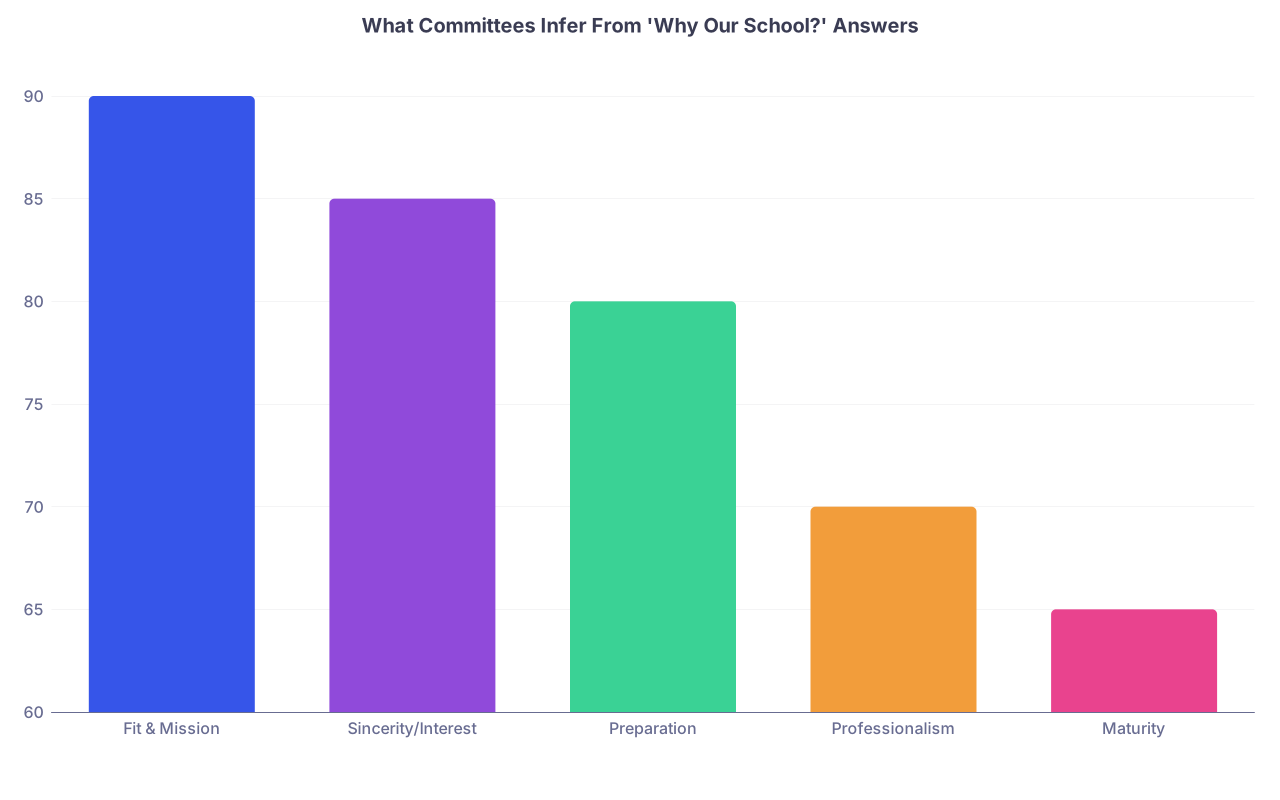
| Category | Value |
|---|---|
| Fit & Mission | 90 |
| Sincerity/Interest | 85 |
| Preparation | 80 |
| Professionalism | 70 |
| Maturity | 65 |
Let me translate those into human terms.
1. Fit and mission alignment
Every school has baked‑in priorities, even if they sound similar on the brochure.
- A state MD school with a heavy primary care and rural pipeline focus genuinely wants people who might practice in‑state.
- A research‑heavy institution like WashU, Penn, or UCSF is quietly ranking your appetite for serious research productivity.
- A community‑focused DO school may value long‑term community engagement more than your three‑month summer bench project.
When your answer is “I love your pass/fail curriculum, strong research, and collaborative environment,” you basically said nothing. Every school says that. It tells them you haven’t even tried to see who they actually are.
When your answer is, “Your longitudinal clinic that assigns M1s to the same refugee family for two years fits the type of continuity work I’ve already done at X Community Center,” that’s different. Now they’re thinking: “They get what we do. They’d probably be happy here.”
2. Sincerity and actual interest
Committees are extremely good at spotting generic answers. They’ve seen thousands.
Phrases that scream “I don’t care, I just need to say something”:
- “Cutting‑edge research opportunities”
- “World‑class faculty”
- “Diverse patient population”
- “Great location in [big city]”
Those aren’t wrong. They’re just content‑free. They could be said about 50 schools with zero edits.
People who are actually interested talk differently. They reference specifics that a casual applicant would not know, like:
- Distinctive curricular elements
- Named clinics or tracks
- Unique evaluation systems
- Concrete local population characteristics
- Specific student‑run groups they’d actually join
This isn’t about memorizing trivia. It’s about showing you’ve looked closely enough to see how you’d plug into their system.
3. Preparation and professionalism
Your “Why us?” answer is a litmus test for whether you actually prepared.
Think of it from the interviewer’s side. You had weeks, sometimes months, between your II and the interview day. If you show up and offer something like: “You’re a great school with strong academics, and I’d be proud to train here,” that’s code for “I did not take this seriously enough to spend 30 minutes on your website.”
People get dinged for that. Quietly. You won’t see it in any feedback, but it ends up in little comments like:
- “Super generic answers”
- “Didn’t seem to know much about our program”
- “No clear reason for interest in [school]”
Those comments absolutely move you down a rank list when there are more enthusiastic, better‑prepared applicants in the same range.
4. Maturity about your own goals
“Why our school?” is also about whether you’ve thought beyond “I just want to be a doctor.”
The stronger answers link:
- What you’ve done
- What you want
- What this school actually offers
Example of a weak answer: “I want to go here because you have lots of research and a diverse patient population.”
Example of a mature answer: “I’ve spent two years coordinating a free clinic in a medically underserved neighborhood. Your Health Equity Track, where students work longitudinally with community-based organizations in [city], is a structure I can see myself in because it mirrors and expands on what I already value and do.”
One of those says: “I like buzzwords.” The other says: “I’m building a coherent training path, and you fit it.”
Committees reward the second type.
How “Why us?” actually influences outcomes
Let’s be precise. This question doesn’t usually rescue a weak 502 MCAT. But among the interview pool and borderline secondary pile, it’s more influential than most applicants realize.
Think of three stages:
- Secondary screen. At many schools, “Why us?” is the main way they decide whether to invest an interview in you. Strong alignment can get you an interview even with stats slightly below their median. Weak, generic answers can bury you even if you’re at or slightly above their stats.
- Interview evaluation. Most interview rubrics have some version of “commitment to our school/mission” or “fit with our program.” That box is basically your “Why us?” answer plus how the rest of your conversation lines up.
- Rank list / committee meetings. When adcom members debate between two similar candidates, someone will say: “I felt X genuinely wanted to be here. Y seemed like we were just one of many.” Guess who gets the higher rank.
Here’s the pattern I’ve seen more than once: an applicant with mid‑range stats and a laser‑targeted “Why us?” answer edges out a slightly stronger applicant who clearly has a generic “I’m applying to 40+ places” vibe.
Yield protection is not a myth. Schools care who is likely to enroll.
| Stage | Weak / Generic Impact | Strong / Specific Impact |
|---|---|---|
| Secondary Review | More likely to be screened out | More likely to get an interview |
| Interview Rating | Lower “fit / interest” scores | Higher “fit / interest” scores |
| Committee Debate | Easy to pass over | Often used as tiebreaker in your favor |
What actually makes a strong “Why our school?” answer
Let me cut through the fluff and give you a usable structure. Not template garbage—logic.
A good answer does three things, in some order:
- Shows you’ve done specific homework.
- Connects those specifics to your past experiences.
- Ties both of those to your future goals.
That’s it. The rest is word choice.
1. Concrete specifics that pass the “Ctrl+F test”
If your answer could be reused for ten different schools by changing only the name, it fails.
Strong specifics look like this:
- “Your longitudinal integrated clerkship in [region] where students care for the same panel of patients across multiple specialties…”
- “The [Name] free clinic where M1s and M2s lead QI projects in collaboration with social workers…”
- “Your 3‑phase curriculum, where pre‑clinicals are 18 months and built around organ systems with early ultrasound training…”
You’re showing that you understand what they actually do differently.
The hack that works: spend 20–30 minutes on three pages only—curriculum, special tracks/programs, and student life/interest groups. Stop skimming the mission statement. Everyone parrots that line.
2. Tie it to who you already are
Committees care less about what sounds impressive and more about what is coherent.
If you claim to love longitudinal primary care, but your entire application screams “lab rat + zero clinical exposure,” your answer rings hollow. And adcoms notice.
So instead:
- If you’ve done research → connect to their research infrastructure, mentorship style, specific centers.
- If you’ve done community work → connect to their service‑learning, pipeline programs, clinics.
- If you’ve done advocacy/policy → connect to their health policy tracks, Capitol Hill programs, or community partnerships.
The internal question they’re asking: “Does what they’re saying line up with what they’ve actually done?”
3. Show how you’ll use what they offer
Future orientation matters. A lot of applicants stop at: “You have X opportunity, which is great.”
Better: “You have X opportunity, which fits with what I’ve done and here is how I’d likely use it.”
Example: “I’ve spent three years working on mental health education for high school students. Your student‑run [Name] Psychiatry Interest Group and the elective in school-based mental health during third year are concrete avenues I can see myself contributing to and learning from.”
That tells them: You’ve thought past the brochure.
The lazy patterns that quietly kill you
There are a few recurring train wrecks. I’ve seen them in essays, in interviews, and in the annoyed comments of faculty afterward.
1. Copy‑pasted “Why us?” across schools
This is the classic:
“I’m drawn to your school’s commitment to diversity, research excellence, and community engagement. Your pass/fail curriculum, collaborative environment, and location in [CITY] will allow me to thrive as I pursue my passion for [vague interest].”
I promise you: they can recite this in their sleep. If your answer looks like this, you’ve just told them you didn’t think they were worth customizing for.
2. Prestige‑driven answers
Any answer that basically boils down to “You’re ranked high / you’re famous / you’re an Ivy” is dead on arrival.
They know you care about prestige. They don’t need you to say it. If prestige is the only real reason you want to go there, do not say it.
3. Over‑complimenting the interviewer or school
“This is my dream school” is almost never believed anymore, because people say it to 10 schools.
Too much gushing—“I’d do anything to come here,” “This is my top choice by far”—can actually work against you if nothing in your application or answer backs that up. It sounds desperate and insincere.
4. Purely personal geography answers
“I want to be close to my partner/family/friends” is fine as a secondary factor, not the main thesis.
If your entire answer is “My boyfriend goes here and I like the city,” you’ve just told them nothing about fit, maturity, or mission alignment. Geography can support your answer, not replace it.
How to prepare without sounding robotic
You shouldn’t memorize a script. You should memorize three anchors per school.
Think of them as three “pillars”:
- One curricular/program element
- One clinical/community/track element
- One cultural/value element
Anchor examples:
- “Organ‑system curriculum with mandatory ultrasound training in M1”
- “Student‑run mobile clinic serving migrant workers”
- “True pass/fail with no internal ranking, heavy emphasis on wellness and advising”
Once you have those, practice talking like a human about how each of those connects to your experiences and future plans. Don’t write a monologue and recite it. Develop a map you can speak around flexibly.
This is what strong candidates actually do: they know roughly what they want to hit, and they improvise naturally from there.

| Step | Description |
|---|---|
| Step 1 | Research School |
| Step 2 | Choose 3 Specific Anchors |
| Step 3 | Link to Past Experiences |
| Step 4 | Connect to Future Goals |
| Step 5 | Practice Natural Delivery |
The real myth: that you can fake care
Here’s the uncomfortable truth people don’t like: the best “Why our school?” answers usually come from people who could actually see themselves enrolling there and have taken the time to picture that life.
You cannot fully fake that. You can only partially camouflage its absence.
If you treat every school as a faceless stepping stone with identical curricula and interchangeable “research and diversity,” your answers will sound like everyone else’s. And in this process, sounding like everyone else is almost as bad as sounding terrible.
Over the next few years, you will forget most specific questions you were asked in interviews. You will not forget the schools where you could genuinely articulate why you belonged there—and the ones where, deep down, you knew you were just saying what you thought they wanted to hear.