What do you do when your interviewer clearly doesn’t like you… and you’re trapped in a 30-minute room with them while your entire future feels like it’s on the line?
First: Are They Actually Disinterested/Hostile… Or Does It Just Feel That Way?
Let me start with the thing nobody tells you: a lot of “hostile” or “cold” interviewers are actually just:
- Tired
- Overloaded
- Socially awkward
- Trying to be “objective” and overcorrecting into robot mode
You’re sitting there thinking, “Wow, I’ve already been rejected,” and they’re thinking, “I really hope I don’t go over my 15-minute schedule block.”
I’ve seen this play out over and over:
- Interviewer never smiles, never nods, no validation. Applicant leaves in tears.
- Same interviewer writes absolutely glowing comments in the file.
- Applicant later gets an acceptance and is stunned.
Med school faculty are not professional interviewers. Some are amazing. Some are chronically burnt out. Some think “neutral face + silence” is how you avoid bias. Some just had a rough patient death that morning and are still mentally in the ICU.
Your brain, already in full “this is my whole life” mode, interprets every blank stare as hatred.
So before you decide the person across from you wants to destroy your career:
- Flat affect doesn’t automatically mean dislike.
- No follow-up questions doesn’t mean they hate your answer; it might mean they’re sticking to a script.
- Looking at a screen may be them scoring you in real time, not ignoring you.
- Short questions can be part of a structured interview.
But yes—sometimes they are actually hostile. Or dismissive. Or rude. Or clearly checked out.
So let’s talk about what you can actually do when that happens and you’re spiraling inside.
Scenario 1: The Disinterested, Checked-Out Interviewer
This is the one where they’re glancing at emails, barely making eye contact, offering nothing back. You finish an answer and they just say, “Next question.”
You start thinking: They’ve already decided. I’m wasting my time. I sound stupid. I knew I shouldn’t have applied here.
Here’s what you do.
Step 1: Stop trying to “fix” their mood
You’re not there to entertain them. You’re not being graded on whether they have fun.
Your job: give clear, structured, thoughtful answers that show who you are. That’s it.
So instead of: “They’re bored, I should talk faster, maybe crack a joke, overshare, fill the silence.”
Think: “Even if they say nothing, I’m going to hit my main points.”
Treat it like you’re recording answers for a video interview: you show up fully, whether or not anyone is reacting.
Step 2: Anchor yourself to a simple answer structure
When your brain is in panic mode, you ramble. Or you cut your answers super short because silence feels like failure.
Use a loose structure like: Situation – Action – Reflection. For almost everything.
Example, “Tell me about a time you handled conflict”:
- Situation: 1–2 sentences. “During my EMT shifts, one partner often dismissed my suggestions in front of patients.”
- Action: what you actually did. “I asked to debrief after a shift, shared specific examples, and suggested using a checklist so both of us could contribute ideas.”
- Reflection: what you learned, how you changed. “It taught me to separate my ego from patient care and to speak up early instead of letting resentment build.”
Even if the interviewer stares like a statue, you know you’ve given a complete answer.
Step 3: Use their silence as extra time to think
It feels unbearable. You finish and they just… stare. Or look at the screen. Or type.
Your brain screams: Say more! Fill the gap! You’re bombing!
Don’t. Let the silence exist for one or two beats. Take a breath. Sip water if there’s water.
Then, if it still feels weird, you can calmly say:
“I think that covers my main thoughts, but I’m happy to clarify anything.”
You’ve just signaled:
- I’m composed.
- I know I gave a full answer.
- I’m open to dialogue.
They might move on. That’s okay. Moving on does not equal “bad answer.”
Step 4: Engage just enough without begging for approval
You can gently re-humanize the conversation without turning into a people-pleaser.
Things like:
- “Would you like a brief example from clinical volunteering, or from my research experience?”
- “I can keep this short, or walk you through the details—what would be most helpful?”
Those questions give them control and force some micro-engagement without coming off as needy.
If they still stay stone-faced… fine. You’ve done your part.
Scenario 2: The Hostile or Challenging Interviewer
This is the nightmare version. You get:
- “Your MCAT isn’t very strong. Why should we take you seriously?”
- “There are thousands of applicants better on paper than you—what makes you special?”
- “So what? Everyone does research. Why does yours matter?”
You feel attacked. Your heart rate spikes. Your brain: They hate me. I shouldn’t be here. I have to defend myself aggressively or I lose everything.
Here’s the twist: some schools intentionally use stress interviews. They want to see how you handle confrontation, criticism, or unfairness. They’re not always trying to bully you; they’re trying to watch your reaction.
Step 1: Buy yourself 2 seconds
The gap between “harsh question” and “your reaction” is literally the test.
Don’t fire back instantly. Don’t drop your face into “hurt/angry.”
Instead:
- Brief pause.
- Tiny inhale.
- Neutral or slight “thinking” expression.
You can even say:
“That’s a fair question—let me think about how to answer it clearly.”
You’ve just demonstrated composure under stress. Huge points.
Step 2: Agree where you can, then pivot
You don’t have to fight the premise of the question to defend yourself.
Example: “Your MCAT isn’t very strong. Why should we take you seriously?”
Instead of spiraling into excuses, try:
“You’re right, my MCAT is below your median. I was disappointed with that score too. What I’d point to is my academic record over time and how I’ve handled heavy course loads while working. For example…”
You acknowledge the weakness, then pivot to evidence that you can handle the work and have grown.
Hostile: “There are thousands of applicants better than you on paper—what makes you special?”
You can say:
“I completely understand that, and I don’t see myself as ‘better’ than anyone. What I can say is what I’d bring to your class. For example…”
You don’t match their aggression. You calmly redirect.
Step 3: Don’t let them drag you into defensiveness
The trap is you starting to sound like you’re on trial. Talking too fast. Over-explaining. Over-sharing personal flaws. Trying to “win.”
Remember: they’re grading your professionalism, not your ability to clap back.
Watch for internal red flags:
- “I need to convince them I’m not a failure.”
- “They’re being unfair; I should call that out.”
- “This is rude—I should show I’m not a pushover.”
Instead, think: “I’m talking to a difficult attending on rounds in front of patients. How would I respond?”
Polite. Clear. Boundaries. But not reactive.
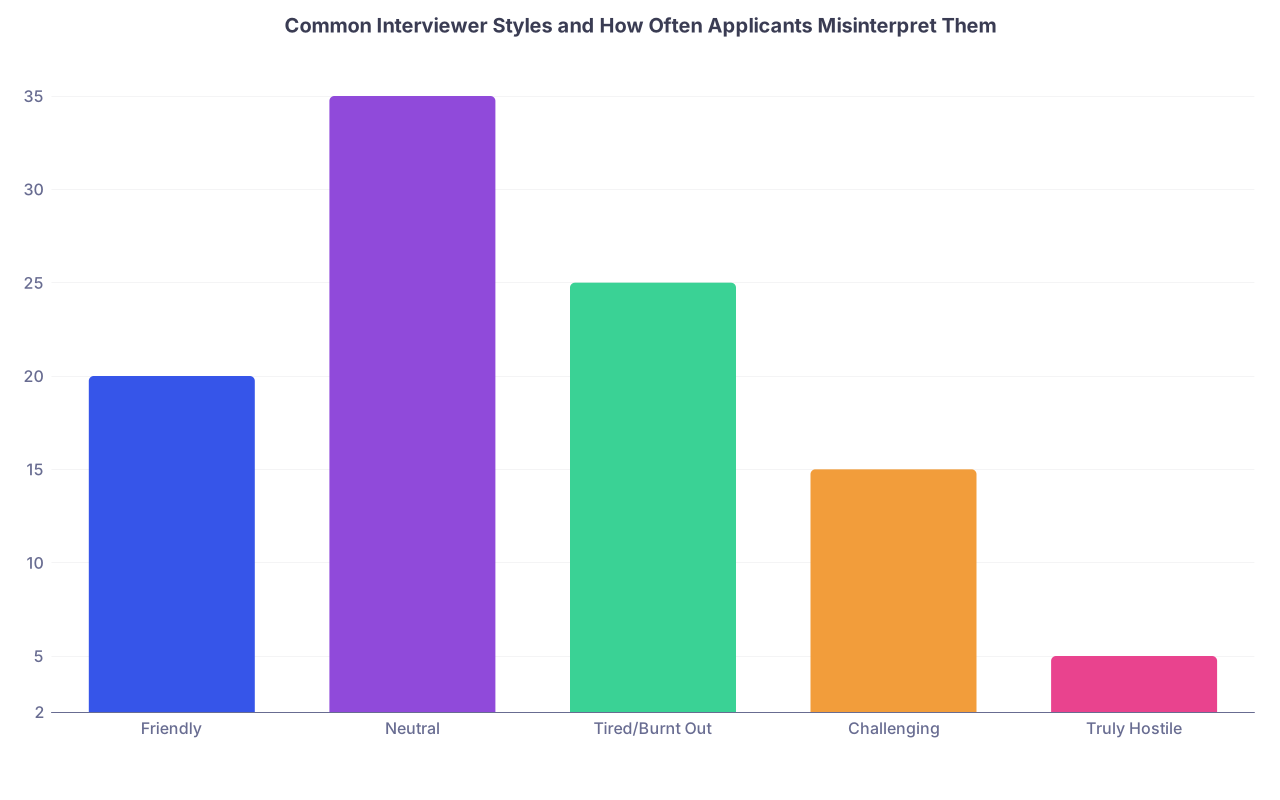
| Category | Value |
|---|---|
| Friendly | 20 |
| Neutral | 35 |
| Tired/Burnt Out | 25 |
| Challenging | 15 |
| Truly Hostile | 5 |
Scenario 3: When They Actually Cross a Line
Sometimes it’s not “stress testing.” It’s just bad behavior.
You might see:
- Inappropriate personal comments
- Discriminatory remarks
- Questions clearly unrelated to your ability to be a physician (“So, do you plan to have kids soon?”)
- Mocking your background, accent, or school
Your brain will probably freeze because you’re thinking, “If I say anything, I’m done.”
Here’s the reality:
- This reflects more on them than on you.
- Most admissions offices want to know when this happens.
- A single interviewer almost never has unilateral power to tank you. There’s a committee.
In the moment, keep yourself safe and minimally reactive
You do not have to “teach them a lesson” in the room. Your only job is not to lose your composure.
You can:
- Answer briefly and redirect.
- Use neutral phrases like, “I’m not sure that’s directly relevant, but I can speak to…”
- Or, if it’s bad enough: “I’m not comfortable answering that. Is there another question you’d like me to address?”
Will that feel terrifying? Yes.
Will some applicants still choose to “just answer to survive”? Also yes.
You are not a bad person if you freeze and just try to get through it. You’re human.
After the interview: document everything
As soon as you’re out:
- Write down exact phrases used.
- Approximate time, location, name of interviewer.
- How it made you feel.
Then decide if you want to report it. If you do, email the admissions office:
- Calm, factual tone.
- Specific examples.
- Not a rant, not all caps, not “this school is trash.”
You can say something like:
“I wanted to share some concerns about part of my interview experience today, in case it’s helpful for your quality improvement process…”
Many schools actually take this seriously. I’ve seen interviewers removed from future seasons because multiple applicants reported similar behavior.
And no, calmly reporting unprofessional conduct does not automatically blacklist you. That’s a fear your anxiety made up.
How to Keep Yourself from Falling Apart Mid-Interview
The real horror isn’t the interviewer. It’s your own brain.
You’re sitting there thinking 5 things at once:
- “They hate me.”
- “I sound stupid.”
- “I’m ruining my only chance.”
- “I knew I didn’t belong here.”
- “Everyone else is doing better.”
Meanwhile, your actual answer falls apart because you’re in a full shame spiral.
Let’s give your brain a script. Something you can cling to when it starts screaming.
Mental reframe #1: “The interview isn’t scored on their facial expression.”
They’re scoring your behavior, not their own.
Stone-faced interviewer? You still get points for:
- Staying calm
- Staying structured
- Staying respectful
- Answering honestly
You don’t get extra points for making them laugh. This is not a comedy set.
Mental reframe #2: “I’m not here to be chosen by this one person.”
You’re not auditioning for their approval specifically.
You’re building a record: every interaction, every file, every note. The committee reads patterns, not one cranky paragraph.
I’ve seen applicants:
- Have one awful-feeling interview
- Feel convinced they were done
- End up accepted because their other interactions were strong and the committee could tell the interviewer was harsh with everyone
You are not doomed by one bad vibe.
Quick physical tricks (that actually help)
These aren’t magic, but they keep your body from hijacking your brain:
- Plant your feet flat on the floor. Feel the pressure. Physical grounding pulls you out of your mental spiral.
- Loosen your jaw. You’re probably clenching. You look and feel more tense than you realize.
- Let your exhale be just a second longer than your inhale. It signals “not immediate danger” to your nervous system.
All of this you can do while they’re talking, without looking weird.

| Step | Description |
|---|---|
| Step 1 | Interviewer seems negative |
| Step 2 | Stick to clear answer structure |
| Step 3 | Pause and respond calmly |
| Step 4 | Use silence as thinking time |
| Step 5 | Agree where possible then pivot |
| Step 6 | Finish interview professionally |
| Step 7 | Document and consider reporting |
| Step 8 | Reflect after, not during |
| Step 9 | Disinterested or Hostile? |
| Step 10 | Crossing a line? |
After the Interview: What If You’re Convinced You Blew It?
You walk out, sit in your car, and immediately start replaying everything in 4K ultra HD humiliation.
“I shouldn’t have said that.”
“They definitely hated my answer about weaknesses.”
“I talked too much about my research. I sounded arrogant.”
Here’s the harsh truth: your memory of the interview is wildly biased.
You remember:
- Every stumble
- Every moment of silence
- Every weird facial expression
You do not remember:
- The many normal, competent things you said
- The parts they actually wrote down
- The curveballs you handled decently
They’re not scoring you on perfection. Just on whether you’re a reasonable human they can trust with patients and classmates.
Should you send a follow-up email?
If the interviewer was just neutral/disinterested/briefly tough: a simple thank-you is fine. Don’t overdo it. Don’t try to “correct” your answers.
If they were clearly inappropriate or unprofessional: that’s separate from a thank-you email. You can still send a thank-you or you can choose not to; neither will make or break you. Report behavior, if you choose, to admissions, not to the individual interviewer.
Should you explain or apologize later?
No. Don’t email with:
- “I realized I gave the wrong answer to…”
- “I hope you don’t think I meant…”
- “I was nervous, please don’t judge me by…”
That almost always makes it worse. It draws attention to something they either didn’t notice, didn’t care about, or already forgot.
You’re allowed to have one or two imperfect moments. They expect that.

The Hard Truth: You Will Probably Have At Least One Bad-Feeling Interview
If you apply to enough schools, statistically:
- One interviewer will be cold.
- One will be oddly hostile.
- One will barely look at you.
- One will hit a sore spot that makes you want to cry.
This doesn’t mean you’re not cut out for medicine. It means you’re interacting with humans. And some humans are tired, burnt out, rigid, or just not good at this.
Your job is not to turn every room into a standing ovation.
Your job is:
- Don’t let their behavior drag you down to their level
- Protect your own dignity and composure
- Answer as clearly and authentically as you can
- Walk out knowing: “I did what I could with the person I got”
You will always think of better answers in the shower later. That’s normal. That doesn’t mean you failed.
FAQ (Exactly 6 Questions)
1. What if I start crying in a hostile or stressful interview? Am I completely done?
Not automatically. People cry under stress. Interviewers are human; some will actually respond with concern. If it happens, don’t apologize 20 times. Just say something like, “I’m sorry, this is really important to me, but I’m okay to continue,” take a breath, and move on. One emotional moment is not a death sentence. What matters is how you recover, not that it happened.
2. Should I ever call out an interviewer during the interview for being rude or inappropriate?
Very carefully. If something is clearly over the line, you can say, “I’m not comfortable with that question,” or, “I’m not sure that’s directly related to my qualifications.” But going into full confrontation (“That’s inappropriate,” “You’re being unfair”) usually just escalates things and doesn’t help you. The safer move is: stay composed, get through, then report afterward if you choose.
3. What if the interviewer obviously didn’t read my application and asks questions I already answered in my essays?
Annoying? Yes. Fatal? No. Assume nothing. Answer like it’s new information: “As I mentioned in my personal statement, I started volunteering at the clinic after my sophomore year, and what really shaped me was…” They’re seeing dozens of applicants; they won’t remember every detail. You don’t score extra points for saying, “It’s in my application.” You do score points for being patient and professional.
4. The interviewer argued with my views on ethics/healthcare policy. Did I just tank my chances?
Disagreement isn’t an automatic rejection. What matters is whether you stayed respectful, used reasoning, and could handle pushback. Committees are not looking for clones who parrot one opinion. If you avoided becoming defensive or combative, articulated your stance, and showed openness to nuance, you likely did fine—even if it felt awful.
5. How do I tell the difference between a “stress test” interview and someone who just hates me?
You often can’t in real time. That’s the problem. So assume it might be intentional stress testing and act accordingly: calm, measured, not defensive. If they’re repeatedly personal, discriminatory, or inappropriate, that’s more likely true hostility/unprofessionalism. But either way, your strategy is similar: protect your composure, answer clearly, and document anything truly concerning after.
6. If I had one terrible-feeling interview at a school with multiple interviewers, am I automatically rejected?
No. Multi-interviewer setups exist precisely so no single bad interaction dominates. If two interviews were good and one was rough, the committee usually sees through that pattern. They know certain interviewers are tough graders or awkward. Do not mentally withdraw your own application because of one bad-feeling room. Let them decide—you don’t need to reject yourself early.
Key points:
- A “cold” or “hostile” interviewer doesn’t automatically mean a bad evaluation; your reaction is what’s actually being judged.
- Stay structured, calm, and professional, even if they’re disengaged or challenging; you’re not there to fix their mood.
- If they cross a serious line, protect your composure in the moment, document details afterward, and consider reporting to admissions.