
You’re not going to “ruin your future” if you cry in an interview. That’s the lie your 2 a.m. brain keeps repeating, and I’m going to push back on it hard.
I know exactly the thought spiral you’re in: replaying imaginary interviews in your head, picturing yourself getting a question about a death in your family, a personal trauma, burnout, or some ethical situation… and then seeing yourself lose it. Tears. Shaky voice. Long awkward silence. Interviewer staring. You mentally stamp “REJECTED” on your own file before it even exists.
Let’s walk through this like actual humans, not robots pretending we’re okay.
The Fear: “If I Cry, They’ll Think I’m Weak and Not Cut Out for Medicine”
This is the core panic, right? You’re imagining:
- That one question that hits a nerve: “Tell me about a time you failed,” “What was the most difficult moment in your journey?” “How did your parent’s illness affect you?”
- Your throat tightening. Vision blurring. You scrambling for control and failing.
- An interviewer mentally writing: “Too emotional. Can’t handle stress. Unsafe as a future physician.”
Here’s the reality that no one says clearly enough:
Humans cry. Physicians cry. Med students cry. Residents definitely cry. Admissions people know this. Most of them were the resident crying in their car after call.
A single moment of visible emotion isn’t disqualifying. What actually matters is:
- Do you completely shut down and become unable to communicate?
- Can you recover and show insight?
- Does the emotion fit the story, or is it so disproportionate that they’re worried about stability or boundaries?
Crying itself is not the problem. Uncontained, uncontrolled, and unexplained emotion might be. Very different things.
What Interviewers Actually Notice When You Get Emotional
Let me be blunt: your worst fear is that they’ll only see tears. But experienced interviewers are watching a lot more than that.
Here’s what they’re really clocking in that moment:
- Self-awareness – Do you notice your emotions and name them? “This is clearly still emotional for me.”
- Regulation – Can you pause, breathe, take a sip of water, and regroup? Or do you spiral?
- Boundaries – Are you trauma-dumping every detail, or sharing enough context with restraint and reflection?
- Meaning-making – Do you just relive the pain, or can you articulate what you learned and how it shaped you?
Think of it like this: in clinical life, you will have emotionally intense moments. A kid coding. A bad outcome. An angry family. They’re asking a sneaky question: “When something hits you hard, can you still show up in a grounded way?”
An answer like this is actually impressive:
“Sorry, this question hit closer to home than I expected. I lost my grandfather in my second year of college, and it changed the way I think about patient care. I’m okay to continue, I just need a second.”
That doesn’t scream “unstable.” It screams “self-aware, human, reflective.”
A Practical Script for “Oh No I’m About to Cry”
Let’s not pretend you can just “decide” not to cry. Your body is going to do what it does. What you can plan is what you say and do around it.
Think of this as your emergency playbook.
Notice it early.
That first lump in your throat? That’s your cue. Don’t wait until your voice fully cracks.Pause and acknowledge.
Literally say something. Silence feels 50x worse in your head than it does to them.Some options:
- “I’m realizing this is more emotional for me than I expected. Could I take a second?”
- “This is a really meaningful topic for me. Sorry, I just need a moment to collect my thoughts.”
- “I’m okay—just want to gather myself so I can answer your question clearly.”
Use a physical reset.
Don’t just stare and suffer. Use small grounded actions:- Take a slow sip of water.
- Look down at your hands for a beat, then back up.
- Take one slow deep breath in, slow exhale out. Even one can help.
Answer in a simpler, more structured way.
When you’re emotional, your brain is not going to produce a perfectly polished STAR/CCL answer. That’s fine. Use something basic:- One sentence of context (“This happened during my second year…”)
- One sentence about what happened.
- One or two sentences about what you learned.
Close with reflection, not rawness.
End with something like:- “This experience is painful to talk about, but it’s also a big reason I’m committed to [communication, palliative care, ethics, etc.].”
- “It reminded me that being a physician isn’t just about knowledge; it’s about how you show up for people at their worst.”
If you break down completely, can’t talk, and stay stuck there for minutes? That’s when it becomes more of a concern. But a few tears, a pause, then a thoughtful answer? That’s not a red flag. That’s actually… normal.
When Is It Too Much Emotion?
You want the unvarnished version: yes, there is such a thing as going too far.
Times when interviewers might worry:
- You share graphic or extremely traumatic details in a way that feels like reliving, not reflecting.
- You can’t stabilize enough to answer the question at all, even after a pause.
- The level of emotion is way out of proportion to the story you’re telling.
- You talk about an event as if it’s still completely raw—no distance, no processing, no meaning.
It’s not that those experiences are “too much” as a human. They’re just sometimes too unresolved to be interview material.
If you know certain topics are still like an open wound (assault, suicide of a close one, recent death, ongoing mental health crisis), you’re allowed to protect yourself. You are not obligated to bleed all over the interview chair.
You can say:
“That’s a very personal topic for me right now. I’m still actively working through it and I’m not comfortable going into detail in this setting. I’m happy to talk instead about another challenge that has shaped my path to medicine.”
That’s not weakness. That’s boundaries. Which, frankly, medicine is short on.
Choosing What Stories You Actually Want to Tell
A lot of us have been sold this idea that only our deepest trauma makes us “interesting” enough for med school. So we drag out the most painful, unresolved story and wonder why we’re terrified we’ll lose it mid-sentence.
You don’t need to use the worst thing that’s ever happened to you as interview content.
Ask yourself:
- Can I talk about this without feeling like I’m being pulled underwater?
- Can I explain not just what happened, but how I’ve had time to process it?
- Can I articulate what I learned or how it changed me—without making the whole room heavy and stuck?
If the answer is no, pick a different experience.
This might help you sort:
| Story Type | Usually Safer If... | Higher Risk If... |
|---|---|---|
| Family illness | You’ve had some years since it happened and can talk about impact on you and your values | It’s very recent, still feels raw, or you still cry uncontrollably |
| Academic failure | You’ve fully recovered (retook course, remediated, improved) | You still feel defensive, ashamed, or blame others |
| Personal trauma | You’ve processed it with support and can share limited, thoughtful details | You’ve never really talked about it before or still dissociate/cry when recalling |
| Death of patient/family | You can connect it to empathy, communication, or resilience | It instantly sends you into silence or panic |
If you’re already worrying “What if I cry?”, that’s your brain telling you there’s something here that still hurts. Listen to that. Pick stories where the wound is more scar than open cut.
What If I Already Know I’m a “Crier”?
Some of us just have faster-acting tear ducts. Doesn’t matter if we’re sad, mad, frustrated, or touched—tears. It’s a wiring thing, not a character flaw.
Here’s how to preempt disaster if you know this is you:
Tell your practice partners the truth.
When you do mock interviews, say, “I get teary easily—don’t sugarcoat your feedback.” Then practice exactly what you’ll say when emotion shows up.Include a meta-comment early in an answer if needed.
Something like:“I’m someone who tears up pretty easily when something is important to me. I’m absolutely okay—I just want to give you a thoughtful answer.”
That one line reframes what they’re seeing.
Practice the physical reset like it’s part of the answer.
Don’t just drill content. Drill: pause → deep breath → resume. Out loud. Repeatedly. So your body has a script.Don’t overcompensate into “robot mode.”
Shutting down all emotion to avoid tears tends to backfire. You come off flat, rehearsed, and artificial. Admissions people hate that more than tears.
How to Practice Handling Hard Questions (Not Just Answering Them)
You can’t fully simulate the emotional spike of a real interview, but you can get closer than “reading answers in your head.”
Use this kind of structure in practice:

| Step | Description |
|---|---|
| Step 1 | Pick Difficult Topic |
| Step 2 | Set Timer 2-3 min |
| Step 3 | Answer Out Loud |
| Step 4 | Pause & Name Emotion |
| Step 5 | Deep Breath or Sip Water |
| Step 6 | Finish Answer Short & Clear |
| Step 7 | Reflect: Content + Emotion |
| Step 8 | Get Emotional? |
Don’t skip the “reflect” step. After each practice, ask:
- Did I feel my throat tighten? When?
- Did I try to bulldoze through? Did that help or make it worse?
- What sentence triggered the spike? Can I say that part slightly differently?
You’re not trying to erase emotion. You’re trying to make it predictable enough that it doesn’t control you.
Worst-Case Scenario: You Fully Cry. Like, Really Cry.
Let’s go straight into the nightmare version your brain keeps replaying.
You’re in the room. They ask about something that hits raw. You start answering. Tears start. You keep going. It gets worse. Your voice cracks, your breathing is weird, and you’re pretty sure your face is blotchy and awful.
What now?
You do NOT have to “power through” at all costs.
You can say:
“I’m really sorry. This is clearly more emotional for me than I expected. Would it be okay if I took a moment, or if we moved to another question and I came back to this at the end if there’s time?”
That’s not unprofessional. That’s emotional triage.
If they’re decent humans (and most are), they’ll:
- Offer you a minute.
- Tell you it’s okay.
- Move on and circle back later, or just move on.
Your application doesn’t explode in flames. They don’t ring a bell that says “overly emotional applicant in room 3.” They write their impressions—hopefully including that you had insight into your own limits and handled a hard moment with as much grace as you could manage.
Do some people get dinged for emotional dysregulation? Yes. But it’s usually when it’s paired with other yellow flags: disorganized thinking, blaming, no self-reflection, or zero boundaries. Crying alone is rarely the deciding factor.
A Quick Reality Check: They Aren’t Looking for Robots
Let me be very clear: if a school truly expects zero visible emotion from someone applying to a career where you tell people life-altering news…that’s not a school you want to chain yourself to for four years.
Modern med schools talk nonstop about:
- Empathy
- Vulnerability
- Emotional intelligence
- Burnout and resilience
You don’t demonstrate any of that by being a stone wall.
What they want is:
- Emotion you’re aware of
- Emotion you can contain enough to still function
- Emotion that connects to values and growth
Not: numbness. Not: meltdown.
If you can show, “This is meaningful to me, it affects me, but I’m still here, still thinking, still communicating”—that’s credibility, not weakness.
One More Thing: It’s Okay to Protect Yourself
The pressure to be “authentic” sometimes turns into pressure to be self-exposing to the point of self-harm.
You do not need to:
- Talk about your most traumatic experience.
- Disclose diagnoses you don’t want to share.
- Rip open something you’ve barely stitched together.
You can be honest and still have boundaries. You can be vulnerable and still have privacy.
There’s strength in saying, “That’s something I’m still working through with my support system. I’d rather answer with another example where I can clearly show you how I’ve grown.”
That’s exactly the kind of emotional maturity clinical medicine will demand of you.
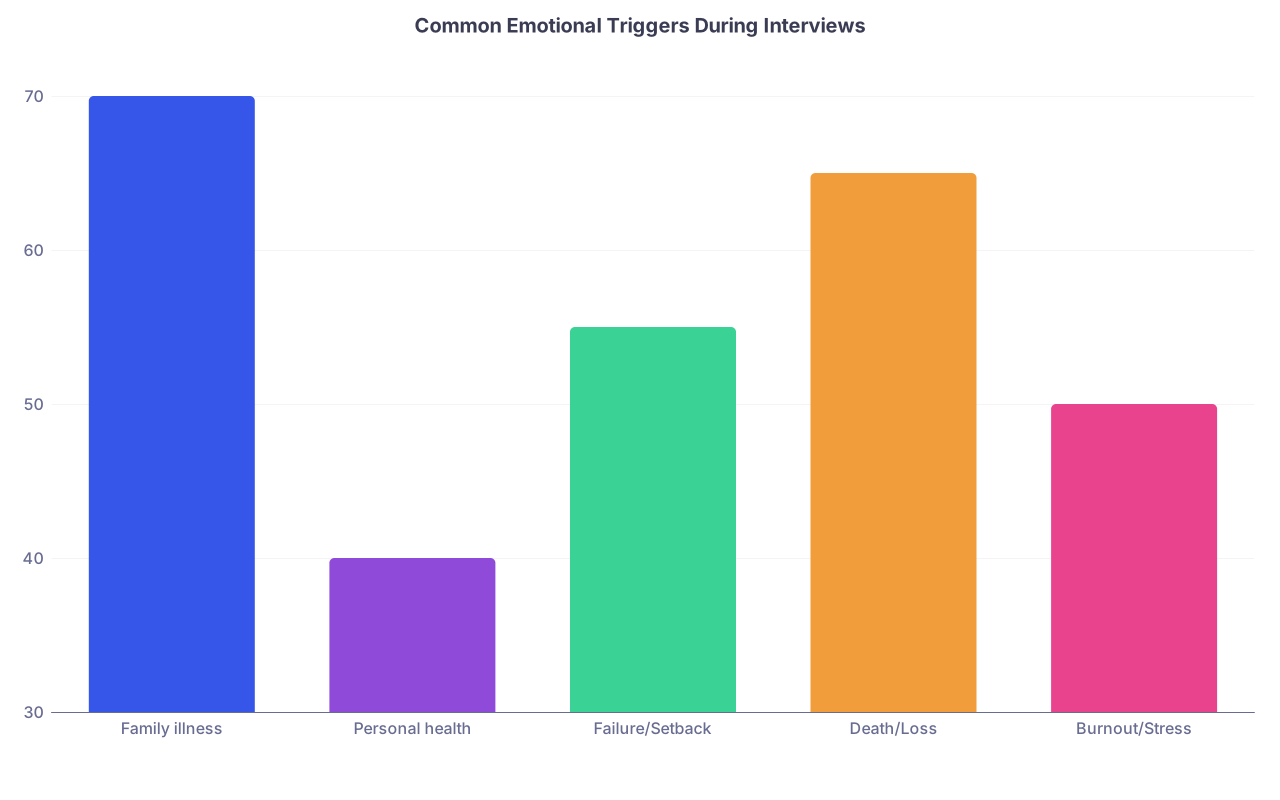
| Category | Value |
|---|---|
| Family illness | 70 |
| Personal health | 40 |
| Failure/Setback | 55 |
| Death/Loss | 65 |
| Burnout/Stress | 50 |
Micro-Prep Plan for the “What If I Cry?” Fear
If your anxiety needs an action plan, here’s a compact one:
- List 3–4 experiences you might talk about that are emotional but not catastrophic to discuss.
- For each, write:
- 1 sentence of context
- 2–3 sentences of what happened
- 2 sentences of what you learned/how it shaped you
- Practice saying them out loud while:
- Pausing intentionally
- Naming emotion if it shows up (“This is still emotional for me…”)
- Ending with reflection, not just description
- Decide in advance:
- Topics you will not talk about
- A boundary phrase if someone wanders near those topics
You’re not trying to eliminate the possibility of tears. You’re building a safety net so if they show up, you’re not free-falling.

FAQ (Exactly 4 Questions)
1. Will crying automatically ruin my chances of acceptance?
No, not automatically. Admissions committees don’t sit around saying, “Anyone who tears up is out.” They look at patterns, not single moments. If you’re generally articulate, reflective, and show you can recover your composure, a brief moment of emotion is usually fine. What hurts more is being completely unprepared, rambling, or having no insight into your own reaction. One emotional moment in an otherwise strong interview is rarely the deciding factor.
2. Should I warn interviewers at the start that I’m an emotional person?
You don’t need to open with, “By the way, I cry a lot.” That can feel awkward and sets a weird tone. Instead, if you feel yourself tearing up in a specific answer, you can give a small in-the-moment frame like, “I tear up when something means a lot to me, but I’m okay to continue.” That’s more natural and actually relevant to what they’re seeing. Preemptive disclaimers at the very beginning usually just feed your anxiety, not calm it.
3. What if I start crying and literally can’t talk for a bit?
You buy yourself time. Say, “I’m sorry, this is hitting harder than I expected. Could I take a moment?” Then actually take it. Breathe. Sip water. Look down, then back up. If after that you still can’t speak, you can ask to move on: “I think this might not be the best story for me to share today. Could we go to another question?” Is that ideal? No. Is it fatal? Not necessarily. They’ll likely note it, but if the rest of your interview is strong, it’s one piece of data, not your entire identity.
4. Are there topics I should avoid if I’m worried about crying?
Yes. Anything that still feels raw, like it could rip you open on a random Tuesday, is a bad candidate for an interview story. Recent deaths, active trauma, unresolved mental health crises—those are things to handle with professionals and trusted people, not strangers assessing you. Choose experiences where you’ve had time to process and can talk more from scar than from open wound. You can still be honest and vulnerable without using the absolute darkest chapter of your life as content.
Key points to walk away with:
- Crying doesn’t automatically tank an interview; how you handle it matters more than the tears themselves.
- You’re allowed to set boundaries around what you share, and you should avoid stories that are still completely raw.
- Practice not just your answers, but your recovery moves—the pause, the breath, the simple phrase that lets you regroup.