
What actually happens if you walk into an MMI station, your brain goes blank, and you just… sit there? Like, full panic, no words coming out, timer ticking?
Let’s talk about that exact nightmare. Because it does happen. And people still get in.
The Truth About “Freezing” in MMIs
Let me just say the thing you’re afraid of:
You’re picturing yourself in front of an interviewer, question on the door said something like “Your attending writes a racist note in a patient chart. What do you do?” and you walk in, sit down, open your mouth, and nothing comes out. The interviewer stares. The timer is running. You feel your ears get hot. And you think: “That’s it. I’m done. Career over.”
Here’s the uncomfortable but useful reality:
You probably will freeze at some point. Maybe not full-on statue mode, but you’ll:
- Misread a prompt
- Forget your train of thought halfway through
- Lose your structure and ramble
- Have one station that feels like a dumpster fire
I’ve seen it at places like UBC, Calgary, McMaster, US schools using MMIs, all over. Every year, strong applicants walk out saying, “I totally bombed that one station.”
And somehow? Admissions committees still give them offers.
Because MMIs are designed assuming you won’t be perfect. They know you’re nervous. They know the format is weird. They’re literally testing not just how well you speak when things go right, but:
- How you handle pressure
- How you recover
- Whether you completely unravel or can stabilize yourself
So freezing doesn’t automatically kill you.
Freezing and staying frozen? That’s the problem.
What “Freezing” Actually Looks Like (And Why It Starts)
You’re not usually going to black out dramatically and collapse. The more common versions are quieter and more insidious:
- You read the door prompt and your mind goes cloudy: “I’ve seen an ethics framework for this but I can’t remember any of it.”
- You start answering, then halfway you realize, “I’m just repeating myself and this is garbage,” and you panic.
- You get a role-play station where the actor pushes back, you weren’t expecting that, and you feel cornered.
- You see the interviewer’s neutral face and your brain translates it as “They hate me, abort, abort.”
The mechanics behind it are boring but real: adrenaline spikes, your prefrontal cortex (the part that does complex thinking) takes a temporary hit, and your body thinks it’s in danger. Not “answer a question” danger. “Lion chasing you” danger.
So your brain does exactly the wrong thing:
It narrows. It stops being flexible. You get stuck on “I don’t know, I don’t know, I don’t know.”
You can’t stop that initial surge completely. But you absolutely can interrupt it and get back online faster.
The 30-Second Rescue Plan When You Freeze
This is the part you actually need burned into your brain for interview day. What do you do when everything inside is screaming and you have no idea what to say?
Use this exact sequence.
Step 1: Say something that buys you time
Silence feels like death. But a short, intentional pause sounds thoughtful, not panicked.
You can literally say:
- “Let me take a moment to organize my thoughts.”
- “That’s a challenging scenario. I’d like to think through the key issues first.”
- “I want to make sure I approach this carefully—just a second.”
Those sentences do three things:
- Signal to the interviewer that you’re still functional.
- Break the panic loop of “I’m silent, they think I’m dumb.”
- Give you 5–10 seconds of breathing room that doesn’t look weird.
Step 2: Fix your physiology first (10 seconds)
You’re not going to “logic” your way out of panic if your body thinks it’s dying.
Do this physically, even if it feels awkward:
- Plant your feet flat on the floor.
- Drop your shoulders. Unclench your jaw.
- Take one slow breath in for 4 seconds, out for 6.
- Feel the chair under you. Literally notice the pressure.
You don’t need to look like you’re doing a coping exercise. Just look like you’re pausing and thinking. The interviewer is used to this. They’re not clocking your breath count.
Step 3: Zoom out: restate the scenario
If you don’t know where to start, start with the obvious. You can always build from there.
Something like:
- “So in this scenario, I’m a medical student who witnesses my attending making a racist comment in the chart about a patient.”
- “Here, the main conflict seems to be between respecting the patient’s autonomy and my obligation to protect them from harm.”
- “I’m being asked what I would do if my friend and classmate was cheating during an exam.”
Restating is not a waste of time. It buys you momentum. It also gives the interviewer confidence that you actually understood the question.
And sometimes, in the middle of saying it out loud, your brain suddenly goes, “Oh, right, I do know what to say.”
Step 4: Use a skeleton, even if it’s ugly
You do not need a perfect ethical framework memorized. You need any structure so you don’t panic about “rambling.”
Use a bare-bones one like this:
- Identify the key issues
- Mention who’s affected
- Say what you’d do first
- Show you’d seek help if needed
You can literally spell it out:
“First, I’d want to identify the main issues here: patient safety, professionalism, and discrimination. The main stakeholders would be the patient, myself as the learner, and the attending.
My first step would be to… [insert one concrete action]. Then, if I felt out of my depth, I’d seek guidance from… [who/why].”
Is it fancy? No.
Is it better than freezing? Yes. By a lot.
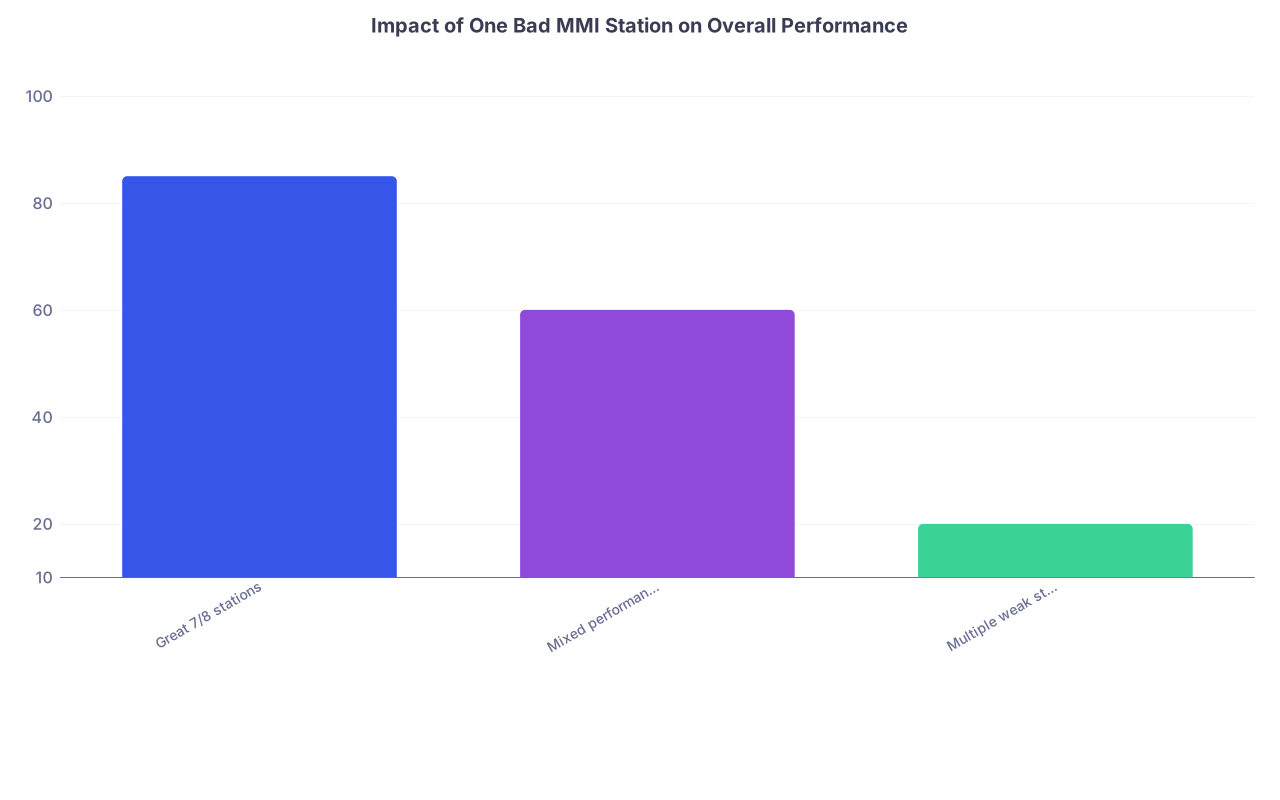
| Category | Value |
|---|---|
| Great 7/8 stations | 85 |
| Mixed performance | 60 |
| Multiple weak stations | 20 |
When You’ve Already Messed Up Mid-Station
Another panic scenario: You’re halfway through talking and you suddenly realize… this answer is going nowhere.
Good news: you’re allowed to pivot in the middle. In fact, it often looks mature.
You can say:
- “Actually, I’d like to clarify my approach here. I initially focused on X, but thinking it through, I realize Y is also important.”
- “Let me reframe that a bit. What I really want to emphasize is…”
- “I don’t think I explained that clearly—what I meant was…”
Interviewers don’t expect flawless monologues. They like seeing that you can recognize a weak answer and adjust. That’s literally what you’ll do as a resident when you catch yourself going down the wrong path on rounds.
If your mind goes blank mid-sentence
Don’t keep spiraling. Stop. Reset. Use:
- “I lost my train of thought there—let me regroup for a second.”
- Short pause. Breathe.
- “I was saying that my first priority would be patient safety, and to build on that…”
Worst case, if nothing comes back, you can generalize:
“I’m not finding the exact words I want right now, but the principle I’m trying to get at is balancing honesty with compassion and ensuring the patient feels heard and safe.”
Is it perfect? No. Does it show you’re still in the game? Yes.
Role-Play Stations: The Freezing Disaster Zone
Let’s be honest: these are where people most often fall apart.
Picture it: You walk in. Angry “patient” or upset “friend” starts firing at you. Your brain goes, “This isn’t real, but it feels real, and also they’re judging me, and also I sound fake.”
Here’s how to survive a freeze specifically in role-plays.
Step 1: Don’t chase the perfect script. Just be human.
You’re not being graded on Oscar-level acting. They’re watching for:
- Do you listen?
- Do you acknowledge feelings?
- Do you stay calm-ish?
- Do you avoid being defensive or dismissive?
If you freeze, go back to basics:
“I can see that you’re really upset about this, and I want to understand what’s worrying you most right now.”
If nothing else, say that. Then shut up and let the actor talk. They’ll give you something to respond to.
Step 2: Use “Name + Validate + Small Next Step”
When your brain is empty, lean on this reflex:
Name: “You seem really frustrated and scared.”
Validate: “That reaction makes sense given what you’ve been told.”
Next step: “Let’s go through what’s happening and what we can do from here, together.”
You can recycle that pattern multiple times. It never looks bad.

The Station You Fully Bomb: Then What?
Let’s talk about the horror story in your head: one station is a complete train wreck.
You say something awkward. You don’t answer the question well. You walk out and your internal monologue is: “They probably wrote ‘do not admit this person, ever’ in giant red letters.”
Here’s how this usually actually works.
Most MMI formats:
- Have 6–12 stations
- Use different interviewers at each
- Score each station independently
- Often drop outliers or heavily weight consistency
That means:
- One bad station rarely destroys you.
- A pattern of rude, unsafe, or unethical answers might.
- But one awkward, panicked, or rambly answer? It’s noise in the data.
I’ve seen people get in who:
- Completely misunderstood a station and only realized afterward
- Cried in a station (yep, it happens) and still recovered in later ones
- Got flustered and said, “I’m really nervous,” then pulled it together
The part that does hurt you more is letting that one disaster follow you into the next 3 stations.
So you need a between-stations reset ritual.
Between Stations: How to Not Spiral
You have like 1–2 minutes between stations. Just long enough to catastrophize… or reset.
Here’s a reset you can run like a script:
One sentence to contain the damage:
“Okay, that station wasn’t great. It’s one data point.”Physically shake it off (yes, literally):
Roll your shoulders, unclench your hands. Imagine you’re dropping that room behind you.Use a mini mantra (cheesy, but it works because your brain is mush):
“New station, new score.”
Or, “They judge me on the next 8 minutes, not the previous 8.”Focus on the door prompt in front of you like it’s the only thing that exists in the universe.
You can have an overall mediocre experience and still be fine if you don’t let one failure infect everything.

| Step | Description |
|---|---|
| Step 1 | Bad Station Ends |
| Step 2 | Name it: One bad station |
| Step 3 | Physical reset: breathe, posture |
| Step 4 | Short mantra: New station, new score |
| Step 5 | Read next prompt slowly |
| Step 6 | Spiraling Thoughts? |
Practicing “Freezing” So It Hurts Less
You don’t build resilience by only practicing when everything is calm and perfect.
If you really want to feel less terrified about freezing:
- Do timed practice with a friend where they’re not allowed to help you when you blank. Sit in the silence. Force yourself to say, “I need a moment to gather my thoughts” and then continue.
- Intentionally ask them to interrupt: “Wait, but what if the patient refuses?” so you get used to regaining your train of thought.
- Record one or two practice answers that go badly. Watch them. Look for: Did it seem as awful as it felt? (Usually, not even close.)
You’re trying to teach your nervous system:
“I’ve been here before. I didn’t die. I figured it out.”
| What You Do When You Freeze | How It Usually Looks to Interviewer |
|---|---|
| Sit in silence, say nothing | Lost, overwhelmed, poor communication |
| Say “I need a second” + breathe | Thoughtful, self-aware |
| Restate scenario + basic structure | Organized, workable under stress |
| Admit confusion + outline principles | Honest, safe, teachable |
| Joke nervously + ramble | Unfocused, harder to score generously |
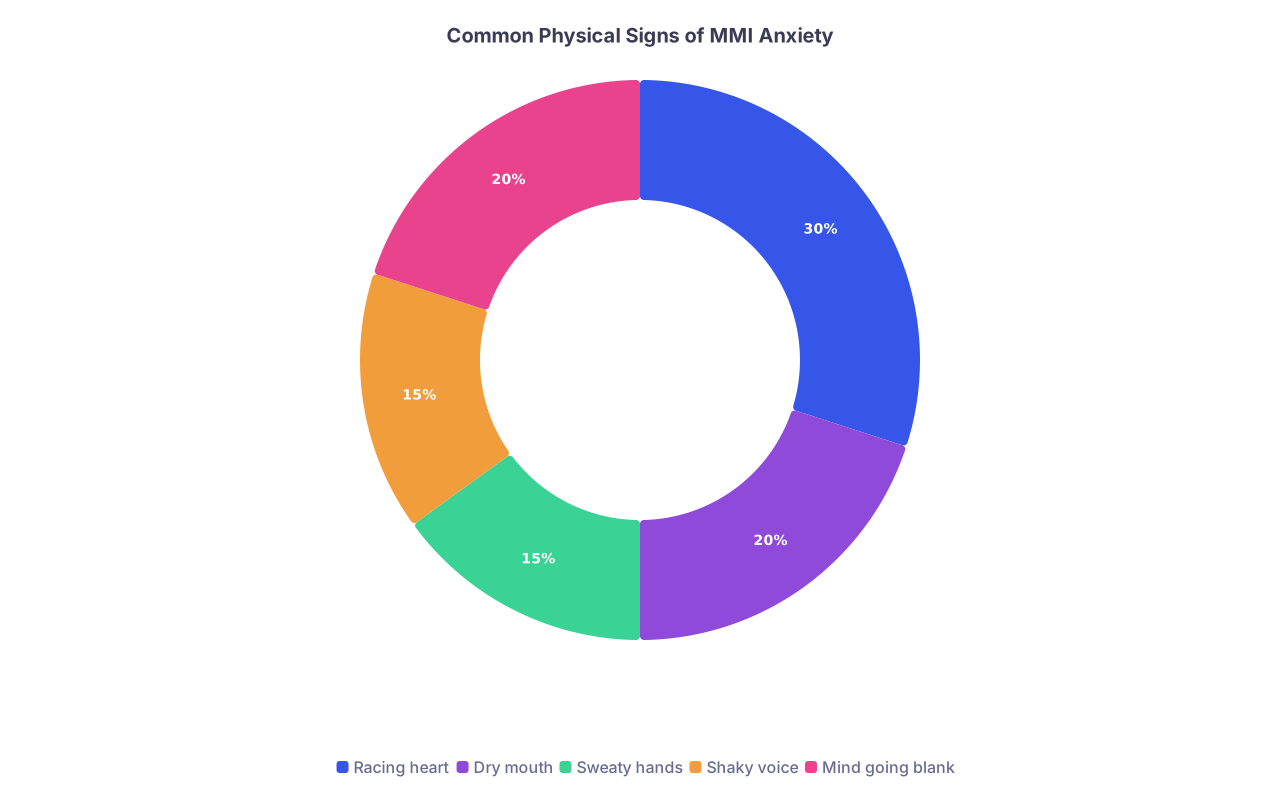
| Category | Value |
|---|---|
| Racing heart | 30 |
| Dry mouth | 20 |
| Sweaty hands | 15 |
| Shaky voice | 15 |
| Mind going blank | 20 |
The Line You Don’t Want to Cross
I’m not going to sugarcoat this: there is a line where “I froze” turns into something more serious.
Red flags that actually hurt you:
- Saying something blatantly discriminatory, dismissive, or unsafe
- Getting defensive when challenged (“Well, that’s just how it is”)
- Refusing to engage (“I don’t know, I just wouldn’t get involved”)
- Shutting down completely and not attempting an answer
If your panic makes you go quiet but you still try to answer with:
- Basic principles (respect, safety, honesty, empathy)
- Willingness to seek help
- A visible attempt to think it through
Then you’re already doing better than you feel.
The bar is not “sound like a fully trained attending.”
The bar is “sound like a thoughtful, safe, teachable future trainee.”

Your Worst-Case Scenario vs. Reality
Your brain is telling you this story:
“If I freeze on one MMI station, they’ll all think I’m incompetent, and I’ll never become a doctor.”
Reality is more like:
- The interviewer sees you’re nervous—because they literally see this all day.
- They notice whether you try to recover or not.
- Your performance is averaged across multiple stations.
- Unless you repeatedly show unsafe reasoning or total shutdown, one bad station fades into statistical noise.
What saves you isn’t perfection. It’s recovery.
Being able to say, in real time: “I’m nervous, I lost my words for a second. Let me regroup and think this through.”
That’s not a failure. That’s exactly what you’ll do in a hospital at 3 a.m. when a situation blindsides you.

FAQ: Freezing on MMI Stations
1. What if I literally say, “I don’t know” during an MMI?
Saying just “I don’t know” and stopping is bad. Saying, “I’m not entirely sure of the perfect answer, but here’s how I’d think about it…” and then walking through your reasoning? That’s fine. They care way more about how you think than whether you have a memorized solution.
2. How long is it “okay” to be silent while I think?
A few seconds is totally normal. Even 10–15 seconds can be fine if you’ve said, “Let me take a moment to collect my thoughts.” Extended, awkward silence with no explanation is what looks concerning. Narrate your thinking pause, and you buy yourself safe time.
3. Will one terrible station ruin my chances?
Almost never by itself. MMIs are built specifically to prevent one station from making or breaking you. It hurts more if that one station triggers a meltdown that affects all the others. Your job is to contain it: reset, move on, and don’t let it become a pattern.
4. What if I cry or visibly panic during a station?
It’s not ideal, but it’s also not an automatic rejection. If you can acknowledge it briefly (“Sorry, I’m quite nervous, but I’d like to keep going”) and still attempt a thoughtful answer, many interviewers will respect that. The bigger issue is if you shut down and refuse to continue engaging.
5. How can I practice for freezing without making myself more anxious?
Practice small, controlled “fails.” Use a friend or mentor to run mock MMIs and ask them to throw in a question where you’re not allowed to answer for 10 seconds. Get used to saying, “I need a moment to think.” Record yourself. The goal isn’t to eliminate anxiety; it’s to prove to yourself that you can still function with it.
Take one concrete step today:
Write down three sentences you’ll use if you freeze (like “Let me take a moment to organize my thoughts”). Put them on a sticky note, on your wall, on your phone—whatever. Read them out loud three times. That way, when your brain goes blank in the room, your mouth will still know what to say.