
What actually happens if you admit in an interview that you were burned out? Or that you doubted medicine? Do they quietly write “red flag” and move on to the next person?
Let me just say the thing we’re both thinking: you’re scared that one honest sentence could blow up years of work.
You’re not crazy for worrying about this. Interviewers love to say “we value authenticity” and then in the same breath talk about “resilience” and “commitment to medicine.” So you’re stuck wondering:
If I tell the truth, will I look weak?
If I don’t, will I sound fake?
Let’s pick this apart like we’re sitting in a coffee shop after your MMI went sideways.
The Harsh Truth: Full, Raw Honesty Can Hurt You
There’s a difference between honesty and unfiltered oversharing.
You absolutely cannot go into a med school or premed interview and say things like:
- “I was so burned out I didn’t care about patients anymore.”
- “I’m not sure I even want to be a doctor.”
- “Sometimes I think I just picked medicine because my parents wanted it.”
- “I’m not sure I can handle residency hours.”
Even if all of that has crossed your mind at 3 a.m.
The people interviewing you are thinking like this (even if they’d never admit it out loud):
- Will this person survive M1 anatomy and exams without completely imploding?
- Will they crumble and quit in third year when they’re on call and sleep-deprived?
- Are they going to be a professionalism or wellness problem we have to manage?
So if what they hear is: “I doubt myself, I burned out badly, and I’m not sure I want this,” they’re not going to be impressed by your “vulnerability.” They’re going to be nervous.
That’s the worst-case scenario we’re both terrified of: you being honest → they interpret it as instability → rejection.
So no, you can’t be completely, brutally transparent about every dark thought you’ve had. That’s not lying. That’s understanding the context you’re in.
But Being Fake Backfires Too (And They Can Smell It)
On the flip side, walking in with this robotic script:
- “I’ve always wanted to be a doctor.”
- “I’ve never doubted this path.”
- “I don’t get burned out — I’m just passionate.”
That sounds like you binge-watched med school YouTube and copied lines. Interviewers have seen 200 versions of that applicant. It’s boring. And fake.
And it doesn’t match reality. There isn’t a single serious premed or med student who hasn’t:
- Questioned themselves
- Hit a wall with exhaustion
- Wondered if they chose the right path
So here’s the annoying tension:
Too honest → red flag.
Too polished → fake.
The goal isn’t “total honesty” or “total performance.” The goal is strategic truth:
- Real experiences
- Real struggle
- Real growth
…framed so you look self-aware and capable, not unstable or checked-out.
What You Can Safely Admit (And How to Say It)
You can talk about burnout and doubts. You just have to control:
- Where the story ends
- How you describe your mindset in the worst moments
- What you learned and changed
Think of it like telling a story where the low point is clearly in the past and the current you is stronger for it.
Here’s the big rule:
Never stop the story at “I was struggling.”
You must end at “I struggle → I recognized it → I took action → I grew.”
Let’s break some examples down.
Example: Academic / Study Burnout
Unsafe version:
“During my junior year, I was so burned out I stopped caring about my classes and my grades dropped. I just felt over it.”
Better version:
“During my junior year, I hit a point where I was pushing myself hard but not in a sustainable way. My study routine became all-consuming, and I started feeling detached and exhausted.
What changed things was realizing that this wasn’t just about working harder but working smarter and taking care of myself as a human, not just a GPA. I met with an academic advisor, cut back on a couple of commitments, built in protected time for sleep and exercise, and started using more structured study schedules instead of just brute-force hours.
The difference showed up not only in my grades but in how much I was actually absorbing. That experience is why I take burnout seriously now — I watch for early signs and adjust before it gets to that point.”
Same basic truth: you burned out. But now you sound like someone who:
- Recognizes patterns
- Seeks help
- Adjusts
- Learns
That’s exactly what they want to see.
Example: Doubts About Medicine
Unsafe version:
“I wasn’t sure if I even wanted to go into medicine. I considered alternative careers.”
That sounds like you’re still halfway out the door.
Better version:
“There was a period, especially during COVID, when I stepped back and really questioned what kind of work I wanted my life to be about. I took that seriously — I talked to physicians in different specialties, explored public health, and shadowed in both clinic and hospital settings.
Those conversations and experiences clarified something for me: I’m drawn to work that combines long-term relationships, problem solving, and responsibility for real outcomes. Medicine isn’t the only place you can find that, but for me, it’s where everything aligns the most.
So yes, I had doubts, but wrestling with them made my decision more solid, not less.”
You admit doubt. But it’s past tense, thoughtful, and leads to a stronger “why medicine.”
The Line You Really Don’t Want to Cross
There are some things where you have to be extremely careful in an interview setting:
- Ongoing, unmanaged mental health crisis
- Current, active thoughts of quitting medicine
- Statements that question your basic ability to handle stress
- Anything that sounds like: “If it gets hard, I might walk”
I’m not saying “hide your mental health forever and suffer silently.” I’m saying an interview is not therapy. It’s not a safe, confidential processing space. It’s a high-stakes professional evaluation.
You can talk about:
- Past depression, anxiety, or burnout
- As long as you clearly show:
- You recognized it
- You sought appropriate help (therapy, counseling, support)
- You put systems in place to prevent a repeat
- You’re currently stable and functioning well
What you don’t want to do is:
“Honestly, I’m still really struggling with burnout and I don’t know if I can handle med school stress.”
That may be true. But if you say it in an interview, they will very likely not take the risk. They’re thinking about attrition, leave of absence, remediation, patient care.
You’re allowed to protect yourself by choosing how much to disclose and at what level of detail. That’s not being dishonest. That’s boundaries.
How Honest Are Other Applicants Actually Being?
Let me blow up a myth:
Most people are not sitting in interviews spilling their deepest fears.
Here’s more or less what your competition is doing:
| Topic | What They Usually Do |
|---|---|
| Study burnout | Admit it vaguely + emphasize new strategies |
| Doubts about medicine | Briefly mention + turn into clarity story |
| Mental health | Past issue + managed + now stable |
| Wanting work–life balance | Frame as “sustainability” and “longevity” |
They’re selective. They’re curated. They’re leaving out the messiest details.
So no, you don’t have to walk in there as the one brutally honest person who admits every intrusive thought you’ve had at 2 a.m. That’s not the game that’s being played.
A Simple Framework: 3-S Sentence for Tough Topics
If your brain freezes and you don’t know how honest to be, use this structure:
- Situation – what happened (brief, not graphic)
- Struggle – what was hard, in professional language
- Strength – what you did, learned, and now apply
For example:
“In my second year, I overloaded my schedule with classes, research, and volunteering (Situation). By mid-semester, I was exhausted and started noticing my focus slipping, and I wasn’t present in my volunteer work the way I wanted to be (Struggle). That pushed me to get help from my advisor, scale back to what I could do well, and adopt a more realistic planning system — now I’m much more intentional about saying yes only when I can show up fully (Strength).”
You’re honest. You just don’t wallow in the middle part.
How Far Can You Go With “Doubts” Without Hurting Yourself?
You can safely admit things like:
- “I questioned whether I was choosing medicine for the right reasons.”
- “I wondered if I’d be able to handle the emotional weight.”
- “I worried about work–life balance and what that would look like long term.”
Those are normal. Human. Mature, actually.
But every single time, you need the rest of the sentence:
- “I questioned whether I was choosing medicine for the right reasons, so I…”
- “I worried about the emotional weight, which led me to…”
- “I wondered about work–life balance, and after talking with physicians, I…”
If “and then I…” doesn’t lead to:
- Insight
- Clarification
- Stronger commitment
then don’t say it in an interview yet. It’s not ready. That’s something to talk through with a mentor or therapist, not an adcom.
What If They Ask You Directly About Burnout?
You know those questions:
- “Tell me about a time you experienced stress or burnout.”
- “How do you handle feeling overwhelmed?”
- “Medical training is stressful. How will you cope?”
They’re basically inviting you to talk about this. So you should have 1–2 prepped stories that follow that 3-S structure.
You are allowed to:
- Choose a version of the story that is serious but not catastrophic
- Omit raw details that don’t help your case
- Emphasize concrete coping strategies:
- Sleep boundaries
- Exercise
- Saying no
- Therapy/counseling
- Time management
- Support systems
If they push with, “Do you ever doubt your decision to pursue medicine?” you can say something like:
“I take the decision seriously, so yes — at different points I’ve stepped back and asked myself if this path aligns with who I am and the kind of life I want to build. Each time I’ve gone through that process — talking with physicians, reflecting on what energizes me, showing up in clinical settings — I’ve come out more certain that this is where I want to be. The doubts didn’t pull me away; they forced me to commit more intentionally.”
That’s honest. Controlled. And not self-sabotaging.
Visual: What Interviewers Want to Hear vs Fear Hearing
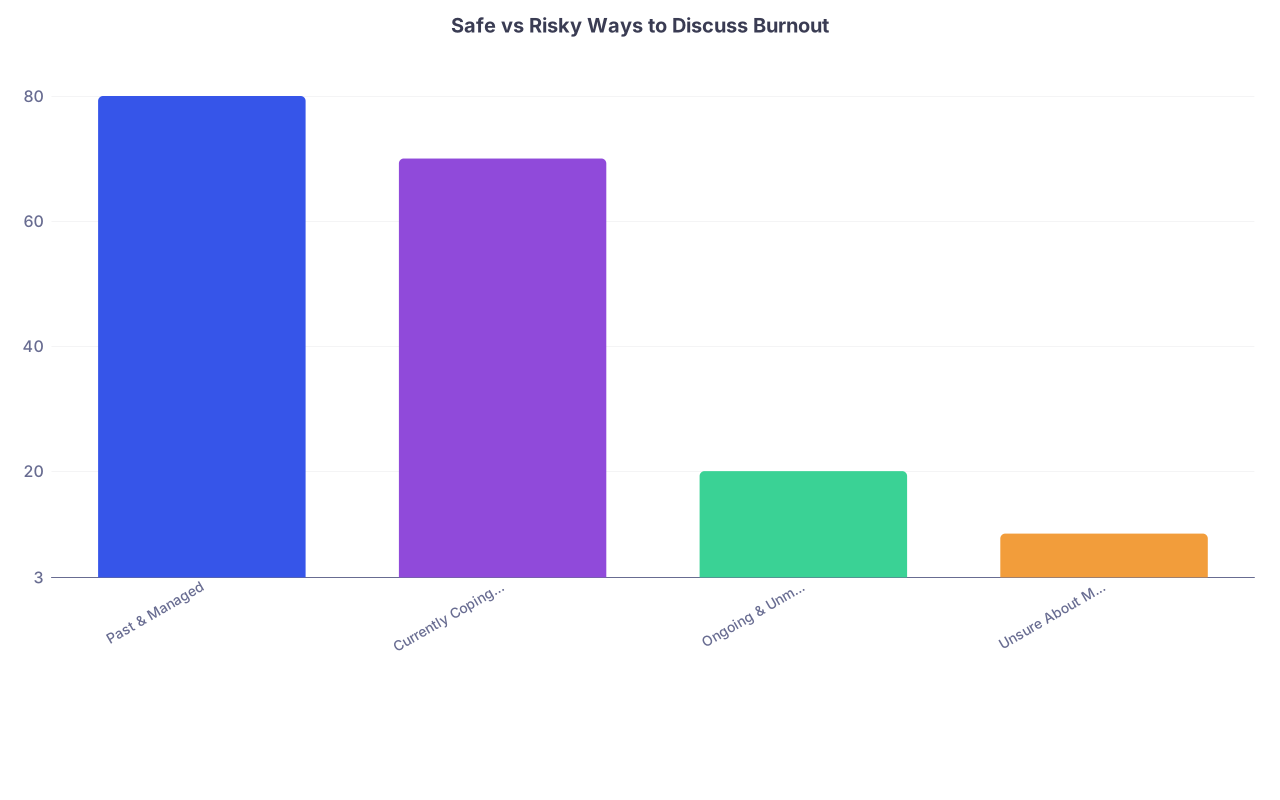
| Category | Value |
|---|---|
| Past & Managed | 80 |
| Currently Coping Well | 70 |
| Ongoing & Unmanaged | 20 |
| Unsure About Medicine | 10 |
Roughly speaking:
- “Past & managed struggle” → high comfort for interviewers
- “Currently coping but with tools/systems” → usually okay
- “Ongoing, unmanaged crisis” → big red flag
- “Not sure I want to be a doctor” → huge red flag
So anchor your honesty in those top two zones.
A Quick Reality Check on “Authenticity”
Everyone throws around “be authentic” like it’s simple. It’s not.
Real authenticity in an interview is:
- You telling true stories
- About real weaknesses and struggles
- Filtered through what’s relevant and appropriate
- With clear growth and reflection
Fake “authenticity” is:
- Trauma-dumping because you think vulnerability = bonus points
- Oversharing in a way that makes them worry about your stability
- Confessing things you haven’t processed yet
You don’t owe an interviewer your whole inner world. You owe them a fair, honest picture of whether you’re ready for this path and how you handle difficulty.
That’s it.
FAQ – Exactly What You’re Afraid to Ask
1. If I don’t mention my worst burnout, am I lying?
No. You’re not under oath. You’re not filling out a psychiatric intake form. You’re choosing examples that are honest and appropriate for a professional setting. That’s normal and expected.
2. Can I talk about depression or anxiety in an interview?
Yes, but carefully. Frame it as: past or well-managed → you sought help → you developed coping tools → you’re currently functioning and stable. If it’s still very raw or unstable, I’d talk with a trusted mentor before deciding how much to disclose.
3. What if I’m still not 100% sure about medicine?
Then this might not be the best time to be interviewing, honestly. In the actual interview, you cannot present yourself as “50/50.” You can say you once had doubts and worked through them. But if you’re still actively unsure, that will leak into your answers. Programs are looking for committed people, not “maybe.”
4. What if I panic and overshare in the moment?
It happens. If you realize mid-answer you’ve gone too far into “I was totally falling apart” territory, pivot fast: “Looking back, that was a turning point for me because…” and then throw all your weight into the growth, support, and systems you built afterward. Don’t leave them sitting in the chaos part of the story.
5. Are interviewers actually sympathetic about burnout, or is that just PR talk?
Some are genuinely empathetic, especially younger faculty and residents who’ve just been through it. Others care, but they’re still thinking like gatekeepers. They’re not your therapist. So yes, they understand burnout is real — but they’re still screening for who looks like they can withstand the pressures.
6. What’s the safest “honest” answer if I’m really scared to talk about burnout?
Prep one solid example of a time you were overwhelmed — not your absolute worst breakdown — and practice telling it with the 3-S structure: Situation → Struggle → Strength. Keep the struggle honest but controlled, emphasize what you do differently now, and stop talking once you’ve clearly landed on growth. That’s usually enough.
Bottom line:
- You can be honest about burnout and doubts — but only if the story ends in growth, stability, and stronger commitment.
- You’re not required to unload every dark moment you’ve had; interviews are professional evaluations, not therapy.
- Use your stories to prove you recognize struggle early, seek help, and adjust — that’s the kind of “honesty” that actually helps you, not hurts you.