You’re not going to blow your interview just because you don’t have a dramatic “I held a patient’s hand in the ICU” story.
Let me say that again, because your brain probably rejected it the first time: you can still have a strong medical school interview without classic clinical stories.
The Fear: “I Have Nothing To Talk About”
Here’s the nightmare script running in your head:
You walk into the interview.
They smile: “So, tell me about a meaningful clinical experience.”
Your mind: static.
You worked at a non-clinical job. Your “shadowing” was three afternoons where you mostly stared at a computer. You never “saved” anyone. You never had a crying-family-in-the-hallway moment.
- “They’re going to think I don’t care about medicine.”
- “Everyone else has scribe stories, EMT stories, hospice stories. I have… nothing.”
- “Are they going to think I lied on my application?”
- “What if they ask about a patient and I literally can’t name one?”
I’ve watched people spiral over this. Smart people. Strong applicants.
And I’ve watched those same people get acceptances anyway.
Because here’s the part you’re missing: they’re not grading the setting of your story. They’re grading the thinking behind it.
If you give them that, you’re not sunk. Not even close.
Reality Check: What Interviewers Actually Care About
Most applicants think the interview is about showing off their “most impressive” clinical moment. Nope. Interviewers are trying to answer a different question entirely:
“Does this person have a realistic idea of what medicine is, and are they ready for this life?”
They use clinical questions as a shortcut to get at:
- How you think about patients and people
- How you handle discomfort, ambiguity, and not-knowing
- Whether you can reflect instead of just narrating events
- Whether your interest in medicine is grounded in something real, not a fantasy
They do not need:
- A heroic trauma bay story
- A 20-minute story where you watched a surgeon do something wild
- An emotionally manipulative “a kid died and I changed forever” monologue
I’ve seen people bomb interviews even with “perfect” clinical stories, because they just described what happened and never showed any insight. And I’ve seen people with minimal clinical stuff absolutely nail it by being clear, honest, and reflective.
So no, lack of “big” clinical stories does not automatically equal bad interview.
It just means you’ll have to be more intentional about how you use what you do have.
Step 1: Audit What You Actually Have (You Probably Have More Than You Think)
Your brain likes to label everything as “not good enough” before you even start. So let’s drag the facts into the light.
Ask yourself: in the last few years, did you ever…
- Volunteer in a hospital, clinic, nursing home, free clinic, rehab center, counseling center, crisis line, or COVID site?
- Shadow anyone for more than a few hours? Primary care, surgery, dermatology, psych, literally anything?
- Work in a semi-medical role: MA, CNA, scribe, tech, front desk at a clinic, research coordinator, vaccine clinic assistant?
- Interact with people in vulnerable situations: tutoring kids from underserved backgrounds, working with homeless populations, disability services, elder care, mental health support, camps for kids with special needs?
If yes, you already have “clinical-adjacent” stories. They count more than you think—if you frame them correctly.
Even tiny stuff can work:
- A 4-hour shadowing afternoon where you watched a PCP slowly explain diabetes to a confused patient
- Helping a non-English speaking family navigate a waiting room
- Sitting with one lonely patient at a nursing home and realizing you were the only visitor that week
None of that is glamorous. Interviewers don’t need glamorous. They need honest and thoughtful.
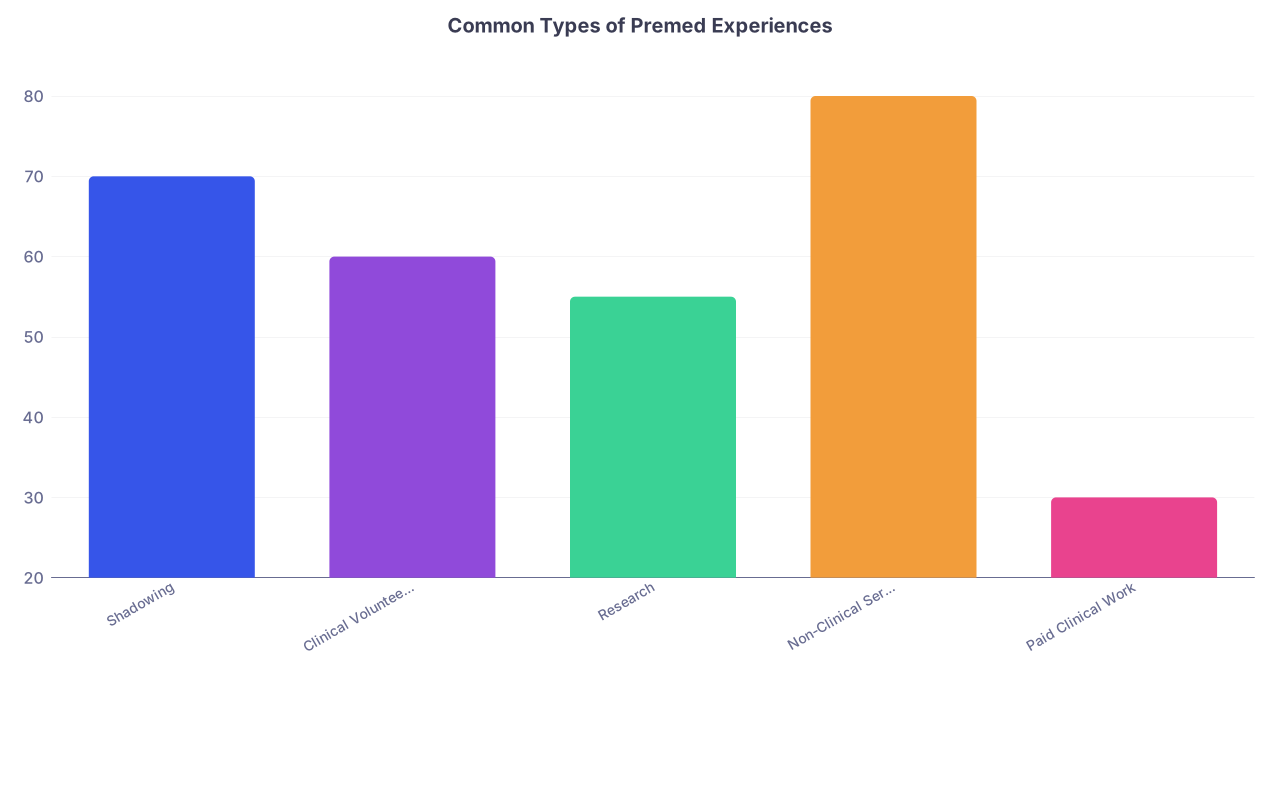
| Category | Value |
|---|---|
| Shadowing | 70 |
| Clinical Volunteering | 60 |
| Research | 55 |
| Non-Clinical Service | 80 |
| Paid Clinical Work | 30 |
The quiet, small stories are often more believable anyway. Everyone has a “I saw a code blue” moment. Not everyone can explain what that moment taught them besides “medicine is intense.”
Step 2: Turn Non-Clinical Into Interview Gold
Let’s deal with the worst-case scenario in your head:
“I literally have no clinical experience. None. Zip.”
Okay. Deep breath. Then this is your strategy:
You stop pretending you do. And you lean hard into two things:
1. Honesty about where you are
2. Evidence that you understand what medicine is like even if you haven’t been in the trenches yet
Here’s what that can sound like:
“I haven’t had as much direct clinical exposure as I’d like yet—that’s something I’m actively working on changing. What I have done is [X, Y, Z experiences], which put me in very similar situations: working with vulnerable people, seeing how systems affect individuals, and dealing with uncomfortable conversations. For example…”
Then you pick a non-clinical story, and you focus on:
- The human piece (empathy, communication, boundaries)
- The messy piece (conflict, confusion, moral tension)
- The “what I learned and how I grew” piece
For instance:
- You mentored a kid whose parent was in and out of jail. You saw how systems fail families repeatedly. That’s relevant.
- You worked front desk at a community center and had to deal with angry, frustrated people while staying calm and helpful. That’s relevant.
- You did research that never touched patients, but you saw how slow and frustrating the process is, and how that affects real-world progress. That’s relevant.
The question isn’t “Was this in a hospital?” The question is “Did this experience change how you understand people, suffering, responsibility, or yourself?”
If yes, it can be used.
If no… then it probably wasn’t that meaningful anyway.
Step 3: How to Answer “Tell Me About a Clinical Experience” When You’re Light on Stories
Here’s the anxiety spike: they use the actual word “clinical” and your soul leaves your body.
You’re allowed to answer this more flexibly than you think.
You can respond in a way that (1) doesn’t lie and (2) doesn’t tank you.
Example if you have some but not much:
“Most of my direct clinical exposure so far has been limited to shadowing in [setting] and volunteering in [setting]. One experience that really stuck with me was when I observed [brief scene]. I wasn’t providing care myself, but watching how [physician or team] handled [challenge] showed me [insight]. It made me realize [what you took away and how it shaped your motivation].”
Example if you truly have almost nothing:
“To be completely transparent, my clinical exposure so far has been more limited than I’d hoped for, partly because of [brief, non-whiny reason if relevant—COVID, geographic, family obligations]. I’ve still tried to get as close as I can to patient-centered work through [non-clinical but people-heavy role]. For example, when I was [describe situation], I had to [difficult interpersonal task], which reminded me of what physicians face when [parallel]. It reinforced for me that medicine isn’t just science—it’s communication, boundaries, and being present with people at really difficult points in their lives.
I’m actively looking for ways to increase my direct clinical exposure before matriculation, but that experience showed me…”
You acknowledge the gap. You show you’re not naive. You pivot to what you do know. That’s what mature applicants do.
The thing you absolutely do not want to do is pretend. Interviewers smell fakeness instantly. And worse, if you can’t talk about basic clinical stuff with any detail, it looks like you embellished your application.
Step 4: Build Stories From Reflection, Not Drama
Most applicants think they need something big.
They don’t. They need something processed.
Take a boring shadowing day:
- You watched a physician see 20 patients
- You sat in the corner and mostly tried to look interested
- No one coded, no one cried, no life-changing diagnoses
This is useless if you say:
“I saw how the doctor cared for patients and listened to them.”
That’s vague and flat.
This is useful if you say:
“What surprised me most was how much of the day was spent doing things that didn’t look like ‘medicine’ from the outside—documenting, calling pharmacies, clarifying insurance issues. At first, I felt a little disillusioned because I’d imagined medicine as nonstop direct patient care. But by the end of the day, I realized those behind-the-scenes tasks were actually what enabled that care to happen. It forced me to confront whether I still wanted this path knowing how administrative it can be. I thought about it for weeks afterward and decided that, for me, the tradeoff is still worth it, but now for much more realistic reasons.”
See the difference? Same day. Different depth.
You’re not graded on how exciting the story is. You’re graded on how clearly you’ve thought it through.
Step 5: If You Still Have Time Before Interviews, Do This Now
If your interviews are months away and you’re spiraling over this, here’s the blunt truth: you should do something about it. Not because the interview will be impossible without it—but because you will feel better if you’re not walking in empty-handed.
Here’s the priority list, shortest to longest ramp-up:

| Step | Description |
|---|---|
| Step 1 | Need Experiences Fast |
| Step 2 | 1-2 Day Shadowing |
| Step 3 | Hospital Volunteering |
| Step 4 | Free Clinic / Community Health |
| Step 5 | Reflect & Take Notes |
Even a few half-days of shadowing are better than nothing—if you actually pay attention and reflect. Don’t chase “hours.” Chase insight.
After each experience, write down:
- One moment that surprised you
- One moment that bothered or unsettled you
- One thing you admired in a clinician
- One thing you didn’t like and what you learned from that
That’s where interview answers come from.
But if you literally have interviews next week? You are not going to magically manufacture 100 perfect hours. Don’t even try. Spend that energy preparing how to talk thoughtfully about what you have done.
How to Structure Your Stories So They Don’t Ramble
Your other fear: “Even if I think of something, I’m going to ramble and make no sense.”
Use a simple structure in your head. Something like:
- Context – 1–2 sentences: where you were, who was involved
- What happened – the key moment or conflict
- Your reaction – what you thought, felt, or struggled with
- What you learned – how it changed your understanding or behavior
Very quick example:
“During my time volunteering at a nursing home, I spent an afternoon with a resident whose family hadn’t visited in months. She told me, very matter-of-factly, that she felt like everyone had moved on without her.
I didn’t know what to say at first—I felt guilty, like my being there for an hour wouldn’t make up for that. But as we talked, I realized she didn’t want me to fix anything, she just wanted someone to sit with her and listen.
That experience shifted how I think about ‘helping’ people. It’s not always about solutions or grand gestures. Sometimes it’s about showing up consistently in small ways. In medicine, where you can’t always fix the underlying problem, I think that mindset will matter a lot.”
Not dramatic. Very human. Completely usable.
Clear About Limits Without Sounding Weak
The voice in your head says: “If I admit I don’t have a lot of clinical experience, they’ll reject me on the spot.”
No. If you admit it poorly, that hurts you. If you admit it clearly and own it, that can actually make you look mature.
What sounds weak:
“I just didn’t really get to do much. I tried, but it was hard. So I don’t have much clinical exposure.”
What sounds solid:
“My clinical exposure is more limited than I’d like so far, and that’s something I’m intentionally working on expanding before matriculation. At the same time, the experiences I have had—in [list briefly]—have already started to show me [1–2 grounded insights]. Those have confirmed for me that medicine is the right path, and I’m looking forward to deepening that exposure as a medical student.”
You’re not apologizing. You’re explaining and redirecting. That’s different.
How Schools Actually Weigh This Stuff
Let’s be blunt: some schools are obsessed with clinical experience. Some aren’t. Some care way more about your MCAT + GPA + mission fit.
Here’s a rough mental comparison, just so your brain has something concrete to hold:
| School Type | Typical View on Limited Clinical Experience |
|---|---|
| Top Research-Heavy (e.g., UCSF) | Tolerant if research is strong and reflection is solid |
| Mission-Driven Community-Focused | Want evidence you care about real people; service can substitute somewhat |
| State MD Schools | Prefer some clinical, but not all are rigid if rest of app is strong |
| DO Schools | Often want demonstrated patient interest, but holistic in review |
| Newer / Expanding Schools | More flexible; strong motivation + service can offset gaps |
You are not getting auto-rejected in the interview because you didn’t spend 500 hours scribing. They’re trying to see if you’re a thoughtful, grounded human who won’t burn out or quit when you realize medicine isn’t all “saving lives” montages.
Show them that. With whatever material you have.
FAQ (Exactly 5 Questions)
1. Am I basically doomed if I don’t have any “real” patient contact yet?
No. You’re not doomed. Is it ideal to have real patient exposure? Of course. But in reality, a lot of applicants—especially first-generation students, people from rural areas, or those who had heavy work/family obligations—end up with limited or patchy clinical time. What matters now is that you (1) don’t pretend otherwise, and (2) can still demonstrate a realistic understanding of medicine through shadowing, people-centered roles, or serious reflection. It’s a gap, not a death sentence.
2. Should I try to cram in a bunch of clinical hours right before my interview?
Not “a bunch.” You are not going to impress anybody with “I did 12 hours in the ER last weekend.” If you still have weeks or months, yes—get even a little more exposure and then think deeply about what you saw. But if you’re in the final stretch, you’re better off preparing how to talk intelligently about your existing experiences rather than chasing a few superficial hours that you won’t have time to process.
3. What if the interviewer keeps pushing for a patient story and I really don’t have one?
Be direct without being defensive. Something like: “I haven’t yet had the chance to work directly with patients in a hands-on role—that’s something I’m trying to build before matriculation. Most of my exposure has been through [shadowing / volunteering / service], where I’ve seen [brief example] and learned [insight]. I know that’s different from being the one delivering care, but those experiences have already shaped how I think about [communication, suffering, systems, etc.].” Then pivot into a concrete example. You answer the concern and then show your depth.
4. Should I exaggerate a minor interaction to make it sound more ‘clinical’?
No. That’s how you end up cornered in follow-up questions you can’t answer. Interviewers have heard every overblown story imaginable—“I basically led the code as a volunteer” type nonsense. It destroys your credibility. It’s far better to say, “I was on the sidelines for this, but watching it made me realize…” than to act like you were the central hero in a situation you barely understood.
5. Is it even ethical for me to go into medicine if I haven’t tested myself in clinical settings yet?
This is the real fear under all of this, isn’t it? “What if I get there and hate it?” The honest answer: you should keep testing your interest in real-world settings. That’s part of your responsibility. But no one walks into med school with a fully confirmed, 100% bulletproof certainty. What you can show ethically is that you’ve done your best, with the constraints you had, to understand what this life entails—and that you’re committed to continuing that reality check, not just chasing prestige or a fantasy. That attitude is what ultimately matters.
Years from now, you won’t remember the exact wording of that interview question about clinical experiences. You’ll remember whether you told the truth about who you were and trusted that it was enough to start.