
The myth about “Why medicine?” is dangerous: everyone thinks they need a movie script when what actually gets people in is clarity, honesty, and self-awareness.
The fear beneath “my story is ordinary”
Let me guess what’s running through your head:
“I didn’t survive a war.”
“I didn’t watch a parent die in the ICU.”
“I didn’t discover some rare disease in myself at age 12.”
“I just…liked science and volunteering and now I want to be a doctor. That can’t be enough.”
And now you’re imagining an interviewer thinking, “Wow, another basic premed. Next.”
I’m going to say something blunt: most “Why medicine” stories sound ordinary on paper. Even the people with dramatic moments still have pretty standard arcs when you strip away the emotion:
- Liked science.
- Exposure to healthcare.
- Wanted to help.
That’s 80–90% of applicants.
The difference isn’t the plot. It’s the insight. The reflection. Whether you actually understand what you’re signing up for and why you, specifically, are choosing this — not just why medicine is “good.”
But when you’re anxious (like I am basically 24/7 in application season), it’s way easier to spiral into “I’m not special” than to sit with your own story and pull out the real material.
Why your “ordinary” story feels so unimpressive
It feels unimpressive because you’re comparing your internal messy life to other people’s polished narratives.
You’ve seen those personal statement examples where someone says, “At 6 years old, I witnessed X, and that was the exact moment I knew…” and you’re like, “At 6 years old I was watching cartoons and eating Cheerios, what are you talking about?”
Here’s what’s actually going on:
- You know every boring detail of your life. You’re desensitized to it.
- You’ve probably told your “why medicine” story to yourself so many times it feels cliché.
- You assume admissions wants shock value instead of maturity. They don’t.
- You think “ordinary” = “weak.” It doesn’t. Unclear and shallow = weak.
I’ve seen applicants with “big” stories get rejected because their answers were basically trauma monologues with no reflection, and people with incredibly simple stories get multiple A’s because they came off grounded, clear, and realistic.
So if your story is:
“I liked biology, I had a good shadowing experience, I enjoy working with people, and I want to keep learning for life.”
That can absolutely work — if you stop leaving it at that bumper-sticker level.
What interviewers actually care about when they ask “Why medicine?”
Let me ruin the magic for a second: “Why medicine?” is not an invitation for you to perform your life’s most dramatic stories.
It’s a screening tool.
They’re silently asking:
- Do you understand anything about what doctors actually do?
- Can you distinguish medicine from nursing, PA, PT, public health, research? Or is this just “I like science + helping”?
- Have you thought realistically about the sacrifices: training length, burnout, emotional load, financial cost? - Does your path into medicine show persistence and commitment, not just a last-minute decision?
- Do you sound like someone who will still want this after a year of anatomy lab and 3 a.m. pages?
That’s it. No Oscar needed. They want someone who won’t crumble in M2 and say “I don’t know why I’m here.”
So if your story is ordinary but clearly answers:
- What drew you in
- What kept you in
- What you’ve learned about medicine from real exposure
- Who you are in this whole thing
You’re doing better than the person with the wild story who never mentions what being a physician actually means.
Turning “ordinary” into compelling: specific, not dramatic
Here’s the part you’re probably scared of: “How do I make my normal life sound like anything other than beige wallpaper?”
You don’t “spice it up.” You get specific.
General = forgettable.
Specific = real.
Look at the difference:
“I volunteered at a hospital and realized I want to help people.”
vs.
“I spent Saturday mornings in the infusion center, mostly bringing warm blankets and snacks. It felt small at first, but over months I started recognizing the same patients, watching them move from fear to familiarity. One day a patient asked if I’d be there for her last treatment because she’d ‘made it to the finish line.’ I wasn’t doing procedures, but I started to understand what continuity and presence meant in medicine.”
Same job. Completely different impact.
Let’s structure this for your interview answer.
A simple framework that actually works
Aim for 3 parts. Not a script — a skeleton you can fill in with your details:
The initial pull
How did you first get interested? It can be simple.“I always liked biology and problem-solving, and in college I started getting drawn to questions around illness and health — why some people get care and others don’t.”
The concrete experiences that changed your understanding
This is where you talk about shadowing, clinical work, research, scribing, etc. But not as a list. As moments that refined your reason.“Scribing in the ED, I saw how chaotic medicine can be. One night, a physician took an extra five minutes to explain a diagnosis to a scared teenager and their mom. No one else saw that moment as special, but I watched the tension leave the room. That balance — moving fast but still making people feel safe — is the kind of work I want.”
The informed, present-day why
Fast-forward to now: based on what you’ve seen, what about this role fits you?“After those experiences, what keeps me drawn to medicine is the mix of long-term learning, complex problem-solving, and the chance to walk with patients through some of their hardest days. I like being the person in the room who can both understand the physiology and translate it into something that actually helps someone decide what to do next.”
Notice something? No tragedy. No “single defining moment.” Just a thoughtful arc.
But what if my experiences are basic too?
You’re probably thinking, “Okay, but I only have the ‘standard’ stuff: hospital volunteering, a bit of research, some shadowing. Everyone has that.”
They don’t all process it.
You can make “basic” experiences powerful if you stop describing the job description and start describing:
- What surprised you
- What challenged you
- What changed your assumptions
- What made you uncomfortable
- What you learned about what doctors actually do all day
Let’s take the most stereotypical thing: college hospital volunteering.
Weak version:
“I volunteered at the hospital where I brought water and blankets and this inspired me to pursue medicine.”
Stronger version:
“I started volunteering at the hospital thinking I’d mostly be inspired. Instead, I was often frustrated. I saw how rushed everyone was, how many patients felt ignored. For a while, I wondered if medicine was too broken to be worth it. But as I watched certain physicians and nurses consistently go back to explain things again, apologize when wait times were long, and still show up the next day, I realized that imperfection doesn’t make the work meaningless. That tension — between system limits and individual impact — is something I’m willing to live with. It’s one of the reasons I still want to be in medicine, rather than walking away from it.”
Same hospital. Same badge. Deeper mind.
That’s what they’re listening for.
Are schools secretly ranking your trauma?
No. And honestly, a lot of people in admissions are tired of trauma Olympics essays and interview answers.
Are there people with genuinely intense backstories? Of course. But a “big event” isn’t a free pass. It actually raises the bar: they want to see that you’ve processed it, not that you’re just throwing it at them hoping for sympathy.
And here’s the part nobody tells you: some of the most “impressive” stories actually backfire if the applicant seems:
- Under-insightful (“My grandma died so I’m becoming a doctor to save everyone”)
- Unrealistic (“I’m going to fix the entire healthcare system”)
- Narrow (“I only want to do this one thing forever or I’ve failed”)
Your “boring” path can look healthier by comparison if you come off:
- Grounded
- Reflective
- Open to the unknown parts of training
- Aware that medicine is not a hero fantasy
That’s the person people want as a future colleague.
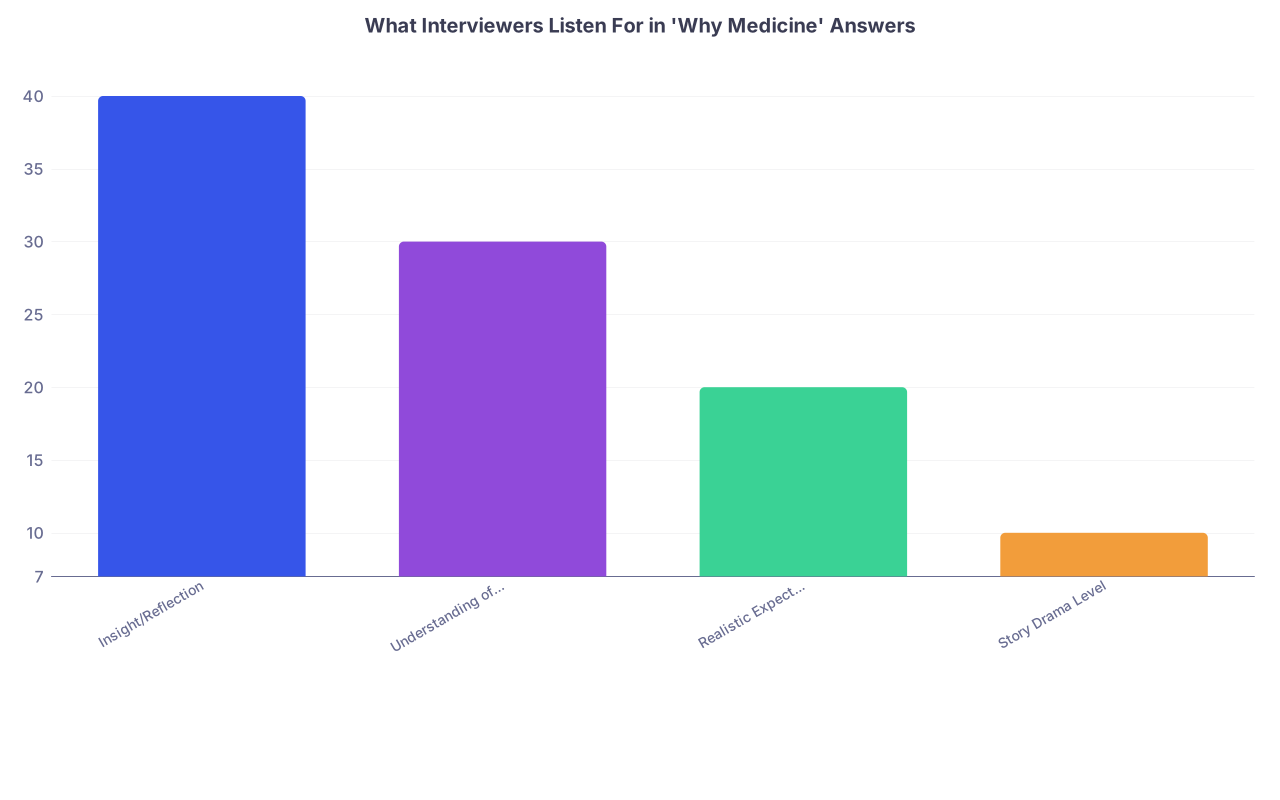
| Category | Value |
|---|---|
| Insight/Reflection | 40 |
| Understanding of Role | 30 |
| Realistic Expectations | 20 |
| Story Drama Level | 10 |
Drama is the least important piece. But it’s the one we obsess over.
Fixing your answer: from anxious ramble to coherent story
If your current “Why medicine” answer makes you cringe, that’s fixable. Try this exercise:
Write it out badly first.
Spill everything: “I like science,” “I want to help,” “My parents are doctors,” whatever. No filter. It’ll sound generic. That’s fine.Underline specifics.
Any sentence with a concrete person, place, or moment? Underline it. Those are your anchors.For each specific, ask yourself: “So what?”
Not in a mean way. In a “What did that show me about medicine or about myself?” way. Write those answers.Trim the fluff.
Anything that could be said by 10,000 other applicants with no changes? Cut or reword it until it’s unmistakably yours.Say it out loud.
Record yourself answering “Why medicine?” in 1–2 minutes. Listen. Do you sound like a person talking, or like ChatGPT on autopilot? Make it more like a conversation with a friend who genuinely asked you why you’re doing this.
If you can walk into an interview and say, calmly:
“This wasn’t one big moment for me. It was a series of experiences — in class, in clinics, and in community work — that kept pulling me toward the intersection of science and people’s lives. Over time, I realized I like being at that intersection, especially when things are uncertain or scary for patients. That’s what keeps me choosing medicine, even knowing how hard the path is.”
That’s not ordinary. That’s mature.
Ordinary story, extraordinary insight: that’s the actual goal
Here’s the shift I want you to make:
Stop trying to convince them your life has been exceptional.
Start trying to show them you think in an exceptional way about very normal experiences.
The person who says, “I’m sure this sounds like a common answer, but here’s what those experiences meant for me…” and then speaks clearly about their journey? That person often feels more trustworthy than the one who insists their story is unbelievably unique.
You don’t need a cinematic “why.” You need a stable one.

| Step | Description |
|---|---|
| Step 1 | Basic Interest |
| Step 2 | Real Experiences |
| Step 3 | Reflection on What You Saw |
| Step 4 | Understanding Doctors Role |
| Step 5 | Personal Fit and Motivation |
That flow is enough. If you’ve lived it and thought about it, your “ordinary” path is doing its job.
Quick comparison: what actually matters vs what you’re worrying about
| What You Obsess Over | What Interviewers Actually Care About |
|---|---|
| Having a dramatic backstory | Clear, coherent motivation |
| Sounding unique at all costs | Realistic understanding of medicine |
| Using big emotional language | Concrete examples and insights |
| Impressing with sacrifice | Signs you can handle training long-term |
The stuff you’re beating yourself up over? Mostly noise.
FAQ (exactly what you’re probably still worrying about)
1. What if my real reason for medicine is partly job security and stability? Can I say that?
You and 90% of applicants. It’s fine for financial security and stability to be part of your reason. It just can’t be the only thing you talk about. You can say something like, “I’m also drawn to the stability and longevity of a medical career — I like the idea of committing to one field long-term — but what really keeps me motivated day-to-day is…” and then go back to patient care, problem-solving, etc. Money/stability can be a supporting character, not the main character.
2. I switched to premed late. Does that make my ‘why’ weaker?
Not automatically. What matters is whether you can explain the switch in a way that makes sense and doesn’t sound impulsive. If you went from consulting to premed after scribing and realizing you miss working directly with people, that’s fine. Just be ready to walk them through: what you thought you wanted before, what you learned, and why medicine is now a better fit. Late is okay. Vague is not.
3. I don’t have a single ‘aha moment.’ Will that hurt me in interviews?
No. Honestly, saying, “I didn’t have one defining moment — it was more of a gradual process over several years of exposure and reflection” often makes interviewers relax. It signals that you didn’t make a life decision off one emotional event. Just make sure you can still give specific examples from along that gradual path, not just “I sort of always knew.”
4. What if I freeze and my ‘why medicine’ answer comes out generic on interview day?
This is the nightmare, right? Brain blank, mouth saying, “I like science and helping people.” The way around this isn’t memorizing a script — that usually makes you sound robotic and actually easier to derail. Instead, memorize 3–4 anchor moments you can always reference: a patient, a physician you shadowed, a challenge you had, a time you doubted medicine but came back to it. If you blank, grab one of those anchors and walk them through what happened and what it meant to you. Specifics will rescue you from generic language every time.
If you remember nothing else, remember this:
Your “Why medicine” doesn’t have to be dramatic.
It has to be honest, specific, and informed.
Ordinary life + deep thinking beats extraordinary drama + shallow reflection every single cycle.