
The worst thing you can do for a medical school interview is memorize your answers word-for-word.
Not exaggerating. Over-rehearsed, scripted answers are one of the fastest ways to tank an otherwise decent interview.
Let’s walk through what actually works, what doesn’t, and exactly how you should prepare instead.
The Short Answer: No, Don’t Memorize Answers. Memorize Frameworks.
You shouldn’t memorize full answers to medical school interview questions. You should memorize:
- Key stories
- Core themes
- Simple frameworks
That’s the difference between sounding polished and sounding fake.
What interviewers hate:
The classic “robot answer.” Perfect phrasing, zero real personality. You can hear the script from a mile away:
“I’ve always wanted to be a physician because I’m passionate about helping others and fascinated by the intersection of science and humanism…”
You’ve heard that line 100 times. So have they.
What interviewers like:
A clear, structured response where you actually sound like yourself:
“I didn’t decide on medicine at age five. It really clicked for me in college after shadowing in the ED and seeing how one physician could shift the entire tone of a room. I liked science before that, but that’s when I realized I liked being in the middle of the chaos with people.”
Same idea. Very different impact.
Why Memorized Answers Fail (And Interviewers Spot Them Instantly)
Let me be blunt: memorized answers make you look:
- Inauthentic
- Rigid
- Anxious
And those are three traits schools don’t want in a future physician.
Here’s what happens when you memorize:
You panic if they change the wording.
You practiced for “Why do you want to be a doctor?”
They ask: “If you couldn’t do medicine, what would you do and why?”
Your brain: System error. This is not the question I pre-loaded.You lose your natural tone.
Real people speak with pauses, adjustments, corrections.
Scripted people don’t. They talk like they’re reading a statement for court.You can’t adapt to follow-up questions.
Interviewer: “Tell me about a time you failed.”
You deliver your memorized “I got a B+ once” speech.
Interviewer: “What did that change about how you act now?”
You don’t have that part scripted. You stumble.You sound like everyone else who did the same thing.
Trust me, they hear the exact same cookie-cutter “weakness,” “teamwork,” and “resilience” monologues all day. It blends together.
Here’s the real rule:
You’re not being tested on your ability to recite.
You’re being tested on your ability to think and communicate in real time.
Memorized = bad for that test.
What To Do Instead: Build Answer “Skeletons,” Not Scripts
You don’t need full paragraphs. You need bones you can put different “skin” on.
Use this formula:
Prompt → Framework → Story → Reflection
Let’s break that down.
1. Prompt
The question they ask you. Example:
- “Why do you want to be a doctor?”
- “Tell me about a time you had a conflict on a team.”
- “What’s your biggest weakness?”
You don’t control the exact wording. So stop trying to memorize for one exact phrasing.
Instead, recognize the type of question: motivation, ethics, challenge, teamwork, etc.
2. Framework
This is your structure. A simple map for your brain so you don’t ramble.
Examples:
- Motivation questions (Why medicine / Why our school):
Past → Pivot point → Present → Future - Challenge/failure questions:
Situation → What went wrong → What you did → What you learned → What changed - Ethics scenarios:
Identify issue → Stakeholders → Options → Pros/cons → Your decision + why
You absolutely can memorize these frameworks. That’s good preparation.
3. Story
This is what you should actually rehearse: 6–10 key experiences you can plug into different questions.
Think:
- Clinical experience that changed how you see patients
- Tough interaction with a patient/family/teammate
- Research setback
- Leadership role that taught you something
- Real failure that actually stung
You’re not memorizing a monologue. You’re memorizing:
- The setting
- The core conflict or challenge
- What you did
- The outcome
Short. Punchy. Flexible.
4. Reflection
This is where most applicants fall flat because reflection is hard to script.
You want answers to:
- How did this change you?
- What did you do differently afterward?
- How does this shape you as a future physician?
You can jot down bullet points for this, but leave some room to be present and think on the spot.
What About Classic Questions? How Much Can You “Prep”?
You should absolutely prepare for the common medical school interview questions. Just not as full essays in your head.
Here’s how to approach the big ones.
| Question Type | Prepare What? |
|---|---|
| Why Medicine? | 2–3 key experiences + framework |
| Why Our School? | 3 specific reasons + examples |
| Tell Me About Yourself | 60–90 sec story arc |
| Strengths/Weaknesses | 1–2 each + concrete examples |
| Ethical Scenarios | Decision framework |
“Tell Me About Yourself”
Don’t script a 3-minute life story. Build a 60–90 second arc:
- Where you’re from / quick background
- A couple high-yield themes (service, curiosity, leadership)
- What you’re doing now
- Smooth landing: why that leads to medicine/this school
Write it out once. Say it out loud 5–10 times. Then stop trying to make it perfect.
“Why Medicine?”
Wrong approach: a 3-paragraph memorized journey from childhood to now.
Better approach:
Use this structure:
Past → Pivot → Present → Future
Example outline:
- Past: “I always liked science and being around people, but medicine wasn’t the only path I considered.”
- Pivot: “What shifted things was [specific clinical / personal event].”
- Present: “Since then I’ve leaned into [clinical volunteering, research, shadowing] and confirmed I like [X and Y parts of medicine].”
- Future: “As a physician I want to be the person who [your long-term vision, even if vague].”
Practice saying it. But be willing to change words as you go.
“Why Our School?”
Here’s where memorizing content is smart, but memorizing sentences is dumb.
You should know:
- 2–3 specific programs, tracks, or features you genuinely like
- 1–2 examples of how you’d plug into them given your background
Poor answer:
“I really like your emphasis on research and community service.”
Better answer:
“I’m drawn to your student-run free clinic because I’ve been working at a community clinic with mostly uninsured patients for the last two years. I’d like to keep building that skill set, especially with your longitudinal clinic model rather than just one-off events.”
Same idea. One is generic. One is grounded in your actual life.
How to Practice Without Sounding Scripted
Here’s the preparation method that works and doesn’t turn you into a robot.
Step 1: Build a Story Bank
Sit down and list out:
- 3 clinical experiences that really stuck with you
- 2 failures or big challenges
- 2 teamwork/leadership moments
- 1–2 ethical or gray-area moments (confidentiality, professionalism, fairness)
For each, jot:
- 2–3 bullet points for what happened
- 1–2 bullet points for what you learned or changed
That’s your content.
Step 2: Practice Out Loud, But Imperfectly
You need reps. But not identical reps.
Do this:
- Turn on your phone’s voice recorder.
- Answer 5–6 common questions. One take each. No restarting.
- Listen once. Cringe. Then identify:
- Did you ramble?
- Where did you lose structure?
- Did you ever actually answer the question?
Rewrite your outline, not the full answer. Try again another day with slightly different phrasing.
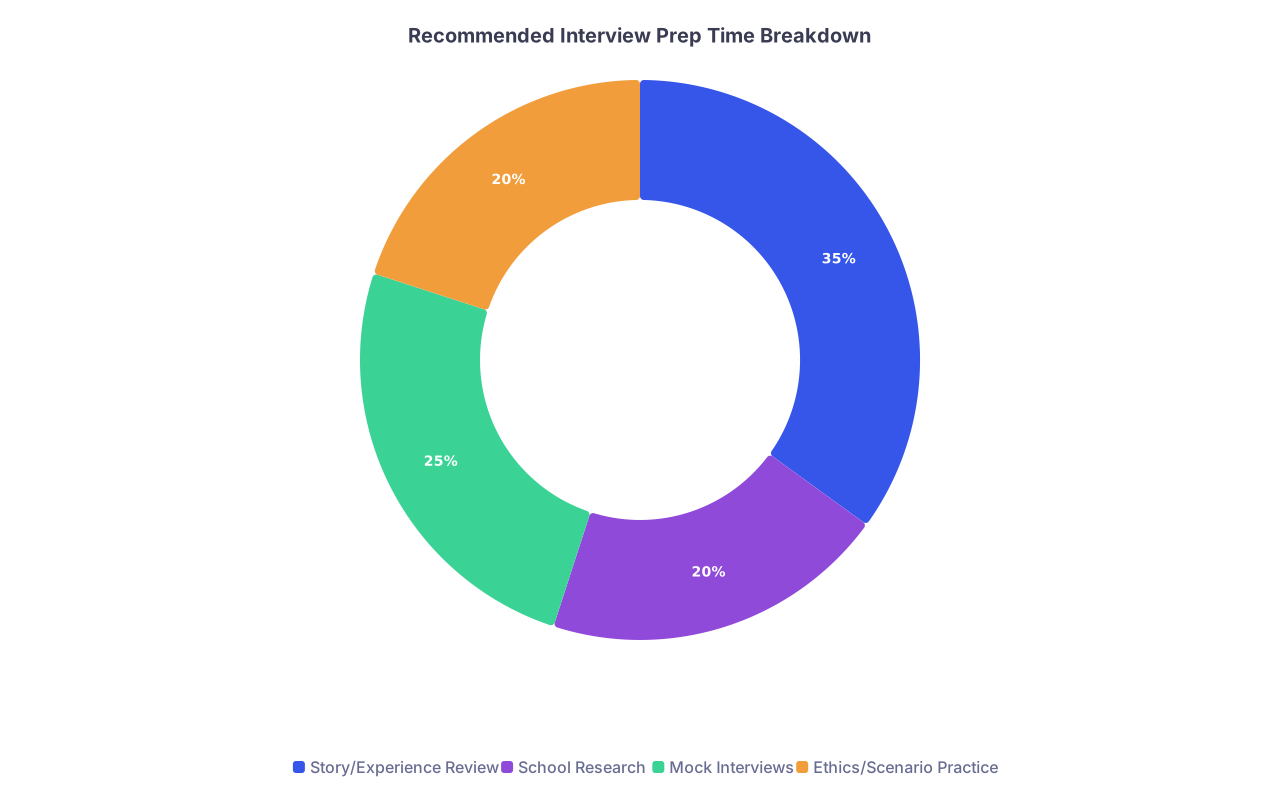
| Category | Value |
|---|---|
| Story/Experience Review | 35 |
| School Research | 20 |
| Mock Interviews | 25 |
| Ethics/Scenario Practice | 20 |
Step 3: Get at Least One Real Mock Interview
If your premed office offers mock interviews, use it. If not:
- Have a friend or mentor ask you 10 random questions from a list
- Tell them they’re NOT allowed to ask in your exact chosen order
- Ask them where you sounded fake or repetitive
The goal: you want to be able to answer new questions using old stories without freezing.
But What About MMI? Should I Memorize Answers There?
No. And it’s even more obvious when you do.
MMI stations (Multiple Mini Interviews) are built to test:
- How you think
- How you communicate under mild pressure
- How you handle ambiguity
If you walk in and dump a memorized ethics speech, it’s obvious. And usually way off-target.
Better strategy:
Memorize a simple decision framework for ethical questions:
- Clarify the scenario in your own words
- Identify the main ethical tension (autonomy vs beneficence, fairness, honesty, etc.)
- Name who’s affected (patient, family, team, institution)
- Consider 2–3 options briefly
- Choose one and justify it
- Acknowledge tradeoffs and how you’d communicate with stakeholders
You can reuse this skeleton across tons of MMI scenarios without sounding like a robot.
For acting stations (difficult conversation with a standardized patient), scripting is deadly. You need to be present, listen, and respond. Memorizing lines will make you miss emotional cues.
How Much Is “Too Prepared”?
There is such a thing.
Here are signs you’ve crossed over into over-preparation:
- You get thrown off when a question is slightly different than your practice set
- You feel the need to “fit in” your favorite phrases in every answer
- Your stories all sound polished in your head but stiff out loud
- You’re more focused on remembering lines than actually listening
You want to land here instead:
You’ve seen a lot of question types, you have flexible stories ready, but you still sound like you just thought of that specific wording in the moment.
Here’s a simple mental rule:
If you can say your answer the exact same way twice in a row?
It’s too memorized.
A Quick Reality Check: What Interviewers Actually Want
Interviewers at med schools are usually:
- Physicians who squeeze interviews between clinic or OR time
- Faculty who care more about your judgment than your polish
- Sometimes students who are very good at sniffing out inauthenticity
They are not sitting there with a rubric for:
- “Used three advanced adjectives.”
- “Sounded extremely formal and rehearsed.”
They are asking themselves:
- Do I believe this person’s reasons for wanting medicine?
- Would I trust them with patients someday?
- Can they listen, think, and respond like a human?
- Would I want them as a classmate or colleague?
Memorized answers push you away from those goals, not toward them.
A Better Way to “Feel Ready” Without Memorizing
If you’re anxious, you’ll be tempted to over-script to feel safe. Totally normal.
Channel that urge more productively:
Make a one-page cheat sheet with:
- Your 8–10 main stories (1 line each)
- 3 themes you want to highlight (e.g., grit, empathy, curiosity)
- 3 specific things you like about each school
Before the interview, review that sheet—not a giant script.
Remind yourself: “My job isn’t to be perfect; it’s to be real, thoughtful, and clear.”
One more trick:
Practice answering a couple questions in a deliberately messy way. Allow yourself to say “Let me think about that for a second,” or “I’d probably approach it this way…” That’s how humans talk. And it’s allowed.

| Step | Description |
|---|---|
| Step 1 | Learn You Shouldnt Memorize |
| Step 2 | Create Story Bank |
| Step 3 | Learn Simple Frameworks |
| Step 4 | Practice Out Loud |
| Step 5 | Do Mock Interview |
| Step 6 | Refine Outlines Not Scripts |
| Step 7 | Go To Interview Prepared But Flexible |

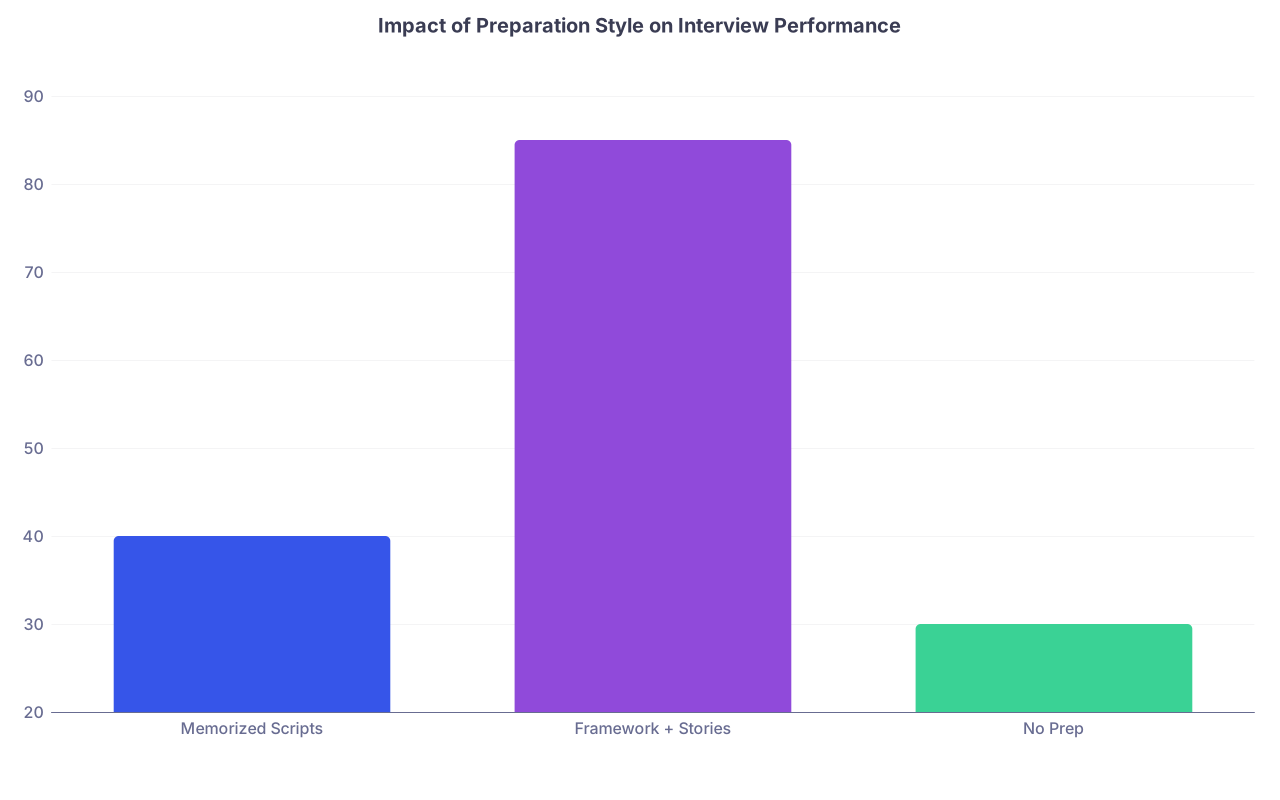
| Category | Value |
|---|---|
| Memorized Scripts | 40 |
| Framework + Stories | 85 |
| No Prep | 30 |
Here’s your next step:
Grab a sheet of paper right now and list 8–10 specific experiences you might talk about in an interview. For each, add one sentence on what you learned. That’s your foundation. Once that’s done, stop trying to memorize speeches—start practicing how you actually talk.