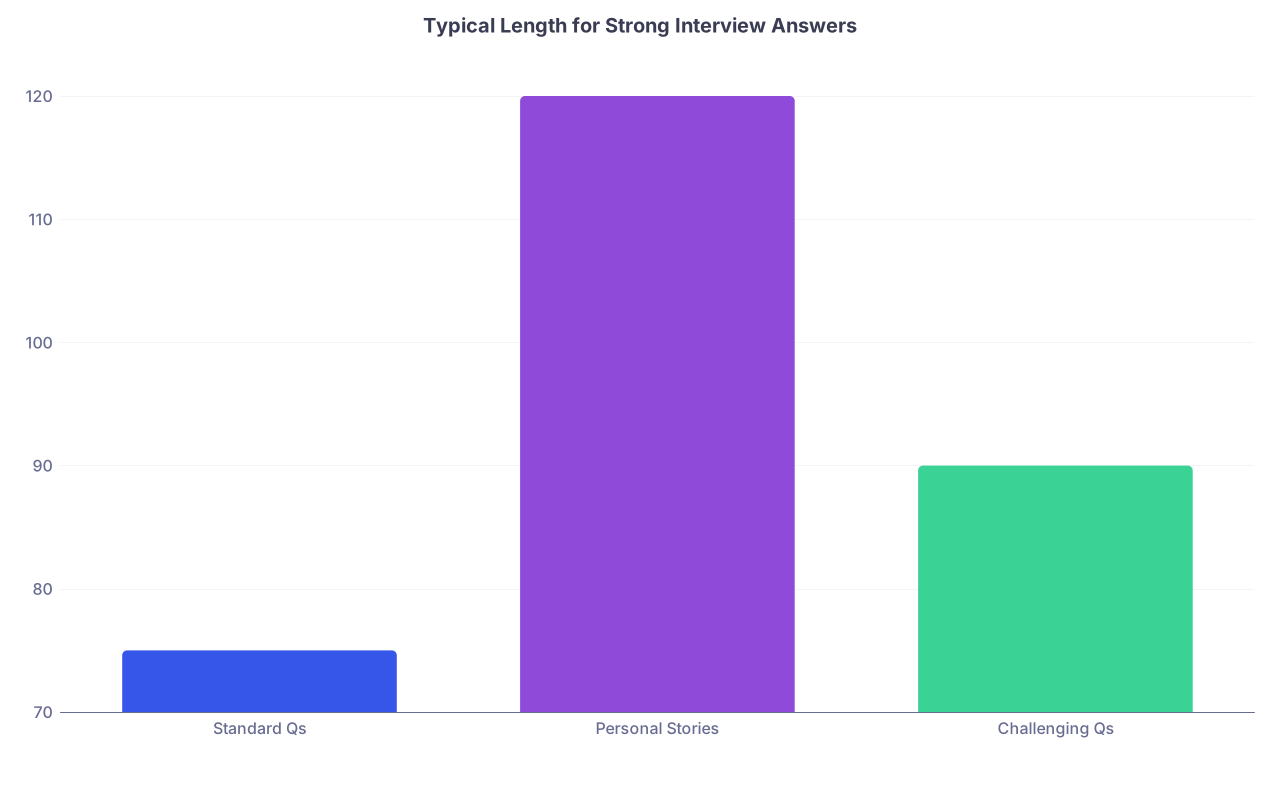
| Category | Value |
|---|---|
| Standard Qs | 75 |
| Personal Stories | 120 |
| Challenging Qs | 90 |
How Long Should a Strong Interview Answer Be in Minutes and Words?
What actually happens if your answer is technically “good”… but it’s 4 minutes long and the interviewer has 25 applicants to see that day?
Let me give you the number you’re looking for first, then we’ll unpack it.
For most medical school and premed interviews, your target range for a strong answer is:
- Time: about 45–90 seconds
- Words: about 120–220 words
That’s it. That’s the main rule of thumb.
You can stretch to 2 minutes (around 250–300 words) when you’re telling a bigger story (like a meaningful clinical experience or “why medicine”), but if you live in the 45–90 second zone, you’ll be better than 80% of applicants who ramble.
Now let’s make this concrete so you know exactly how to hit that range without sounding robotic.
The Core Answer Ranges (Minutes and Words)
Here’s the breakdown I use when coaching premeds and med students for MMI, traditional, and panel interviews.
| Question Type | Time Range (sec) | Word Range |
|---|---|---|
| Simple background questions | 30–60 | 80–150 |
| Standard behavioral/fit questions | 45–90 | 120–220 |
| Deep narrative ([“Why medicine?”](https://residencyadvisor.com/resources/med-school-interview-tips/what-do-interviewers-really-want-to-hear-when-they-ask-why-medicine)) | 60–120 | 160–300 |
| Ethical/complex scenario (MMI) | 60–90 (per turn) | 160–220 |
Assuming normal conversational pace (about 150–180 words per minute):
- 30 seconds ≈ 75–90 words
- 60 seconds ≈ 150–180 words
- 90 seconds ≈ 220–260 words
- 120 seconds ≈ 300–360 words
If you don’t want to think about all that:
Aim for about a minute. If the question is bigger and you’re clearly organizing your thoughts, you can push up to two minutes. Past that, you’re talking too long unless they explicitly say “take as long as you need” and clearly look engaged.
Here’s the hard line nobody tells you:
- Regular answers over 2 minutes usually feel long to an interviewer.
- Regular answers under 20–25 seconds usually feel shallow or underprepared.
Stay between those guardrails.
By Question Type: Exact Targets and Structure
1. “Tell me about yourself” / “Walk me through your resume”
These are the answers most people butcher. They either recite their entire AMCAS or give a vague life story.
Target:
- Time: 60–90 seconds
- Words: ~150–220
Simple structure:
- Present – Who you are now (year, school, major, current focus)
- Past – 1–2 key experiences that shaped your path (briefly)
- Future – What you’re looking for in medicine/this school
If you’re going over 90 seconds here, you’re probably listing too many activities or dates. They have your CV. They want the highlight reel, not the full documentary.
2. “Why medicine?” / “Why our school?” – The big narrative questions
These can legitimately be a bit longer because they’re foundational.
Target:
- Time: 90–120 seconds
- Words: ~220–300
Any longer and it starts sounding like a memorized personal statement.
Basic template for “Why medicine?”:
- Hook (1–2 sentences) – brief moment or realization
- Development (3–6 sentences) – 1–2 concrete experiences that deepened your interest
- Now (2–3 sentences) – how you’ve tested and confirmed this path
- Future (1–2 sentences) – what type of contribution you want to make
If you’re hitting all that cleanly, you’re naturally going to land around 1.5 minutes. That’s perfect.
For “Why our school?”:
- Time: 60–90 seconds
- Words: ~150–220
Go longer only if you’re saying specific, real things (e.g., “your student-run clinic in [neighborhood]” or “the longitudinal primary care track”) rather than vague flattery.
3. Behavioral questions (“Tell me about a time when…”)
Example: “Tell me about a time you had a conflict on a team.”
Target:
- Time: 60–90 seconds
- Words: ~150–220
Use a simple structure like STAR (Situation, Task, Action, Result):
- Situation – 1–2 sentences
- Task – 1 sentence
- Action – 2–4 sentences
- Result/Reflection – 2–3 sentences
If your “Situation” part is taking 4–5 sentences, that’s the problem. Compress the setup. Most of your words should be on what you did and what you learned.
4. Ethical or MMI scenario questions
Example: “You see a resident yelling at a nurse in front of a patient. What do you do?”
Typical MMI station gives you:
- 2 minutes reading
- 6–8 minutes in the room
You’re not supposed to talk non-stop for 8 minutes. That’s a conversation, not a monologue.
For your initial response:
- Time (first pass): 60–90 seconds
- Words: ~160–220
Then pause. Let them follow up. Your goal is to:
- Quickly frame the issue
- Identify stakeholders
- Outline your approach in clear steps
If they ask, “Anything else?” or dig deeper, you add another 30–60 seconds at a time.
The worst thing you can do is try to fill the whole station with one massive pre-planned speech. It sounds rehearsed and tone-deaf.
5. Rapid-fire or yes/no plus explanation
Sometimes you’ll get things like:
- “Do you think healthcare is a right?”
- “Is pass/fail grading in preclinical good or bad?”
They’re fishing for your stance and your reasoning, not a policy paper.
Target:
- Time: 30–60 seconds
- Words: ~80–150
Format:
- Clear position in 1–2 sentences
- 2–3 short reasons or one concrete example
- Brief acknowledgment of complexity if relevant
If you cross 60–75 seconds here, you’re probably repeating yourself.
How to Actually Control Your Length (Without Sounding Scripted)
Knowing the numbers is one thing. Hitting them in real time is another.
Here’s what actually works.
1. Practice with a timer and word counter (once, properly)
Pick 5 common questions:
- Tell me about yourself
- Why medicine?
- Why this school?
- Tell me about a challenge you faced
- Tell me about a time you worked with a difficult person
Do this once:
- Record yourself answering each question out loud, naturally, with your phone timer visible but not obsessing over it.
- Transcribe one or two answers (or use basic voice-to-text).
- Check:
- How long did you talk?
- How many words did you use?
- Where did you start repeating or adding fluff?
Most people are shocked to find their “short” answers are 3+ minutes and 400+ words. Once you see that, tightening up becomes much easier.
2. Use invisible “beats,” not memorized sentences
Rather than scripting every word, script your beats:
Example for “Why medicine?” – three beats:
- First exposure (grandparent’s hospitalization, free clinic, etc.)
- Concrete evidence you enjoy the work (scribe, EMT, MA, shadowing with specific takeaway)
- How you see your future role (population, type of impact, environment)
Speak to each beat for 20–30 seconds. That naturally gives you a 60–90 second answer without turning you into a robot.
3. Build a “wrap up” reflex
Train yourself to recognize this internal signal:
“If I’m about to give a third example or repeat a point, I should probably wrap.”
Strong wraps sound like:
- “So overall, that experience made me a lot more comfortable with uncertainty and asking for help early.”
- “That’s why I’m really interested in schools with strong longitudinal primary care experiences.”
- “In short, it pushed me to be much more proactive about communication on teams.”
One sentence. Land the plane. Then stop talking.
4. Watch the interviewer’s body language
If they:
- Stop taking notes
- Lean back, glance at the clock
- Say “uh-huh” in a flattened way
You’re probably running long. Next natural pause, wrap.
If they’re still leaning forward, asking follow-ups, or actually smiling, you’re usually fine—even if you’re at 90 seconds.
Examples: What 30 vs 60 vs 90 Seconds Actually Sound Like
You should have an internal feel for these lengths.
30 seconds (~80–100 words)
Good for: quick follow-ups, clarifications.
You might say:
“I’d say my biggest strength is follow-through. In our student-run clinic, I took over coordination of follow-up calls. Initially, a lot of patients were missing labs and appointments. I created a simple tracking sheet, we divided calls among volunteers, and our no-show rate dropped noticeably over a few months. It pushed me to be systematic and reliable, especially when patients were depending on me to close the loop.”
Short, one core story, done.
60 seconds (~150–180 words)
Good for: standard behavioral questions.
“I’m interested in medicine because I like working at the intersection of science and relationships. My first real exposure was volunteering in a safety-net clinic in college. I started out just rooming patients, but over time I got to sit in on visits. One patient with uncontrolled diabetes came in repeatedly, and I watched as the physician adjusted not just meds, but also asked about his work schedule, his food access, and his family stressors. That combination of problem-solving and understanding someone’s context clicked for me. Since then, I’ve worked as a scribe in an emergency department, which showed me both the intensity and the systemic frustrations of our healthcare system. Despite the long shifts and occasional chaos, I left feeling more energized than drained. That pattern—being tired but still wanting to go back—has been consistent, and it’s a big part of why I’m committed to medicine.”
That’s around a minute. Full, but not bloated.
90 seconds (~220–250 words)
Good for: “Tell me about yourself” or a bigger “Why medicine” story.
At this length you can add a second experience or a bit more reflection, but if you feel like you’re stacking example on example, you’ve gone too far.
Common Length Mistakes (And How to Fix Them Fast)
The life story answer
Symptom: You start at childhood, your AP classes, high school sports.
Fix: Start at college or later. Nobody needs your middle school origin story.The AMCAS recitation
Symptom: You literally walk through activities in order.
Fix: Group experiences by theme (“service,” “teamwork,” “scientific curiosity”) and pick one example per theme.The TED Talk
Symptom: 4-minute philosophical treatise on healthcare.
Fix: One clear stance, one concrete example, one sentence recognizing nuance. Stop.The 10-second shrug
Symptom: “I just like science and helping people,” then silence.
Fix: Force yourself to give at least one concrete example or story. Aim for at least 30 seconds.
Quick Answer Length Reference
Here’s the cheat sheet you can screenshot and glance at the day before your interview:
- Most answers: 45–90 seconds / 120–220 words
- Big questions (“Why medicine?”): 60–120 seconds / 160–300 words
- Rapid/clarifying questions: 30–60 seconds / 80–150 words
- Anything past 2 minutes: Assume it’s too long unless it’s a complex MMI station and clearly interactive

| Step | Description |
|---|---|
| Step 1 | Hear Question |
| Step 2 | 30-60 sec 80-150 words |
| Step 3 | 45-90 sec 120-220 words |
| Step 4 | 60-120 sec 160-300 words |
| Step 5 | 60-90 sec first pass |
| Step 6 | Conclude & Pause |
| Step 7 | What type? |

FAQ: Strong Interview Answer Length
Is a 3-minute answer ever okay in a medical school interview?
Rarely. A single 3-minute answer to a very complex question could be fine if the interviewer is clearly engaged and you’re structured and concise. But if all your answers creep to 3 minutes, you’ll be remembered as the rambler. Keep most answers under 2 minutes and reserve anything close to 3 for truly complex ethical/MMI scenarios with interaction.How can I tell if my answer is too short?
If you respond in under 15–20 seconds to a substantial question (“Why medicine?”, “Tell me about a challenge”), you probably haven’t given any depth or examples. As a rule: at least one specific example or story, plus what you learned from it. That usually gets you to at least 30–45 seconds without fluff.Should I memorize my answers to hit the exact time?
No. Memorized answers sound stiff and are easy to spot. Instead, memorize your structure: the 2–3 “beats” you want to hit for each common question. Practice enough that your natural delivery lands in the right time range. Knowing the beats, not the script, keeps you flexible and human.Do MMI stations change how long my answers should be?
A bit. For MMI, think in terms of an initial 60–90 second response that outlines your approach, then shorter 30–60 second follow-ups as the interviewer probes. You’re aiming for a back-and-forth, not a single uninterrupted monologue that fills the whole station.How fast should I talk in interviews?
Aim for a normal conversational pace—roughly 150–180 words per minute. If you talk so fast that 60 seconds crams in 250+ words, you’ll feel rushed and hard to follow. If you speak extremely slowly, your 60 seconds may feel empty. Record yourself once and adjust based on how you sound, not how it feels.What if I realize mid-answer that I’m going on too long?
Stop adding new details and move directly to a wrap-up. You can literally say, “So, to summarize,” and give a one-sentence takeaway. Interviewers don’t punish you for self-correcting; they actually appreciate the awareness.How many words should I write when practicing my answers?
For practice, writing out a 150–200 word version of a few key answers (“Why medicine?”, “Tell me about yourself”, 1–2 challenge stories) is useful. It gives you a tangible sense of length. But don’t bring these scripts into the interview. After you’ve written them once, practice speaking from bullet points and let your words vary around that 150–200 word target.
Open your phone’s voice recorder, pick “Why medicine?” and answer it right now. Then check the time stamp. Are you under 2 minutes and over 45 seconds, with at least one concrete example? If not, tighten or deepen until you’re in that zone.