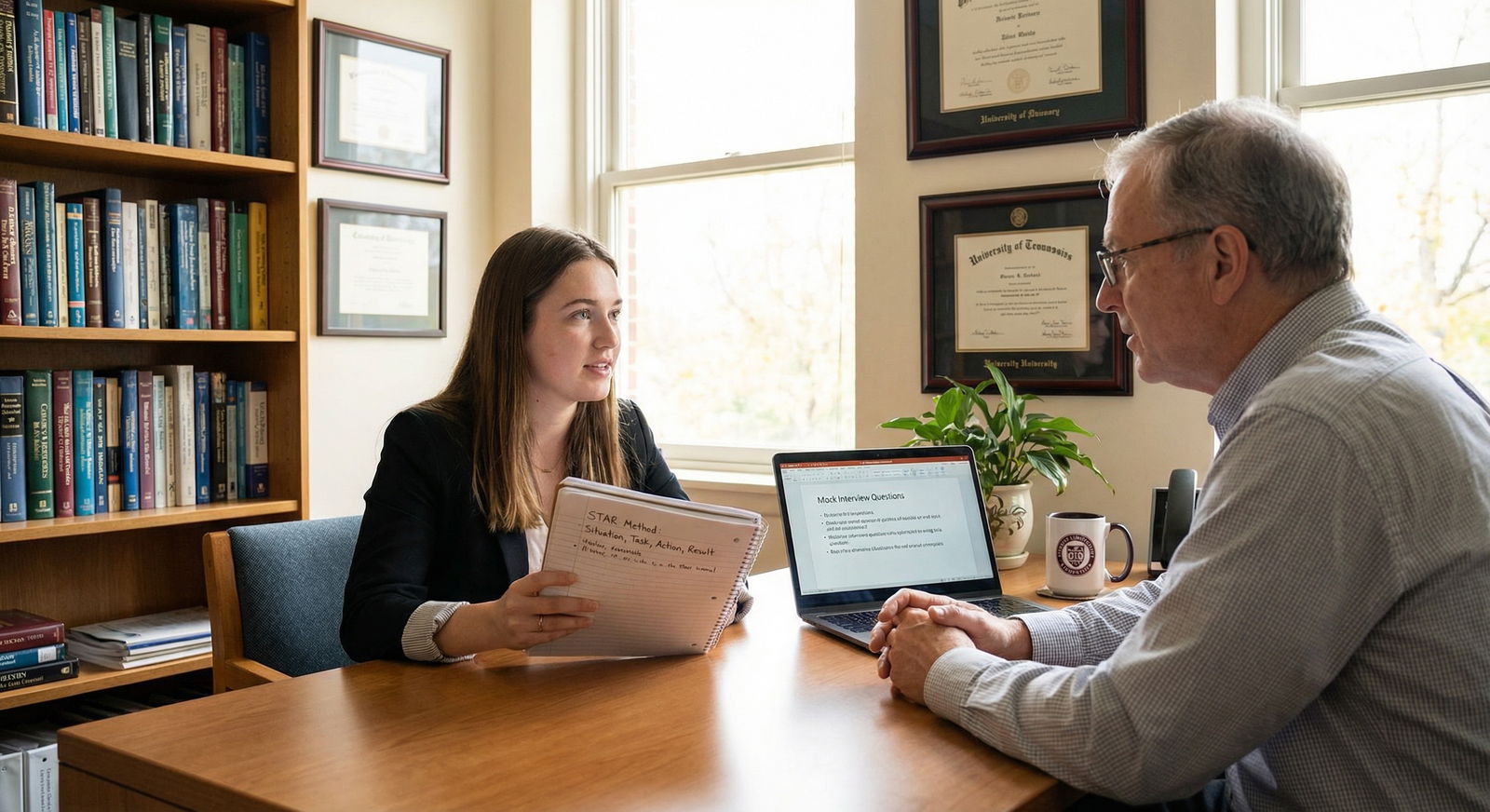
It’s 9:42 a.m. on interview day. You’ve just crushed a question about healthcare disparities and navigated the “Why medicine?” classic without rambling. Then the interviewer flips a page, glances at your activities list, and says it:
“I notice you don’t have a lot of shadowing or clinical experience. Can you talk about that?”
Your stomach drops. You know this was the weak spot in your application. Maybe your hospital shut down volunteering during COVID. Maybe you were working 30 hours a week just to pay rent. Maybe you were late to the game and only figured out medicine was your path in junior year.
This is the moment. If you handle it badly, they’ll tag you as “doesn’t really know what medicine is like.” If you handle it well, it can actually become a strength: self-awareness, maturity, and clear-eyed commitment.
Let’s walk through exactly how to handle this—both if the interview is next week and if you’re still early in your premed or med school journey and trying to fix the problem before anyone asks.
First: Understand What They’re Really Asking
On the surface, they’re pointing out a numbers problem:
- Only 10–20 hours of physician shadowing
- Minimal or no longitudinal clinical volunteering
- A big gap between “I want to be a doctor” and “I’ve actually been around doctors/patients”
But under that, there are three questions in their head:
- Do you actually understand what physicians do day to day?
- Are you choosing this path based on reality, not TV shows, family pressure, or prestige?
- When life isn’t convenient, do you find ways to engage with your goals—or do you just let things slide?
If you miss those and defend yourself with, “Well, COVID happened” and then stop talking, you lose. They already know COVID happened. So did for everyone sitting in that applicant pool.
Your job isn’t to make excuses. It’s to show judgment:
“I see this gap. I take it seriously. Here’s why it happened, what I’ve done about it, and how I’ve still developed a realistic view of medicine.”
Step 1: Do a Quick, Brutal Inventory Before You Ever Walk In
You can’t bluff this. Interviewers can smell it.
Sit down and list everything that could possibly count as “clinical-ish.” Be honest, but be generous. Do this before you craft your answer:
Direct clinical:
- Shadowing physicians or PAs
- Scribing
- Medical assistant, EMT, CNA, phlebotomist
- Hospital or clinic volunteering with patient contact
Indirect but medically relevant:
- Hospice volunteering
- Crisis hotline work
- Public health outreach with patient interaction
- Clinical research with patient-facing components
Other realities:
- Heavy work hours in non-clinical jobs
- Major caregiving responsibilities
- Late career decision (decided on medicine junior/senior year)
Now be honest: are you “limited” as in 15 hours of shadowing and almost nothing else? Or “limited” as in you have 80 hours total but mostly compressed into one experience?
Your answer strategy depends on which bucket you fall into.
Step 2: Use a Simple, Direct Structure in the Interview
When they ask, “You don’t have much clinical experience—why?” you do not want to mumble your way into a 6-minute ramble about COVID, work schedules, and hospital policies.
Use this framework in your head:
- Acknowledge the gap (briefly)
- Give a concise, real reason (no whining)
- Show what you did do despite the constraints
- Demonstrate reflection: what you actually learned about medicine
- Close with what you’re doing now and how you’ll keep deepening exposure
Let’s do this with concrete scripts.
How to Answer if You Truly Have Limited Clinical Experience
Scenario A: You were working a lot / had major responsibilities
Here’s the situation: You worked 25–35 hours a week as a server, tutor, or cashier. You helped support your family. Shadowing opportunities were limited and you couldn’t just drop everything for unpaid time in a clinic.
Bad answer:
“I really wanted to, but I was so busy with work and school that I just couldn’t fit it in.”
Good answer:
“I agree that my formal shadowing and clinical hours are lighter than ideal. The main reason is that throughout college I was working 25–30 hours a week as a [job] to cover my expenses and contribute at home. That limited my ability to take on unpaid daytime roles in clinics or hospitals.
That said, I knew I owed it to myself to see medicine up close before committing. So I arranged [X]: for instance, I shadowed Dr. ___ in internal medicine over winter break and spent [Y hours] in clinic and on rounds. I also volunteered at [place] where I [describe direct or semi-direct patient interaction].
Through those experiences, I saw [specific reality: long days, dealing with uncertainty, emotional conversations with patients]. It confirmed that I’m drawn to the combination of [examples: problem-solving, continuity with patients, working in teams even when things are chaotic].
Recognizing this is a growth area, I’ve already lined up [or just started] additional clinical exposure this year: [scribe, MA, clinic volunteer, hospice, etc.]. I’m planning to continue that during my glide year so I enter medical school with more sustained experience on the patient side of healthcare.”
Key pieces: you own the gap, you explain it like an adult, and you demonstrate movement—not helplessness.
Scenario B: You decided on medicine late
You were a finance/engineering/psych major who pivoted to medicine halfway through undergrad or even later. So your timeline is compressed.
Good answer:
“You’re right that most of my shadowing and clinical exposure has happened in the last [X] months. I didn’t come into college premed. I was originally planning on [old path] and only seriously considered medicine in my [junior/senior] year after [concrete turning point: family illness, volunteering experience, course, etc.].
Once I started considering medicine, I knew I needed more than an idea of “helping people.” So I set up shadowing with [specialty/physician] and volunteered at [clinical or quasi-clinical site]. Even though the hours are modest compared to someone who’s been on this path since day one, those were very concentrated, intentional experiences. I paid attention to what the job actually looks like on a random Tuesday at 3 p.m.—not just the “hero” moments.
What I saw was [specifics about workflow, team dynamics, emotional labor]. That sealed for me that this isn’t a romanticized decision. I’m continuing to build on this foundation now through [current or planned roles] so that by the time I start medical school, I’ll have a deeper base of patient-facing experience.”
You show them this wasn’t impulsive; you moved deliberately once the decision crystallized.
Scenario C: COVID and systemic shutdowns
This is the one I see handled badly most often. People lean on COVID like it’s a unique excuse. It’s not. Your competition also lived through it.
So you can mention it, but then you shift quickly into what you did do.
Weak answer:
“Honestly, I tried to get shadowing, but with COVID everything shut down. It was just impossible.”
Stronger answer:
“I started college right as COVID hit, so traditional shadowing and hospital volunteering were largely shut down in my area for a substantial period. That did delay some of the in-person experiences I’d hoped to have early on.
I tried to work around that by doing [virtual shadowing, telehealth observation if you had it, crisis hotline, vaccine clinic volunteering once available, public health projects, etc.]. Once clinical sites opened up again, I [what you did: joined a clinic volunteer program, did X hours in Y setting].
I agree that my total shadowing hours aren’t huge, but within those experiences I focused on understanding the day-to-day realities—how physicians manage time, communicate uncertainty, work with nurses and staff, and cope with burnout risk. Those observations, plus my ongoing role at [current site], have given me a realistic, not idealized, sense of the career. I’m going to keep expanding that exposure during the coming year.”
COVID is context, not the whole story.
If You’re Still Early: Fix the Problem Now
If you’re a premed or early med student reading this before your interview season: good. You have time to make sure this question isn’t a death blow.
I’m blunt here: relying on “I didn’t have time” or “it was hard to find opportunities” while doing 3 research projects and two clubs is not going to impress anyone. Programs want you near patients.
You need at least:
- Some meaningful shadowing (yes, numbers matter; 20–40+ hours is a decent goal, more is better if spread over time)
- At least one longitudinal, patient-adjacent role (6+ months is ideal)
| Option | Training Needed | Real Patient Contact? | Typical Time to Start |
|---|---|---|---|
| Hospital volunteer | Short orientation | Limited but real | 2–8 weeks |
| EMT | Formal course | Yes, high | 3–6+ months |
| Medical scribe | On-the-job | Yes, continuous | 1–3 months |
| Hospice volunteer | Training sessions | Yes, intense | 1–2 months |
| Community clinic volunteer | Brief training | Yes, variable | 2–6 weeks |
Pick one or two. Commit. Depth beats collecting five flimsy roles.
The Med School Angle: Already In, Still Limited Exposure
If you’re already in medical school, this question will show up in:
- Summer research interviews
- Competitive program tracks (global health, primary care, etc.)
- Early specialty interest groups or funded opportunities
The dynamic shifts slightly. They’re not doubting if you should be in medicine at all—they already admitted you. They’re asking:
“Have you actually seen what this specialty/setting looks like, or are you chasing a fantasy?”
Same basic structure, but more specialty-focused:
“I’ll be honest—I’m early in my clinical exposure to [specialty]. My interest started from [class, mentor, personal experience], and I’ve had the chance to [shadow X, attend Y clinic, participate in Z project]. It’s not a huge number of hours yet, but in that time I’ve specifically paid attention to [patient population, lifestyle, team dynamics, cognitive vs procedural mix]. I’d like to use [this summer / this program] to deepen that exposure and test whether the reality matches what I think I’m drawn to.”
Owning your early stage actually reads as grounded, not weak.
What You Absolutely Should Not Do
Let me be blunt about a few pitfalls I see all the time:
Do not get defensive.
“Well, where I live there just aren’t opportunities” said with an edge? That’s a red flag. They’re not attacking you. They’re checking judgment.Don’t exaggerate or fudge hours.
They can tell when someone’s “200 hours” sound like three afternoons and a memory of a stethoscope. And inconsistencies between primary app, secondary, and what you say? That sticks.Don’t overplay non-clinical service as “basically clinical.”
Working retail, customer service, or being an RA gives transferable skills. Great. But it is not clinical exposure. You can mention parallels, but don’t pretend they’re the same thing.Don’t pretend you’ve seen more than you have.
Saying, “I fully understand what being a physician is like” with 8 hours of shadowing just screams naïve. Instead: “I’ve seen some parts clearly, and I know there’s a lot I still have to learn.”
How to Talk About What You Did Learn (Even From Limited Hours)
The best way to salvage low numbers is to show high-quality reflection. Pick 1–2 specific moments and squeeze them.
Think in categories like this:
- What surprised you about physicians’ work that you didn’t expect?
- What did you see that was genuinely hard or unglamorous?
- How did you see doctors navigate uncertainty or bad outcomes?
- How did the physician interact with nurses, MAs, social workers?
- What did a “boring” routine day look like, and how did you feel about that?
Concrete example:
“During one of my shadowing days in clinic, I watched my preceptor see eight patients in about three hours. None of the visits were dramatic. Mostly diabetes management, blood pressure checks, a refill request. What stood out wasn’t medicine-as-TV, but the pattern: every patient brought in non-medical problems. Transportation issues, family conflict, language barriers.
Watching my preceptor switch between medical decision-making and social problem-solving, and still somehow stay on time, was both exhausting and oddly energizing to me. It made clear that medicine isn’t just ‘diagnose and treat’—it’s a long game of relationship-building under time pressure. That’s the part that resonated with me the most.”
That sounds like someone who paid attention. Even if they only shadowed for 10 hours.
What To Be Doing Right Now If You Have an Upcoming Interview
If your interview is within the next 2–8 weeks and your clinical exposure is objectively limited, you still have a play.
Here’s your emergency plan:
Lock in at least something real before interview day.
- Even 5–10 new hours in a clinic or ED shows current engagement
- Reach out to local physicians through:
- Family doctor
- Clinic websites
- LinkedIn / alumni networks
- Religious or community organizations
Mention what’s already started and what’s scheduled.
- “In the last month, I’ve started shadowing Dr. X… I’m also scheduled to begin volunteering at Y clinic next month.”
Build a tight, rehearsed answer using the framework:
- Acknowledge gap
- Reason without whining
- What you did manage to do
- Reflection on what you learned
- Concrete next steps already in motion
Practice it out loud.
Not to sound robotic—but to avoid rambling and panic-defending yourself.
Visualizing the “Fix It” Timeline
Here’s roughly how fast you can realistically build exposure if you stop delaying and start acting.
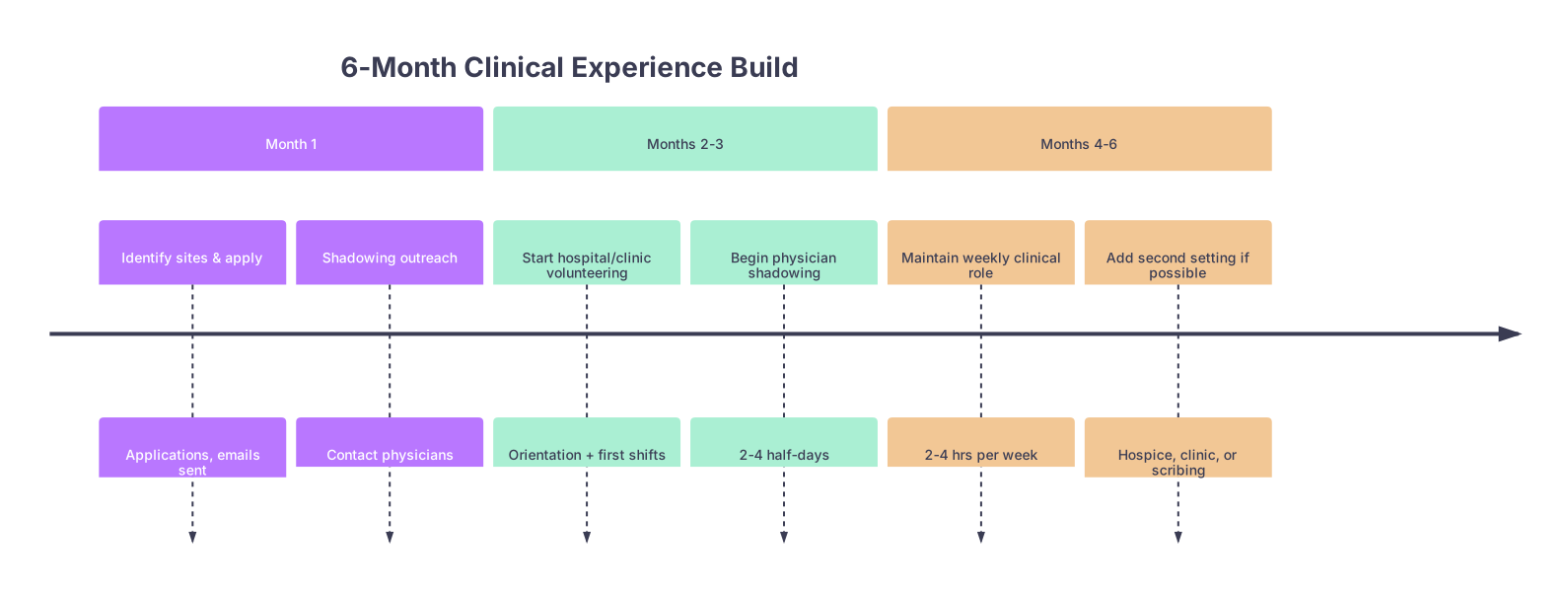
| Period | Event |
|---|---|
| Month 1 - Identify sites & apply | Applications, emails sent |
| Month 1 - Shadowing outreach | Contact physicians |
| Months 2-3 - Start hospital/clinic volunteering | Orientation + first shifts |
| Months 2-3 - Begin physician shadowing | 2-4 half-days |
| Months 4-6 - Maintain weekly clinical role | 2-4 hrs per week |
| Months 4-6 - Add second setting if possible | Hospice, clinic, or scribing |
Six months of consistent effort can turn “weak” into “respectable,” especially if you actually think and reflect along the way.
How This Plays in Committee
Behind closed doors, admissions conversations about applicants with limited clinical exposure often sound like this:
- “She doesn’t have a ton of hours, but she talks about what she did see in a very grounded way.”
- “COVID clearly impacted his opportunities, but he pivoted into a clinic role as soon as he could. That tells me something.”
- “I don’t love the light exposure, but I believe she understands enough of the realities to make an informed choice—and she’s clearly already fixing the gap.”
Your goal isn’t to magically erase the weakness. It’s to turn it from a potential veto into a manageable concern.
Own it. Explain it. Show your work. Show your growth.
Do that well enough, and you’ll be surprised how quickly “limited shadowing” falls off the list of reasons to say no.
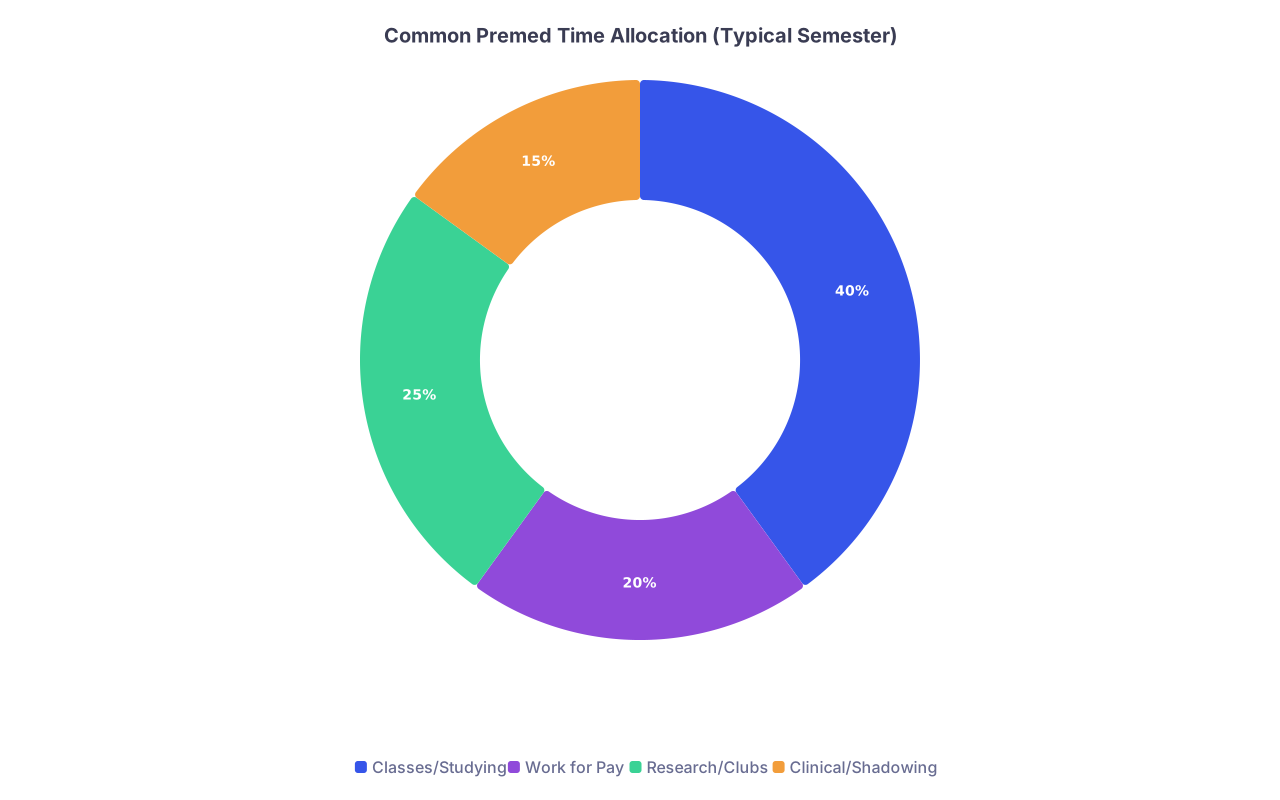
| Category | Value |
|---|---|
| Classes/Studying | 40 |
| Work for Pay | 20 |
| Research/Clubs | 25 |
| Clinical/Shadowing | 15 |
The point of that chart? Most premeds under-invest in the clinical slice. You’re not uniquely behind. You just need to be one of the few who corrects it intentionally.