
The worst way to handle a low MCAT or GPA in an interview is to “hope they don’t bring it up.” They will. And if you’re not ready, you’ll lose the room in 30 seconds.
You got the interview. That means the committee already knows your numbers and still decided you’re worth their time. Your problem now is not the score or GPA itself. Your problem is whether you let those numbers define you—or you walk in with a controlled, confident story that makes sense of them and moves the interviewer on.
This is how you control the narrative instead of getting steamrolled by it.
Step 1: Understand What Your Low Stat Signals To Them
Before you can control the narrative, you need to know what narrative they already have in their heads.
A low MCAT or GPA usually triggers one or more of these silent questions:
- “Can this person handle our curriculum?”
- “Will they pass Step/COMLEX on time?”
- “Are they inconsistent?”
- “Is this someone who crumbles under pressure?”
- “Is this a maturity issue or a one-time blip?”
Your job is not to pretend these concerns are irrational. They’re not. Your job is to:
- Acknowledge reality without self‑destructing.
- Reframe the data point in context.
- Show a track record of changed behavior that makes the concern obsolete.
Do not walk in thinking, “I just need to show them I’m more than my numbers.” That’s vague nonsense. Walk in thinking, “I know exactly what my numbers make them worry about, and I have tight, specific evidence that those worries no longer apply.”
That shift alone will change how you answer questions.
Step 2: Decide Your Core Framing Story (Before You Ever Walk In)
You need one clear “anchor story” for your low MCAT or GPA. Not five. One.
The worst interviews I’ve watched are where applicants improvise a new explanation for every person they talk to. Inconsistent, rambling, defensive. It kills trust.
You’re going to build a 3-part framing story:
- Brief, non-dramatic explanation (what happened).
- Evidence-backed turnaround (what changed and how you proved it).
- Forward-looking confidence (why this won’t be a liability in med school).
Let me give you some concrete molds you can adapt.
If your GPA is low, MCAT decent
Example frame:
- “Early on in college, I underestimated the jump in rigor and I did not have strong study skills. I took on too many extracurriculars too quickly and didn’t ask for help soon enough.”
- “Starting junior year, I changed how I worked: I used office hours regularly, studied in structured blocks, and shifted to active recall. As a result, my upper-division science GPA is a 3.65 across 50+ credits, and my MCAT is 513, both reflecting how I now learn.”
- “Those last four semesters and the MCAT are much closer to how I operate today—and that’s how I expect to perform in medical school, especially since the structure is even more aligned with how I now study.”
If your MCAT is low, GPA strong
- “Standardized testing has been a relative weak point for me compared to coursework. I made the mistake of balancing MCAT prep with full-time work, which limited how effectively I prepared the first time.”
- “What matters to me is that over 120+ science credits, I’ve consistently performed at a high level, including in courses like biochemistry and physiology that mirror medical school content. I also completed a rigorous post-bacc with a 3.8 GPA while working part‑time, which felt very similar to the intensity I expect in med school.”
- “My transcript is a better reflection of how I’ll perform when the work is sustained, structured, and application-based. I’ve already started using NBME-style practice resources to improve my test-taking approach, because I know I’ll face more standardized exams.”
If both MCAT and GPA are weaker
Then your leverage is growth and recency. You cannot pretend they are invisible.
- “The first half of college was rough—family instability and working 30+ hours weekly led to poor time management and inconsistent performance.”
- “Since things stabilized, my last 45 credits of science coursework were at a 3.6 while maintaining clinical work, and I improved my MCAT from 498 to 505 on the second attempt. I focused heavily on building systems—weekly schedules, spaced repetition, group review—that I plan to carry into medical school.”
- “What matters to me is that the person you see on the application is not the same person who stumbled early on. My recent track record—academically and in structured clinical roles—shows the level I now operate at.”
Notice what’s going on in all of these:
- Short, specific explanation.
- No melodramatic over-sharing.
- Concrete, numeric evidence of change.
- A confident pivot to the future.
You will repeat this same structure in some form every time the topic comes up.
Step 3: Pre‑Rehearse the Hard Questions (Word-for-Word)
You should never hear these questions for the first time in the interview room:
- “Can you explain your MCAT score?”
- “Your GPA is below our median. What happened?”
- “I see a trend of weaker performance in your early coursework. What changed?”
- “Are you concerned about handling the rigor here?”
- “If you struggled with the MCAT, how will you handle Step 1/Level 1?”
You need exact sentences ready. Not vague ideas. Script them, then sand off the robotic edges.
Here’s a template you can adapt:
- Start with ownership, not excuses.
- One-sentence context.
- Two sentences of concrete improvement.
- One sentence connecting it to future performance.
- Stop talking.
Example answer for a low MCAT:
“Sure. I’m not satisfied with my MCAT score either, and I take responsibility for that. I made two mistakes: trying to prepare while working close to full-time, and relying too much on passive review instead of timed practice.
Where I’m more confident is in my academic track record and how I’ve adjusted my approach. Over my last 60 science credits I earned a 3.7 while balancing work and clinical volunteering, and I’ve now built study systems that are much more aligned with test-style questions and spaced repetition.
Given how medical school assessment works, I expect my current habits and coursework performance to be more predictive of how I’ll do here than that single test day.”
Then you stop. If they want more, they’ll ask. Overexplaining reads as guilt.
Step 4: Use Data To Your Advantage (Instead of Hoping They Don’t Notice)
If you’re in this situation, you need to bring receipts. Numbers that help tell the story you want.
Here are some examples of academic data points you can weaponize:
- Upward trend: “First 60 credits: 2.9 GPA. Last 60 credits: 3.7 GPA.”
- Upper-division performance: “In courses that mirror M1 content—biochem, physiology, immunology—I earned A or A‑ in X out of Y classes.”
- Post-bacc/SMP metrics: “In my post-bacc, 28 credits of upper-level biology and chemistry with a 3.8 GPA.”
- Retake improvements: “Organic Chemistry I from C to A- after changing study strategies.”
If you’ve got multiple pieces, organize them for yourself. For example:
| Phase | Credits | GPA |
|---|---|---|
| First 2 years | 60 | 2.9 |
| Last 2 years | 60 | 3.7 |
| Upper-division sci | 40 | 3.8 |
Bring this into the interview mentally. You’re not reading it off a sheet, but you know your numbers cold so you can say:
“I’d ask you to weigh my last 60 credits at a 3.7 and my upper-division science at a 3.8 more heavily than my early coursework, because that’s when I developed the study skills I’d be relying on in medical school.”
That’s how you stop being passive. You’re telling them how to read your file.
Step 5: Balance Honesty and Strategy (No Trauma Dumping, No Fake Perfection)
Interviewers don’t want a soap opera. They also don’t want a robot.
There’s a line you’re walking:
- Too vague: “I had personal issues and struggled.” → Sounds evasive.
- Too detailed: 10-minute story about your landlord, your cousin, and your breakup → Unprofessional.
Here’s a reasonable middle ground if you had real life chaos:
“I was dealing with significant family and financial instability during my first two years, which I didn’t manage well academically. I didn’t seek support early enough and tried to handle everything alone, which was a mistake.
Once things stabilized and I learned to use campus resources, my performance improved significantly: my last four semesters were all above a 3.6 while I maintained consistent work and clinical experiences.”
You’ve:
- Given context.
- Taken responsibility.
- Shown the outcome.
- Demonstrated growth.
That’s all they need. If they want more, they’ll ask.
Step 6: Redirect the Conversation Without Sounding Defensive
You are not trying to hide your low MCAT or GPA. You’re trying to contain it.
Your goal: spend maybe 10–15% of the interview on this, not 70%.
The pivot is your best friend. You answer the question, then move to something that shows who you are now.
Example:
“Yes, my MCAT is below your median, and I’ve reflected a lot on that. I’ve already started applying more rigorous, question-based studying in my current coursework and I’ve seen the impact—in my last two semesters, my science GPA was 3.8.
What I’m most proud of, though, is how those same systems helped me be effective in my clinical role as an ED scribe, where I had to learn new protocols quickly and apply them accurately. That experience showed me I can translate structured learning into real-time patient care.”
You acknowledged. You reframed. You pivoted to strength and clinical relevance.
If you answer and then just stare at them, they’ll stay on the topic. If you show a natural bridge, many interviewers will take it.
Step 7: Align Your Story With Their Real Fear: “Can You Survive Here?”
This is where most applicants miss. They defend their number, but they never touch what committees are really thinking about: risk.
Med schools, especially mid- and lower-tier ones, are terrified of:
- Step/COMLEX failure rates.
- Remediation.
- Attrition.
- Match problems.
So your narrative must directly say, in not-so-subtle terms: “I am not a risk. I know how to grind. I’ve tested it.”
You do that by:
- Describing specific systems: spaced repetition, question banks, schedule structure.
- Giving real examples: “I studied 25–30 focused hours weekly while working 20 hours and maintained a 3.7.”
- Showing self-awareness: “I know I’m not a natural test-taker, but I’ve learned to perform above my first-attempt MCAT would suggest.”
You can even say it plainly:
“I understand that, looking at my MCAT and early GPA, you might wonder how I’ll handle your curriculum and board exams. What gives me confidence—and what I hope gives you confidence—is that in the last two years I’ve already lived at that level of rigor: structured study, long hours, high expectations. And my results have matched that.”
That’s speaking directly to the hidden concern most applicants tiptoe around.
Step 8: Practice Out Loud With a Hostile and a Friendly Audience
You need both.
- Hostile practice: Someone (advisor, friend, tutor) whose job is to push you. Interrupt you. Ask, “That sounds like an excuse—try again.” This sharpens your answers.
- Friendly practice: Someone who actually believes in you and will tell you when you start sounding ashamed, apologetic, or hollow.
Record yourself. Painful, yes. Useful, absolutely.
Specific things to watch for:
- Do you talk too fast when the score comes up?
- Do you laugh nervously or trash yourself (“Yeah, that score is terrible…”)
- Do you ramble and give your entire life story?
- Do you sound angry at the test, the system, your professor, your ex, whoever?
Fix those. Your words can be perfect on paper and still land poorly if your tone screams, “I’m embarrassed to be here.”
Step 9: Make the Rest of Your Interview So Strong They’d Be Stupid Not to Take You
Controlling the narrative about low stats works only if the rest of your interview supports your story.
High-yield areas to make rock solid:
- Motivation for medicine: Clear, grounded in real exposure, not a vague “I want to help people.”
- Clinical maturity: You can talk comfortably about actual patients you’ve seen, what you learned, and how you handled hard moments.
- Teamwork: You can point to real examples where you worked in high-stress environments (ED, CNA, MA, EMS, etc.) and did not fold.
- Self-awareness: You can calmly admit flaws and show how you’ve addressed them.
If you show up as someone who is reflective, hardworking, calm under pressure, and experienced with clinical realities, your low MCAT or GPA becomes one data point in a much larger picture—rather than the headline of your file.
To make sure your prep covers everything, you can map it out like this:

| Step | Description |
|---|---|
| Step 1 | Interview Prep |
| Step 2 | Low Stat Narrative |
| Step 3 | Motivation for Medicine |
| Step 4 | Clinical Experience Stories |
| Step 5 | Teamwork & Resilience |
| Step 6 | Future Plans & Fit |
Most applicants in your situation over-focus on defending their numbers and under-prepare everything else. That’s backwards. You want the low stat answer to feel like a small, controlled piece of a larger, confident performance.
Step 10: Know When To Shut Up About It
If they don’t bring it up, you probably shouldn’t either.
Exception: if your low stat is directly relevant to a specific growth story you’re telling.
For instance, if they ask, “Tell me about a failure,” you might say:
“In my sophomore year, I earned a C in Organic Chemistry I, which was a wake-up call. I had coasted on high school habits and I wasn’t using active learning or asking for help. I overhauled how I studied—office hours, group review, Anki—and retook the course the next semester, earning an A-. More importantly, I kept that system and used it for the rest of my upper-division work.”
Here, the “failure” is connected to a specific, measurable turnaround. That’s fine. Just don’t turn every answer into a confessional about your GPA or MCAT.
If an interviewer clearly doesn’t care about your stats and is vibing with your experiences, do not drag them back to your numbers out of insecurity.
A Quick Reality Check: Where You Actually Stand
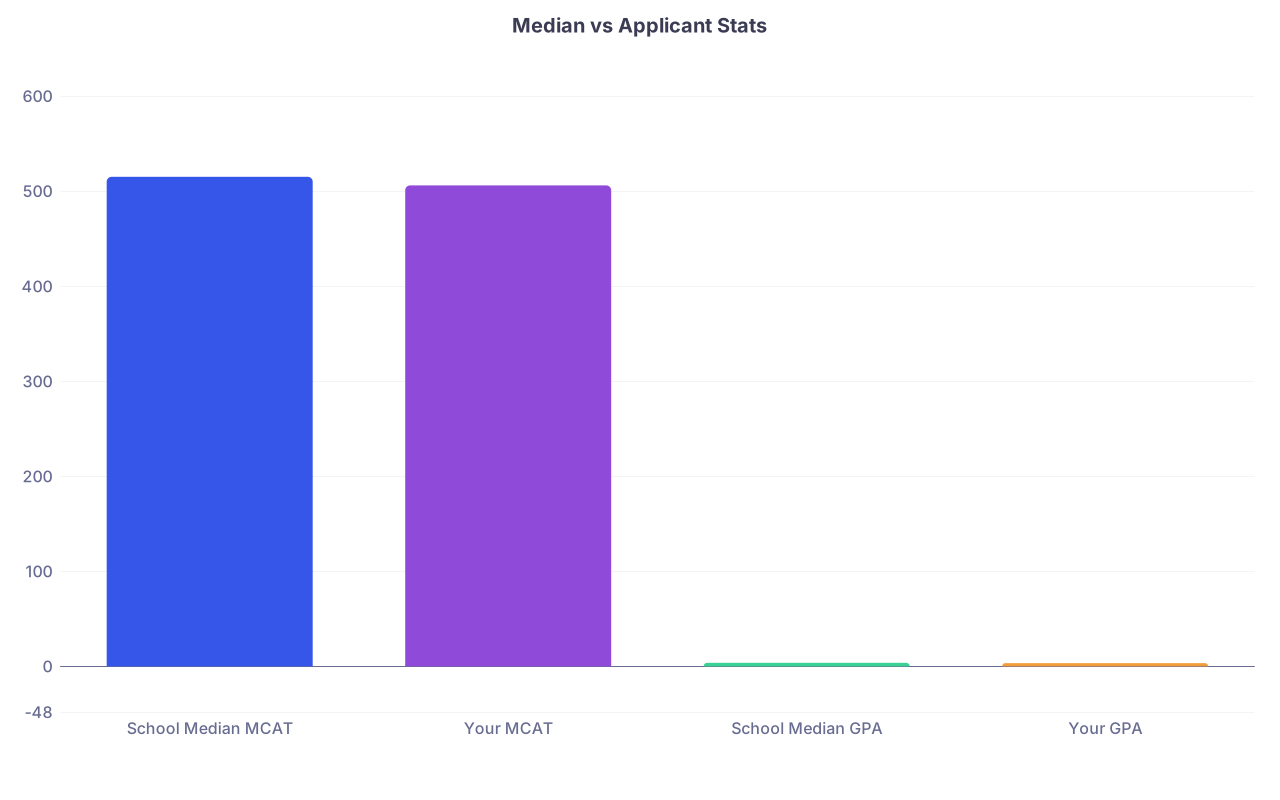
Sometimes it helps to sanity-check how far off you are from typical numbers. Rough comparison:
| Category | Value |
|---|---|
| School Median MCAT | 515 |
| Your MCAT | 506 |
| School Median GPA | 3.8 |
| Your GPA | 3.4 |
If you’re in this rough disparity zone, your interview will absolutely need a strong narrative. But the fact you have an interview at all signals they saw enough elsewhere to justify hearing you out.
So act like someone they were right to invite, not like someone who snuck in the back door.
If You’re Still Pre-Interview Season: Fix What You Can Now
If you’re reading this before you have interviews, you still have time to strengthen your story on the front end.
Priorities:
- Crush current/future coursework or post-bacc.
- Take on structured, consistent clinical work (scribing, CNA, MA, EMS).
- If realistic, thoughtfully plan and execute an MCAT retake with a clear different strategy, not “more of the same.”
You want your eventual interview narrative to sound like:
“Those numbers are old information. Here’s what I’ve done since then that’s much more predictive of who I am now.”
For example:
| Category | Value |
|---|---|
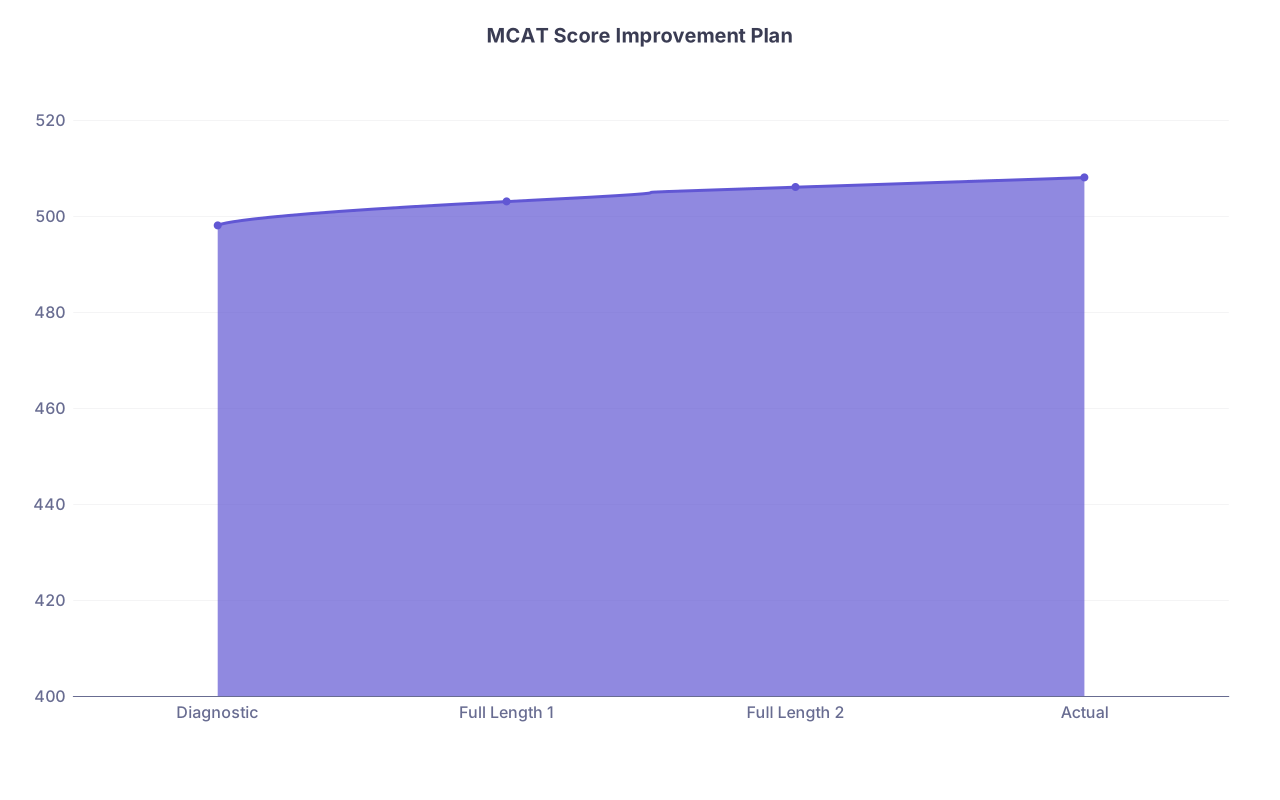
| Diagnostic | 498 |
| Full Length 1 | 503 |
| Full Length 2 | 506 |
| Actual | 508 |
You can literally point to that trajectory in your story: “The more I shifted to active, timed practice and reviewed errors systematically, the more my scores climbed—ending with a 10-point improvement.”
Final Tightening: Checklist Before You Walk Into the Room
By the time you’re sitting in front of an interviewer, these should all be true:
| Item | Status |
|---|---|
| 3-part low stat story scripted | Ready |
| 3–4 hard questions practiced aloud | Ready |
| Key academic data points memorized | Ready |
| Specific examples of changed habits | Ready |
| 5–7 strong non-stat stories prepared | Ready |
If you can’t honestly check these off, you’re walking in underprepared for the situation you already know you’re in.
Key Takeaways
- Do not avoid your low MCAT or GPA. Own it briefly, explain it clearly, and immediately show evidence of sustained improvement.
- Your tone and structure matter more than one perfect sentence. Calm, specific, and forward-looking beats defensive, apologetic, or rambling every time.
- Your goal is containment, not erasure: tighten your low-stat narrative into 1–2 minutes, then make the rest of the interview so strong they’d be irresponsible not to look past the numbers.