
The worst way to handle a leave of absence or personal crisis in an interview is to pretend it did not happen.
If it’s in your file, they’ve seen it. If it’s not in your file but clearly impacted your path, they will sense the gap. Your job isn’t to hide it. Your job is to control the narrative.
Let’s walk through exactly how to do that.
Step 1: Figure out what you actually need to disclose
You do not need to dump your whole life story in an interview. You do need to be honest, consistent with your application, and prepared.
Here’s the basic rule:
- If your leave of absence (LOA) or crisis is already in your application (transcript note, dean’s letter, AMCAS “Institutional Action,” explanation essay, etc.) → you must be ready to discuss it.
- If it created a visible gap (semester off, sudden GPA drop, MCAT delay, multiple withdrawals) → assume it may come up, and prepare.
- If it didn’t affect your record and isn’t mentioned anywhere (quiet personal issue you managed privately) → you do not have to raise it unless it’s directly relevant to a question and you choose to share.
The mistake I see over and over: applicants either overshare or under-explain.
- Oversharing: telling the interviewer every detail of a breakup, family conflict, or psychiatric hospitalization. They don’t need that.
- Under-explaining: “I just had some stuff going on” for a documented LOA and a 1.8 semester. That sounds evasive.
Your target: clear, honest, minimal. Enough for them to understand:
- What happened at a high level
- How it affected your path
- What you did to address it
- Why it’s not a current risk
That’s it.
Step 2: Classify your situation (because the strategy changes)
I’m going to be blunt. Different types of leaves/crises trigger different concerns in interviewers’ minds.
Here are the four big buckets, with how committees actually think about them:
| Type | Main Concern for Interviewers |
|---|---|
| Medical / Mental Health LOA | Risk of recurrence, reliability |
| Family or Caregiving LOA | Future caregiving burden, boundaries |
| Academic/Performance LOA | Academic readiness, insight |
| Conduct/Professionalism Issue | Judgment, honesty, patterns |
1. Medical or mental health leave
What they worry about (whether they say it or not):
- Will this happen again in the middle of anatomy, clerkships, or residency?
- Has the issue been properly treated or stabilized?
- Can this person handle stress without completely falling apart?
Your task: make it clear that you have insight, treatment/support, and a realistic plan for keeping yourself stable under medical training stress.
You do not need to share diagnoses unless you want to. You do need to show you took it seriously.
2. Family or caregiving leave
Their questions:
- Is this ongoing?
- Are you still the primary caregiver?
- Will this interfere with the demands of training (time, relocation, overnight calls)?
You’re not being judged for caring about your family. The concern is whether you can realistically prioritize medicine when required.
3. Academic/Performance leave
Example: LOA for academic difficulty, probation, Step 1 fail (for med students), failed prerequisite.
What they’re thinking:
- Can this person handle our curriculum?
- Was this a one-time misstep or a pattern?
- Did they actually fix the underlying problem or just “try harder”?
You must show structural change, not just “I studied more.”
4. Conduct / professionalism issues
This is the toughest one: academic misconduct, harassment complaint, professionalism citation, legal issues.
Their questions are harsh but simple:
- Can we trust this person?
- Are they honest with us now?
- Is there a pattern of poor judgment?
You can’t spin your way out of this. The only way through is direct ownership, clear growth, and no defensiveness.
Step 3: Build a 4-part explanation (the only structure you need)
Do not walk into an interview with vague ideas in your head. When they ask:
“So I see you took a leave of absence in 2022. Can you tell me about that?”
You should have a rehearsed but natural-sounding 4-part answer:
- Brief context – high level, 1–2 sentences
- Impact – what actually happened to your academics/trajectory
- Response – what you did to address it
- Resolution & readiness – why this won’t derail you now
You’re not reading a script, but you are hitting the same four beats.
Example: mental health leave (depression/anxiety) – premed
Context:
“During my junior fall, I went through a period of significant depression and anxiety that affected my ability to function day-to-day.”
Impact:
“It reached a point where I was missing classes and my grades dropped sharply, so I made the decision with my advisor and physician to take a leave for that semester.”
Response:
“During that time, I started therapy, began medication under supervision, and worked with a counselor on time management and coping skills. I also slowly reintroduced structure through part-time work and volunteering.”
Resolution & readiness:
“Since returning, I’ve completed three full-time semesters with strong grades while maintaining care and a more balanced schedule. I’ve learned my early warning signs and I have a concrete support plan in place. I feel confident about my ability to manage my mental health alongside the demands of medical training.”
That hits everything they actually care about without oversharing.
Step 4: Decide your “detail line” before you walk in
You need a clear internal rule for how much to share and where you’ll stop.
Use this simple standard:
Share:
- General category (medical, mental health, family, financial, academic, conduct)
- Time frame (semester, year, rough dates)
- What changed because of it (LOA, lower GPA, switch majors, delayed graduation)
- What you did to address it (therapy, tutoring, schedule changes, new habits)
- How stable the situation is now
Do NOT feel obliged to share:
- Specific diagnosis if you’re not comfortable
- Graphic details of trauma, abuse, or illness
- Family members’ confidential information
- Legal case minutiae beyond what’s already documented
If an interviewer pushes too deep, you can draw a boundary without being confrontational:
“I’m comfortable sharing that this was related to a significant mental health episode, but I’d prefer not to go into more personal detail than that. The key piece for my training is that I received consistent care, I’ve been stable for over two years, and I have a plan in place to maintain that.”
That’s a perfectly acceptable answer.
Step 5: Translate crisis into competence (without sounding like a Hallmark card)
Everyone says, “It made me stronger.” That line is useless by itself.
You must connect your experience to specific skills or insight relevant to being a physician.
Ask yourself:
- What did this actually force me to learn?
- What do I now do differently week to week because of this?
- How does this change how I see patients or colleagues?
Some real examples:
- Chronic illness → better at advocating for yourself in the healthcare system, more attuned to invisible suffering, less likely to blame patients for “noncompliance.”
- Family caregiving → strong skills juggling appointments, meds, work; understanding caregiver burnout; comfort with difficult conversations.
- Academic failure → data-driven studying, using resources early, comfort asking for help instead of hiding weakness.
- Conduct issue → deep understanding of how small actions affect trust; taking responsibility quickly; respecting boundaries and rules.
Then turn that into one or two concise sentences in your answer:
“This experience has made me much more proactive about asking for help early rather than waiting until I’m overwhelmed. It’s also given me a lot more empathy for patients managing chronic mental health issues, because I know how exhausting it can be just to show up.”
No drama. Just clear cause and effect.
Step 6: Handle the actual questions they’ll use
Here’s what this looks like on game day.
Common ways the topic gets raised
They rarely say, “Explain your trauma.” You’ll hear things like:
- “I noticed you took time off during ___, can you tell me more about that decision?”
- “There’s a gap between these semesters—what was going on during that time?”
- “Can you explain what led to the academic action listed in your application?”
- “How do you think this experience will affect you in medical school?”
You answer using your 4-part structure, tailored to the type.
Example: family caregiving LOA
“During the spring of my sophomore year, my mother had a stroke and I became her primary caregiver temporarily. I took a leave of absence that semester so I could coordinate her appointments, rehab, and daily care.
Once she was medically stable and we arranged longer-term support, I returned to school full-time. That semester off was challenging, but it helped me develop a lot of practical skills—coordinating with multiple specialists, managing medications, keeping detailed records—that have actually carried over into my clinical volunteering. At this point, my role is supportive rather than primary caregiver, which allows me to fully commit to medical training.”
That last line matters. It answers their hidden question: “Is this still going to be a problem?”
Example: academic LOA after failing courses
“In my first year, I underestimated the jump in rigor after transferring to a larger university. I tried to manage a full course load, work, and leadership roles without adjusting my study strategies. I ended up failing two science courses.
My advisor and I agreed on a leave for the following semester to reset. During that time, I worked with an academic coach, revamped my study methods, and built a weekly schedule that included consistent review and practice questions. When I returned, I retook the courses, earned A’s in both, and maintained that level of performance in subsequent upper-level science classes. It was a painful wake-up call, but it forced me to build systems that I’ve continued to use.”
You’re not blaming anyone. You’re not pretending it was “bad luck.” You are owning the mistake and showing a clear, measurable turnaround.
Step 7: If your issue was conduct or professionalism
This is the one people want to sugarcoat. Do not.
If you had an institutional action for cheating, plagiarism, unprofessional behavior, or something in that category, your priorities are:
- Align with what’s already documented.
- Do not minimize, deflect, or blame.
- Show concrete change and lack of recurrence.
Bad approach:
“There was kind of a misunderstanding with a professor about a group assignment…”
Good approach:
“In my sophomore year, I submitted an assignment that included text from an online source without proper citation. The university classified this as academic misconduct, and I received an institutional action.
At the time, I told myself it was a minor shortcut under time pressure, but I’ve come to understand that it was a breach of academic integrity, regardless of my stress level. I completed the required academic integrity workshop and, on my own, met with the academic honesty office to understand expectations clearly. Since then, I’ve had no further issues, and I’ve been deliberate about maintaining high standards in my coursework and research. It was a serious mistake and I take full responsibility for it.”
If there’s any hint of “the professor was out to get me” or “everyone else does it,” your candidacy bleeds credibility.
Step 8: Practice your delivery until it’s boring
Your goal is not to sound emotional. Your goal is to sound:
- Steady
- Matter-of-fact
- Not ashamed, not proud—just grounded
Three things to do:
Say it out loud
The first few times you tell this story, your voice may shake or you may ramble. Do that in private or with a trusted friend, not at your first interview.Time yourself
Your core explanation should take about 60–90 seconds. If it’s 4 minutes, you’re oversharing or wandering.Record and adjust
Listen for:- Defensive tone (“It wasn’t really my fault…”).
- Vague language (“some stuff happened”).
- Overly graphic detail or trauma dumping.
You want to reach the point where describing this is as routine as talking about your research. Still sincere. Just not raw.
Step 9: Know when to pivot the conversation
After you’ve answered, don’t sit there marinating in your worst moment.
Use a clean pivot:
“…and that experience really clarified for me why I want to work in primary care, particularly with underserved patients managing chronic conditions.”
Or:
“…and the habits I built then are exactly the ones I used during my MCAT prep and my upper-level coursework.”
You acknowledge the low point, then steer them back to your strengths and current readiness. If they want more detail, they’ll ask. Many won’t. They just needed to see you talk about it like an adult.
Step 10: If they never bring it up—should you?
Here’s the uncomfortable truth: interviewers are inconsistent. I’ve seen candidates grilled on a minor LOA and others sail through with big gaps untouched.
General rule:
If it’s clearly in your file and serious (LOA, institutional action, documented academic probation): it’s safer to have it surface on your terms at least once, typically in a “Tell me about yourself” or “Is there anything else we should know?” moment. A brief, controlled mention signals you’re not hiding.
If it’s a smaller issue or not visible (slightly bad semester, personal crisis that never showed on the transcript): let them ask. Don’t drag it in proactively.
If you decide to bring it up yourself, keep it surgical:
“Something that doesn’t always come through on paper is that I took a leave of absence in 2021 due to a significant health issue. I’ve addressed it thoroughly, have been stable since returning, and it’s shaped how I think about patient care and resilience. I’m happy to talk more about that if it’s helpful, but I also want to respect our time today.”
Then if they want details, you go into your 4-part answer.
A quick visual: what interviewers are really judging
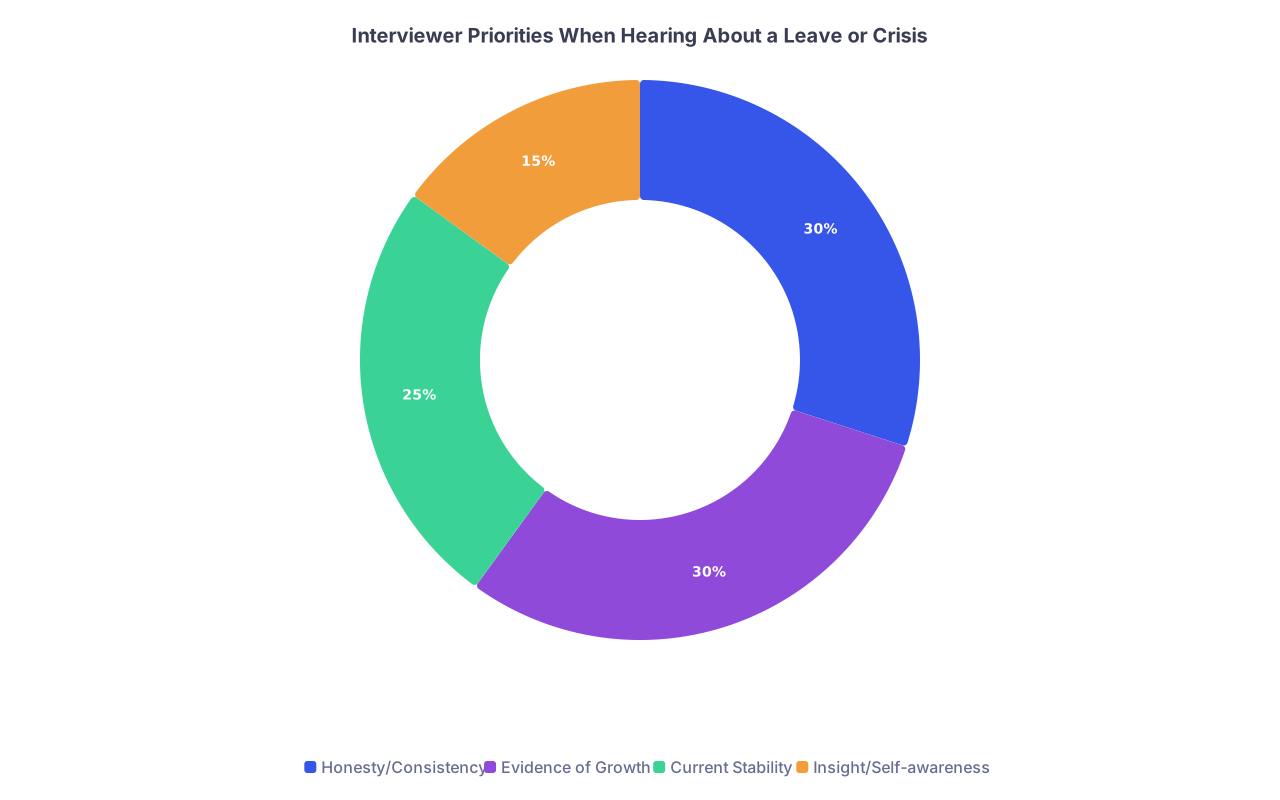
| Category | Value |
|---|---|
| Honesty/Consistency | 30 |
| Evidence of Growth | 30 |
| Current Stability | 25 |
| Insight/Self-awareness | 15 |
If you’re wondering where to put your energy: honesty and growth are non-negotiable. Stability and insight seal the deal.
A simple planning flow you can follow

| Step | Description |
|---|---|
| Step 1 | Identify LOA/Crisis |
| Step 2 | Build 4-Part Explanation |
| Step 3 | Only Share if Relevant |
| Step 4 | Decide Detail Boundaries |
| Step 5 | Practice 60-90 sec Answer |
| Step 6 | Plan Pivot Back to Strengths |
| Step 7 | Visible in Record? |
| Step 8 | Major Impact on Path? |
This is literally the map. Follow it and you’ll be ahead of 90% of applicants in your situation.
Quick sample phrases you can steal and adapt
Use these as building blocks, not a script:
- “I took a leave of absence during ___ due to a significant health issue that required focused treatment.”
- “My grades that semester reflect what was going on—I was not able to perform at my usual level.”
- “I worked with a therapist/physician/academic coach to address the underlying issues, not just the symptoms.”
- “Since returning, I’ve completed ___ semesters with ___ GPA while managing [research / work / volunteering].”
- “This experience has changed how I approach stress, in that I now [specific habit].”
- “I take full responsibility for that decision, and I’ve been intentional about rebuilding trust through [concrete actions].”
- “I’d prefer not to discuss certain personal details, but I’m comfortable sharing that…”
- “Today, the situation is stable because [clear reason], and I’m confident in my ability to handle the demands of your program.”
That’s the tone you want: candid, specific, not dramatic.
What to do today
Open a blank document and write out your 4-part explanation—context, impact, response, resolution—in under 200 words.
Then read it out loud once.
If you can’t get through it without rambling, apologizing excessively, or oversharing, keep tightening it until it sounds like something you could say across a desk to a calm, skeptical physician.