
What do you actually say when the interviewer looks you in the eye and asks, “Tell me about this institutional action on your record”?
If you are reading this, you probably have one of the following:
- An Institutional Action (IA) reported to AMCAS/AACOMAS
- An academic misconduct finding (cheating, plagiarism, collaboration issues)
- A professionalism citation (unprofessional email, social media, patient confidentiality breach, etc.)
- A failed course or remediation tied to “academic dishonesty” or “conduct”
And now you are wondering: How do I talk about this in an interview without torpedoing my chances?
Let me walk you through what to do – specifically – if you are walking into interviews with an IA or academic misconduct in your past.
We are not doing vague “be honest and reflective” nonsense. You need scripts, strategy, and guardrails.
Step 1: Know exactly what’s in your file before you walk in
If you have an IA or academic misconduct, and you have not seen the official wording from your institution, fix that first.
Here’s what you do this week:
- Pull your AMCAS/AACOMAS application and re-read the IA section you filled out.
- Request (if you haven’t already) the official documentation or letter from your school:
- Conduct report
- Academic integrity finding
- Dean’s letter / notation explanation
You need to know:
- The formal charge (e.g., “academic dishonesty – unauthorized collaboration on exam”)
- The sanction (warning, probation, course failure, suspension)
- The dates and whether it’s “resolved” or “in good standing now”
- Whether your school reported it as an IA to AMCAS/AACOMAS (sometimes students are told “this is internal only” and that’s wrong)
Why this matters: In interviews, they aren’t asking about your memory of events. They’re asking about the documented event they already read.
If you say something that does not line up with the written record, you look either evasive or careless. Both are fatal in a conversation about integrity.
So step one: align your story with the actual record. Not the version you wish existed.
Step 2: Understand what interviewers are really testing
They’re not just asking, “Did you screw up?” They already know you did.
They’re asking:
- Can you be trusted with patients, exams, and confidential information?
- Are you honest when it’s uncomfortable and high-stakes?
- Did you actually grow from this or just learn how to talk around it?
- Are you going to be a recurring problem for the dean of students?
I have heard admissions folks say this verbatim:
“One IA doesn’t kill you. A defensive answer does.”
So your goal is not to prove you are perfect. Your goal is to show:
- You accept responsibility.
- You understand the impact and seriousness.
- You changed behavior in concrete ways.
- This will not happen again.
If your answer feels like a legal defense, you are doing it wrong.
Step 3: Build a clear, tight narrative – and stick to it
You need a rehearsed but not robotic answer. Something you could say, word-for-word, when you’re stressed and your heart is pounding.
Use this simple structure:
- Brief context
- Clear ownership
- What you learned
- Concrete changes
- One-sentence reassurance
Do not spend 80% of the time on the story and 20% on growth. Reverse that. They do not need the cinematic version.
Here’s a general template you can adapt:
“During my sophomore year, I was found responsible for [brief description of misconduct] in [course/situation]. I [very short explanation of what you did / what happened], and the university issued [sanction].
At the time, I was [mindset – stressed, immature, trying to cut corners, etc.], and I made a decision that absolutely violated our academic integrity policy. I didn’t fully appreciate then how seriously that undermines trust in the classroom and later in patient care.
Since then, I’ve [specific actions: met with dean / completed ethics course / changed study habits / instituted new systems / sought accountability]. I’ve had [X] semesters/years with no further issues and strong academic performance.
This was a hard but important turning point for me. It changed how I approach honesty, pressure, and responsibility. I’m confident the behavior that led to that incident is not who I am now or how I operate.”
Notice what’s not in there: finger-pointing, long excuses, “I didn’t realize it was a rule,” or “other people were doing it too.”
You can explain contributing factors, but you cannot use them as a shield.
Step 4: Tailor your approach to the type of misconduct
Not all IAs land the same way. How you talk about them should reflect that.
1. Classic academic dishonesty (cheating, unauthorized aid)
If you were caught cheating on an exam, using notes, sharing answers, or similar, that’s one of the most serious from an integrity standpoint. You cannot sugarcoat this.
Bad approach:
“I was in a really tough course and everyone was sharing answers. I just got caught.”
Good approach:
“In organic chemistry, I used unauthorized resources during an exam. That’s cheating, plain and simple, and the university gave me a failing grade and an institutional action.
At the time, I let anxiety about my grade override my judgment. I knew the rules, and I chose to ignore them. I own that decision.
Afterward, I met with the professor and dean, completed an academic integrity seminar, and overhauled how I prepare for high-stakes exams – I now use scheduled practice tests, office hours weekly, and I started studying earlier rather than cramming. Since then, I’ve had [X semesters] with strong grades and no further issues.
It was humiliating, but also clarifying. I learned that short-term gain at the cost of integrity will never be worth it, especially in medicine, where trust is everything.”
Specific, direct, no dodging.
2. Plagiarism / citation problems
This one ranges from “sloppy citations” to “copy-paste from a website.” Be honest about where you land.
If it was really unintentional but still your fault, you say that. But you still own the result.
“In my junior year, I was cited for plagiarism in a writing-intensive course. I used several sentences from a source that were too close to the original wording, even though I cited the article. The university considered that plagiarism and issued an IA.
I initially felt it was unfair because I hadn’t meant to claim the ideas as my own, but I’ve since learned that intention doesn’t erase impact. I should have paraphrased properly or used quotation marks.
I met with the writing center, completed an academic integrity workshop, and I now run all major written work through plagiarism-checking tools and have a stricter personal rule for paraphrasing and citing.
It made me more careful, but also more respectful of intellectual honesty, which translates directly to how I’ll handle research, patient documentation, and collaboration in medicine.”
If you actually copy-pasted whole sections, say it more bluntly:
“I copied portions of a paper from an online source and turned it in as my own work. That was a conscious choice and a serious violation of academic integrity.”
Own the verb. “Copied.” Don’t hide behind “improperly referenced material” if that’s not how your letter is written.
3. Professionalism or conduct issues (non-academic)
This might be alcohol-related incidents, dorm violations, unprofessional email, boundary issues, or social media.
Admissions committees care about these a lot, because professionalism problems are exactly what get med students in trouble.
Example – alcohol incident:
“During my freshman year, I was cited for an alcohol-related conduct violation in the dorms. I was underage and intoxicated, and the RA documented the incident, which led to an institutional action.
I wasn’t belligerent, but that doesn’t matter – I broke policy, put myself in a risky situation, and required staff intervention.
Afterward, I completed the mandated education program, met with a counselor, and changed my approach to alcohol and social situations. I haven’t had any further conduct issues, and I’ve been intentional about setting boundaries for myself, especially knowing the responsibility I want as a physician.
It pushed me to grow up a lot faster and take my judgment outside the classroom as seriously as my academics.”
For things like unprofessional emails or social media:
“I sent an email to a professor that was disrespectful in tone after receiving a grade I disagreed with. It was escalated and documented as a professionalism concern. Looking back, I’m embarrassed by how reactive I was.
Since then I’ve implemented a personal rule: I never send a difficult email without waiting at least 24 hours and asking a neutral person to read it. I’ve also learned a lot more about how power dynamics work in academic medicine and how important respectful communication is, even when you disagree.”
Again, the theme: clear action + clear change.
Step 5: Control your tone: neither defensive nor groveling
How you sound often matters more than the specific words.
Watch out for these traps:
Defensive tone
- Phrases like “It wasn’t really a big deal,” “Other students did worse,” “The professor had it out for me.”
- This signals you learned nothing.
Overly dramatic self-flagellation
- “It was the worst thing in the world, I’ll never forgive myself, I’m a horrible person.”
- This sounds performative and sometimes manipulative. They don’t want guilt; they want growth.
Detached / robotic
- Overly memorized speech with zero emotion.
- They will wonder if you care or if you are just gaming the system.
Aim for calm, serious, and candid.
You should sound like someone who has told this story before, not someone who is still in shock from it.
One test: If your explanation takes more than 2 minutes before you get to “here’s what I changed,” it is too long and too story-heavy.
Step 6: Expect follow-up questions – and prepare answers now
They will not always just nod and move on. Common follow-ups:
- “If I called your dean today, how would they describe this incident now?”
- “Why should we believe this won’t happen in medical school?”
- “How did your peers or mentors react when this happened?”
- “What would you do differently if you were in the same situation today?”
- “Did you report this IA on your application yourself?”
You should have tight answers ready.
Example – “Why should we believe this won’t happen again?”:
“Because I’ve changed both my mindset and my systems. Mindset-wise, I no longer see grades or ‘winning’ as worth more than my integrity. Systems-wise, I prepare earlier, I ask for help sooner, and I avoid situations where shortcuts are tempting.
The evidence is in my record since then – [X years] of clean conduct, strong academics, and positive evaluations from faculty who know this history. I’m not asking you to ignore what happened; I’m asking you to look at the trajectory since then.”
Example – “Did you report this yourself?”:
“Yes. I disclosed it on my application because I believe you can’t build a medical career on half-truths. I’d rather own my history upfront than have it discovered later.”
If you did not initially realize it had to be reported and fixed it later, be honest:
“Initially I misunderstood and thought it would remain internal to the university. When I realized it met the definition of an institutional action, I updated my application/secondary and took responsibility for the oversight.”
Do not lie here. Schools do cross-check.
Step 7: Align your story across application, secondary essays, and interview
If you already wrote about this in your primary or secondary, your interview answer must match the same:
- Timeline
- Level of responsibility
- Core lesson learned
You can add nuance in person, but do not contradict the written version.
One common mistake:
The written version says, “I violated the academic integrity policy.”
The verbal version says, “It was kind of a misunderstanding.”
No. Pick one adult version and stick with it.
If your written explanation was bad (too defensive, too vague), you can improve the framing in the interview, but you should not pretend the earlier version did not exist. If they quote your own essay back to you, you need to be able to say:
“When I first wrote about this, I was still pretty focused on [X]. Since then, I’ve had more distance and I see [Y] more clearly. The core facts are the same, but my perspective has matured.”
That’s honest, and it actually shows growth.
Step 8: Practice out loud, not just in your head
This is one of those topics where “I know what I’ll say” is a lie you tell yourself.
You need to actually say the words out loud. Several times. Preferably to another human.
Here’s how to practice:
- Write your 60–90 second “base answer” using the structure above.
- Record yourself saying it on your phone.
- Listen once. Cringe. Then fix:
- Cut jargon.
- Remove defensive phrases.
- Add one concrete behavior change.
- Practice with a friend, advisor, or mock interviewer and tell them, “Do not be nice. Tell me where I sound evasive or weirdly rehearsed.”
If, when you practice, you start rambling, oversharing, or launching into a 5-minute saga about your professor, trim. You are not trying to win a trial. You’re trying to show maturity.
Step 9: Know how different schools might react (and what you can’t control)
Reality check: Some schools won’t care much about a single, resolved IA with a strong recovery. Others will use it as an easy screen in a competitive pool.
That’s not fair. It’s also not your problem to fix.
What you can control:
- Applying broadly, including schools that explicitly say they review IAs “holistically.”
- Making sure your LOR writers know about the incident (when appropriate) and can speak to your integrity now.
- Showing a sustained track record of clean behavior and strong performance after the incident.
Here’s a quick comparison table to give you a sense of what tends to land how:
| IA Type | Typical Perceived Severity | Key Concern |
|---|---|---|
| Cheating on exam | High | Core honesty under pressure |
| Plagiarism (major) | High | Intellectual honesty, research |
| Repeated alcohol violations | High | Judgment, professionalism pattern |
| Single alcohol incident | Moderate | Maturity, behavior change |
| Dorm / noise violation | Low–Moderate | Respect for rules |
| Unprofessional email | Moderate | Professional communication |
Is this universal? No. But it’s close to how a lot of committees talk behind closed doors.
Your job: move them mentally from “risk” to “rehabilitated.”
Step 10: Do not hide it. Ever.
If you’re still toying with the idea of not reporting an IA because “maybe they won’t find out,” stop.
Medicine functions on trust. Licensing boards, hospitals, and residency programs all ask versions of this question:
“Have you ever been subject to disciplinary action, academic misconduct, or professionalism sanctions?”
If your med school finds out later that you lied or omitted something? They can dismiss you. And they do. I’ve seen it happen with people who were months from graduating.
So your options are:
- Disclose, own it, and accept that it may cost you some interviews but preserve your integrity and future.
- Hide it, hope nobody finds it, and build a career on a crack that can split open at any licensing or credentialing step.
Pick the adult option.
One more thing: How to mentally carry this into interview day
Walking into an interview with an IA feels like wearing a label on your forehead: “Not trustworthy.”
You will be tempted to overcompensate – be extra charming, extra polished, extra “perfect.”
Resist that.
Your best posture is this:
“I made a serious mistake. I did the work to grow from it. I’m not defined by it, but I will never pretend it did not happen.”
You shouldn’t sound crushed. You also shouldn’t sound casual. You sound like someone who’s lived with a hard lesson long enough to metabolize it.
If they ask about it, you answer. Then you move on. You don’t keep coming back to it. You let the rest of your application – your grades, letters, experiences – speak as loudly as the IA.
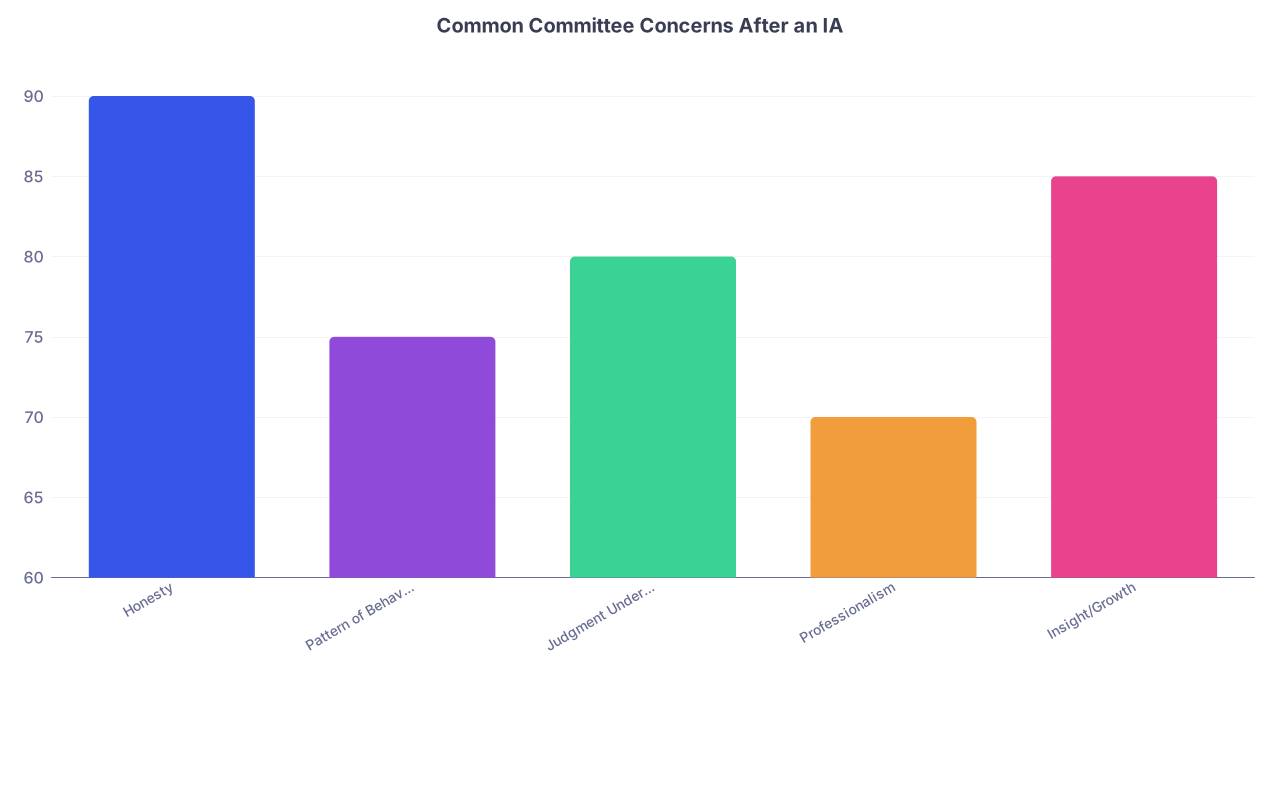
| Category | Value |
|---|---|
| Honesty | 90 |
| Pattern of Behavior | 75 |
| Judgment Under Stress | 80 |
| Professionalism | 70 |
| Insight/Growth | 85 |

| Step | Description |
|---|---|
| Step 1 | Know the official record |
| Step 2 | Write 60-90 sec narrative |
| Step 3 | Practice out loud |
| Step 4 | Give clear, concise answer |
| Step 5 | Focus on strengths |
| Step 6 | Answer follow-up questions calmly |
| Step 7 | Move on to rest of interview |
| Step 8 | Asked about IA? |
FAQ (exactly 3 questions)
1. Should I bring up my IA even if they don’t ask?
No. You already disclosed it in your application. Interview time is limited; you don’t need to reopen every wound unprompted. Be fully prepared to discuss it if they ask. If they don’t, focus on your strengths, your fit with the school, and why you’re ready for medicine. The only exception: if there is a new update or clarification that materially changes how it should be understood (rare), then you can briefly mention it when they ask, “Anything else we should know?”
2. What if I genuinely believe the IA was unfair?
You can say that you disagreed with aspects of the process or outcome, but you must not let your answer turn into a complaint session. Something like: “I didn’t agree with every part of the process, but I recognize I contributed to the situation by [X], and I’ve focused since then on what I can control: my behavior, my communication, and my preparation.” If you spend more than 20–30 seconds on “unfair,” you sound like you haven’t moved on.
3. Will an IA or academic misconduct automatically keep me out of medical school?
No. It will close some doors, especially for the most competitive schools and for the most serious offenses. But many applicants with a single, well-managed IA plus a strong upward trajectory do matriculate. Your job is to make it as easy as possible for a committee to say, “Yes, this happened – and yes, we still trust this person now.” That comes from a clean subsequent record, strong letters, solid academics, and a mature, honest interview performance.
Key points to walk away with:
- Know the official record cold and build one clear, ownership-focused narrative.
- Practice giving a concise, calm, responsibility-heavy answer – then move on to your strengths.
- Never hide or minimize; your long-term medical career depends more on your honesty now than on any single mistake you made before.