
You’re sitting in a Zoom “waiting room” for your med school interview. Your heart’s already doing its thing. Then you remember the line on your AMCAS: three different colleges in four years. Or a post-bacc, a leave of absence, then a transfer.
And you can almost hear the interviewer’s voice in your head:
“So, I see you changed schools a few times. Can you tell me about that?”
This is where a lot of people freeze. Or worse — overshare, ramble, or sound defensive. Let’s make sure you do none of that.
This is about how to explain multiple transfers or school changes without sounding flaky, unstable, or like a walking red flag. You’ll come out of this with ready-to-use, scenario-specific scripts and a clear strategy for handling the question in an interview.
Step 1: Diagnose Your Situation (Brutally Honestly)
Before you can explain your story, you need to understand how it looks on paper to someone who doesn’t know you.
Typical “multiple move” situations I see:
- Community college → 4-year → maybe another 4-year
- 4-year → transfer to another 4-year (sometimes twice)
- 4-year → leave of absence → return / new school
- Foreign university → U.S. university (sometimes plus a post-bacc)
- Med school → transfer to another med school
- Mix of online, in-person, and non-traditional routes
You probably fit into some flavor of these.
Now ask yourself three questions, and answer like you’re your own admissions dean:
- Was there a clear, reasonable reason to move each time?
- Does the transcript show instability (grade dips, withdrawals, repeated starting over)?
- Does your story have a clear “I stabilized here and moved forward” point?
If you cannot answer yes to #3, that’s your biggest problem, not the transfers themselves. Admissions committees forgive change. They don’t forgive ongoing chaos with no clear turning point.
Your task: identify the moment when things settled and improved. That will become the anchor of your explanation.
Step 2: Understand What Raises Red Flags (And Avoid Triggering Them)
Interviewers are not allergic to transfers. They’re allergic to three things:
- People who blame everything on others.
- People who sound like victims of life with no agency.
- People who seem like they might bail when med school gets hard.
If your answer sounds like:
- “That school was terrible.”
- “My advisor didn’t support me, so I had to leave.”
- “The environment was toxic.” you’re in trouble.
Even when those things are partially true (and sometimes they absolutely are), you have to be smart about how you say it.
What they want to hear instead:
- Thoughtful decisions, even if made under stress
- Evidence you learn from hard situations
- Clear upward trajectory: maturity, grades, focus
So your answer needs to hit three beats:
- Brief, non-dramatic context
- What you learned / how you grew
- Proof that you stabilized and succeeded afterward
If you miss #2 or #3, they’ll keep poking with follow-up questions until it feels like an interrogation.
Step 3: Build a Clean, 2–3 Sentence Story for Each Move
Every transition needs its own tight script. Not a monologue. A controlled, 20–30 second explanation.
Structure:
- One line on why you started there
- One line on why you moved (neutral, not blaming)
- One line on what got better / what you accomplished after
Example 1: Community College → State University → Another University
Let’s say:
- You started at a community college for cost reasons
- Transferred to Big State U
- Then transferred again after a bad fit academically and personally
Bad answer: “I just didn’t like State, the classes were huge, the advising was terrible, so I moved again.”
Better answer: “I started at community college because it was the most affordable option for my family, and it allowed me to explore science while working part-time. After I completed my prerequisites and earned my associate’s, I transferred to State University for more advanced biology coursework. Once there, I realized the environment wasn’t a great fit for me academically, so I transferred to [Final School], where I was able to build stronger relationships with faculty and really hit my stride academically — that’s where you see my most consistent performance and research involvement.”
Notice:
- No ranting
- The “problem” school is described as “wasn’t a great fit,” not “awful”
- It ends with stability and success
That last part is key: always land on where you stabilized.
Example 2: 4-Year → Leave of Absence → New School
Let’s say you had significant mental health issues or serious family illness.
You don’t need your psych history on the table. You also don’t need to lie.
Something like:
“I began at [University A], and during my second year some significant personal circumstances outside of school impacted my ability to perform at the level I expected of myself. I took a leave of absence to address those issues and, when I was ready to return full-time, I enrolled at [University B] to have a fresh start closer to home. Since then, you can see my grades have been consistently strong and I’ve maintained a full course load while taking on research and clinical volunteering.”
That’s enough. If they press (“What circumstances?”), you can set a boundary while still being responsive:
“I’d prefer not to go into all the specifics, but it was a combination of health and family issues that I needed to address. The important part for me is that I got appropriate support, learned how to manage those challenges, and since then I’ve been able to maintain strong academic performance and commitments — which I think better reflects who I am now.”
You answered the question. You showed growth. You did not turn the interview into a therapy session.
Step 4: Decide What Category Your Reasons Fall Into — Then Frame Smartly
Most transfers fall into one or more of these buckets:
| Reason Type | Risk Level | Best Framing Focus |
|---|---|---|
| Financial / Family | Low | Responsibility, maturity |
| Academic Fit | Medium | Seeking rigor, alignment |
| Personal / Health | Medium | Resilience, support use |
| Disciplinary Issues | High | Accountability, change |
| Immigration / Move | Low | Stability after move |
Let’s go through how to handle each.
1. Financial or Family Constraints
These are the least suspicious when explained cleanly.
Example: “I started at [Local College] because staying at home and working part-time was the only realistic way for me to attend college. Once I had saved enough and completed the first two years, I transferred to [University] for the upper-level science courses and research opportunities. That path actually helped me build time management skills early, which I leaned on heavily once I started full-time at the university.”
No apology. Just facts and maturity.
2. Academic Fit or Program Availability
This gets trickier because it can sound like “I ran away because it was hard” if done poorly.
Bad: “The classes were too big and curved, so I left.”
Better: “At [University A], I realized that the large, lecture-based environment made it difficult for me to build relationships with faculty or get involved in meaningful research. I knew I wanted a more interactive environment, so I transferred to [University B], where the smaller classes and accessible faculty allowed me to get more engaged academically — for example, joining Dr. X’s lab and completing my thesis on Y. That change really shifted me from just ‘getting through’ coursework to actually engaging deeply with it.”
Focus on:
- Proactive decision
- Fit with learning style
- Concrete results after the move
3. Personal, Mental Health, or Medical
Handled this earlier, but the short version:
- You do not need diagnoses
- You do need to show that it’s managed now
- You must anchor it to current stability and performance
You want the interviewer thinking: “Rough patch, handled. Not an ongoing crisis.”
4. Disciplinary or Academic Trouble
This is the hardest one. And you cannot lie — schools often already know.
You need:
- One clear sentence about what happened
- Direct ownership (no vague language)
- Specific steps you took to change
- Evidence of changed behavior over time
Example: “In my first year at [University A], I was placed on academic probation after I underperformed in several courses. I underestimated the transition from high school and didn’t yet have the study habits I needed. I met with academic support, changed my approach to time management and studying, and ultimately decided to transfer to [University B] for a fresh start. Since then, as you can see, I’ve maintained [X] GPA over [Y] credits, and I’ve been much more deliberate and disciplined about my academics.”
If it was disciplinary (e.g., plagiarism, conduct violation), same structure:
“At 19, I made a serious mistake in [brief description, e.g., ‘submitting a lab report with improperly cited sections from another student’]. That resulted in [sanction]. It was a wake-up call. I met with [advisor/dean], completed [required course or program], and since then I’ve been very intentional about [specific behaviors: time management, academic integrity habits]. Over the past [X] years, I’ve had no further incidents and have taken on [responsibility roles] that require a high degree of trust.”
They’re asking: will you be a problem in their program? You’re answering: I used to be a problem; now I’m not, and here’s the proof.
5. Immigration, Relocation, or External Forces
These are straightforward. Don’t dramatize.
“I completed my first year of undergraduate coursework at [University Abroad], but my family relocated to the U.S., so I transferred to [U.S. University] to continue my education here. There was an adjustment period, especially with the different grading system, but over the next few semesters you can see I adapted and my performance stabilized.”
Step 5: Tie All Moves Into One Coherent Arc
If you’ve had more than two moves, you need a macro story, not just micro-explanations.
Think of it as your “academic journey in 30 seconds” script.
Example: three transitions, one arc
“I’ve had a somewhat unconventional academic path, but there’s a clear progression. I started at [Community College] for financial reasons while working, then transferred to [State University] for more advanced coursework. After realizing that environment wasn’t the best fit for me academically, I transferred to [Final University], where I really found my footing — that’s where you see my strongest grades, my research in [field], and my long-term clinical volunteering. Each move was a step toward the environment where I could perform at my best, and once I found it, I stayed and built depth.”
You’re not apologizing for the path. You’re curating it into a rational progression that ends in stability and strength.
Step 6: Practice Out Loud Until It’s Boring
On paper, your script might look great. Out of your mouth, the first few times, it will probably sound either:
- Too stiff and rehearsed
- Or too rambling and defensive
You want calm, matter-of-fact, trimmed of drama.
Use your phone, record yourself answering:
“Can you walk me through your school changes?”
Watch for:
- Do you over-explain early pain points?
- Do you talk longer about the problems than the resolution?
- Do you sound like you’re trying to convince yourself it was okay?
Adjust so:
- Problem = 15–25% of the answer
- Transition/decision = 25%
- Resolution and current stability = 50%+
A useful trick:
After you give your answer, add one short sentence that explicitly shifts to the present:
“…and that experience is part of why I feel very ready for the rigor and consistency of medical school now.”
Or: “…and that’s also why I’ve been very deliberate about committing long-term to research and clinical work once I found the right environment.”
One line like that tells the interviewer, “Story over. I’m not still in the swirl.”
Step 7: Have Receipts Ready — Evidence of Stability
Words are nice. Data is better. Interviewers relax when they can match your explanation to hard evidence.
Evidence you want on your side:
- A strong GPA in your final institution or phase
- Solid upward trend over the last 2–3 years
- Long-term commitments (1+ year) to:
- One clinical site
- One research lab
- One significant extracurricular or job
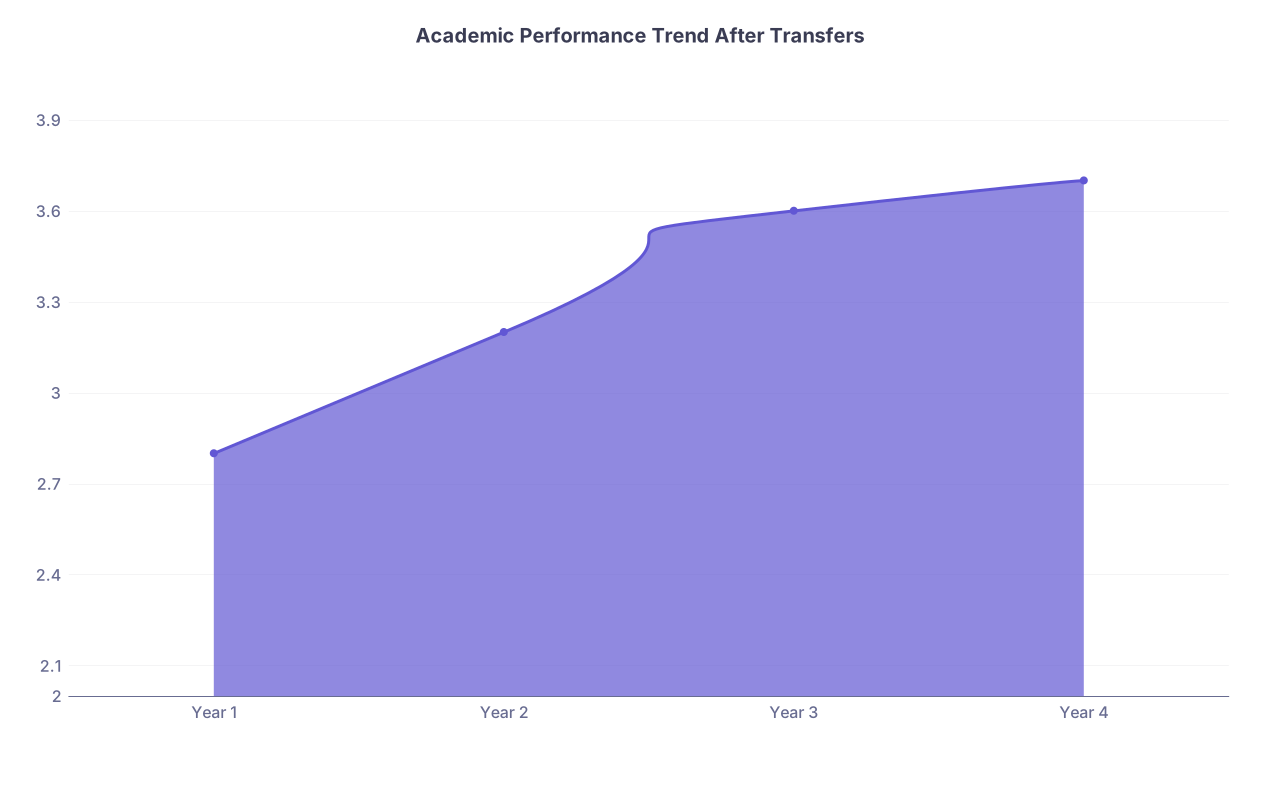
| Category | Value |
|---|---|
| Year 1 | 2.8 |
| Year 2 | 3.2 |
| Year 3 | 3.6 |
| Year 4 | 3.7 |
If your AMCAS shows that once you landed in your final environment you stayed there three years, pulled mostly As, and held the same research position for two years — that does more work than any speech you could give.
In the interview, you can point to this:
“At [Final University], over the past three years I’ve maintained around a [GPA] while taking upper-level sciences, and I’ve stayed in the same research lab and clinical volunteering role. Those experiences reflect the stability I’ve built since those earlier transitions.”
Now your story and your transcript match. That’s when doubt disappears.
Step 8: Anticipate the Tough Follow-Ups
Some interviewers will poke. Not because they hate you, but because it’s their job.
Common follow-ups:
- “If things were so challenging at [School], why didn’t you just stick it out?”
- “How do we know you won’t want to transfer again in medical school?”
- “Was there any disciplinary or conduct issue involved?”
- “Do you think the frequent changes affected your academic performance?”
Sample responses.
For “Why not stick it out?”: “I thought carefully about that. At the time, I weighed staying versus transferring. I realized that the specific environment at [School] — especially [size/structure/logistics] — wasn’t one where I could realistically build the kind of mentoring and research relationships I was looking for. Transferring wasn’t an impulsive decision; I discussed it with advisors and my family, and once I moved to [Final School], I committed fully and stayed there through graduation.”
For “How do we know you won’t transfer again?”: “That’s a fair question. I think the best predictor is my track record in the last several years. Once I found an environment where I could engage deeply — at [Final School] — I stayed, took on increasing responsibility, and built long-term relationships in research and clinical settings. I’ve also learned that constantly changing environments makes it harder to build depth, and I’m very intentionally seeking stability and continuity for medical school and residency.”
For “Did this affect your academics?”: “During the transitions, yes. There was an adjustment period each time — different systems, different expectations. You see that in [this semester/these grades]. What I’m proud of is that once I adapted, my performance improved and then stabilized. The last [X] semesters are a better reflection of my capabilities than those transition terms.”
You don’t dodge. You acknowledge. Then you point them to your stable, current version.
Step 9: Specific Scenarios and Ready-Made Scripts
Scenario A: Three Undergrad Schools, Mixed Grades
Core story:
- Financial → bad fit → stabilized
- Own the messy middle, highlight the stable end
Script skeleton:
“I started at [School 1] because [financial/family reason]. After completing my first year, I transferred to [School 2] for [reason]. That transition was harder than I expected, and my grades that year reflect the adjustment. I realized I needed a different environment, so I transferred to [School 3], where I committed to staying through graduation. That’s where you see my strongest grades and my longest-standing commitments in research and clinical work. So while my path isn’t linear, the direction is clearly upward.”
Scenario B: Med School Transfer
Med school transfers are heavily scrutinized. Here’s what matters: your reason can’t be “I didn’t like it.”
Strong reasons:
- Spousal relocation / family
- School closure / loss of accreditation concern
- Serious health needs requiring move
Example:
“I transferred from [Med School A] to [Med School B] after my partner matched into a residency program across the country and a close family member developed significant health issues in that same region. I discussed staying versus transferring extensively with my dean. Ultimately, I felt that being geographically closer would allow me to maintain the support system I needed while continuing to perform at my best academically. Since transferring, I’ve remained in good academic standing and stayed involved in [clinical/research] work, which I think reflects that it was the right decision.”
Again: grounded, not dramatic. And anchored in continued performance.
Scenario C: Online → In-Person → Post-Bacc
“I completed my first degree largely online while working full-time. At that time, I wasn’t yet sure about pursuing medicine. Once I decided to commit to this path, I enrolled in an in-person post-bacc program at [Institution] to complete rigorous, face-to-face science coursework and gain more traditional classroom and lab experience. That’s where you see my recent science grades and most of my clinical exposure, which I view as my true preparation for medical school.”
You’re essentially saying: earlier stuff is background; my real premed training is here.
Step 10: Clean Up Your Application So It Backs Up Your Story
Even though we’re talking interviews, you should check that everything already sent (or about to be sent) isn’t silently undermining you.
Quick audit:
- Do your activity descriptions show duration and progression (e.g., “2019–2023, increasing responsibility each year”)?
- Did you avoid complaining about institutions anywhere in your written app?
- Did you put your strongest, most stable experiences in the most prominent slots (most meaningful activities, etc.)?
If not, fix what you still can. Then in the interview, emphasize the parts of your record that show stability and depth.


| Step | Description |
|---|---|
| Step 1 | Multiple Transfers |
| Step 2 | Clarify Real Reasons |
| Step 3 | Group Into Categories |
| Step 4 | Write 2-3 Sentence Story Per Move |
| Step 5 | Create One Overall Arc |
| Step 6 | Practice Out Loud |
| Step 7 | Prepare For Follow-Up Questions |
| Step 8 | Highlight Stability & Growth |

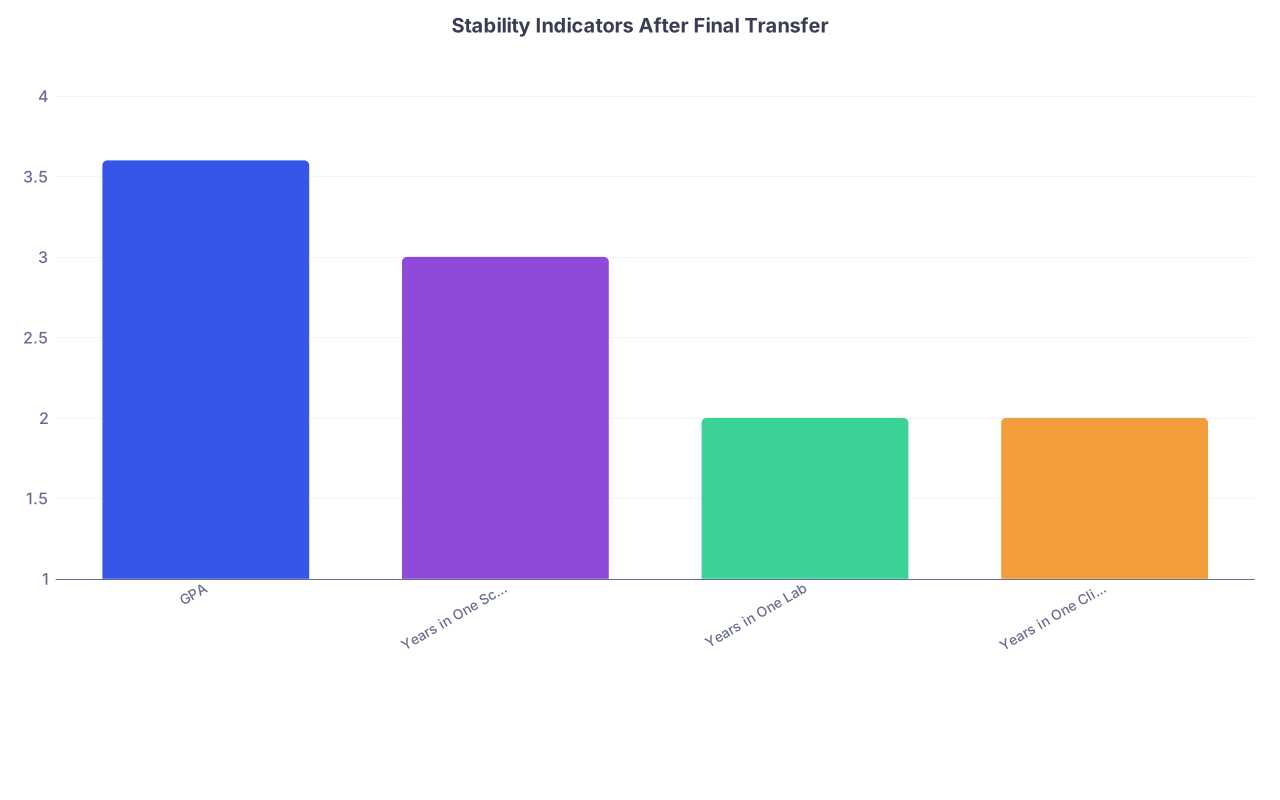
| Category | Value |
|---|---|
| GPA | 3.6 |
| Years in One School | 3 |
| Years in One Lab | 2 |
| Years in One Clinical Role | 2 |

Boil It Down: What You Actually Need To Do
- Stop apologizing for your path and start curating it. Every move gets a short, neutral explanation and you always land on how you stabilized and grew afterward.
- Practice out loud until your story is calm, concise, and clearly anchored in your strongest recent performance and long-term commitments.
- Back your words with evidence: upward trends, multi-year experiences, and one clear moment where you “found your footing” and stayed put.
If you do those three things, multiple transfers stop looking like chaos and start looking like a non-traditional path that led to a stronger, more self-aware applicant. Which is exactly what you want in that interview room.