
It’s 8:32 a.m. on interview day. You’re sitting in the Zoom waiting room or outside a faculty office. You know they’re going to ask some version of: “Tell me about a challenge,” or “How have you dealt with adversity?” You’ve got real answers. Serious ones. Family instability. Depression. Assault. A parent’s addiction.
And you’re stuck on one question: How personal is too personal? If you downplay everything, you sound fake and sheltered. If you dump your whole trauma file on the table, you worry you’ll make the room awkward or hurt your application.
Here’s the answer you’re looking for.
The Core Rule: Processed, Relevant, Bounded
If you remember nothing else, remember this framework. You can safely talk about very personal things if your story is:
- Processed – You’re not in the middle of the emotional crisis.
- Relevant – It genuinely connects to who you are as a future physician.
- Bounded – You share a slice, not the whole documentary.
When something is too personal in an interview, it usually breaks one of those three.
- If you’re tearing up and unable to continue, it is not fully processed.
- If the story doesn’t help them understand your character, motivation, or resilience, it’s not relevant.
- If you need 8 minutes of backstory before they understand the point, it is not bounded.
Let me walk through what that actually looks like in practice.
What Topics Are Generally Safe vs Risky?
You’re not a robot. You’re allowed to be a human with real experiences. But medical schools are not your therapy space. The line is about degree of detail, not the fact that something happened.
Here’s a quick comparison.
| Category | Generally Safe If… | Risky / Too Personal When… |
|---|---|---|
| Mental health | Past, treated, stable, clear growth | Current, unstable, graphic, no treatment or insight |
| Family illness/death | Focus on impact, maturity, motivation | Graphic descriptions, unresolved rage or despair |
| Financial hardship | Concrete, specific, shows perseverance | Long rant about unfairness or resentment |
| Discrimination | Tied to advocacy, reflection, professionalism | Pure venting, oversharing details about perpetrators |
| Assault/abuse | Very high-level, processed, ideally [disclosed in writing first](https://residencyadvisor.com/resources/med-school-interview-tips/how-honest-should-you-be-in-medical-school-interviews-about-weaknesses) | Graphic, recent, emotionally destabilizing in the room |
If you’re dealing with anything in the “risky” column and still feel raw, that’s a sign: scale back or choose a different example for live interviews.
How Personal Is “Too Personal”? A Simple Litmus Test
Ask yourself five blunt questions:
Can I tell this story in 2–3 minutes max?
If not, it’s probably too big or too complex for an interview answer.Can I talk about it without emotionally unraveling?
Some emotion is fine. Completely losing the thread is not.Do I clearly understand what I learned or how I changed?
If you cannot state the “takeaway sentence” in <15 seconds, it’s not ready.Does this make me sound capable and safe to train?
Not perfect. Not invincible. Just stable and functional.Would I be okay if this interviewer mentioned this story in a committee meeting with 12 strangers?
Because they might.
If you get “no” to any of those, either adjust the level of detail or choose a different story.
Talking About Trauma: What Works vs What Backfires
You can reference trauma. Plenty of strong applicants do. The key is owning the frame of the story.
Good example: high-level, reflective, competent
“I grew up in a home with significant instability due to a parent’s substance use. For a long time, I felt like I was just trying to keep everyone afloat. In college, I finally connected with a counselor and learned how to set boundaries and take care of myself.
That experience is a big part of why I’m drawn to medicine and especially interested in addiction care. I’ve seen how complex it is at the family level, and it’s pushed me to be more patient, less judgmental, and more aware of the systems that fail people. It also forced me to build strong coping strategies so I could succeed academically while things were chaotic at home.”
Why this works:
- No graphic details.
- Focus is on processing, growth, and relevance to medicine.
- You sound like someone who’s done work on themselves, not someone in freefall.
Bad example: unprocessed and too detailed
“My dad was an alcoholic. He would come home drunk, breaking things, yelling at everyone, sometimes hitting my mom. One night he…”
You see the problem. By the second sentence, the interviewer is thinking more about your safety and stability than your suitability for medical training. This belongs in therapy, not in a 30-minute interview.
The rule: mention the category of trauma, not the scenes of it. “I experienced intimate partner violence in college” is very different from a play-by-play of the incident.
Mental Health: How Much Should You Say?
This is the landmine everyone tiptoes around. You want to be honest. You also do not want to hand a nervous committee ammunition to doubt your ability to handle residency.
Here’s the line I recommend:
- Past anxiety, depression, eating disorder, etc., that’s treated, stable, and clearly tied to growth? Reasonable to disclose at a high level.
- Ongoing, severe, impairing symptoms? That’s not interview material. That’s something to manage with your clinician and school support systems.
Example that usually lands well:
“In my second year of college, I went through a major depressive episode. I was overwhelmed, my grades dipped, and I finally sought help from counseling and my physician. With treatment and support, I recovered, my performance improved, and I learned how to set limits and recognize when I need help. That experience changed how I think about mental health in medicine and made me better at recognizing struggles in others.”
Notice what’s missing:
- No medication lists.
- No graphic descriptions of self-harm.
- No suggestion you’re currently unstable.
You’re signaling: “This happened. I took responsible steps. I learned. I’m functional.”
If you are actively struggling, your priority is care and stability, not disclosure in an interview. You can still be an excellent applicant—just don’t use the interview as confession hour.
How Personal Should You Be in Different Contexts?
You do not need one “master story” you use everywhere. Different contexts tolerate different depths.
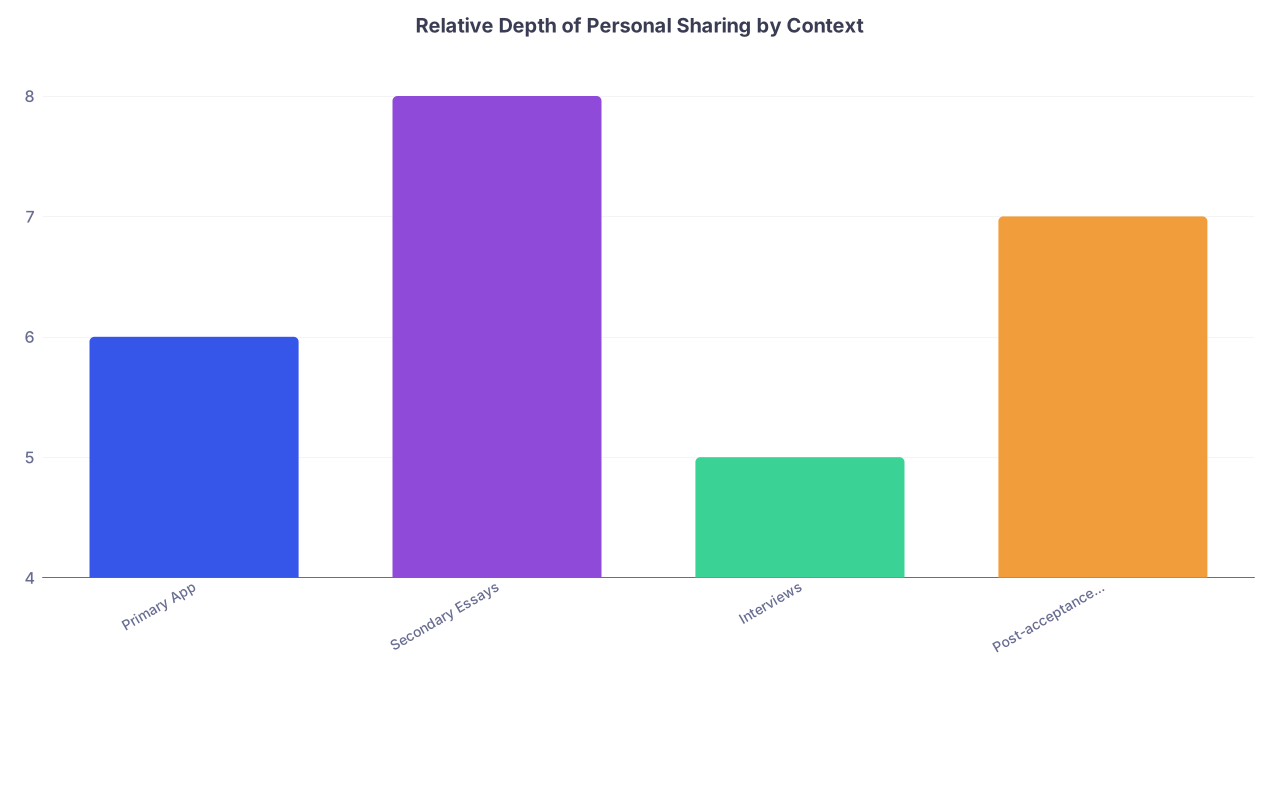
| Category | Value |
|---|---|
| Primary App | 6 |
| Secondary Essays | 8 |
| Interviews | 5 |
| Post-acceptance conversations | 7 |
(Think of those numbers as rough “depth” on a 1–10 scale.)
Primary Application
Moderate detail. This is where you can share significant challenges with enough context to make sense, especially in the disadvantaged essay or personal statement. But word counts force you to be efficient. No multi-page trauma narratives.
Secondary Essays
Often the best place to give more nuanced context. Diversity, adversity, or “something not in your primary” prompts are designed for this. You can be a bit more open here than in a live interview because:
- You can edit.
- The reader has time and space to process.
- You’re not trying to stay composed in real time.
Interviews
This is where you pull back a bit. Not because you should hide. But because:
- You have to manage your own emotions while thinking on your feet.
- There’s limited time.
- Individual interviewer biases are unpredictable.
Stick with the processed–relevant–bounded rule.
Concrete Examples: “Too Personal” vs “Just Right”
Let’s run through some scenarios I see over and over.
1. Sexual assault
Too personal in live interview: “I was raped my sophomore year. It destroyed me. For months I couldn’t…”
Better high-level version: “In college, I experienced a sexual assault that had a profound impact on my mental health and academic performance for a time. With therapy, support, and accommodations, I was able to recover, return to my classes, and ultimately graduate on time. That experience gave me a deep appreciation for trauma-informed care and for how healthcare systems can either retraumatize or support survivors.”
Key move: name the category, not the details. Emphasize recovery, support, and what it means for how you’ll treat patients.
2. Parent with severe mental illness or addiction
Too personal: “My mother has bipolar disorder and used to disappear for days. One time she…”
Better: “I grew up in a household affected by severe mental illness, which meant a lot of unpredictability and responsibility at a young age. That shaped my empathy for patients and families dealing with chronic mental illness and taught me how to function under stress. It also pushed me to seek mentorship and support systems outside my immediate family.”
Again: impact, not scenes.
3. Your own hospitalization / suicide attempt
This is tricky and very individual. In most interviews, I’d advise high-level disclosure, if at all.
Too personal: “I was hospitalized for three days after a suicide attempt when I was 19. I took…”
Safer framing: “In late adolescence, I went through a mental health crisis that required intensive treatment. With ongoing care and support, I’ve been stable for several years. That period of my life gave me very personal insight into patient vulnerability and helped me develop sustainable coping strategies that I still use in demanding situations.”
If this is less than a year or two in the past or still unstable, I’d be very cautious about bringing it up at all in interviews. That’s not judgment. That’s me being honest about how risk-averse some committees are.
How to Structure a Personal Challenge Answer
Use a simple, no-drama structure:
- Brief context – 1–2 sentences. High level.
- What was hard – focus on your internal or practical challenge.
- What you did – specific actions, support sought, changes made.
- Where you are now – stability, current functioning.
- What it means for medicine – empathy, resilience, perspective.
Example pulled together:
“In my first year of college, my family lost our primary source of income, and I suddenly had to work 30+ hours a week while in school. Balancing shifts with labs and exams was a real struggle, and my GPA took a hit that semester.
I met with my advisor, adjusted my course load, and found a more flexible job on campus. Over time, I learned how to plan realistically and communicate when I was overwhelmed. Since then, I’ve maintained a strong academic record while continuing to support myself.
That experience showed me how invisible financial stress can be and how easily we can misjudge someone’s performance if we do not see their full context. It’s made me slower to judge and more intentional about asking patients what else is happening in their lives.”
That’s personal. But not “too personal.”
Red Flags That You’ve Crossed the Line
You probably went too far if:
- The interviewer goes silent and looks genuinely distressed.
- You feel emotionally flooded and can’t think clearly.
- You need to say, “Sorry, this is hard for me to talk about,” more than once.
- The main impression you’re leaving is “this person is still in crisis,” not “this person has grown.”
If that happens once, you adjust. Make a mental note: That version was too much. Next time I’ll keep it higher level.
FAQs: Exactly 7 Questions
1. Should I mention trauma at all, or avoid it completely?
Do not force trauma into your story. If it’s central to who you are and why you’re pursuing medicine—and you can talk about it in a processed, relevant, bounded way—it can be powerful. If you’re not sure, you’re usually better off choosing a less loaded challenge for live interviews and keeping deeper detail in written essays.
2. What if my biggest challenge is something “small,” like a rough semester or time management?
That’s fine. Not every compelling answer needs tragedy. A tough academic period, a failed leadership initiative, or a team conflict can all be strong if you show real reflection and growth. The point is not to “out-trauma” other applicants; the point is to show maturity.
3. Can I talk about ongoing therapy or medication?
Yes, briefly, if it supports a narrative of stability and insight. Something like: “I still see a therapist periodically to maintain the coping skills I developed, which has been very helpful in managing stress.” You do not need to list diagnoses or meds. Keep it high-level and focused on responsibility, not symptoms.
4. What if I start crying in an interview when discussing a challenge?
A few tears are human. Take a breath, sip water, say “Excuse me,” and continue if you can. If you fully lose the ability to respond, that’s a sign the topic is still too raw for interviews. For future interviews, choose either a different story or a much more surface-level version of that one.
5. Should I warn an interviewer before mentioning something like assault or abuse?
You do not need a formal warning, but you can soften your entry. For example: “This involves a difficult experience related to sexual violence, but I’ll keep it brief because the important part is what I learned and how it shaped my approach to patients.” Then stay high-level and focused on growth.
6. How do I know if programs will see my experience as a liability?
Ask yourself how a risk-averse stranger on a committee would hear your story. If your version emphasizes ongoing instability, lack of support, or no coping plan, they’ll mark it as risk. If your version emphasizes responsible help-seeking, sustained stability, and concrete strengths you bring as a result, many will see it as a positive. But some bias always exists; that’s reality.
7. Who should I test my story on before interviews?
At minimum: one person who knows you well and one person who doesn’t. Ideally a prehealth advisor, mentor, or counselor. Ask them directly: “Does this feel appropriately personal for a professional interview? Do I sound stable and reflective, or does it feel too raw?” Listen to their discomfort, not just their words.
Today, pick one challenge story you’re considering using. Write it out in 250–300 words, then cut every graphic or unnecessary detail and add two sentences on what you learned and how it shapes you as a future physician. That’s your baseline interview version.