
It’s late February. Your MCAT is booked for late April. AMCAS opens in June. You keep hearing “Don’t forget MMI prep,” but right now you’re buried in amino acids and optics, not ethical dilemmas and healthcare policy.
You’re trying to answer a simple question:
When, exactly, do you start MMI practice so you do not tank your score or your interviews?
Let’s build the timeline.
Big Picture: How MMI Fits Around MCAT & Applications
Here’s the order of operations whether you like it or not:
- MCAT – non‑negotiable first priority.
- Primary application (AMCAS/AACOMAS/TMDSAS) – personal statement, activities, school list.
- Secondaries – fast turnaround, lots of writing.
- Interviews (including MMIs) – months later, but you feel them earlier.
You don’t train for a marathon the week before. Same for MMIs. But you also don't blow up MCAT prep to rehearse fake ethical scenarios in March.
The trick is phasing:
- Phase 1 – MCAT‑dominated: Light MMI exposure only.
- Phase 2 – Application + foundation: Build core MMI skills, low intensity.
- Phase 3 – Pre‑interview ramp‑up: Structured, serious MMI practice.
- Phase 4 – Active interview season: Maintain and sharpen.
Let me walk you month by month, then zoom into weeks once invites hit.
12–6 Months Before Primary Submission: MCAT First, MMI Seeds
Assume a “traditional” timeline:
- MCAT: April
- AMCAS opens: early May
- Submission: early June
- Secondaries: July–August
- Interviews: September–February
Adjust your months relative to your MCAT and application year, but the sequence holds.
10–12 Months Before Submission (Deep Content / Early MCAT Phase)
You are here: maybe August–October of the year before you apply.
Primary goal: Build MCAT content base, set up long‑term plan.
MMI role: Barely on the radar, but not zero.
At this point you should:
- Spend 95–98% of your bandwidth on:
- Learning MCAT content
- Building study habits
- Getting question volume up
- Limit MMI to:
- Casual exposure:
- Listen to 1–2 med school podcast interviews a month (e.g., admissions dean Q&As).
- Read 1 article a week on healthcare ethics or policy (NYTimes health section, STAT News, NEJM perspectives).
- Reflection journaling once a month:
- “A time I failed.”
- “A time I disagreed with someone in a group.”
- “A time I handled a conflict professionally.”
- Casual exposure:
This is not “MMI practice.” This is laying the raw material so later, when you need examples, your brain isn’t blank.
6–9 Months Before Submission (Full MCAT Mode)
Now we’re in December–February for a June application, with a spring MCAT.
Primary goal: Crush MCAT.
MMI role: Light introduction only.
At this point you should:
- Keep MCAT as top priority. If your MCAT is not on track, MMI waits. Period.
- Spend 1–2 hours per month on MMI‑adjacent skills:
- Watch 2–3 YouTube MMI station walk‑throughs (from reputable channels, not random undergrad clubs guessing).
- Read through a list of common MMI station types:
- Ethical scenarios
- Teamwork / collaboration
- Role‑play with actor
- Policy / healthcare systems
- Personal questions / motivation for medicine
- Start noticing:
- How good candidates structure answers (not what they say, how they say it).
- Use of frameworks: pros/cons, stakeholders, options, recommendation.
No mock circuits. No elaborate practice calendar. Just awareness.
3 Months Before MCAT Through MCAT Month: Do Not Overcrowd
Now it’s February–April. MCAT is 4–10 weeks away. Stress is climbing.
This is the danger zone for over‑achievers who want to “do everything” and end up half‑prepped for both.
8–12 Weeks Before MCAT
At this point you should:
- Commit: MCAT first, everything else second.
- Cap MMI work at 30–45 minutes per week, max. That might look like:
- 1 short ethical prompt → 5–7 minutes thinking + 5 minutes speaking answer out loud + 5 minutes self‑critique.
- 1 article on healthcare (insurance, health disparities, physician burnout) → 10 minutes read, 5 minutes jotting themes.
Your goal here is:
- Get used to:
- Talking out loud alone (yes, it feels weird).
- Hearing your own voice giving semi‑structured answers.
- Not to “master MMI.”
If you’re scoring below your MCAT targets on practice exams, cut MMI to zero until scores stabilize.
MCAT Month (Last 4 Weeks Before Exam)
You’re tired. You’re cranky. You’re dreaming in AAMC passage fonts.
At this point you should:
- Eliminate all non‑essential MMI practice.
- Keep only:
- Occasional reflection on experiences while walking or showering.
- Maybe 1–2 very short verbal answers a week (3–5 minutes tops).
If you have a free evening and must touch MMI, do this:
- Take one prompt:
“Tell me about a time you had a conflict on a team. How did you handle it?”
Speak for 2 minutes. Record. Listen once. That’s it.
Anything more risks crowding out MCAT recovery and deep work.
MCAT Done → Between MCAT and Primary Submission: Foundation Build
Let’s say you test in late April. Primary opens in early May. You submit in early June.
This 4–6 week window is misunderstood. People either collapse completely or pile on everything at once.
Now MMI prep becomes legitimate – but still secondary to your application writing.
0–2 Weeks After MCAT
You’re recovering, refreshing, starting to think about personal statements and activities.
At this point you should:
- Shift from MCAT mental mode to story and reflection mode.
- Time split:
- ~70% on primary application (personal statement, activities, school list)
- ~20–25% on rest/normal life
- ~5–10% on MMI foundations
MMI work this period:
Build a story inventory document:
- 10–15 experiences with:
- Situation
- Your role
- Conflict/problem
- Action you took
- Outcome & reflection
- Include:
- Clinical exposure
- Research
- Leadership
- Teaching/tutoring
- Non‑medical jobs
- Major failures/struggles
- 10–15 experiences with:
Practice 1–2 personal‑style questions per week out loud:
- “Why medicine?”
- “Tell me about a time you received critical feedback.”
- “What’s your biggest weakness?”
No timers yet. Just clarity and coherence.
2–6 Weeks After MCAT (Leading Up to Submission)
You’re drafting and revising your personal statement, finalizing your 15 activities, and maybe getting transcripts and letters sorted.
At this point you should:
- Keep application work #1. You cannot interview without an application.
- Lift MMI prep slightly:
- 1–2 sessions per week, 20–30 minutes each.
Each session:
- Pick two prompts:
- 1 personal / behavioral (“Tell me about a time…”)
- 1 ethical / policy scenario
- For each:
- 2 minutes thinking silently
- 2–3 minutes speaking answer out loud
- 2 minutes of quick notes:
- What was clear?
- What was rambling?
- Did I state a structure?
You’re not simulating a full MMI circuit. You’re installing habits:
- Think → Structure → Speak → Reflect.
After Primary Submission: Secondaries + Real MMI Build
Primary goes in early June. Secondaries start hitting by late June and run hard through August.
This is the ideal period to build your MMI muscles more seriously – if you’re disciplined.
June–July: Secondaries Heavy, MMI Steady
At this point you should:
- Expect 2–6 weeks of “essay firehose.”
- Stick to a simple weekly MMI plan:
Time allocation (per week):
- 6–12 hours: Secondary essays (depends on school count)
- 1–2 hours: MMI practice
- Regular life, sleep, minimal sanity.
MMI work here should include:
Framework drills
- For ethical / policy scenarios:
- Identify stakeholders.
- Articulate competing principles (autonomy, beneficence, justice, etc.).
- Lay out 2–3 options.
- State your recommendation + rationale.
- Practice on:
- Resource allocation scenarios
- Confidentiality dilemmas
- Impaired colleague situations
- For ethical / policy scenarios:
Recorded answers
- Once a week:
- Set a 2‑minute reading/think time + 6–8 minute speaking time.
- Use a bank of MMI questions (like UBC, Calgary, or generic MMI prep books).
- Record, then watch once:
- Eye contact (or camera contact).
- Filler words.
- Coherence of structure.
- Once a week:
Partner session (every 2–3 weeks)
- Find one friend applying or already in med school.
- Trade 3 MMI prompts each.
- Give each other blunt feedback:
- “I did not understand your main point.”
- “Too long on background, not enough on decision.”
This is where you build actual skill, but still below the emergency level of interview season.
Pre‑Interview Season: 4–6 Weeks Before Expected Invites
Most MD schools start sending interview invites anywhere from August–October. Some earlier, some later.
You don’t wait for an invite to start real prep. You ramp in advance.
Let’s say you submitted in early June. By mid‑August, you should be in targeted MMI prep mode, especially if your stats and school list make interviews reasonably likely.
4–6 Weeks Before Expected Invites
At this point you should:
- Move to 2–3 hours per week dedicated MMI practice.
- Shift from “answer bits and pieces” to station simulation.
Your schedule might look like:
Week structure:
Session 1 (45–60 min) – Solo circuit
- 4 stations:
- 1 personal/behavioral
- 1 ethical
- 1 role‑play style scenario (talk through how you’d handle it, even if no actor present)
- 1 “policy/healthcare” station
- 2 minutes think, 6 minutes speak each.
- Quick notes between stations.
- 4 stations:
Session 2 (45–60 min) – Feedback‑heavy
- 2–3 questions with a partner or mentor.
- Longer feedback:
- Were you answering the actual question?
- Did you show empathy, not just logic?
- Any red‑flag phrasing or attitudes?
Optional Session 3 (30 min) – Content/topical reading
- Skim 2–3 short pieces on:
- Health equity
- Physician shortages
- AI in medicine
- Abortion/access debates (be careful and thoughtful here)
- Practice summarizing in 1–2 minutes:
- “Here’s the issue, the key tensions, and my stance.”
- Skim 2–3 short pieces on:
You’re installing speed, structure, and comfort under a mild time crunch.
Once Invitations Arrive: Week‑by‑Week and Day‑by‑Day
Now the stakes are real. Dates are on the calendar. You might have a September MMI at one school and an October MMI at another.
Your question now changes from “when do I start” to “how much, how often, and what right before the big day.”
From First Invite → Ongoing Interview Season (September–February)
Assume you’re in school or working. You can’t just “practice all day.” Nor should you.
At this point you should:
- Treat interview prep like a part‑time job of 3–5 hours per week when you have upcoming MMIs.
Weekly plan during active MMI season:
1 full MMI simulation (60–90 minutes)
- 6–8 stations, timed properly:
- 2 minutes reading time
- 6–8 minutes answering
- Rotate types:
- 2 personal/behavioral
- 2 ethical/policy
- 1–2 role‑play
- 1 teamwork/communication scenario (even if improvised solo by describing your approach)
- Do this with:
- A premed advisor
- A med student
- A reliable friend using good prompts
- 6–8 stations, timed properly:
1 refinement session (45–60 minutes)
- Review recorded answers from the simulation.
- Pick the worst two → redo each once, more concise, clearer.
- Focus on one specific skill:
- Reducing rambling
- Showing empathy
- Handling “I don’t know” questions
Light touch sessions (2–3x / week, 10–15 minutes each)
- One random prompt, spoken answer.
- No recording needed every time.
- Goal: keep the “MMI voice” warm.
3–7 Days Before a Specific MMI Date
Now we go day‑by‑day. Let’s say your MMI is on a Saturday.
Monday–Wednesday
At this point you should:
- Do one solid mock MMI early in the week.
- Identify 2–3 personal stories that:
- Show resilience
- Show teamwork under stress
- Show conflict resolution
Create a cheat sheet (not to bring, but to imprint):
- Bullet phrases only:
- ICU volunteer communication issue
- Research project setback / failed experiment
- Coaching younger students / mentorship conflict
Also:
- Skim school‑specific info:
- Mission statement
- Focus on community, research, primary care, etc.
- Any special tracks (rural, urban underserved, etc.)
2 Days Before (Thursday if MMI is Saturday)
At this point you should:
- Cut intensity a bit. No more full circuits.
- Do:
- 2–3 single‑station practices, timed.
- 1–2 role‑play style scenarios and talk through your approach and language.
- Review:
- How you introduce yourself.
- How you close answers without rambling:
- “So, in summary, I would…”
1 Day Before (Friday)
Do not cram a ton of scenarios. People burn out and sound robotic.
At this point you should:
Limit to 30–45 minutes of prep:
- 1–2 warm‑up questions in the morning.
- Quick glance at:
- Interview confirmation email
- Schedule
- Tech requirements (for virtual MMIs)
Prep logistics:
- Clothes laid out.
- Transportation or Zoom setup confirmed.
- Backup plan: second device, charger, quiet room.
Sleep > another 5 practice scenarios. Every time.
Day of the MMI
You don’t learn new content today. You warm up.
At this point you should:
-
- 1–2 practice questions out loud, short.
- Quick “values review”:
- Patient welfare
- Honesty
- Respect for colleagues
- Awareness of your limits
Don’t script intros. Just remember:
- Listen fully to prompts.
- Take the full reading time.
- It’s fine to pause for 2–3 seconds before answering.
Quick Timeline Table: When to Start What
| Period | MCAT Focus | MMI Focus Level | Key MMI Activities |
|---|---|---|---|
| 10–6 mo pre‑submission | High | Very Low | Light exposure, reflection |
| 6–3 mo pre‑MCAT | Very High | Minimal | 30–45 min/week max |
| MCAT month | Max | Near Zero | Occasional brief answers |
| 0–6 weeks post‑MCAT | Medium | Low–Moderate | Story inventory, basics |
| Secondaries (Jun–Aug) | Medium | Moderate | 1–2 hrs/week structured |
| Pre‑interview (Aug–Sep) | Low | High | 2–3 hrs/week, mini circuits |
| Active interview season | Low | Very High | 3–5 hrs/week, full circuits |
Visual: Year‑Long Prep Curve
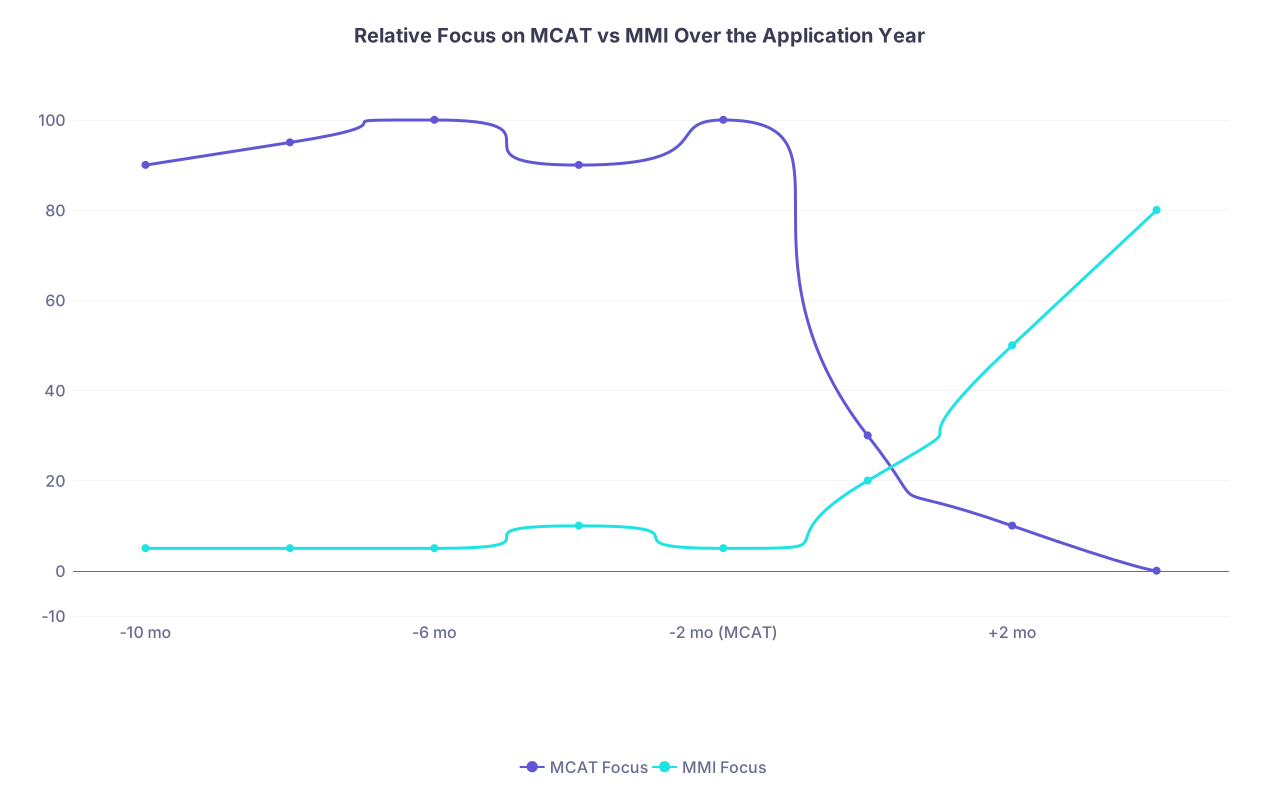
| Category | MCAT Focus | MMI Focus |
|---|---|---|
| -10 mo | 90 | 5 |
| -8 mo | 95 | 5 |
| -6 mo | 100 | 5 |
| -4 mo | 90 | 10 |
| -2 mo (MCAT) | 100 | 5 |
| 0 (Submit) | 30 | 20 |
| +2 mo | 10 | 50 |
| +4 mo (Interviews) | 0 | 80 |
How This Shifts for Early or Late MCAT Takers
Quick adjustments:
If you take MCAT very early (Jan/Feb):
- MMI foundation can start earlier and be a bit heavier March–May.
- Your “post‑MCAT foundation” phase is longer. Use it.
If you take MCAT late (June/July) and still apply that cycle:
- Your MMI ramp‑up will be compressed.
- You’ll do more intense MMI work during secondaries.
- Do not attempt heavy MMI prep within 2 weeks of your MCAT. You’ll pay for it in score.
One‑Glance Timeline Diagram
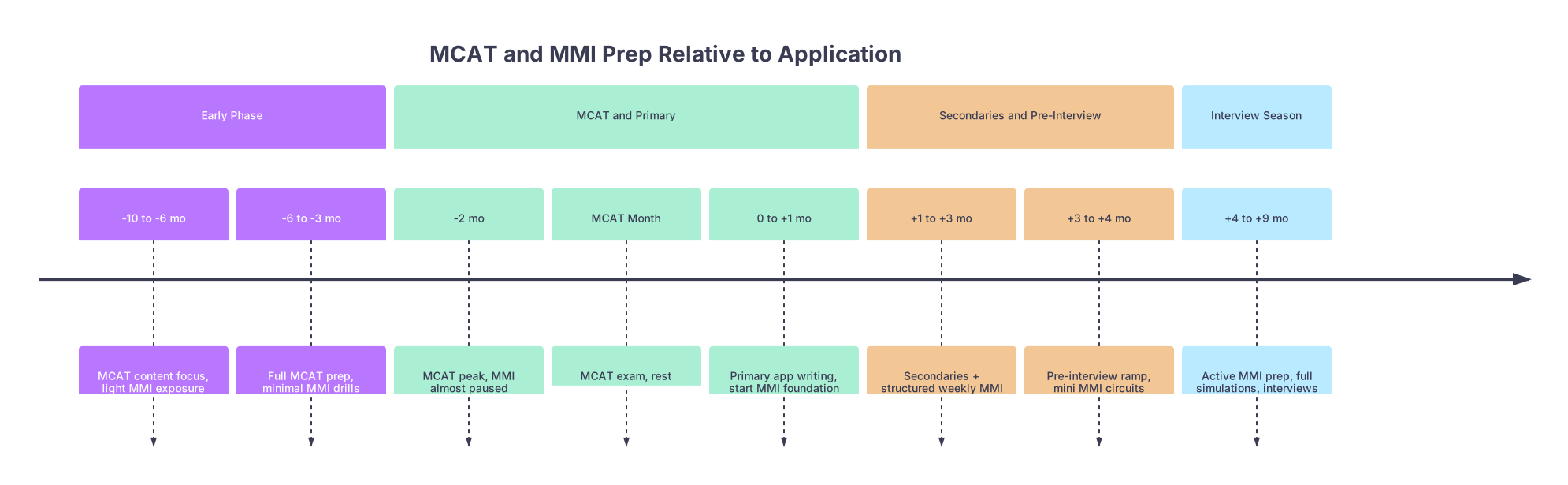
| Period | Event |
|---|---|
| Early Phase - -10 to -6 mo | MCAT content focus, light MMI exposure |
| Early Phase - -6 to -3 mo | Full MCAT prep, minimal MMI drills |
| MCAT and Primary - -2 mo | MCAT peak, MMI almost paused |
| MCAT and Primary - MCAT Month | MCAT exam, rest |
| MCAT and Primary - 0 to +1 mo | Primary app writing, start MMI foundation |
| Secondaries and Pre-Interview - +1 to +3 mo | Secondaries + structured weekly MMI |
| Secondaries and Pre-Interview - +3 to +4 mo | Pre-interview ramp, mini MMI circuits |
| Interview Season - +4 to +9 mo | Active MMI prep, full simulations, interviews |
A Few Non‑Negotiables
To close this out, here are the three things I will not compromise on:
Do not sacrifice your MCAT for early MMI prep.
A 3–5 point MCAT hit hurts you far more than slightly rougher MMI skills you can build later.Start structured MMI practice 4–8 weeks after your MCAT, not the week you get your first invite.
Light foundations during application writing; serious work by late summer.In the week before each MMI, shift from volume to refinement.
One good mock, a few focused drills, plus rest beats grinding 30 random questions and showing up mentally fried.
If you align your MMI practice to this timeline, you won’t be the student saying, “I wish I’d started earlier,” or, just as bad, “I burned out trying to do everything at once.” You’ll be the one walking into those MMI stations already warmed up, not learning on the fly.