
The blunt truth: if you lead with “money” or “lifestyle” in your career goal answers, you’re shooting yourself in the foot.
But that doesn’t mean you have to pretend money and lifestyle don’t matter. The trick is knowing what’s okay to say, what sounds terrible, and how to thread that needle in real interview answers.
Let’s walk through it like I would with a nervous applicant the week before their MMI.
The core rule: Motives vs realities
Here’s the line you can’t cross:
- It’s okay to acknowledge money and lifestyle as realities to manage.
- It’s not okay to present money or lifestyle as your primary motivation to become a physician or choose a specialty.
Interviewers are listening for why you want this career and whether patients can trust you. The second you sound like you’re in it “for the paycheck” or “for the hours,” they start doubting your judgment and your professionalism.
They’re not stupid. They know:
- Different specialties earn very different incomes
- Some fields have easier call schedules
- Burnout is real and lifestyle matters
But in an interview, they want to hear that:
- Your primary driver is service, impact, curiosity, or challenge, and
- You understand sustainability (including burnout, boundaries, family, etc.) without sounding entitled or transactional.
If you can hold those two truths at the same time, you’ll be fine.
So, can you mention money at all?
You can. But only in certain ways, and you need to be precise.
Ways mentioning money is acceptable
Use money as part of a bigger, mature picture. For example:
As a factor in long-term sustainability, not a main motivator
- “I don’t expect to be rich as a physician, but I do want financial stability so I can support a family and do this work for the long term.”
When talking about debt and realistic planning
- “Given the cost of medical education, I’ve thought seriously about how to manage loans and not let financial stress undermine my ability to care for patients well.”
In the context of systemic issues, not ‘my salary’
- “I’m interested in how reimbursement models affect access to care in underserved areas and how that shapes what specialties students choose.”
When connecting to advocacy or policy interests
- “I’m drawn to health policy because physician compensation structures directly impact time with patients and burnout.”
Notice the pattern? Money is framed as:
- A reality
- A constraint to manage
- A systemic issue you’re aware of
Not as: “I want to be a dermatologist because they make a lot and work 9–5.”
Ways mentioning money will hurt you
These are the phrases that sink applicants:
- “I want a high-paying specialty.”
- “I don’t want to struggle financially, so I’m considering orthopedics.”
- “Honestly, I’ve worked hard, so I want to be compensated well.”
- “Primary care doesn’t pay enough.”
Even if you believe some of those things, saying them out loud in an interview reads as:
- Self-focused
- Lacking in professional identity
- Clueless about what interviewers are screening for
You’ll get mentally tagged as “red flag for professionalism” or “not here for the right reasons.”
If you’re not sure whether a money-related comment is safe, assume it isn’t.
What about lifestyle? Is it okay to say you want balance?
Yes, but carefully.
Saying “lifestyle” to interviewers can mean two totally different things:
- To you: reasonable hours, time for family, not burning out at 35
- To them: “I don’t want to work hard and I’m picking this for easy hours”
You have to bridge that gap. You need to make it clear you’re not running from work; you’re planning for a sustainable career.
Healthy ways to talk about lifestyle
These sound mature, grounded, and sane:
- “I’ve seen burnout up close, and I want a career where I can show up fully for my patients and still be present for my family.”
- “Work–life integration matters to me, not because I want fewer responsibilities, but because I want to be able to do this work well for decades.”
- “I’m okay with call and long hours, but I know I’ll need to build habits that protect my physical and mental health.”
You’re not saying: “I only want 9–3 clinic and no call.” You’re saying:
“I understand this job is demanding, and I’m proactively thinking about how to do it sustainably.”
That’s what they want.
Dangerous ways to talk about lifestyle
These are the ones I’ve heard that torpedo interviews:
- “I don’t want a specialty with crazy hours.”
- “I want something with a good lifestyle.”
- “I don’t want to be on call all the time.”
- “Surgery seems like too much; I want more free time.”
Those may be true for you. They’re just better kept out of your answer key in a med school OR residency interview.
If you must talk about avoiding a field, frame it around fit, not convenience:
- Good: “I value continuity of care and long-term relationships more than the OR environment, so I don’t see myself in surgery.”
- Bad: “I don’t want to work that hard.”
How to answer common “career goals” questions without stepping on a landmine
You’re going to get some version of these:
- “What kind of physician do you see yourself becoming?”
- “What are your long-term career goals?”
- “What factors are most important to you in choosing a specialty?”
- “How do you see work–life balance fitting in to your career?”
Let’s go through how to answer them without sounding like a lifestyle-chaser.
1. “What kind of physician do you see yourself becoming?”
What they actually want: values, impact, not “dermatologist in a beach town.”
Bad answer:
“I’m not sure, but I know I’d like a high-paying specialty with predictable hours.”
Stronger answer:
“I’m still exploring, but I know I want to be the kind of physician who explains things clearly, respects patients’ time, and is still curious 20 years in. I’m drawn to fields where I can build ongoing relationships with patients, but I’m keeping an open mind during clinical rotations.”
You’ve said nothing about money or lifestyle but showed maturity and direction.
2. “What are your long-term career goals?”
Bad answer:
“I want a career that pays well and lets me have time for my hobbies.”
Better structure:
- Lead with impact
- Add growth or leadership
- Optionally mention sustainability near the end
Example:
“Long term, I want to practice in a way that combines patient care with teaching. I see myself in an academic or community setting where I can work directly with patients, mentor trainees, and improve systems of care. I also know this work is demanding, so I’m intentional about building a career that’s sustainable—where I can keep showing up fully for my patients over decades, not just a few intense years.”
Lifestyle is there. But it’s not the headline.
3. “What factors are most important to you in choosing a specialty?”
This is where people panic and blurt out “lifestyle” or “income.” Don’t.
Safe priorities to name:
- Type of patient population
- Type of problems you like solving (procedural vs cognitive)
- Acuity level (clinic vs ICU vs OR)
- Team environment
- Continuity vs episodic care
- Opportunities for teaching, research, advocacy
You can tuck lifestyle into this list, but it should be last and framed well.
Example:
“I’m looking at three main things: the type of problems I’m solving, how much continuity I have with patients, and the team environment. I know myself well enough to say I want a career that’s demanding but still allows space for family and outside interests, so I’ll also be paying attention to what a sustainable schedule realistically looks like in different fields.”
That reads as self-aware, not lazy.
A quick comparison: Good vs bad phrasing
Here’s how small wording changes completely flip the message.
| Theme | Bad Phrasing | Better Phrasing |
|---|---|---|
| Money | “I want a high-paying specialty.” | “I want a stable career that lets me focus on patients without constant financial stress.” |
| Lifestyle | “I want a good lifestyle specialty.” | “I care about building a sustainable career so I can do this work well long-term.” |
| Hours | “I don’t want to work too many hours.” | “I understand medicine is demanding, and I’m thinking about healthy boundaries to prevent burnout.” |
| Avoiding fields | “Surgery is too intense for me.” | “I’m more drawn to longitudinal relationships than the OR environment.” |
Same core concern. Completely different professional impression.
What interviewers are really screening for when you talk about this
They’re not asking, “Is this person allowed to care about their life?”
They’re asking:
- Will this person put patients first?
- Do they understand what medicine actually involves?
- Are they thoughtful about burnout without being entitled?
- Are they making career decisions from purpose, not comfort?
When you mention money or lifestyle poorly, you light up all their warning systems:
- “This person has unrealistic expectations.”
- “They may resent the work when it’s hard.”
- “They might bail on primary care/underserved care the second a better-paying option appears.”
When you mention them wisely, you show:
- “This person understands the realities and is planning like an adult.”
- “They’ve thought about sustainability in a realistic way.”
- “They can acknowledge hard truths without centering themselves.”
That’s exactly what you want.
Specific phrases you can safely borrow
If you need some plug-and-play language for your answers, use versions of these:
On not being money-motivated:
“I’m not pursuing medicine for financial reasons; if that were my main goal, there are easier paths. I’m here because I find the work meaningful, and I want enough financial stability to do it well over the long haul.”
On lifestyle and balance:
“I’ve seen how demanding this career can be, and I take that seriously. I care about finding a field where I can give my best to patients and still have the bandwidth to be present for the people in my life.”
On specialty choice:
“When I think about specialties, I’m prioritizing the type of patient care I enjoy, the clinical problems that fascinate me, and the team environments I work best in. I’m also paying attention to what a realistic, sustainable schedule looks like so I can stay in the field for decades.”
On burnout:
“Burnout is a real concern across medicine. For me, part of choosing a career is asking: where can I do meaningful work, with enough support and structure, that I can still be the kind of physician I’d want for my own family?”
These answers don’t dodge reality. They just put the focus where it belongs.
A quick decision rule you can use before you speak
Right before you answer anything related to money or lifestyle, run it through this filter in your head:

| Step | Description |
|---|---|
| Step 1 | Thinking about mentioning money or lifestyle |
| Step 2 | Do NOT say it. Reframe to values/impact. |
| Step 3 | Adjust wording. Avoid high-paying or good lifestyle. |
| Step 4 | Say it briefly, tie back to patient care and long-term career. |
| Step 5 | Is this my main motivation? |
| Step 6 | Am I framing it as sustainability or reality? |
If money or lifestyle is the headline of your answer → stop. Reframe.
If it’s a secondary, realistic factor tied to sustainability and patient care → you can include it, briefly.
Common trap: “But honestly, money is a big factor for me.”
Yeah. For a lot of people it is. You’re not weird for thinking:
- “I don’t want to be drowning in debt forever.”
- “I grew up poor; financial security matters.”
- “I don’t want to work 80 hours a week for 30 years.”
Those are valid. They just don’t belong front and center in admissions answers.
Your job in an interview is to:
- Tell the true story of your motivations
- Without volunteering every internal calculation you’ve ever made
You’re not lying by focusing on service, curiosity, and impact—assuming those are real for you. You’re being professionally appropriate.
If your only reason for medicine is money and status? Then yes, this field probably isn’t a great match, and interview prep isn’t your biggest problem.
What you should do today
Open a document and write 3 answers:
- “Why medicine?”
- “What are your long-term career goals?”
- “What factors matter most to you in choosing a specialty?”
Then do this:
Highlight any sentence that directly mentions “money,” “salary,” “pay,” “lifestyle,” “hours,” “time off,” or “work–life balance.”
For each highlighted part, rewrite it so:
- The main focus is values, impact, or fit
- Money/lifestyle is, at most, a secondary, brief, sustainability point tied back to being a better physician
That edit alone can be the difference between sounding self-centered and sounding like someone they actually want in their program.
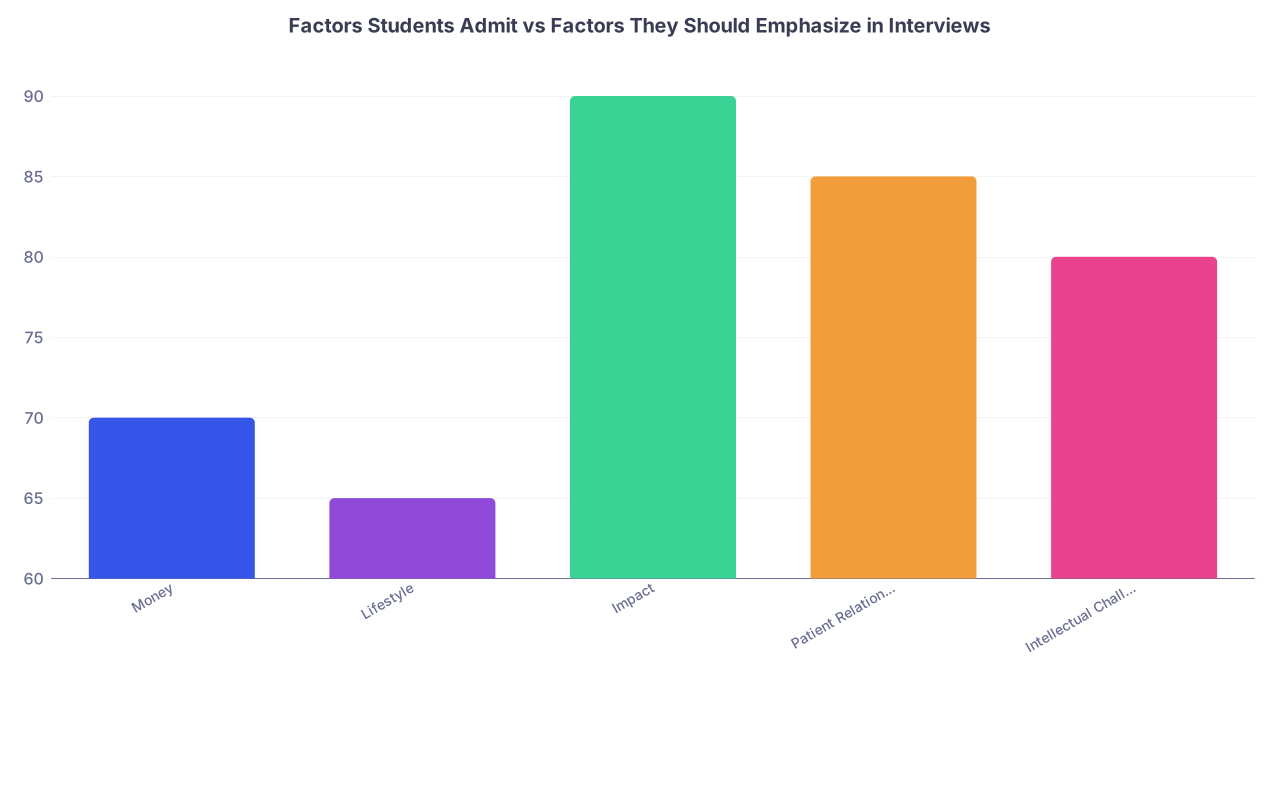
| Category | Value |
|---|---|
| Money | 70 |
| Lifestyle | 65 |
| Impact | 90 |
| Patient Relationships | 85 |
| Intellectual Challenge | 80 |



| Step | Description |
|---|---|
| Step 1 | Career Goals Question |
| Step 2 | Lead with impact or values |
| Step 3 | Describe type of work or patients |
| Step 4 | Optionally mention sustainability briefly |
| Step 5 | Tie back to being effective long-term physician |