It is the evening of your last interview day. You are back in your room or your hotel, blazer on the chair, name tag in your bag, brain completely fried. The adrenaline is fading, and now the paranoia starts:
“Should I email them?”
“Did I sound weird when I answered that ethics question?”
“What if I do not get in anywhere—what do I write down now so I am not starting from zero next cycle?”
This week right after interviews is where most applicants either get strategic… or just spin in anxiety. You are not going to spin. You are going to run a clear, time-based plan.
Below is what you should do:
- That same day
- The next 48 hours
- The rest of the week
- The following 2–4 weeks
- If you might need to reapply next cycle
Same Day: Lock in Details Before Your Memory Fades
At this point you should not be doing anything polished or public-facing. You are just trying to capture reality before your brain rewrites it.
Within 1–2 hours of getting home / back to your room
Sit down, set a 20–30 minute timer, and do three things:
Dump every memory you can recall
- Interviewer names, roles, and any distinctive features.
- “Dr. Ramirez – pediatric oncologist, mentioned new survivorship clinic.”
- “MS2 Jamie – talked about free student-run clinics on Saturdays.”
- Specific questions that actually got asked.
- “Tell me about a time you failed.”
- “How would you address vaccine hesitancy in a clinic?”
- Your own answers, especially ones that felt strong or shaky.
- Anything odd: tech glitches, awkward pauses, moments you clearly connected.
- Interviewer names, roles, and any distinctive features.
Capture program-specific info
- Curriculum structure (true P/F? mandatory attendance? early clinical exposure?).
- Research and tracks that interested you (physician-scientist track, global health pathway, etc.).
- Culture signals:
- Did students seem exhausted or genuinely content?
- How did faculty talk about wellness (as a slide, or with specifics)?
- Location / logistics:
- Commute from likely housing.
- Cost of living impressions (you saw rents on Zillow earlier, right?).
Rate your overall impression while it is fresh Use a simple 1–5 quick rating for:
- Fit with your learning style.
- Fit with your non-academic life (support system, city, climate).
- Vibe of students and faculty.
- Gut feeling.
You are not building your final rank list yet. You are just freezing the version of today’s reality that Future You will not remember in February.
Next 24–48 Hours: Thoughtful Follow-Up and Structured Reflection
At this point you should move from “brain dump” to “intentional documentation and communication.”
Day 1: Write and send thank-you emails (or decide not to)
Yes, programs see a ton of them. No, a good thank-you email will not “win” you a spot. But it does three useful things:
- Reinforces your interest.
- Keeps you memorable (especially if you reference something specific).
- Forces you to crystallize why this school might actually work for you.
Who to email:
- Every interviewer whose contact information you were given or can reasonably find.
- The coordinator / admissions office if there was significant logistical help or a big group session.
When to send:
- Within 24–48 hours after the interview day. Earlier is fine. Three weeks later is pointless.
Basic structure (short, not dramatic):
- Line 1: Thank them for their time and the conversation.
- Line 2–3: Reference 1–2 specific things you talked about that matter to you.
- Line 4: Brief statement of continued interest and appreciation.
Aim for 3–6 sentences. Not a second personal statement.
If the school explicitly says “no post-interview communication” or “we do not track thank-you notes,” respect that. Ignoring clear instructions is a red flag.
If they are neutral or silent on it, write the emails.
Day 2: Build your post-interview record for this school
Now that the immediate haze is fading, you formalize your notes. This is where you create something Future You can actually use—for ranking and for reapplication.
Create a simple document or spreadsheet with one tab per school or one row per program. Then fill it in systematically.
| Field | Example Entry |
|---|---|
| School | State University SOM |
| Date of Interview | 10/03/2026 |
| Interview Format | 2 x 30 min faculty, 1 student panel |
| Vibe (1–5) | 4 |
| Curriculum Notes | P/F pre-clinical, organ systems, early clinics |
| Best Fit Factors | Close to family, strong primary care, low COL |
| Concerns | High lecture attendance, limited bench research |
| Key People Met | Dr. Lee (IM), MS3 Sam (student panel) |
| Follow-Up Sent? | Yes – 3 thank-you emails |
Also record:
- Specific phrases you heard that stuck out:
- “We do not rank students against each other; it is strictly competency-based.”
- “Most of our students study 6 days a week; there is less free time than you might expect.”
- Any promises:
- “We expect to release decisions in mid-December.”
- “You will be notified either way by email.”
This becomes your central “Post-Interview Week” record.
Days 3–7: Systematic Reflection and Planning for Next Time
By the middle and end of this week, you should stop obsessing over any single awkward answer. That part is done. You shift from individual interviews to pattern recognition.
Step 1: Review your performance across interviews
Set aside 45–60 minutes. Pull up your notes from all interviews so far (even earlier ones). Ask yourself, in writing:
What questions tripped you up consistently?
- Ethics / policy?
- “Tell me about yourself” sounding rambly?
- Conflict / teamwork examples?
Where did you feel strongest?
- Discussing your long-term goals?
- Talking about a particular research project?
- Questions about resilience / personal challenges?
How was your pacing?
- Did you run out of time answering complex questions?
- Did you give 30-second superficial answers to deep prompts?
Capture patterns, not isolated embarrassments. You are building a performance map that will matter for future cycles or future interviews (MD/PhD, residency, competitive fellowships).
Step 2: Create a mini “next-cycle feedback” file
Even if you get in this year, this is still valuable as a meta-skill. But if you end up reapplying, this file is gold.
Create a doc titled: Next Cycle: Interview Lessons – DO NOT IGNORE.
Include headings like:
Stories that worked well
- “Shadowing in rural clinic with language barrier – used for communication questions.”
- “Failure story about org leadership meltdown – authentic and concrete.”
Stories that flopped or felt flat
- “Generic ‘I studied harder’ failure response – no real insight.”
- “Volunteering description where I listed tasks, not growth.”
Questions I need better answers for
- “Why our school?” (need specific tie-ins).
- “What do you do for fun?” (need less canned, more real).
- “Anything else you want us to know?” (better closing pitch).
Body language / presence issues
- Tended to talk too fast when nervous.
- Looked at timer too often in virtual MMI stations.
- Overused filler words when buying time.
This is not just “reflection.” You are pre-writing your improvement plan for the next round.
Step 3: Compare programs realistically
Now, with some emotional distance, you can start comparing schools with a bit more objectivity. Not “dream school vs backup,” but actual fit factors.
At this point in the week you should start sorting schools into preliminary tiers based on your post-interview notes:
- Tier 1: Would be genuinely happy here; strong fit academically and personally.
- Tier 2: Good option, some reservations.
- Tier 3: Acceptable if needed, but concerns are real.
Use your documented impressions, not what Reddit says about “prestige.” Your life is going to be at that school for 4 years.
Weeks 2–4 After the Interview: Strategic Communication and Emotional Management
Once the immediate week is done, the temptation is to check your email like a lab rat pressing the dopamine lever. Do not let that be the only thing you do.
Ongoing: Track communications and timelines
At this point you should build a simple tracking system so you are not constantly guessing who might email when.
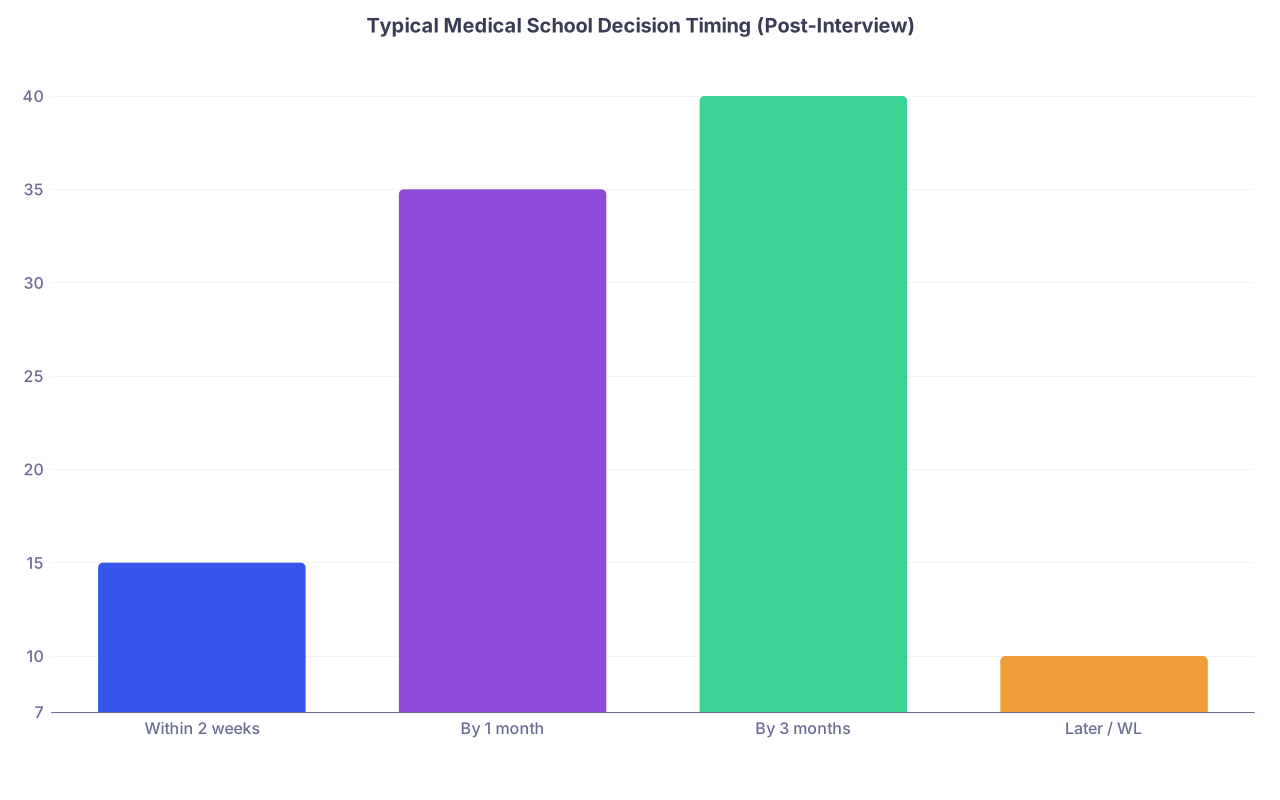
| Category | Value |
|---|---|
| Within 2 weeks | 15 |
| By 1 month | 35 |
| By 3 months | 40 |
| Later / WL | 10 |
Create a table or sheet with:
- School
- Interview date
- Stated decision timeline
- Current status (no update, on hold, waitlist, accepted, rejected)
- Date of any updates (thank you sent, LOI sent, update letter, etc.)
Do not email schools weekly to “check in.” That reads as anxious and uninformed. Once you have thanked them, you wait unless:
- They invite updates.
- A major, meaningful update occurs (new publication, award, MCAT retake, degree completion, significant role change).
If you have a clear top choice
If one school emerges as your clear first choice and their policy allows post-interview communication:
Wait until you have enough information.
Do not anoint a school as #1 based on pure prestige. Make sure:- You have compared cost of attendance.
- You understand curriculum and grading.
- You have thought through location and support system.
Decide between:
- A Letter of Interest (LOI) if they are one of several favorites.
- A Letter of Intent if they are your true #1, and you would attend if accepted.
Timing:
- Usually 3–6 weeks after interview, or at a key decision window (e.g., before December decisions, or before a known committee meeting).
Check each school’s policy. Some schools explicitly say “Do not send letters of intent.” That is not a subtle hint. It is a rule.
Emotional management: what to do with the dead space
This part matters more than students admit. Weeks 2–4 after interviews can be psychologically ugly. Your job:
- Set specific days you allow yourself to check portals / email intensely (for example, Monday and Thursday evenings). The rest of the time, normal checking only.
- Spend time on non-application life:
- If you are still in school, protect your GPA.
- If you are working, do not let performance collapse because you are mentally on SDN all day.
- Start a list of things you want to do before med school:
- Travel home.
- See specific friends.
- Fix whatever mess your sleep schedule has become.
Paradoxically, the better you handle this waiting period, the more sane you will be if you need to go through this again.
If You Suspect You Might Reapply: Notes for Future Cycles
You may already have that sinking feeling: your stats are marginal, interview count was low, or you know your performance was shaky. You cannot fix the current cycle now. You can, however, steal information from it.
At this point in the application year, if you are even 20–30% worried about reapplying, start a parallel track: “insurance planning.”
1. Build a brutally honest self-assessment
Write this out. Not in your head.
Sections:
Academic profile
- GPA trend, science vs non-science.
- MCAT breakdown, not just total.
- Any academic red flags (withdrawals, failures, leaves).
Clinical experience
- Total hours, roles, level of responsibility.
- Direct patient contact vs just “in the building.”
Non-clinical service
- Did you actually serve disadvantaged populations, or just do resume-padding clubs?
Research
- Depth (multi-year vs one summer).
- Any output (posters, abstracts, papers).
Interview skills
- Confidence, clarity, authenticity.
- Evidence-based: what interviewers seemed to respond well to, where you froze.
Do not let this become self-flagellation. It is data collection.
2. Identify 2–3 highest-yield changes for next cycle
Future cycles are not “do everything better.” That is how people burn out and reapply with the same application in different font.
Pick 2–3 targeted upgrades, such as:
- Retake MCAT with a structured plan and more practice exams.
- Add a consistent, weekly clinical role with direct patient contact.
- Take on a real leadership responsibility with measurable outcomes.
- Work with a prehealth advisor or admissions consultant specifically on interview prep.
Tie these back to what you saw in interviews:
- If questions about health policy or ethics kept stumping you, maybe you need a structured way to read and think about those topics.
- If you had no real stories about working with diverse populations, maybe your service experience has been too insulated.
3. Save concrete examples and stories now
The biggest mistake reapplicants make: they “remember” their experiences in vague terms. Then their second-cycle essays and interviews sound generic again.
Solve that now:
For each major activity you discussed in interviews, write:
- 1–2 specific patient / person encounters (de-identified).
- What you actually did.
- What you learned that changed your behavior or understanding.
For each “challenge” story you used:
- What the situation was.
- What you did right.
- What you did wrong.
- What you would do differently now.
This gives future you a rich bank of examples that sound real. Because they are.
A Simple Week-By-Week Snapshot
Let me condense this into a rough month after your interview:
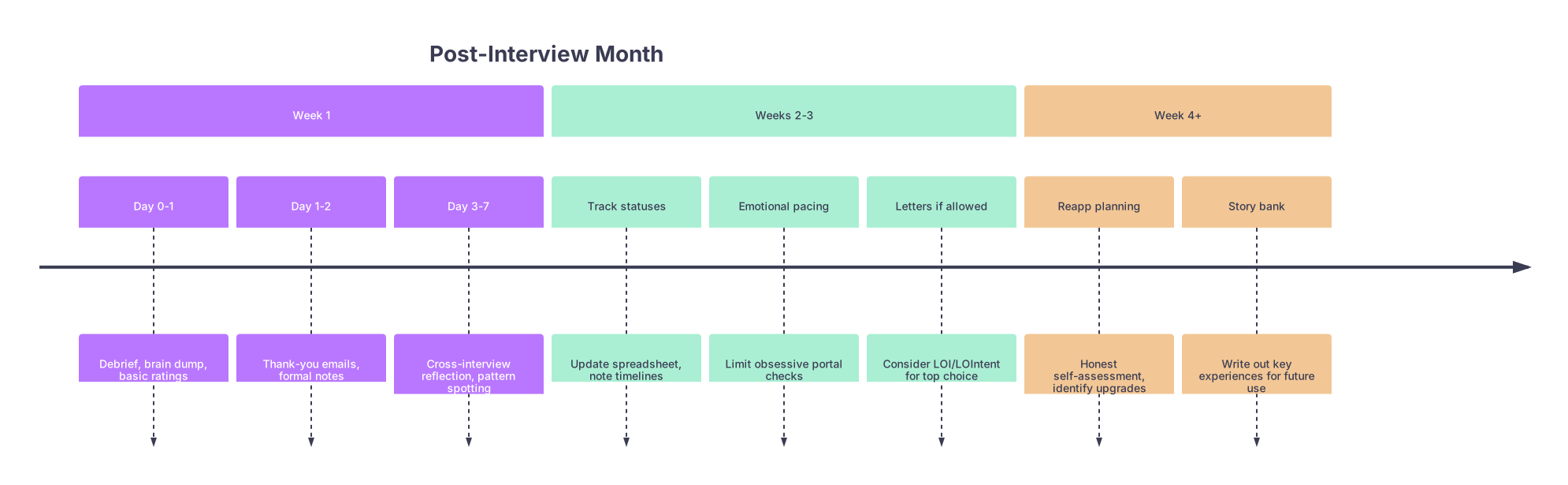
| Period | Event |
|---|---|
| Week 1 - Day 0-1 | Debrief, brain dump, basic ratings |
| Week 1 - Day 1-2 | Thank-you emails, formal notes |
| Week 1 - Day 3-7 | Cross-interview reflection, pattern spotting |
| Weeks 2-3 - Track statuses | Update spreadsheet, note timelines |
| Weeks 2-3 - Emotional pacing | Limit obsessive portal checks |
| Weeks 2-3 - Letters if allowed | Consider LOI/LOIntent for top choice |
| Week 4+ - Reapp planning | Honest self-assessment, identify upgrades |
| Week 4+ - Story bank | Write out key experiences for future use |
And a quick sense check: if it has been 4+ weeks since your interview, the portal is silent, and the school’s stated timeline has passed, mentally move that school to “unlikely” while still leaving room for waitlist or delayed decisions. Prepare emotionally for that possibility now instead of pretending everything is still wide open.
One More Piece: Notes Specifically for Future-Cycle Interviews
You are in a rare position right now: you remember what interview day actually feels like. Use it.
Capture “process” lessons
Write down:
- What time of day you performed best (morning vs afternoon).
- What breakfast / routine helped you feel steady.
- Tech issues you had in virtual formats and how to avoid them.
- Clothing that was actually comfortable for a full day.
It sounds trivial. It is not. The applicants who treat themselves like athletes on game day do better over time.
Document your question list
Every interview day, you probably asked some version of:
- “What kind of student thrives here?”
- “How are struggling students supported?”
- “What changes are you most excited about in the curriculum?”
Which ones got you useful answers? Which ones were met with empty platitudes?
Create two lists:
- Questions that generated real, concrete information. Keep those.
- Questions that led nowhere. Replace those next time.
You will not remember this nuance a year from now without writing it down.
FAQ (Exactly 2 Questions)
1. If I did poorly in an interview, should I address it in any follow-up communication?
No. Do not email to apologize for a bad answer or to “clarify” statements unless you made a genuine factual error with real consequences (for example, misrepresenting a publication or misstating a serious fact). Interviewers expect imperfection. Over-focusing on your own worst moment just highlights it. Use your follow-up to reinforce fit and interest, not to re-litigate the conversation.
2. How many schools should I send letters of intent or strong interest to?
Exactly one for a true Letter of Intent. That is the point—you are telling that school you will attend if accepted. Sending multiple LOIs is dishonest and, frankly, unprofessional. Letters of Interest (more general “I am very interested” notes) can go to a few top programs, if their policies allow and you actually have specific reasons. Quality and specificity matter more than volume.
Today, your next step is simple: open a new document titled “Post-Interview Notes – [School Name]” and spend 15 uninterrupted minutes dumping everything you remember from your most recent interview day—questions, people, impressions. Time yourself. Do it before you forget the details you will desperately wish you still had six months from now.