The worst thing you can do between interviews is “just move on.”
Debriefing is where you actually get better. If you skip it, you repeat the same mistakes school after school and call it “bad luck.”
Below is a structured, time-based system for what to do from the moment you walk out of the building (or log off Zoom) until the night before your next interview. Think of it as your between‑interviews operating manual.
Immediately After the Interview (First 2 Hours)
At this point, your memory is sharp and your emotions are noisy. You need to capture everything before it blurs.
Step 1: The 15‑Minute “Parking Lot” Download
As soon as you’re out of the building or out of the Zoom room:
- Sit somewhere quiet: your car, a bench, a coffee shop corner.
- Set a 15‑minute timer.
- Brain‑dump everything you remember. Not polished. Just raw.
Use these prompts and literally write phrases, not essays:
- Who did I meet? (names, roles, any personal details)
- What questions did I get that surprised me?
- Where did I stumble or ramble?
- When did I feel most confident or relaxed?
- Did any answer feel rehearsed or fake?
- Did I get any concrete feedback or hints about what they valued?
Do it in a single running document (Google Doc/Notion/OneNote). Same file for every school. That’s your “Interview Log.”
At this point you should not be editing or judging. Just recording.
Step 2: 5‑Minute Emotion Check
You’re probably either hyped or convinced you’re doomed. Both are unreliable.
Write three bullet points only:
- 1 thing I did well
- 1 thing I want to improve
- 1 thing I learned about this school or myself
This keeps you from spiraling into “I blew it” or “I crushed it” territory and gives you something concrete to use later.
Same Day Evening (Within 6–12 Hours)
Now you’ve had a little distance. This is when you turn the raw notes into something usable.
Step 3: Structured Debrief (30–45 Minutes)
Open your Interview Log and do a structured pass. Create the same headings for every school so you can compare later.
Suggested headings:
- Format & Setting
- Questions Asked
- My Strong Moments
- My Weak Moments
- Content Gaps (things I wish I’d prepared)
- Fit Signals (does this school actually fit me?)
- Follow‑Up Tasks
Under each:
Format & Setting
- Traditional vs MMI vs group vs panel
- Time per station / per interview
- Any tech issues (for virtual)
- Any odd logistical things (late start, rushed, group icebreaker)
Questions Asked
List them as best you remember. Don’t stress about exact wording. Group them:
- Classic: “Tell me about yourself,” “Why medicine?”, “Why our school?”
- Behavioral: “Tell me about a time you failed…”
- Ethical: “What would you do if…”
- Application‑based: “I see you did research in X—tell me more.”
- Curveballs: anything that made you pause or think hard
You’re building your own question bank from real interviews, not generic lists from Reddit.
My Strong Moments
Be specific:
- “Explained my gap year with a clear narrative and no defensiveness.”
- “Connected my scribing story to their emphasis on underserved care.”
You’re identifying what to keep next time.
My Weak Moments
Be ruthless but objective:
- “Rambled when answering ‘biggest weakness’; no clear point.”
- “Blanked on recent healthcare policy example for underserved communities.”
Name the moments, not “I was terrible.” Then attach one improvement idea to each.
At this point you should have turned vague feelings into concrete patterns.
Step 4: Immediate Fix List (10 Minutes)
From that debrief, create a short “Before Next Interview” list. No more than 3–5 items.
Examples:
- Draft and rehearse a tighter 60‑second “Tell me about yourself.”
- Prepare one story for conflict with a teammate.
- Read 2 recent articles on a health policy topic I actually care about.
- Clarify why I like urban vs suburban campuses with a specific example.
This becomes your micro‑curriculum between interviews.
Within 24 Hours: Strategic Follow‑Through
Now you clean up your external impression and log any school‑specific details.
Step 5: Send Targeted Thank‑You Emails (Within 24 Hours)
Not optional. But also not a place to overthink.
Write short, specific emails to each interviewer and any key staff (student host, dean who led the info session, etc.) if you have their contact info.
Basic structure:
- Subject: “Thank you – [Your Name], [Interview Date]”
- 1 sentence: Thank them for their time and mention the role (“faculty interviewer,” “student ambassador”).
- 1–2 sentences: Reference something specific you discussed or something they said that resonated.
- 1 sentence: Reaffirm your interest in the school (without sounding like a template).
- Simple sign‑off.
Example skeleton:
Dear Dr. Smith,
Thank you for taking the time to speak with me during my interview day on January 4. I appreciated our discussion about your work in community‑based addiction treatment and how students get involved early in first year. Our conversation reinforced my interest in [School]’s commitment to longitudinal community engagement.
Best regards,
[Name], AAMC ID XXXXXXXX
Do not:
- Apologize for answers you think were weak.
- Add new information or “fix” your interview.
- Make it a love letter to the school.
At this point you should have closed the loop professionally and left a clean final impression.
Between Interviews: Multi‑Day Improvement Cycle
Now to the real question: how do you actually get better before the next school, especially if the next one is 2 days away vs 2 weeks away?
Let’s split this into 3 scenarios.
Scenario A: Back‑to‑Back Interviews (Next Interview Within 2–3 Days)
You don’t have time to reinvent yourself. You have time to sand down the sharp edges.
Day 1 Evening (After Interview #1)
At this point you should have:
- Raw notes (parking lot download)
- Structured debrief
- Immediate Fix List (3–5 items max)
Now:
Prioritize 1–2 high‑yield fixes only. Examples:
- Your “Why this school?” answer was generic.
- You rambled on behavioral questions.
- Your “tell me about yourself” took 4 minutes.
Build tiny drills, not big projects:
If “Why this school?” was weak:
- Spend 20 minutes on the next school’s website.
- Identify 3 specific things: a program, a curricular feature, a community focus.
- Write a 3–4 sentence response tying those to your experiences.
If behavioral questions were messy:
- Choose 3 common prompts: failure, conflict, leadership.
- For each, outline STAR (Situation, Task, Action, Result) with bullet phrases only.
Do a 15‑minute mock aloud:
- Record yourself on your phone.
- Answer:
- “Tell me about yourself.”
- One behavioral question.
- One “Why our school?” for the upcoming school.
- Listen once. Make ONE tweak per answer.
Total time: 60–75 minutes. Then stop. Sleep matters more than over‑rehearsing.
Day 2 (Day Before Next Interview)
Your day should look something like this:
- Light review of:
- School’s mission
- 2–3 distinctive programs
- Your own application highlights you want to emphasize
Afternoon (20–30 minutes):
- Quick practice:
- 2 classic questions
- 1 ethical/healthcare issue question (keep it conversational, not like a debate team speech)
Evening (20 minutes):
- Logistics check: clothes, directions, Zoom link/test, time zones.
- Skim your Interview Log to remind yourself of previous mistakes once—then close it.
At this point you should be primed, not crammed.
Scenario B: Moderate Gap (Next Interview 1–2 Weeks Away)
This is the sweet spot. Enough time to build skills, not just patch holes.
Week Structure Overview
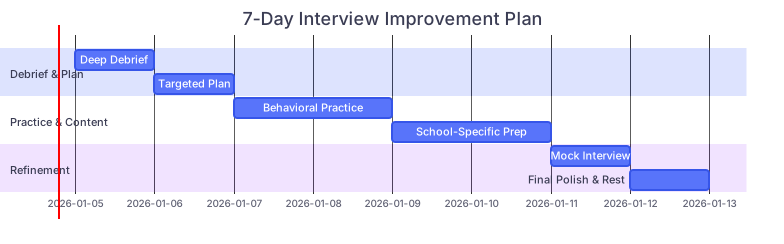
| Task | Details |
|---|---|
| Debrief & Plan: Deep Debrief | a1, 2026-01-05, 1d |
| Debrief & Plan: Targeted Plan | a2, after a1, 1d |
| Practice & Content: Behavioral Practice | a3, 2026-01-07, 2d |
| Practice & Content: School-Specific Prep | a4, 2026-01-09, 2d |
| Refinement: Mock Interview | a5, 2026-01-11, 1d |
| Refinement: Final Polish & Rest | a6, 2026-01-12, 1d |
Adjust dates, but keep the order.
Day 1–2: Deep Debrief and Targeted Plan
Go beyond “I wish I’d done better.”
Review your Interview Log from all schools so far.
Look for recurring themes:
- Do you always rush questions about weakness or failure?
- Do you struggle explaining your research simply?
- Are you vague on specialty interests or too rigid?
Create a “Core Issue List” (3–7 items max) that shows up across multiple interviews.
Examples:
- My answers don’t always end with a clear point.
- I don’t tie my stories back to medicine or this school enough.
- I sound scripted when talking about underserved work.
- I freeze on ethical questions.
- Pick 2–3 of those to actively work on this week.
At this point you should have a focused improvement plan, not a vague “get better at interviewing” goal.
Day 3–4: Skill Drills
Treat interview improvement like you’d treat MCAT sections: controlled practice.
For each priority issue:
If your stories ramble:
- Take 3 of your common stories (failure, conflict, leadership).
- Write them out in strict STAR format, bullet‑only.
- Practice delivering each in 90–120 seconds, timed.
- After each run, answer: “What’s the single takeaway sentence?” and say that out loud at the end.
If you’re bad at “Why this school?”:
- For the next school, fill this mini‑template:
- 1 curricular or structural thing (e.g., longitudinal integrated clerkships, early clinical exposure).
- 1 community or mission‑driven thing.
- 1 specific opportunity (clinic, track, dual degree, research center).
- Write one sentence connecting each to a specific experience you’ve had.
- For the next school, fill this mini‑template:
If you freeze on policy/ethics questions:
- Choose 2 healthcare topics you actually care about (e.g., prior experiences with uninsured patients, mental health access, rural medicine).
- Read 1–2 short summaries or articles for each.
- Practice explaining:
- What the issue is
- Why you care
- How it connects to your experiences and future as a physician
Total: 30–60 minutes per day. Not more. Beyond that, your returns drop.
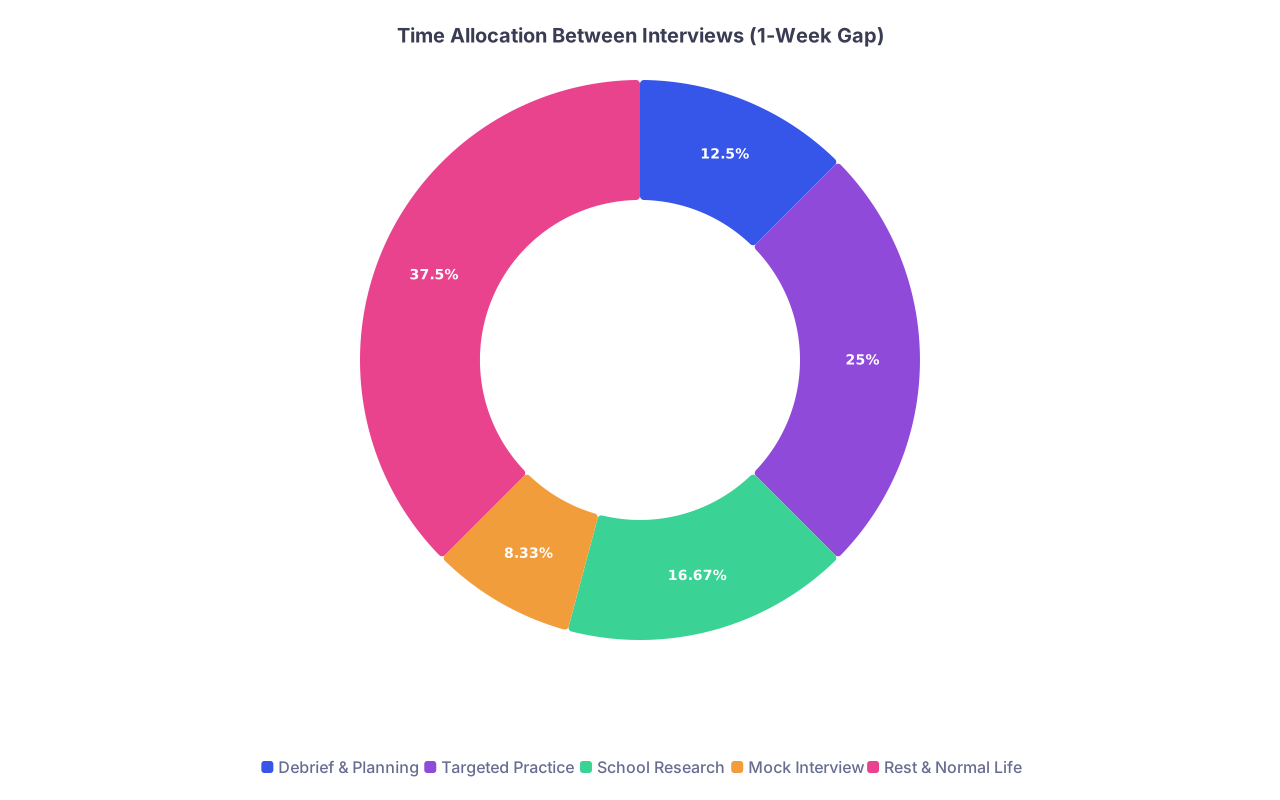
| Category | Value |
|---|---|
| Debrief & Planning | 90 |
| Targeted Practice | 180 |
| School Research | 120 |
| Mock Interview | 60 |
| Rest & Normal Life | 270 |
Day 5–6: School‑Specific Customization
Now switch from general skills to tailoring for the upcoming school.
Build a one‑page “School Snapshot” for each school:
- 2–3 mission keywords from their website (e.g., “primary care,” “urban underserved,” “research‑intensive”)
- 2 specific programs or tracks that truly interest you
- 1–2 clinical opportunities or partnerships that stand out
- 1 personal reason you’d actually want to live in that city/region
- 2–3 of your own experiences that align with their vibe
You use this sheet the night before and morning of the interview. No more clicking around 20 website tabs and remembering nothing.
Scenario C: Long Gap (3+ Weeks Before Next Interview)
Between now and then, you can either coast or actually become a measurably better interviewer.
Here’s where I’d push you to be more aggressive.
Week‑by‑Week Outline (3 Weeks)
Week 1: Diagnose and design
Week 2: Reps and feedback
Week 3: Polish and conserve energy
| Week | Primary Focus | Key Activities |
|---|---|---|
| 1 | Diagnose patterns | Review logs, identify gaps |
| 2 | High-rep practice | Mocks, peer practice, drills |
| 3 | Polish & maintain | Light practice, school-specific |
Week 1: Diagnosis in Detail (2–3 hours spread out)
- Do a full mock interview (friend, advisor, career center, or record yourself with a list of 8–10 questions).
- Watch the recording. Yes, the whole thing.
- For each answer, rate:
- Clarity (1–5)
- Authenticity (1–5)
- Conciseness (1–5)
- Connection to medicine/this school (1–5)
Identify your three lowest‑scoring question types. Those become your Week 2 focus.
Week 2: High‑Rep Practice (3–4 short sessions)
Goal: Turn weakness questions into normal questions.
Each session (30–45 minutes):
- Warm‑up with 1–2 questions you already do well.
- Drill 3–4 of your weakest question types.
- End with “Tell me about yourself” and “Why medicine?” as a cooldown.
Twice this week, get outside feedback:
- Friend who’ll be honest.
- Physician mentor.
- Pre‑health advisor.
- Mock interview service (some schools or orgs offer them free).
Give them permission to be blunt: “Tell me what felt off, rehearsed, or unclear.”
Week 3: Polish Without Burning Out
You should not be grinding every day.
Focus on:
- 2–3 short practice bursts a week (15–20 minutes each).
- Fresh review of each upcoming school.
- Sleep, normal exercise, and some non‑application life so you don’t show up fried.
At this point you should feel like the same person—just with sharper, cleaner stories and less panic.
The Day Before Each Interview
No matter how much time you had since the last one, the day‑before routine should be nearly identical each time. Consistency kills anxiety.
The 60‑Minute Pre‑Day Checklist:
15 minutes – School Snapshot review
- Reread your one‑page summary.
- Answer out loud:
- “Why this school?”
- “How will you contribute here?”
20 minutes – Core Questions
- Answer out loud:
- “Tell me about yourself.”
- “Why medicine?”
- One failure or weakness story.
- One ethical or healthcare issue you care about.
- Answer out loud:
10 minutes – Logistics
- Confirm:
- Time and time zone
- Address/parking OR Zoom link/platform
- Dress outfit clean and ready
- Tech check if virtual: camera, mic, internet, background
- Confirm:
15 minutes – Shut down
- No more Reddit, SDN, or panicked group chats.
- Prep bag, set alarms, review transport.
- Do something normal for 30–60 minutes before bed.
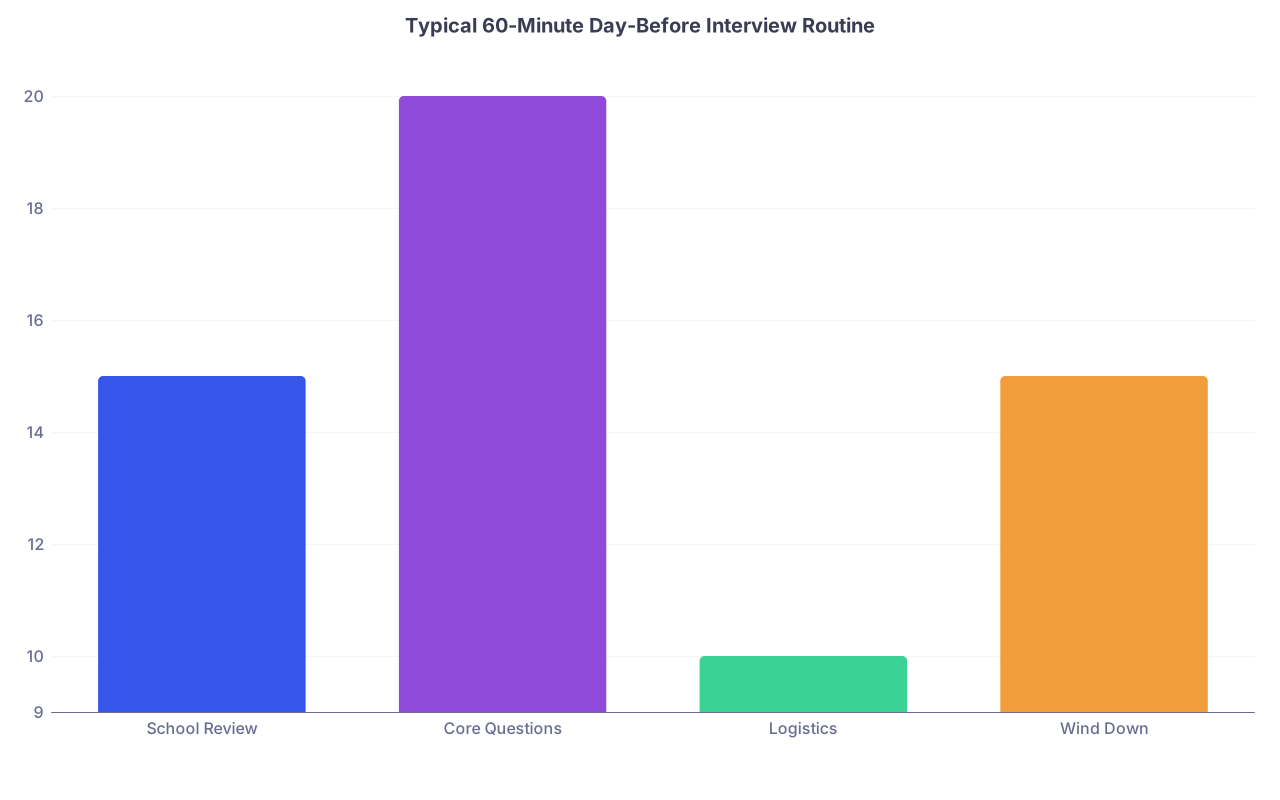
| Category | Value |
|---|---|
| School Review | 15 |
| Core Questions | 20 |
| Logistics | 10 |
| Wind Down | 15 |
Building a Longitudinal Interview Log
If you’re doing multiple interviews this season, you’re sitting on valuable data—if you bother to organize it.
Set up your Interview Log with columns (if spreadsheet) or repeated headings (if doc):
- School
- Date
- Interview Format
- Questions that stood out
- 2 things I did well
- 2 things to improve
- New questions I need to prepare for
- How well did this school actually fit me? (1–5)
- Status (waiting / WL / A / R)
Over time, you’ll start to spot:
- Patterns in questions by region or school type
- Which stories consistently land well
- Which issues you keep dodging or over‑talking
That kind of pattern recognition is what separates the applicants who “get better as the season goes” from the ones repeating the same awkward answer five schools in a row.

| Step | Description |
|---|---|
| Step 1 | Interview Day |
| Step 2 | Immediate Debrief |
| Step 3 | Same-Day Structured Notes |
| Step 4 | Identify 2-3 Fixes |
| Step 5 | Targeted Practice |
| Step 6 | School-Specific Prep |
| Step 7 | Next Interview |
One More Thing People Don’t Tell You
Not every interview deserves the same emotional weight. Some schools are practice for others. Some are dream programs. That’s reality.
But your process between interviews should be stable:
- Capture data
- Extract patterns
- Choose a few focused improvements
- Practice briefly but consistently
- Protect your sleep and sanity
That predictability is what keeps you from burning out halfway through a 6‑school season.

Right now—before you click away—do this:
Open a new document titled “Interview Log,” create headings for your last interview, and spend 10 minutes dumping everything you remember. Then write down exactly three things: one strength, one weakness, and one concrete fix for next time.