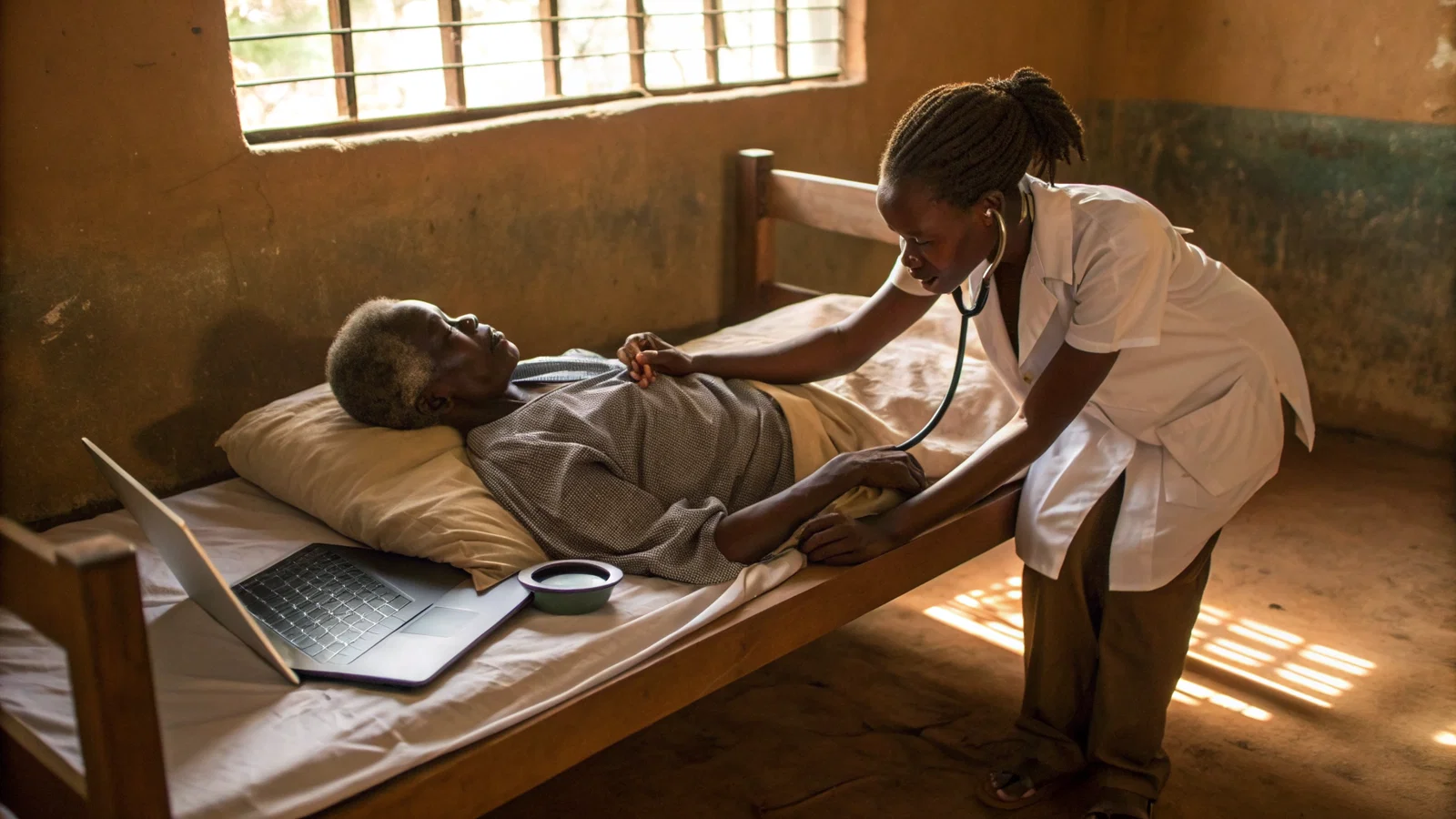
The Late-Night Panic: Is My Mission Trip a Liability?
It's 2:47 AM and I'm staring at the ERAS application like it's a bomb about to go off. My cursor hovers over that one line item, the medical mission trip to Guatemala I did last summer. Seven days. One week of checking blood pressures, handing out vitamins, and shadowing a local physician who probably could've managed just fine without me. And now I'm wondering if listing it is going to tank my entire application.
Before you list your experience, consider how program directors interpret mission work on your application.
I know I'm not the only one doing this. Half my classmates are in the same boat, lying awake replaying every decision they've made since MS1, wondering if that short-term trip looks like genuine commitment or just a privileged student collecting passport stamps for the CV.
The imposter syndrome is suffocating. I went, I helped where I could, I learned things I couldn't have learned in a simulation lab. But did I? Or did I just insert myself into a community I don't understand, take photos that'll look good on a personal statement, and leave without any real follow-up? The word "voluntourism" keeps flashing through my mind like a neon warning sign. I can practically hear a residency director scoffing at my application: "Oh, another one. Spent a week abroad and now thinks they understand global health."
And here's what really keeps me up, I've heard the rumors. Not from official sources, but from mentors, from Reddit, from that one attending who made an offhand comment about "mission trip people." The fear that program directors secretly roll their eyes at short-term mission work is pervasive. It's the kind of thing nobody puts in a formal advising document, but everybody seems to know. Like an unwritten rule that says: if you can't commit to months, don't bother, because we see right through you.
The worst part? I can't undo it. The trip happened. The experience shaped how I think about resource-limited care, even if that sounds like something I ripped from a brochure. I can't un-list it without creating a weird gap. I can't pretend I didn't go. So I'm stuck, paralyzed between including something that might hurt me and omitting something that definitely creates questions.
What if they think I'm exploitative? What if they assume I went for the photo op? What if the single patient encounter I describe in my personal statement, the one where I held a mother's hand through a difficult conversation about her child's malnutrition, comes across as performative? I wasn't performing. I was terrified and humbled and completely out of my depth. But how do you convey that in 200 characters on ERAS without sounding like every other applicant who's ever flown south of the border?
The panic isn't just about the trip itself. It's about the narrative. It's about the gap between what I experienced and what I can articulate. And the terrifying possibility that the gap is where my application dies.
The Anatomy of a Red Flag: Why Program Directors Are Skeptical
Here's what I've pieced together from conversations with advisors, from attending interviews where I asked uncomfortable questions, and from reading between the lines of every "what PDs look for" article I could find.
Program directors aren't stupid. They've seen thousands of applications. They can smell the difference between authentic clinical immersion and a vacation with a stethoscope. The distinction matters more than whether you went at all.
For those unsure about how to categorize their travel, it is helpful to understand the dos and don'ts of listing self-funded mission trips on your ERAS.
The first red flag: lack of continuity of care. Seasoned clinicians know that medicine is a longitudinal relationship. You adjust medications, you see what works, you build trust over time. A one-week trip where you see a patient once and never again? That's a snapshot, not a clinical experience. PDs know this because they live it, their entire practice is built on follow-up. When an applicant frames a single encounter as profound patient impact, it signals clinical immaturity. It tells the PD you don't understand what continuity means yet.
The second red flag: over-representing what you did. I've seen classmates describe themselves as having "provided comprehensive care to underserved populations" when what they actually did was take vitals and distribute deworming medication. That gap between language and reality is exactly what makes PDs skeptical. They're not against mission trips. They're against the inflation of mission trips.
The third red flag, and this is the one that haunts me, is the savior narrative. "I went to help those less fortunate." Even typing it makes me cringe. Every advisor I've spoken to has warned me about this. The moment your application implies you swooped in and saved people who couldn't save themselves, you're done. Not because PDs are hypersensitive, but because that mindset is clinically dangerous. Patients aren't props for your growth. Communities aren't backdrops for your personal statement. And if you can't see that, how are you going to handle a complex patient population back home?
What I've come to understand, and what I keep reminding myself at 3 AM, is that PDs aren't looking for reasons to reject you because you went on a mission trip. They're looking for evidence that you can reflect honestly on a limited experience. The skepticism isn't a wall. It's a filter. And the filter is designed to catch people who can't distinguish between genuine learning and self-congratulation.
That actually makes me feel a little better. Not much. But a little.
Quantifying the Value: Data vs. Your Worst-Case Scenarios
Let me walk through the nightmare scenario. A PD is reviewing my application. They see my Step scores, solid but not stellar. They see my clinical grades, mostly honors, a few high passes. They see one publication in progress, a poster presentation, and then... the mission trip. They spend exactly four seconds on it before moving to the next applicant.
Is that what happens? Probably not, but my brain insists it might.
Here's the reality I've had to dig for, because nobody hands you a spreadsheet of how PDs weight experiences. Mission work sits in the extracurricular category, and extracurriculars are the smallest slice of the pie.
That chart is simultaneously reassuring and terrifying. Reassuring because it means my mission trip isn't going to make or break anything. Terrifying because it means nothing extracurricular is going to save me if my core metrics are weak. Mission work doesn't cancel out a failed rotation. It doesn't compensate for a below-average Step 2 CK. It sits in the "nice to have" column, not the "must have" column.
I've also learned, through uncomfortable conversations with advisors, that different specialties view global health experiences differently. Primary care residencies, particularly family medicine and internal medicine programs with strong global health tracks, actually value mission work. They see it as alignment with their values. A mission trip to a rural clinic screening for hypertension? That's gold for a FM application if framed right.
Surgical specialties? They're more skeptical. Not hostile, but skeptical. A one-week mission trip where you didn't scrub into cases doesn't tell a surgery PD anything about your technical skill or your ability to handle a 12-hour operative day. If you're applying ortho and your mission trip was a public health outreach, the PD isn't thinking "well-rounded human." They're thinking "why didn't this person spend that week doing research or sub-internships?"
That doesn't mean the trip is worthless for surgical applicants. It means the framing has to shift. You're not highlighting clinical impact. You're highlighting team dynamics, adaptability in resource-limited settings, and the ability to work with people who don't share your language or cultural framework. Those are transferable skills. But they're secondary, and you need to know that going in.
The worst-case scenario I keep constructing, where a PD sees my mission trip and immediately rejects me, is almost certainly wrong. The data doesn't support it. PDs rank mission work low in priority, which means it's not a weapon they're using against you. It's just not a shield either. And honestly, understanding that distinction has helped me sleep slightly better. Slightly.
Strategic Reframing: Turning the Experience into a Narrative Asset

So what do I do with this? I can't un-go on the trip. I can't pretend it didn't shape me. And honestly, I don't want to, it did change how I think about medicine, even if that sounds like a cliché. The question is how to write about it without sounding like I'm auditioning for a documentary about myself.
The answer, as far as I can tell from every advisor, every PD interview I've read, and every anxious late-night search session, comes down to two words: cultural humility.
Not "I helped them." Not "I made a difference." Not "They were so grateful." The narrative has to be about what I didn't know, what I learned about my own limitations, and how that changed my approach to medicine going forward. The trip isn't the story. The reflection is the story.
When I describe that single patient encounter, the mother and the malnutrition conversation, I don't frame it as "I counseled her." I frame it as "I watched a local community health worker navigate a conversation I would have fumbled, and I realized my toolkit was inadequate." That's not performative. That's honest. And PDs can tell the difference.
The other reframing strategy: resource-limited decision-making. Short-term mission work puts you in environments where you can't order the labs you want, the imaging you need, or the specialist referral that would be automatic back home. That experience, of making decisions with incomplete information, is genuinely valuable. It translates to night float, to rural rotations, to any setting where you can't just order another test. If you can articulate that, you've turned a one-week trip into evidence of clinical reasoning.
And here's the closing thought I keep coming back to, the one that finally lets me close my laptop and try to sleep: I am more than my shortest rotation. A one-week mission trip is a line item. It's one data point in a multifaceted application that includes years of clinical work, research, personal statements, and letters of recommendation. It will not define me unless I let it define me through bad framing.
The trip happened. I learned from it. I'm going to write about it honestly, position it appropriately under "Volunteer Experience" rather than "Clinical Experience," and trust that the PDs reviewing my application are intelligent enough to distinguish between a thoughtful applicant and a voluntourist. And if they can't? Then that program wasn't going to be a good fit anyway.
That's what I tell myself. Most nights, I almost believe it.
Key Takeaways
- A mission trip will not sink your application unless you try to frame a two-week trip as equivalent to a fellowship. PDs aren't looking for reasons to reject you over volunteer work. They're looking for honesty about what it was and what it wasn't.
- Reframing the narrative from 'savior' to 'learner' is the only way to avoid the 'voluntourism' red flag. The moment your application implies you rescued people, you've lost credibility. Focus on cultural humility and what the experience taught you about your own limitations.
- Residency directors care about what you learned, not just the stamps in your passport. A thoughtfully reflected-upon one-week trip is worth more than a six-month stint described with buzzwords and no introspection.