
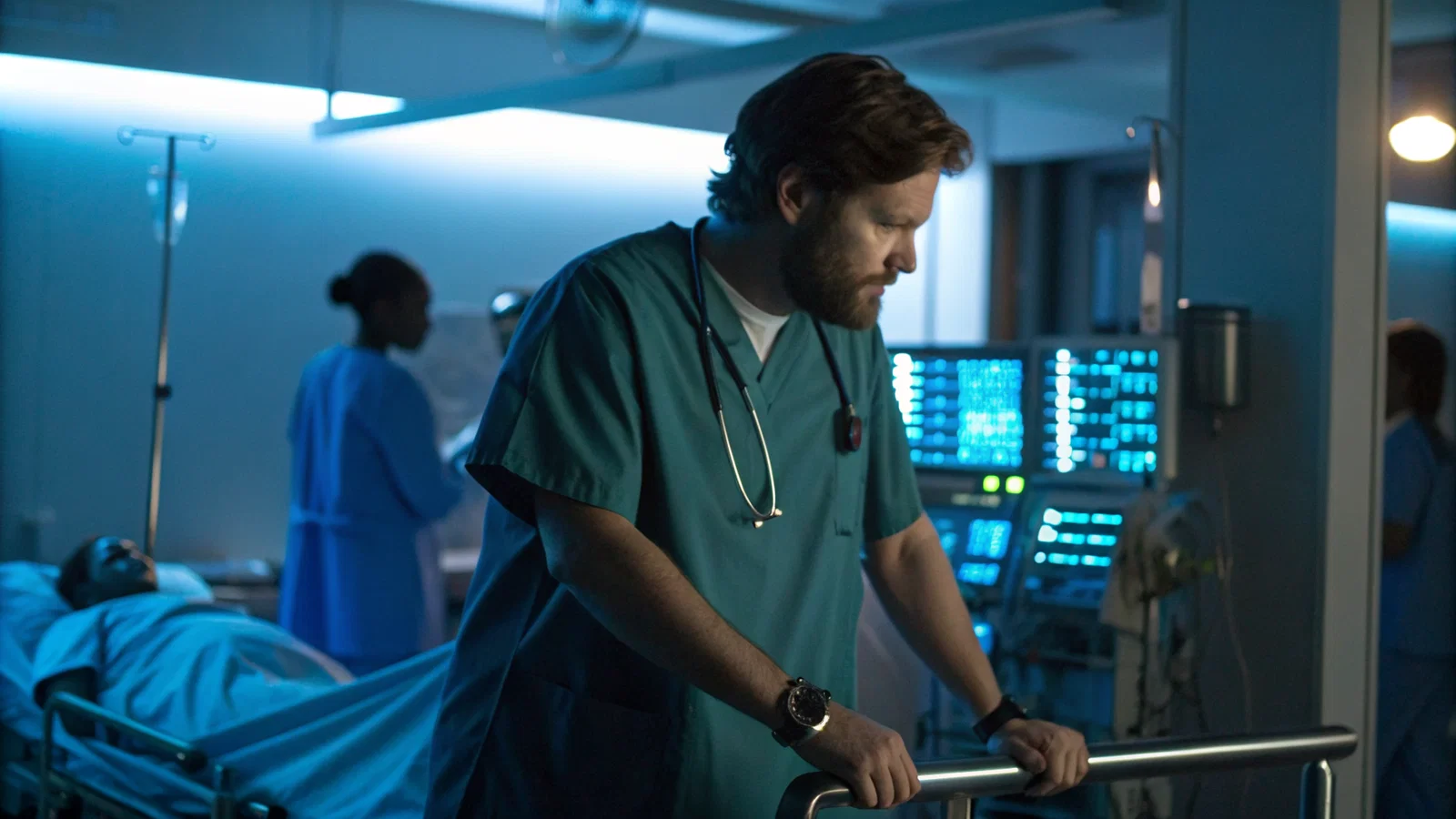
"Mindfulness" gets sold like a spa day for your brain. Soft lighting. Gentle breath. Less rushing. So of course someone in every ED asks the same nervous question: if triage nurses and docs start getting mindful, will they get slow, and miss the patient who's circling the drain?
I've heard the fear out loud. I've seen it in meeting rooms where someone confuses a two-minute attention reset with floating off protocol into crystal-and-candle land. The marketing doesn't help. Mindfulness is branded as calmer, softer, less "protocol-driven." That framing is the misconception. It invites a false tradeoff: serenity versus safety.
Here's the real question. Not whether mindfulness feels calm. Whether it improves decision quality under stress, specifically, whether it helps or hurts time-critical recognition of red-flag vitals.
I'm not interested in vibes or Instagram wellness. I'm interested in signal: attention research, stress physiology, clinical performance data. And I'm defining red-flag vitals the way triage actually should, operational thresholds that demand action, not "numbers that look a little off." Hypoxia. Hypotension. Severe tachypnea or bradypnea. Shock physiology. Sudden altered mental status. The stuff that should yank you out of any contemplative posture in under a second.
This article is for educational purposes only. It is not financial advice, not legal advice, and not tax advice. Figures vary by individual circumstances, so consult a qualified professional before acting.
Myth: Mindfulness = slower triage and missed emergencies
The myth is simple and sticky: mindfulness means slowing down, so emergencies get missed. Wrong mechanism. Wrong definition.
Trained mindfulness is not inherent deceleration. It's attentional control, keeping what matters in working memory, resisting the shiny distraction, and switching when a high-salience cue appears. In triage, the shiny distractions are everywhere: EHR pop-ups, family interruptions, hallway noise, the stable-looking patient who's actually desaturating.
Stress does the opposite of what good triage needs. It narrows attention. It creates cognitive tunneling. You lock onto one task, maybe the complaint, maybe the chart, and your brain stops scanning for the weird vital that should stop the line. I've watched competent clinicians miss a crashing SpO2 because they were buried in a medication reconciliation under noise and time pressure. That's not a character flaw. That's load plus tunneling.
Mindfulness training, at its useful core, targets that failure mode. Widen the aperture. Notice the anchor. Then reorient to what's salient. The point isn't to become a slower person. It's to become less hijacked.
What would actually count as harm? Not "someone looked peaceful for ten seconds." Measurable delays in time-to-intervention for critical patients. Higher miss rates against predefined high-acuity criteria. Dropped sensitivity for hypoxia, hypotension, severe respiratory derangement, or acute mental status change. Those are fair tests.
Fair tests are triage accuracy, sensitivity and specificity for red flags, and throughput metrics like time to first clinical action or time to provider notification. Not whether the room felt zen. Vibes are not a safety endpoint.

What the data actually says: attention, stress, and clinical performance
Strip the hype. Mindfulness-based interventions (MBIs) show a fairly consistent pattern in the literature: reduced stress reactivity and measurable gains in aspects of attention and executive function that matter for clinical judgment, sustained attention, inhibitory control, and the ability to reorient when priorities shift. That's not the same as "mindfulness cures burnout forever" or "meditation replaces experience." It's more modest and more useful: under load, trained people often handle distractors better and recover focus faster.
Triage is pattern recognition plus rule-based thresholds under time pressure. You are hunting for high-salience abnormalities while sorting a queue. If attention training improves cue detection and reduces tunneling, the theoretical bridge is straightforward: better chance you notice the SpO2 of 86% while someone is talking at you about a medication allergy.
Be honest about the evidence gap. Direct RCTs of "mindfulness for triage staff" with primary endpoints like missed red-flag vitals are thin. Much of what we have is indirect, stress reduction, attention tasks, clinician performance proxies, error rates in related clinical work, decision-making under pressure. That's not nothing. It's also not a blank check.
And no, limited direct evidence does not mean mindfulness harms triage. That's the absence-of-proof fallacy wearing a safety badge. It means if you implement it, you implement it like an adult: protocol first, micro-skill second, outcomes measured. You don't replace the ESI algorithm with a singing bowl.
Read that chart as directional evidence patterning, not a claim that your ED will get a precise 28-point bump. The literature leans toward better stress modulation and attentional control. Marketing claims that it's magic? Noise. Anecdotes about one calm nurse who "just knew"? Noise. Controlled attention and stress data? Signal.
Workflow reality check: good triage is protocol + escalation, not meditation
Another misconception needs killing: that mindfulness replaces protocols. It should not. Ever.
Red-flag recognition stays algorithmic. Vital thresholds. Reassessment intervals. Checklists. EHR hard-stops and triggers. Mandatory escalation when criteria are met, no discretionary "I feel centered, so let's wait." Calm is not a clinical criterion.
The safer model is mindfulness as a micro-skill: 10-60 seconds to reset attention, then immediate return to standard triage rules. Breath anchor. Name the task. Scan the vitals board. Apply the threshold. Escalate if crossed. That's it. You're not scheduling a retreat between patients.
Operational guardrails matter more than the brand of mindfulness app. Escalation criteria that override judgment. Double-checks for critical abnormalities. Standardized documentation. Rapid reassessment triggers when something smells wrong even if the first pass looked okay. Miss-prevention metrics should be boring and hard: sensitivity for predefined red flags, median time to notify the provider, frequency and compliance of reassessments.
If your "mindfulness program" can't sit inside that machine without bending it, you don't have a safety tool. You have a wellness brochure.
Notice where the optional reset sits. After the red-flag screen, and never as a substitute for escalation. That's the whole design philosophy in one diagram.
So will mindfulness make you miss red-flag vitals? The contrarian answer
Direct answer: mindfulness, by itself, is unlikely to make you miss red-flag vitals if triage remains protocol-driven with hard escalation triggers.
The fear persists because people conflate mindfulness with freeform judgment, drifty presence, gut vibes, "being with the patient" instead of reading the monitor. That's a category error. Evidence-aligned mindfulness in this context is a tool against stress-related attentional failure, not a permission slip to soft-pedal acuity.
Risk can still rise in specific, avoidable ways. If "mindfulness time" replaces required vital checks. If staff delay calling a rapid response because they're finishing a breathing cycle. If calm becomes overconfidence, "I feel regulated, so this is fine", while the MAP is tanking. Those are implementation failures, not proof that attention training is toxic. They're also exactly what you design against.
What you should do instead is treat mindfulness as additive, not alternative. Skill plus safeguards plus monitoring. If you can't measure safety, you shouldn't scale the intervention.
Implementation blueprint: how to try mindfulness in triage without gambling with safety
Start small. Short modules for triage staff. Micro-skills only, breath or attention anchoring measured in seconds, not minutes, and explicit scripts for how it plugs into existing protocols. No vague "be more present." Teach the exact moment: after the first red-flag pass is clean, before you dig into lower-acuity sorting, or between cases when residual arousal is still high.
Training content must include when not to use it. Confirmed critical abnormality? You escalate. You do not anchor. Unstable airway picture, shock, severe hypoxia, protocol owns the next actions. Teach that out loud so nobody confuses composure training with delay.
Build an evaluation plan like you would for any process change. Pre/post measures or a stepped-wedge rollout. Track sensitivity for red flags. Time-to-notification. Near-miss events. Reassessment compliance. Clinician workload and burnout scores. If stress drops but miss rates wobble upward, you stop or redesign. Full stop.
Equity matters. This can't become a club for people already comfortable with meditation language, or a quiet performance loophole for staff who want to opt out of hard escalation culture. Offer plain-language versions. Make participation about skill, not identity. And never let "I was practicing mindfulness" become an acceptable explanation for skipped vitals.
That dashboard is a recommended monitoring framework, not trial-derived magic numbers. Lower missed events. Faster notification. Higher reassessment compliance. Lower burnout if you're lucky. You're looking for no harm or improvement, not a spiritual transformation of the waiting room.
Key takeaways
Mindfulness doesn't have to slow triage. Implemented correctly, it functions as an attention reset while clinicians still follow protocolized vital thresholds and escalation rules.
The true safety question is measurable: sensitivity for red-flag vitals, time-to-notification, and reassessment compliance, not subjective feelings or marketing claims.
Remember the tradeoff that isn't real. Calm focus and hard thresholds aren't enemies. Tunneling under stress is the enemy. If you keep escalation non-negotiable and you measure what matters, mindfulness won't make you miss the red flags, it might help you see them when the room is loud and your attention wants to shrink.


