

The way mindfulness gets sold in medicine—“totally secular,” “scientifically validated,” “religion-free stress reduction”—is misleading at best and intellectually lazy at worst.
You cannot talk honestly about mindfulness in medicine without talking about religion. And you cannot talk honestly about ethics in medicine while pretending belief systems do not shape what we prescribe, promote, or mandate—whether those beliefs are Buddhist, Christian, “spiritual but not religious,” or aggressively atheist.
Let’s pull this apart properly.
The Myth of “Purely Secular” Mindfulness
The standard sales pitch you’ve probably heard in hospitals and CME modules goes like this: mindfulness is just “paying attention, on purpose, in the present moment, non-judgmentally.” Jon Kabat-Zinn’s famous line. Then comes the reassuring follow-up: “It’s not religious. It’s evidence-based.”
That’s only half true.
Historically, what’s called mindfulness in modern healthcare is a stripped, translated, and rebranded slice of Buddhist contemplative practice (particularly Theravada and Zen lineages), run through Western psychology, corporate HR, and wellness marketing. That doesn’t make it bad. It does make it dishonest to pretend it popped out of nowhere as a neutral brain hack.
Look under the hood of older mindfulness manuals and teacher trainings and you’ll see it: references to insight, liberation, non-self, compassion rooted in specific worldviews. Most are cleaned out, softened, or carefully rephrased for hospital settings.
So what do we actually have in clinical practice?
| Format | Religious Content | Typical Setting |
|---|---|---|
| MBSR (8-week course) | Minimally explicit | Hospitals, clinics |
| App-based mindfulness | None explicit | Personal use |
| Buddhist sangha groups | Strong | Temples, centers |
| “Wellness” sessions | Varies, vague | Hospitals, residencies |
The key point: most “medical mindfulness” is not full-blown religious practice. But it’s not value-neutral either. It smuggles in specific ideas about suffering, agency, and what counts as “good” mental health. That matters ethically.
What the Evidence Actually Shows (Not the Brochures)
Let’s cut through the Instagram quotes and industry hype and look at the data.
Meta-analyses of mindfulness-based interventions (MBIs) in healthcare workers and patients show small to moderate benefits for:
- Stress and burnout
- Anxiety and depressive symptoms
- Sleep quality
- Pain perception (especially chronic pain)
We’re talking effect sizes in the 0.3–0.5 range in many studies. Helpful, yes. Miraculous, no. On par with other structured psychosocial interventions when done properly.
Now the part people conveniently ignore: the evidence is messy.
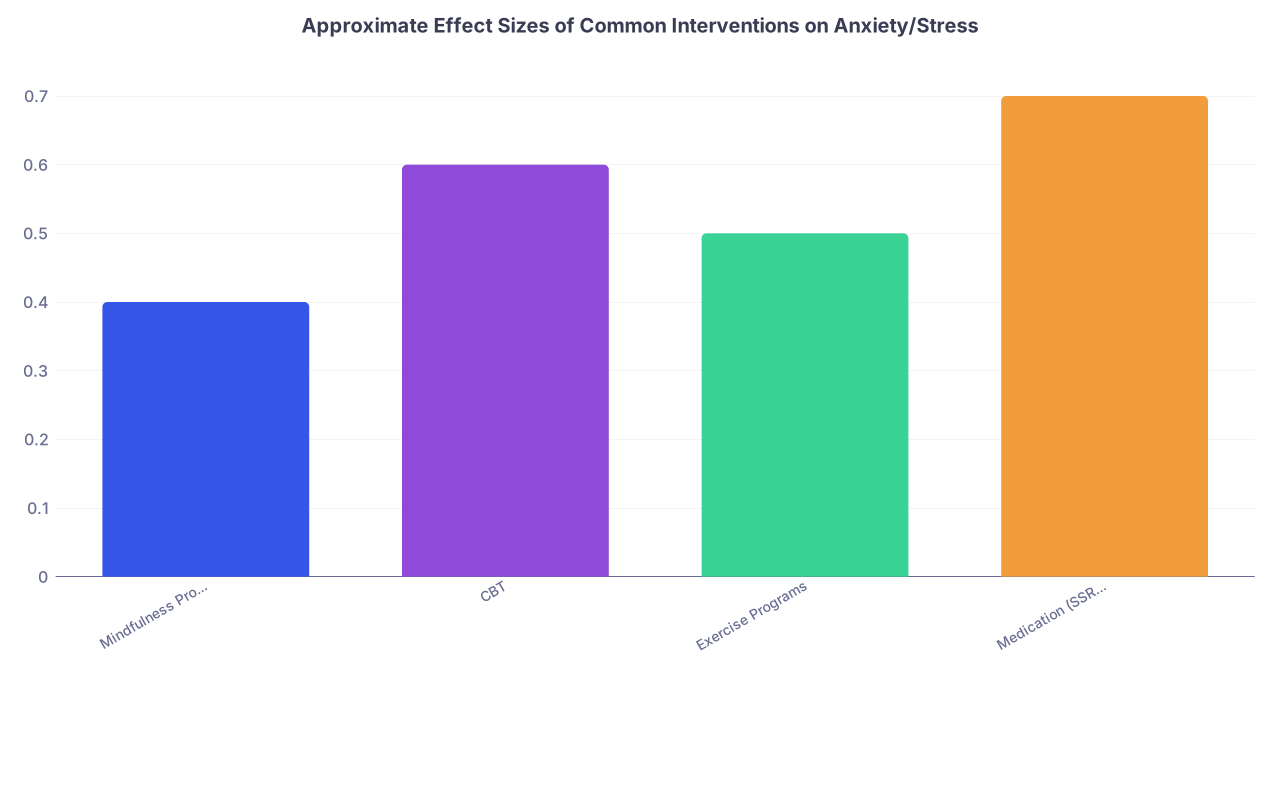
| Category | Value |
|---|---|
| Mindfulness Programs | 0.4 |
| CBT | 0.6 |
| Exercise Programs | 0.5 |
| Medication (SSRIs) | 0.7 |
Mindfulness is not uniquely powerful. It’s another evidence-backed tool in the box, comparable to cognitive behavioral therapy or exercise programs. Yet mindfulness often gets framed as spiritually superior—“deeper,” “more authentic,” “transformational”—language that drifts from science into belief territory.
There are other problems in the data:
- High dropout rates in some trials (the most stressed or skeptical may just vanish from analysis)
- Self-selection bias (people drawn to mindfulness are often already open to its worldview)
- Inconsistent program quality (a weekend-trained facilitator vs a seasoned clinician is not the same intervention)
- Underreporting of adverse effects (yes, there are some—worsening anxiety, dissociation, resurfacing trauma)
Mindfulness can be clinically useful. It is not neutral. And it is not ethically trivial to recommend.
Where Religion Actually Shows Up in Mindfulness
People love to say “mindfulness isn’t religious” because they’re looking at surface features: no chanting, no robes, no statues in the hospital conference room. That’s like saying a diet isn’t ideological just because you removed the word “vegan” from the recipe book.
The religious (or quasi-religious) elements show up in three places.
1. The metaphysics under the hood
Even “secular” mindfulness often quietly assumes or implies:
- Suffering comes mainly from the mind’s relationship to experience, not from external injustice.
- The “self” is something to observe, distance from, or sometimes deconstruct.
- The goal is acceptance and equanimity toward what arises.
Those ideas aren’t value-free. They align quite comfortably with certain Buddhist and Hindu philosophical perspectives, and with some modern therapeutic models, and clash hard with others (say, liberation theology or community-organizing worldviews that emphasize changing external conditions before accepting them).
You don’t have to believe any metaphysics to benefit from mindfulness exercises. But if you’re teaching or prescribing mindfulness, you are implicitly pushing a certain stance about how to relate to suffering.
2. The moral tone
There’s a moral layer that rides along with mindfulness: be compassionate, non-judgmental, patient, accepting. Good things, generally. But these are moral prescriptions, not neutral techniques.
In medicine, that matters. Telling a burnt-out resident to “accept this moment as it is” is not the same as validating their anger at an unsafe staffing ratio. It’s an ethical intervention, not just a psychological one.
3. The community and identity piece
Go hang out in a hospital-based “mindfulness for staff” group long enough and you’ll see it: a loose, soft-focus community identity. “We’re the mindful ones.” The non-mindful colleagues become—implicitly—the less evolved, less self-aware, more “negative” ones.
That’s not full-on religion, but it rhymes: in-group, shared practices, shared stories, shared virtues. And once you have that, the power dynamics get interesting. Who gets to define “mindful”? Who gets praised? Who gets pathologized?
When Mindfulness Becomes a Tool of Control
Here’s where I’m going to be blunt: in healthcare institutions, mindfulness is very easy to weaponize.
I’ve watched hospital systems roll out mandatory or strongly “encouraged” mindfulness modules while refusing to fix scheduling abuses or understaffing. The message becomes:
“We can’t change your working conditions. But we can change your reaction to them.”
I’ve literally heard an administrator say, after a mindfulness presentation on burnout, “It’s great we’re giving them internal tools instead of promising things we can’t deliver.” That’s not wellness. That’s moral outsourcing.
Mindfulness in that context stops being a neutral skill and starts being part of an institutional belief system:
- Suffering is primarily a problem of individual coping.
- Systemic issues are background noise.
- “Resilience” is a personal duty, not a shared responsibility.
That’s a belief system—arguably a secular religion of productivity and stoic acceptance.
Ethically, this is where we cross the line. Using contemplative tools to help clinicians or patients live better is legitimate. Using those tools to get people to tolerate ethically unacceptable conditions is not.
Religion, Spirituality, and the Patient in Front of You
Let’s switch to the bedside, because this is where things get concrete.
You have a patient with chronic pain, high anxiety, and poor sleep. You know that mindfulness-based strategies can help, and the evidence backs you up. But this patient is deeply committed to a particular religious tradition—Christian, Muslim, Hindu, doesn’t matter—and may or may not be comfortable with something that feels “Eastern” or “New Age.”
You’ve got ethical landmines to avoid.
First mistake I see: clinicians selling mindfulness as “completely secular, just brain science.” Patients are not stupid. Many can smell the Buddhist or “spiritual but not religious” flavor, even if you never say the word. If it feels like you’re hiding the roots, you’ve already undermined trust.
Second mistake: assuming mindfulness is somehow superior to the patient’s own spiritual practices. You see this in tone: “Have you tried mindfulness?” said as if prayer, rosary, dhikr, or other contemplative practices are amateur hour compared to your eight-week protocol.
Here’s what the smarter move looks like:
You explicitly acknowledge that what you’re proposing has roots in particular contemplative traditions but is used in medicine in a secular way. You invite the patient to decide for themselves whether it fits their beliefs. You explore their existing spiritual or religious practices and see whether there’s already a contemplative element that could be strengthened, rather than replaced.
Sometimes the best “mindfulness-based” intervention is actually helping a religious patient deepen practices they already find meaningful, with some guidance on attention, breath, and body awareness. You don’t need to call it mindfulness. You certainly don’t need to pretend your version is ideologically superior.
The Ethics of Mandating Mindfulness for Clinicians
Let’s talk about you and your colleagues now.
There’s a trend in hospitals, residencies, and even med schools: mandatory wellness modules, many of which include mindfulness, meditation, or “guided reflection” with a strong contemplative flavor.
From an ethics standpoint, there are at least three big problems.
Coercion (even if soft)
You can say “optional” all you want, but if non-participation is noticed, recorded, or quietly judged, it’s not truly voluntary. When your program director runs the session, or your eval mentions “engagement with wellness offerings,” we’re not in free-choice territory.
Now imagine the religiously observant trainee who finds certain forms of meditation in conflict with their faith. Or the atheist who is simply not comfortable with any practice that feels “spiritual.” Forcing participation is crossing into belief territory.
Blurred boundaries between psychological and spiritual care
Mindfulness practices often touch deep psychological and existential layers. That’s part of their power. But hospitals frequently outsource these sessions to facilitators with limited clinical training and very little exposure to the religious/ethical side of what they’re guiding.
You wouldn’t hire a random motivational speaker to run trauma debriefs on your ICU team. Yet people happily bring in a “mindfulness coach” with minimal training to guide staff through practices that can stir up trauma, grief, or existential distress.
Measuring the wrong outcomes
Here’s the institutional fantasy: “We’ll roll out mindfulness workshops and see burnout scores drop. Then we’ll claim success.”
What actually happens in many places? Burnout scores budge a bit, maybe, but moral injury, cynicism, and disillusionment stay high because nothing changed about workload, EMR torture, or staffing. The mindfulness becomes a fig leaf to say “We did something.”
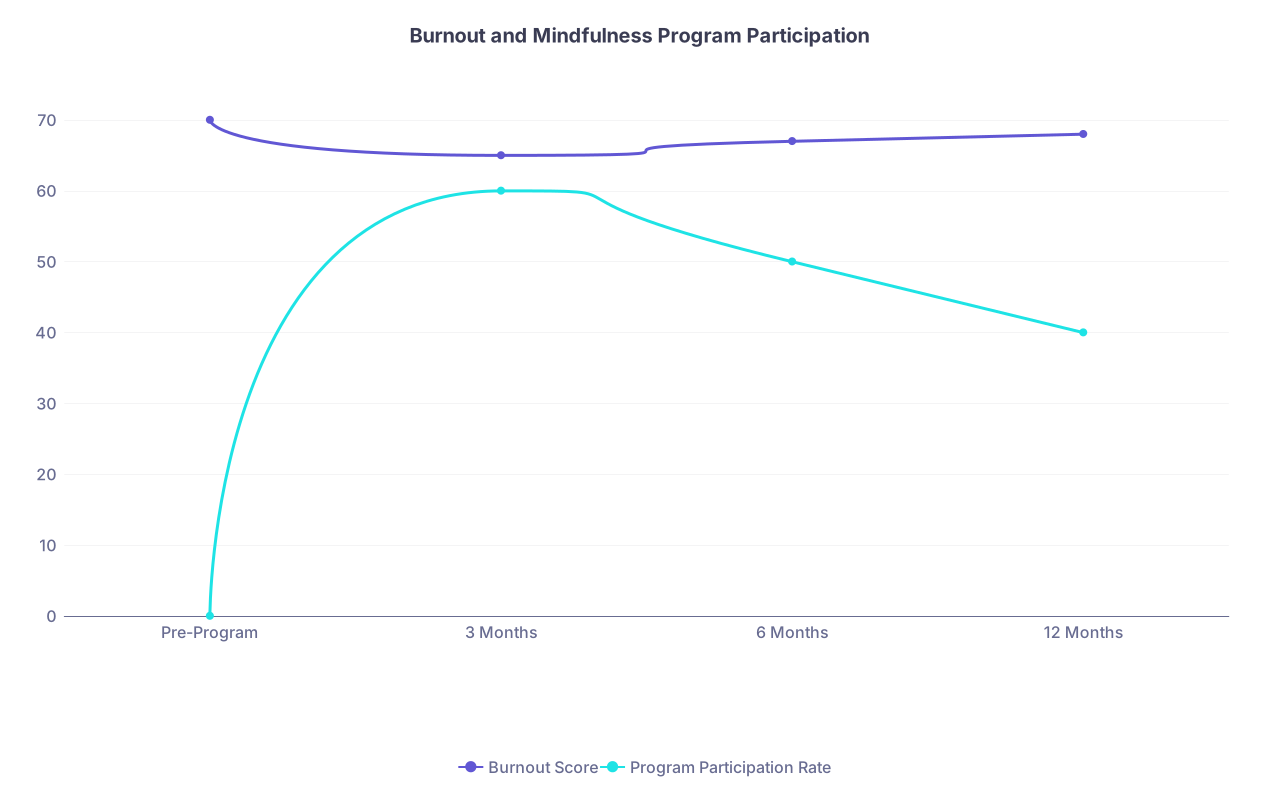
| Category | Burnout Score | Program Participation Rate |
|---|---|---|
| Pre-Program | 70 | 0 |
| 3 Months | 65 | 60 |
| 6 Months | 67 | 50 |
| 12 Months | 68 | 40 |
You cannot meditate your way out of fundamentally broken systems. Pretending otherwise is an ethical failure.
How to Use Mindfulness Without Playing Amateur Chaplain
So what does a sane, ethically defensible approach look like—in medicine, not in a monastery?
Be explicit about what it is and isn’t
Stop the “just brain science” marketing. Say something closer to:
“This is a set of attention and awareness practices that have roots in contemplative traditions, especially Buddhism, but are now used in medicine in a secular way. Some people find them helpful for stress, mood, and pain. Some don’t connect with them. You’re free to take or leave it.”
That respects autonomy. It acknowledges belief systems without preaching.
Offer alternatives with equal respect
No, mindfulness is not the only evidence-based mental health tool. For a given person, it may not even be the best.
If you’re offering mindfulness, you should be just as ready to offer:
- Exercise-based programs
- CBT or other structured therapies
- Chaplaincy or clergy referral for spiritually framed support
- Peer support groups without contemplative practice
And you should not quietly judge patients or colleagues who choose those over your pet mindfulness program.
Keep the spiritual depth where it belongs
If someone wants to use mindfulness as part of a deeper spiritual path—that’s their right. But that’s not your job as their clinician. You’re not their meditation teacher, guru, or spiritual director. You’re there to help them function, cope, and heal within their belief system, not replace it.
For patients and clinicians who do want religiously grounded contemplative practice, the ethical route is referral: to chaplains, religious communities, or well-trained spiritual directors who understand the theology and the psychology, not just the breathing scripts.

Guard against institutional misuse
If your system is rolling out “mindfulness for burnout” while refusing to address basic workload, patient safety, and staffing issues, you’re allowed—actually, you’re obligated—to call that out.
The ethical sequence is:
- Fix what’s structurally wrong as far as possible.
- Then offer individual tools like mindfulness to help people cope with what remains hard.
Flip that order and mindfulness becomes part of the problem, not part of the solution.
Where This Leaves You
Mindfulness is neither a magic bullet nor a religious Trojan horse that must be banned from medicine. It’s a powerful psychological technique with philosophical baggage, and it’s been dragged into healthcare in sloppy ways.
If you want the short version:
- Mindfulness in medicine is not value-neutral; it carries implicit beliefs about suffering, self, and acceptance that you need to acknowledge, not hide.
- Using mindfulness to patch over systemic abuse or as a quasi-mandatory “wellness” ritual is ethically suspect; it easily becomes a tool of control rather than care.
- The ethical path is transparency, genuine voluntariness, and respect for patients’ and clinicians’ existing religious or secular worldviews—mindfulness as an option, never as an unexamined ideology.
You do not have to choose between science and belief. But you do have to stop pretending that what we call “mindfulness” in medicine floats above both. It doesn’t.
And once you see that clearly, your practice—and your ethics—get sharper.


