The idea that “mindfulness is for burned‑out residents, not attendings” is backwards. The people carrying the most risk, responsibility, and moral exposure on a care team are exactly the ones who can’t afford to ignore it: attendings.
You want data, not soft wellness slogans. Good. Because the evidence is brutally clear: the higher you go on the responsibility ladder, the more cognitive load, moral distress, and decision fatigue you absorb. And the less protected you are by structure, supervision, or training wheels.
Residents are burning out. True. Attendings are burning out and quietly eroding in place. Equally true.
Let’s kill this myth properly.
Where This Myth Comes From (And Why It Persists)
I’ve heard this line verbatim in academic halls: “Mindfulness sessions are for the residents—we’re too busy running the service.” Translation: mindfulness is remedial. A fix for the weak or overwhelmed. Once you “level up” to attending, you’re supposed to have transcended the need for structured mental training.
The culture helps this along:
You see noon talks on “Mindfulness for PGY‑1s,” wellness seminars branded for “trainees,” optional yoga after intern orientation. Then you look at attending calendars: RVU dashboards, coding updates, malpractice risk reviews. No one is scheduling “Mindful Practice for Senior Surgeons” on a Tuesday at 7 a.m. between OR turnovers. So the signal is clear: mindfulness is a teaching tool for developing minds, not a performance tool for senior clinicians.
That’s nonsense.
Mindfulness, when it’s not watered down into “breathe and feel grateful,” is cognitive and emotional skills training:
- Attentional control under stress
- Metacognitive awareness (noticing your own thought and emotion patterns in real time)
- Response inhibition (catching the impulse to snap, cut corners, or anchor on the wrong diagnosis)
Those are not “resident problems.” Those are “physician problems.” They just get more consequential the more authority you have.
What the Data Actually Shows About Attendings, Burnout, and Mindfulness
Let’s look at actual numbers, not hallway impressions.
Multiple large‑scale studies of physicians show attending‑level burnout rates hovering around 40–60% in many specialties, often higher than in trainees. The difference is that residents’ distress is visible and “expected,” while attending distress often goes underground—masked by productivity, seniority, or sarcasm.
Mindfulness‑based interventions have been tested on practicing physicians, not just residents. They are not miracle cures, but they are not fluff either.
Here’s a snapshot of what the research keeps finding:
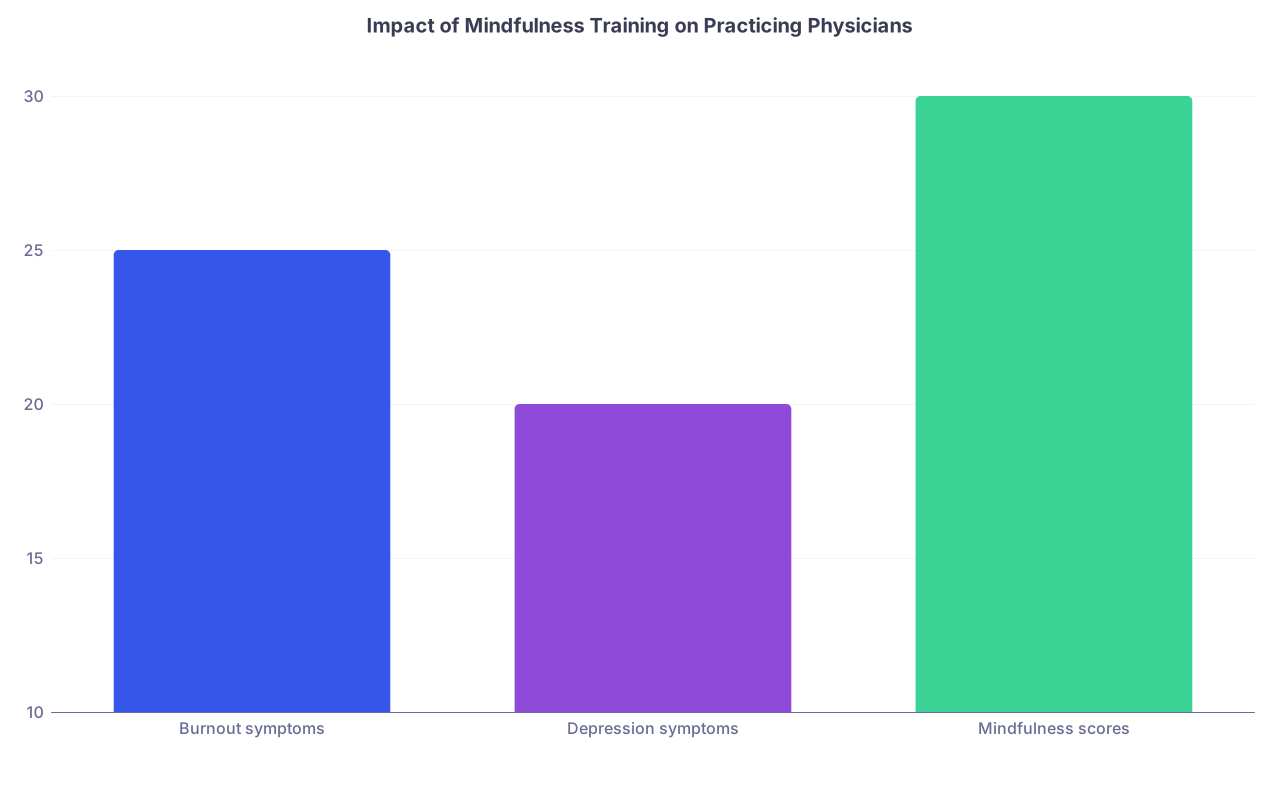
| Category | Value |
|---|---|
| Burnout symptoms | 25 |
| Depression symptoms | 20 |
| Mindfulness scores | 30 |
Those percentages are representative of reductions or improvements often observed in physician-focused mindfulness programs over weeks to months. Different studies have different effect sizes and designs, but the direction is consistent: improved well‑being, better perceived quality of care, reduced emotional exhaustion.
And—this matters—most of those participants are not interns. They’re mid‑career physicians.
One well‑known program for practicing clinicians, Mindfulness‑Based Stress Reduction (MBSR) adaptations and “Mindful Practice” courses, repeatedly show reductions in burnout and improvements in empathy and job satisfaction among attendings. These are people with clinics, OR block time, admin roles, and full malpractice exposure.
The myth that “this is resident stuff” survives not because of data, but because of ego, time pressure, and a very medical form of magical thinking: “I survived residency; therefore I am now immune.”
You are not.
The Power Differential: Residents vs Attendings in Mental Load
If you strip away the hierarchy, here’s what actually changes from resident to attending: the kind of pressure, not the existence of pressure.
Residents:
- Sleep deprivation
- Constant evaluation
- Fear of failing exams
- Lack of control over schedule
Attendings:
- Final legal responsibility
- Leadership and conflict management
- RVU and financial pressures
- Moral distress from system constraints
- Chronic exposure to death, complications, and complaints, with fewer people checking in on you
So who logically needs stronger internal regulation skills? The person taking the orders, or the person writing them?
Let’s lay out some contrasts.
| Factor | Residents | Attendings |
|---|---|---|
| Control over decisions | Limited | High |
| Legal responsibility | Shared/supervised | Ultimate |
| Emotional burden | High | Higher, but less acknowledged |
| System pressures | Schedule/workload | Productivity, politics, litigation |
| Access to “wellness” | Often built into curriculum | Rare, optional, or nonexistent |
The uncomfortable truth: we design mindfulness and resilience curricula for the least powerful people in the system, then withhold it from the people whose decisions shape culture, patient care, and everyone else’s stress levels.
That’s ethically backward.
“But I Don’t Have Time” — The Classic Attending Escape Hatch
I’ve heard surgeons say, “I don’t have time for this.” Same surgeons who spend 20 minutes scrolling through useless EHR alerts at 11 p.m. Or sit in meetings so unproductive they should qualify as malpractice.
The time argument usually hides one of three things:
- Skepticism – “This is soft, not real.”
- Shame – “If I need this, it means I’m weak or can’t cope.”
- Control – “I won’t be told how to manage my inner life.”
All understandable. All still wrong.
Mindfulness for clinicians is not an hour‑long daily retreat. Most effective protocols for busy physicians use tiny, repeated inserts—30–90 seconds before high‑stakes events, micro‑check‑ins, brief formal practice a few days a week. The total time cost can be less than what you burn in revenge‑scrolling or complaining about admin in the lounge.
The data suggests that even moderate engagement yields returns. Not spiritual enlightenment. Just fewer errors under stress, better emotional regulation, less depersonalization, and sometimes better patient satisfaction scores.
If it were an app that promised 3–5% improved diagnostic accuracy or 20% lower risk of leaving medicine early, every hospital CFO would shove it down your throat. Because it sounds like “wellness,” we shrug.
Mindfulness Is Not a Spa Treatment. It’s a Performance Skill.
This is where the myth really collapses. We’ve branded mindfulness as a coping mechanism. Something you reach for when you’re at the end of your rope.
That’s like teaching hand hygiene only to people after they cause a hospital outbreak.
The deeper literature on mindfulness in high‑stakes professions—aviation, elite sports, military, police—frames it as performance enhancement under pressure. Not self‑care. Not bubble baths. Skilled, trained use of attention and awareness.
In medicine, that skill shows up in moments like:
- Catching your own rising anger in a family meeting before it shapes your tone
- Noticing a subtle cognitive bias (“I just don’t like this patient”) before it affects your workup
- Staying mentally present in the 12th consult of the day, instead of functioning on autopilot
- Pausing for a beat in the OR when something doesn’t feel right, rather than plowing ahead
Residents absolutely need that. So do attendings. If anything, attendings need it more, because their unregulated reactions cascade down the chain.
A mindless resident snaps at a nurse? Bad.
A mindless attending normalizes that behavior on rounds? Now you’ve got a culture problem.
Mindfulness, Authority, and Medical Ethics
You flagged this as “Personal Development and Medical Ethics.” Good. Because mindfulness isn’t just about feeling better; it’s about behaving better when you hold power.
Ethically, attendings sit at the convergence of three responsibilities:
- To patients (non‑maleficence, beneficence)
- To trainees and staff (just, supportive use of authority)
- To themselves (maintaining capacity to practice safely and humanely)
Chronic stress, emotional numbing, and burnout erode ethical behavior. Not in dramatic ways at first. In small, insidious ways: cutting corners on informed consent, dismissing patient suffering as “noncompliant,” retaliating against a trainee who questioned you, normalizing disrespect, rationalizing bias.
Mindfulness—actual awareness of your mental state in real time—extends the gap between impulse and action. That gap is where ethics live.
I’ve watched attendings who practice this well:
- Notice their own implicit bias when a patient with substance use disorder comes in, and explicitly check it verbally
- Admit, calmly, “I’m getting frustrated right now; let’s pause,” instead of escalating a conflict
- Catch the urge to belittle a resident during a pimping session and redirect into teaching
That’s not soft. That’s ethical discipline.
The “Resident Problem” Framing Actually Hurts Residents
Another under‑discussed angle: if you package mindfulness as “for the burned‑out residents,” you send a loud message:
“You are the problem. Your distress is an individual failure to cope, not a result of the system we run.”
Residents are not stupid. They see who’s generating the schedule, who’s setting the culture, whose anger they’re afraid of. If the only people getting structured support are the most powerless, while those in power opt out because it’s “not for them,” what you’re doing is moral outsourcing.
Leaders who practice mindfulness (and show it) change the signal:
- You normalize mental skills training as part of professional excellence, not remedial support
- You own your contribution to the climate of the ward, not just your RVUs
- You make it easier for residents to admit distress, because they see you doing your own work
If your residents are in a “resilience workshop” while your attendings are in a “productivity optimization meeting,” do not pretend you’re addressing wellness ethically. You’re not.
What It Actually Looks Like for Attendings (Not Fantasy Retreats)
Let’s get concrete. What does real‑world, non‑cringey mindfulness look like for attendings?
Think small, repeatable, integrated.
Pre‑clinic or pre‑OR check‑ins
Sixty seconds. Close the door, feel your feet on the ground, notice your breath, label what’s actually present: “tired,” “annoyed,” “rushed,” “nervous about this difficult case.” No fixing. Just seeing. You walk out less likely to discharge that mood onto the first person you see.Micro‑pauses at decision points
Before committing to a high‑stakes plan (escalating to surgery, calling something futile, signing out a borderline patient), one breath, one question: “What am I not considering because I’m rushed/annoyed/certain?” That’s not woo‑woo. That’s cognitive debiasing via awareness.Post‑event decompression
After an unexpected death, a bad outcome, or a horrible family meeting, two minutes alone. Notice body tension. Notice thoughts. Let them be. This reduces the chance you numb out long‑term or dump the emotional residue on the next patient or trainee.Formal practice, minimal dose
Ten minutes, three times a week. That’s it. Focused attention (breath/body sounds) or open awareness practice. Enough to train the muscle of noticing and returning. No incense. No mantras. Just training.
That’s the real shape of an attending‑level regimen. Not month‑long retreats in a monastery.
To visualize how these insert into a typical week without fantasy scheduling:
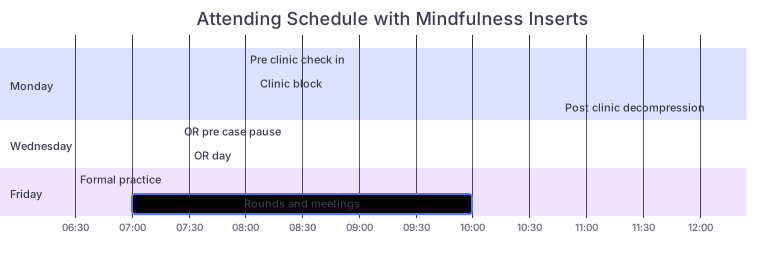
| Task | Details |
|---|---|
| dateFormat HH | mm |
| axisFormat %H | %M |
| Monday: Pre clinic check in | done, 08:00, 0:05 |
| Monday: Clinic block | active, 08:05, 4:00 |
| Monday: Post clinic decompression | done, 12:05, 0:05 |
| Wednesday: OR pre case pause | done, 07:25, 0:05 |
| Wednesday: OR day | active, 07:30, 8:00 |
| Friday: Formal practice | done, 06:30, 0:10 |
| Friday: Rounds and meetings | active, 07:00, 10:00 |
We’re not talking about massive time investments. We’re talking about small, disciplined changes in how you use your attention.
The Real Myth: That You “Grew Out Of” Needing This
Underneath the surface, the myth “mindfulness is for burned‑out residents” rests on another, more fragile belief:
“I’m an attending now. I should be able to handle this by myself.”
Medicine trains you to self‑sacrifice and self‑deceive. You’ll accept help with a difficult airway faster than you’ll accept that your own mind needs retraining after a decade of chronic stress.
But the comparison is apt. You wouldn’t let someone manage airways for 30 years without feedback, simulation, or updated training, then call it “resilience” when they struggle. Yet we assume our own mental habits under stress will magically self‑correct.
They don’t. They calcify. Unless you work on them.
Bottom Line: Who Actually “Owns” Mindfulness in Medicine?
Three points, no fluff:
Mindfulness is not remedial therapy for fragile residents. It’s mental skills training that becomes more critical as responsibility, authority, and ethical exposure increase. Which means attendings are prime candidates, not exceptions.
The evidence does not support the myth. Physician mindfulness programs show benefits for practicing clinicians—reduced burnout, improved empathy, better perceived quality of care. Ignoring that because of ego or stigma is a choice, not a data‑driven position.
Ethically, attendings who shape culture, teach trainees, and hold power over patients’ lives have a duty to manage their own minds. Mindfulness is one of the few structured, trainable ways to do that. Dismissing it as “for the burned‑out residents” is not just inaccurate. It is, frankly, irresponsible.