
The way most clinicians handle pre‑op jitters is broken. White‑knuckling through anxiety and calling it “being prepared” is not resilience. It is a liability.
You cannot eliminate pre‑procedure nerves. Nor should you. But you can convert that spike of adrenaline from shaky to sharp in under five minutes with a repeatable mindfulness routine. That is what we are going to build.
This is not about scented candles, apps, or “finding your center.” It is about a simple, ethical, performance‑oriented protocol you can use before procedures—whether you are a med student doing your first femoral line or an attending leading a Whipple.
Why Your Pre‑Op Anxiety Is Not the Problem (But Your Response Might Be)
I have watched residents pace outside the OR, breathing fast, glancing at their phones, saying things like, “I just need to get through this case.” Wrong frame. If you treat every procedure like a threat, your brain will cooperate—it will put you in threat mode.
You know the physiology:
- Sympathetic surge
- Increased heart rate
- Narrowed attentional field
- Tunnel vision and impulsive decisions
That can help reaction time in trauma. It wrecks precision for an elective lap chole or a delicate central line.
The problem is not the arousal; it is the unmanaged arousal. Mindfulness, done correctly, is not about relaxation. It is about:
- Controlling arousal level
- Widening attention when it narrows too much
- Returning to your pre‑defined priorities when your mind spins
Think of it as the mental equivalent of “time‑out” and the surgical checklist. A pre‑procedure check of you.
The Core Routine: A 5‑Step Pre‑Procedure Mindfulness Protocol
Here is the protocol. Start with this. Customize later.
You can run this in 90 seconds if needed, or stretch it to 5 minutes.
Step 1 – Physical Reset (30–60 seconds)
You cannot out‑think a dysregulated nervous system. Start with the body.
Protocol: Box Breathing With Posture Check
- Stand or sit with both feet on the floor.
- Straighten your spine just enough to feel alert, not stiff.
- Relax your shoulders deliberately—let them drop.
Then:
- Inhale through your nose for 4 seconds.
- Hold for 4 seconds.
- Exhale slowly through pursed lips for 6–8 seconds.
- Pause for 2 seconds.
- Repeat 3–4 cycles.
If 4‑4‑8 feels too much, cut it to 3‑3‑6. The point is longer exhale than inhale. Parasympathetic activation. Less tremor. Clearer thinking.
Non‑negotiable rule: While you breathe, no phones, no EMR, no talking. Thirty seconds of only breathing.
Step 2 – Name the Jitters, Do Not Fight Them (30 seconds)
Trying to suppress anxiety is like trying not to think of a pink elephant. It will get louder. You label it instead. Quickly and clinically.
Protocol: Label and Normalize
Quietly, to yourself:
- “My heart is fast. That is adrenaline.”
- “I feel anxious. That is my system preparing.”
- “This is pre‑op activation, not a problem to fix.”
Then add one intentional reframe:
- “This energy is here to help me focus.”
- “I can be anxious and still perform precisely.”
- “I have done hard things before. I can do this one while anxious.”
Do not overdo it. Two or three sentences. Done. You are not doing therapy. You are doing calibration.
Step 3 – Narrow, Then Widen Your Attention (45–60 seconds)
Left unchecked, your mind does one of two things:
- Tunnels into worst‑case scenarios.
- Fragments into 20 competing concerns.
You need controlled attention. First narrow. Then widen. Like zooming a camera.
Protocol: 3‑Point Focus Scan
Body (10–15 seconds)
Brief internal scan:- Jaw
- Shoulders
- Hands
Ask: “Where am I clenching?” Then release 5–10% of that tension. Not all of it. You still need some tone.
Breath (10–15 seconds)
Put attention on air moving at the nostrils or chest rising. One full inhale and exhale with full awareness. That is it. You are anchoring, not meditating on a mountain.Room (20–30 seconds)
Look up. Ground in real, external cues:- Count 3 distinct sounds (monitors, overhead announcements, distant voices).
- Notice 3 visual details (color of the floor, the pattern on the door, the light panel).
Silent thought: “I am here, on this floor, about to start this case.” You are pulling your brain out of abstract worry and into the actual environment.
Step 4 – Intentional Mental Rehearsal (60–90 seconds)
This is the step most people skip. Big mistake.
Half‑baked visualization (“It will be fine”) does nothing. You want procedurally specific rehearsal—one clean mental run of the critical path and worst‑case bailout.
Protocol: Two‑Pass Visualization
Do this with eyes open or closed, whichever works. I prefer eyes slightly lowered; less awkward in a busy hallway.
Pass 1 – Ideal Course (30–45 seconds)
Run through the key stages without narrating every micro‑step:
- Positioning and prep
- Critical step 1
- Critical step 2
- Expected endpoint
Example for a central line:
- Patient positioned, draped.
- Ultrasound probe, identify vein clearly.
- Needle in with smooth hand, wire glides without resistance, catheter passes, flush good.
Focus on sensations: how your hand feels, the tone of your voice when you give instructions, what you see on ultrasound.
Pass 2 – Single Complication + Bailout (30–45 seconds)
Pick one realistic problem, not a disaster movie. Then mentally walk through the planned response.
Examples:
For central line: arterial puncture
→ “I recognize bright pulsatile blood, I stop, hold pressure, reassess.”For lap chole: bleeding from cystic artery
→ “I see bleeding, I call for suction, expose, clip or tie, confirm hemostasis.”
You are sending a clear message to your nervous system: “If X happens, I know what to do.” Anxiety drops because uncertainty drops.
Step 5 – One-Line Ethical Commitment (10 seconds)
Here is where personal development and medical ethics intersect. Anxiety shrinks when you re‑anchor to your role and values, not your ego.
You say one sentence—internally or quietly to yourself—that commits to an ethical stance.
Pick something like:
- “My priority is this patient’s safety, not my performance rating.”
- “I will speak up if something feels wrong, regardless of hierarchy.”
- “I will be honest about what I notice, even if it slows the case.”
- “I will treat everyone in that room with respect.”
You are not doing a TED talk; you are giving your brain a direction. Values over vanity.
Then you go in.
Where This Fits in the Real Pre‑Op Timeline
You do not have 20 minutes to sit in lotus before cases. You do have 2–5 minutes. Usually more than once.
Here is how to slot this in across a typical pre‑op flow.

| Step | Description |
|---|---|
| Step 1 | Review Cases |
| Step 2 | Mindfulness Step 4 Rehearsal |
| Step 3 | See Patient |
| Step 4 | Consent and Safety Check |
| Step 5 | Outside OR Door |
| Step 6 | Mindfulness Steps 1-3 and 5 |
| Step 7 | Enter OR and Setup |
1. Earlier in the day (or night before):
Do a longer version of Step 4 (mental rehearsal) for your most complex or anxiety‑provoking case. This is where you think through anatomy, variations, bailout strategies. Ten minutes max.
2. Outside the patient’s room:
Quick check of your own state:
- 1–2 cycles of box breathing
- One short “label and normalize” (Step 2)
Then you walk in. You do not bring your visible jitters into the patient encounter if you can help it.
3. Just before going into the OR or procedure room:
Run the full 5‑step quick routine. Lean against a wall. Stand by a window. Step into a less trafficked corner of the hallway. It takes 2–3 minutes once you know it.
4. Immediately before incision or key step:
Micro‑reset:
- One slow breath.
- Brief glance around the room (widen attention).
- Quiet thought: “Patient first. Team safety. Start.”
No drama. No performative announcements. Just a small, visible pause. People will come to know you as “that person who always centers before starting.” That is not a bad reputation.
Customizing the Routine: Quick Variants for Different Roles
Not everyone is primary operator. Your anxiety pattern depends on your role.
| Role | Main Stressor | Key Focus in Routine |
|---|---|---|
| Med Student | Fear of looking inept | Step 5: Ethics over ego |
| Junior Resident | Performance pressure | Step 4: Rehearse bailouts |
| Senior Resident | Managing team | Step 3: Widen attention |
| Attending | Responsibility weight | Step 2: Normalize arousal |
| Anesthesia | Rapid decision-making | Step 1: Breath and posture |
If you are a med student
Your brain is screaming about evaluation, not patient safety. You know it. I know it.
Adaptations:
- In Step 2, label the ego fear: “I am worried about looking stupid.”
- In Step 5, use: “My job is to learn safely and advocate for the patient, not to impress.”
- In Step 4, rehearse one or two things:
- How you will present the patient.
- The single step you will be asked to do (e.g., driving the camera, cutting sutures).
The win for you is not “no anxiety.” It is “I can still form sentences and follow instructions.”
If you are a junior resident
You are in the worst of both worlds: more responsibility, less control.
Adaptations:
- Put more weight on Step 4 (bailout scenarios) for the common procedures you do.
- In Step 5, commit to: “I will ask for help early rather than late.”
That single sentence can prevent both patient harm and your own burnout. - Add a post‑case 60‑second reflection (we will get to that).
If you are a senior or attending
Your stress is often anticipatory: complexity, team dynamics, system failures.
Adaptations:
In Step 3, extend the “room” scan to include:
- Who is in the room.
- Who is new or less experienced.
- Whether anyone looks confused or checked out.
In Step 4, incorporate team communication into your visualization:
- “I clearly state when we are at a critical step.”
- “I invite the team to speak up if they see concerns.”
Ethically, models of “mindful leadership” fit here. You are not calming yourself only for you; your regulation affects the whole room.
Quick Ethical Guardrails: When Mindfulness Is Not Enough
Mindfulness is not a magic eraser. Some situations require structural or behavioral fixes, not more breathing.
Here are the red‑flag situations where you must go beyond this routine:
You are so anxious you are having trouble seeing clearly, controlling your hands, or following a coherent train of thought.
Action: Step back. Tell a colleague or attending, “I am more anxious than usual and not thinking clearly. I need a minute or a different role.” That is ethics, not weakness.You are engaging in avoidance—skipping key steps in pre‑op planning because the case feels overwhelming.
Action: Slow down. Use your rehearsal time (Step 4) to identify the specific gap. Ask for targeted supervision or review imaging with someone more experienced.You notice chronic dread before every procedure.
Action: This is not a pre‑case tweak. It is a sign of burnout, depression, or misalignment with your specialty. You need mentorship, and possibly mental health support.
Using mindfulness to tolerate a toxic environment or unsafe workload is unethical. The tool is for sharpening performance and presence, not for self‑anesthetizing.
Building the Habit: Turning a Technique into a Reflex
Knowing the protocol is nothing. Having it wired in before a real crisis is everything.
Here is how to make it automatic in 4–6 weeks.
1. Start with one anchor time
Pick one moment in your day when you will always run the 5‑step routine:
- Before your first procedure of the day.
- Before your first patient encounter in pre‑op.
Set a discrete cue:
- A silent phone alarm labeled “Reset.”
- A sticky note on your ID badge: “Pause.”
Commit to two weeks of never skipping that one anchor.
2. Track the basics, not your feelings
Do not journal your soul unless you want to. Just track:
- Did I do the routine? (Y/N)
- Duration (1–2 minutes or 3–5 minutes)
- One word on effect: “scattered,” “steady,” “sharper,” “same”
Use whatever you like—notes app, spreadsheet, back of your sign‑out sheet.
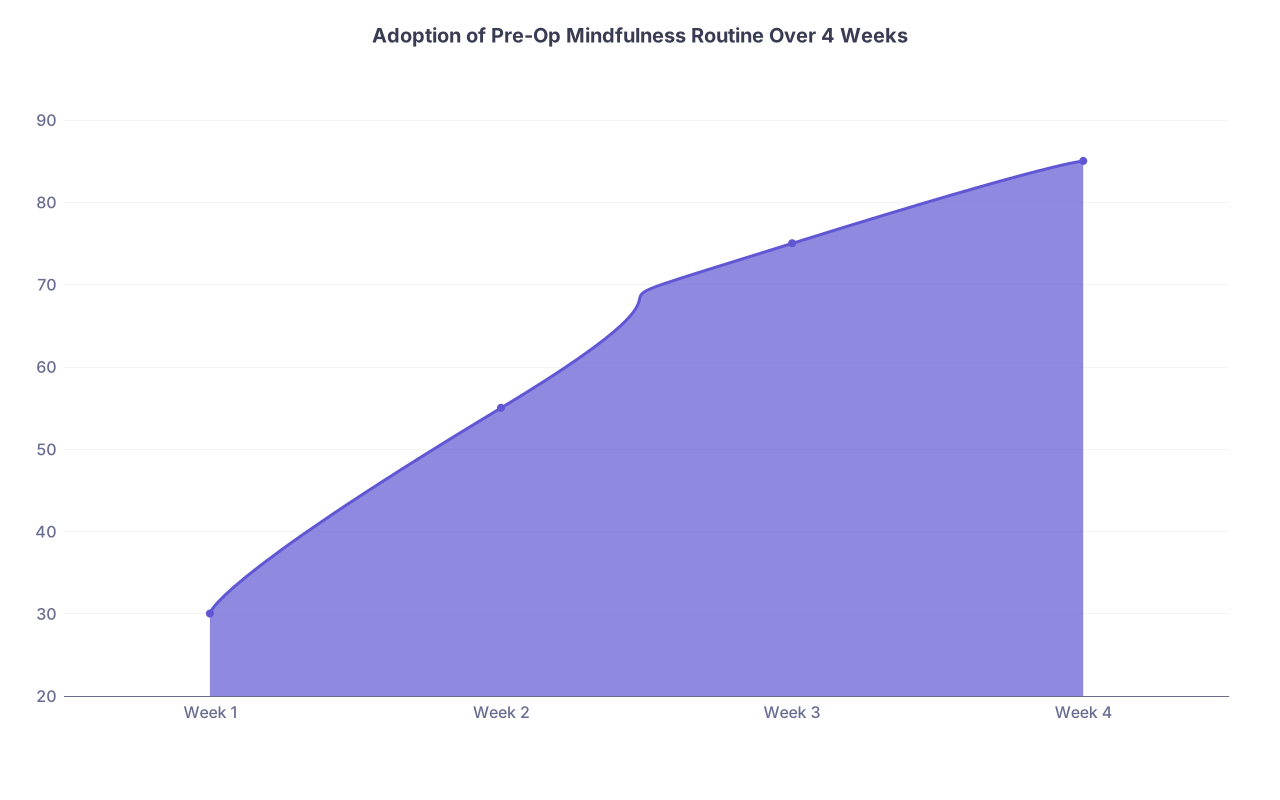
| Category | Value |
|---|---|
| Week 1 | 30 |
| Week 2 | 55 |
| Week 3 | 75 |
| Week 4 | 85 |
3. Add a 60‑second post‑case debrief (optional but powerful)
Right after the case, while walking out or washing hands, ask yourself three questions:
- “What did I do well?”
- “What will I do differently next time?”
- “Did the routine help? How?”
You do not need to write it down. Just answer honestly. This connects the mindfulness routine to performance outcomes in your brain.
4. Share it with one colleague
Yes, out loud. Something as simple as:
- “I started doing a 2‑minute breathing and rehearsal thing before cases. Surprisingly helpful.”
Two things happen:
- You make it more real for yourself.
- You open the door for mutual support. I have seen entire call teams start doing a 30‑second collective breath before big cases. Morale and communication went up. Nobody complained.
Common Mistakes That Make Mindfulness Useless
Let me save you from the usual traps.
Turning it into a long ritual.
If it takes 20 minutes, you will not do it consistently. Keep the core under 5.Waiting until you are panicked.
This is pre‑op, not during a code. Build the habit when stakes are lower so it is available under pressure.Using it as a self‑judgment session.
The goal is not to evaluate your worth. It is to optimize your state. If your inner monologue starts with “I should be better than this,” you are sabotaging yourself.Treating it as “extra” instead of part of prep.
You would not skip verifying the patient’s identity. Treat checking your own mental state the same way: a safety step.Forgetting the ethical piece.
If all you care about is your performance metrics, your anxiety will keep spiking. Anchor to the patient and the team. That is what your professional identity is built on.
Putting It All Together: Your Minimal Working Template
Here is the stripped‑down version you can print or write on an index card.
Pre‑Op Mindfulness (2–3 minutes)
Body + Breath (30–60s)
- Stand / sit, straighten spine, drop shoulders.
- 3–4 cycles: inhale 4, hold 4, exhale 6–8.
Label + Reframe (30s)
- “I feel anxious. This is activation.”
- “This energy can help me focus.”
3‑Point Focus (45–60s)
- Release 5–10% tension in jaw, shoulders, hands.
- One fully attended breath.
- Notice 3 sounds, 3 visual details in the room.
Two‑Pass Rehearsal (60–90s)
- Ideal path: key steps, smooth execution.
- One realistic complication + specific bailout.
Ethical Commitment (10s)
- One line: “Patient safety over my ego,” or similar.
Then you step into the room and start your usual procedural checklist.