
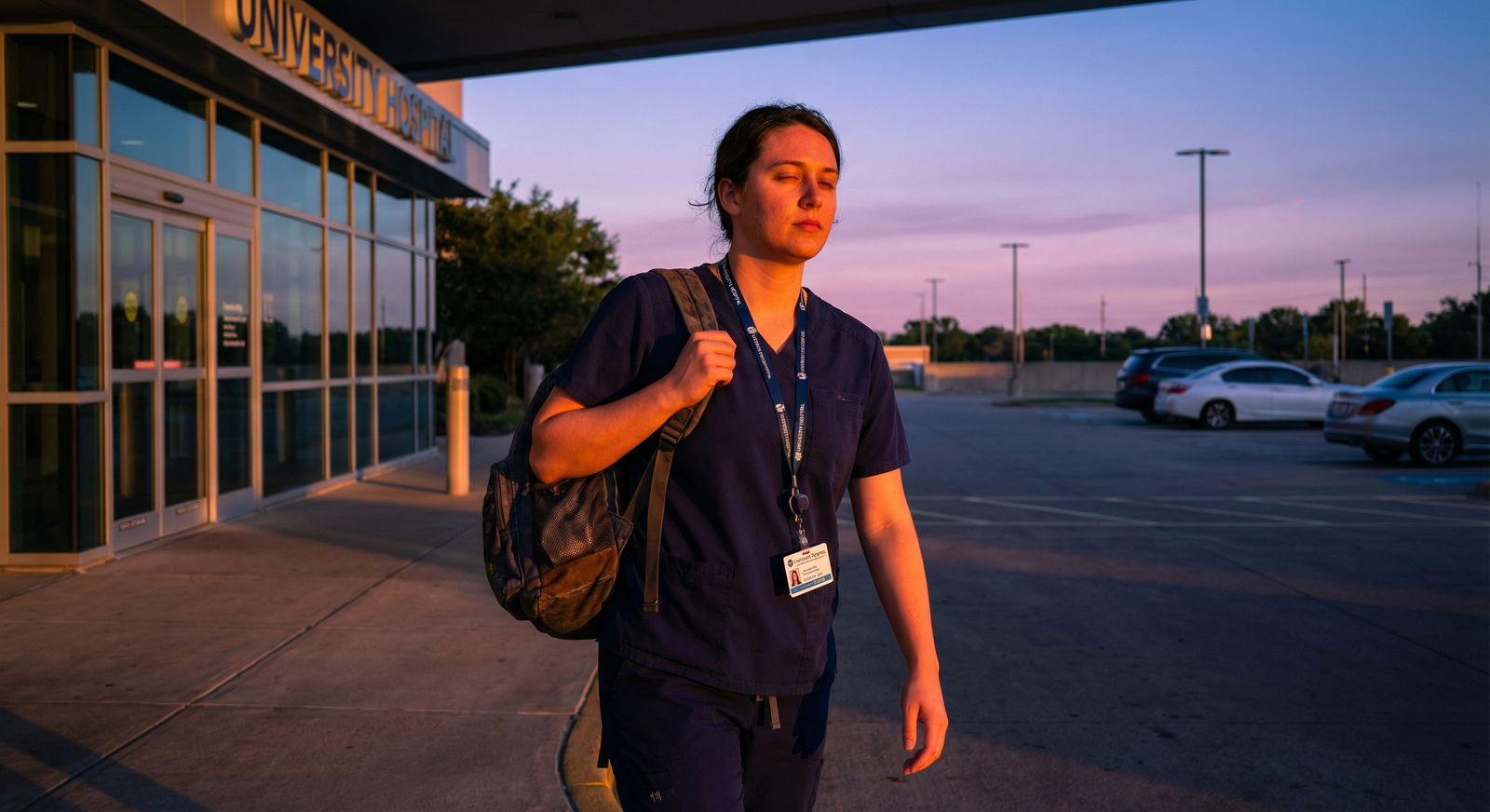
It is 5:45 a.m. You have been awake for twenty-three hours. Three hours ago, at 3:00 a.m., you were leaning against a nurses' station, praying for the clock to move. Your eyes burned. Your legs ached. You would have traded a kidney for ten minutes of horizontal silence.
But something strange just happened. The sun started to peek through the blinds of the ICU, and suddenly, you feel... fine. Not just fine. Alert. Sharp. You are cracking jokes with the phlebotomist. You are double-checking lab values with a speed you did not possess at midnight.
This is the 6 a.m. Second Wind. And it is a liar.
This article is for the residents, fellows, and attending physicians who mistake this biologic sleight-of-hand for recovery. It is not recovery. It is a neuroendocrine trap. And if you do not plan for it, it will get you into a car accident on the drive home or ruin your sleep for the next three days.
Here is the specific physiology and the exact protocol to fix your post-night shift transition.
Direct Start: Why the 6 a.m. Second Wind Happens After Nights
The most dangerous misconception in residency is believing that feeling awake at 7:00 a.m. means you are rested. It does not. It means your body has initiated a survival protocol designed to keep a tired mammal moving until it finds a safe place to sleep.
I have seen residents use this burst of energy to run errands, go to the gym, or, worse, decide they do not need sleep until noon. By 11:00 a.m., they are wrecked. By the next night, they are running on fumes.
Here is what is happening under the hood.
Your circadian rhythm does not care that you worked all night. The suprachiasmatic nucleus, your brain's master clock, is synced to light and the rotation of the planet. As dawn approaches, the clock sends wakefulness signals to override the homeostatic sleep drive that has been building since yesterday morning. This is called the circadian alerting signal, and it peaks in the early morning hours. It is the same mechanism that gets a day-walker out of bed. For you, it arrives at the worst possible time: the end of a shift.
Right around this time, your body releases the cortisol awakening response (CAR). Normally, this surge of cortisol occurs right before you wake up to help you wake up. But if you have not slept, the spike still fires, hitting a sleep-deprived nervous system. Add in a little adrenaline from the stress of sign-out and the psychosocial relief of "I'm almost done," and you have a potent pharmacologic cocktail.
Your body temperature also begins rising in the early morning. This increases metabolic rate and arousal. You warm up. You speed up.
So the 6 a.m. surge is not a sign of resilience. It is a combination of circadian timing, a stress-hormone dump, and the psychological relief of finishing. It masks profound sleep debt. You are not "recovered." You are an exhausted driver with coffee jitters.
What's Actually Driving the Surge: The Body's Hidden Morning Reset
Let's break down the four main drivers. Understanding these mechanics helps you predict the crash before it hits.
1. The Circadian Wake Drive
The sleep/wake system is a two-process model: Process S (sleep pressure) and Process C (circadian alerting). By 5:00 a.m., Process S is screaming at you to sleep. But Process C, having bottomed out around 3:00-4:00 a.m. begins ramping up hard. This is why the 3:00 a.m. to 4:00 a.m. block feels like death. That is the crossover point where circadian alerting is lowest and sleep pressure is highest. By 6:00 a.m., Process C is winning. You feel better.
2. The Cortisol Awakening Response (CAR)
CAR is a pre-programmed spike in cortisol that happens roughly 30-45 minutes after waking. But in a sleep-deprived person, the HPA axis can become dysregulated. For many night workers, the cortisol spike fires regardless of whether they are asleep or awake. The result is a jolt of glucose and alertness that feels like a second espresso. It is not free energy. It is borrowed energy, and the debt comes due later.
3. Stress Hormones and Task Momentum
The last hour of a shift is active. You are wrapping up notes, making the final rounds, updating the sign-out list. The anticipation of leaving triggers a sympathetic nervous system response. Norepinephrine rises. Dopamine spikes as you visualize the exit. The brain loves finishing tasks. Completion triggers reward pathways that can temporarily mask fatigue. This is the "I can finally stop" effect. The relief is real, but the physiologic reserves are not.
4. Environmental Amplifiers
Hospital lighting is brutal. Bright light suppresses melatonin and stimulates the alerting pathways. If you slammed a coffee at 4:00 a.m. to survive the pre-dawn trough, the caffeine peak might be hitting right at 6:00 a.m. Add in mild dehydration and a missed meal, and your body is in a metabolic state that can feel like alertness but is actually compensatory stress.
The takeaway is this: the surge is an illusion of function. It is a reflex, not a resource. Treat it as such.
How Sleep Docs Would Fix It: A Step-by-Step Pre-, During-, and Post-Shift Protocol
You do not need a sleep study to fix this. You need a plan. Here is the exact pre-, during-, and post-shift protocol I would give to a resident who tells me they get a second wind at 6:00 a.m. and then cannot sleep until noon.
Pre-Shift (Before You Even Get to the Hospital)
Strategic Nap (1:00 p.m., 3:00 p.m.) If you are working a 7:00 p.m. to 7:00 a.m. shift, take a nap before your shift. Do not nap too late in the afternoon. A 90-minute nap ending by 4:00 p.m. gives you one full sleep cycle without making you groggy at the start of the shift.
Caffeine Cutoff Plan Do not mainline coffee all night. Set a hard rule: no caffeine after 4:00 a.m. The half-life of caffeine is 5-6 hours. If you drink a cup at 5:00 a.m., half of it is still active at 10:00 a.m. That is why you cannot sleep when you get home. Front-load your caffeine early in the shift, say, 10:00 p.m. to 2:00 a.m. and stop.
Hydration and Meal Timing Eat a meal before the shift. Do not rely on vending machine carbohydrates. A protein-heavy meal at 6:00 p.m. stabilizes blood sugar for the first six hours. Stay hydrated throughout the night, but taper fluids after 5:00 a.m. so you are not waking up to urinate at noon.
During-Shift (Managing the Trough)
Light Strategy at 3:00 a.m. When the 3:00 a.m. wall hits, do not retreat to a dark call room and close your eyes. That only worsens the next trough. Use bright light for 20-30 minutes. Stand near an illuminated computer screen or in a bright hallway. Light exposure at the circadian nadir actually pushes the circadian phase later, which helps you feel better later in the shift.
Micro-Breaks Take a five-minute break every two hours. Walk stairs. Do not scroll on your phone in a dark room. Movement increases core temperature and counteracts the sleep drive. A five-minute stair climb at 4:00 a.m. is more effective than another cup of coffee.
Fluid and Protein Paring If you must take caffeine, pair it with water and a protein snack. Think a string cheese stick or a handful of almonds. The combination slows the caffeine absorption and prevents the post-caffeine crash. Avoid sugar. Sugar gives a 20-minute lift followed by a worse drop.
Post-Shift (The Most Important Hour)
Dark Glasses on the Way Out Put on sunglasses before you leave the hospital. Yes, even on a cloudy day. Morning light is the primary signal that locks in wakefulness. Block it. Blue-light blocking glasses are even better. I have had residents tell me the glasses alone made the difference between sleeping five hours and sleeping eight.
Do Not Run Errands You will feel tempted to stop at the pharmacy or the grocery store because you have "so much energy now." This is the trap. The second wind will crash in 30-60 minutes. Go home. Do not spend the energy. Bank the sleep.
Protect the Sleep Window Your sleep window is until noon or 1:00 p.m. Put your phone on Do Not Disturb. Use blackout curtains. Use a white noise machine. The goal is to preserve a block of sleep that is as long as possible. Do not accept fragmenting because you wanted to check email or answer a text from a co-resident.
Recovery Nap If you wake up at 1:00 p.m. and still feel destroyed, take a 90-minute recovery nap before 5:00 p.m. Do not nap after 5:00 p.m. That will wreck your next night's sleep.
These steps are not complicated. They just require intention. The residents who suffer the most are the ones who "wing it" and let the schedule happen to them.
When the Second Wind Becomes a Problem: Safety Risks, Misreads, and Red Flags
The most common mistake I see is a resident using the 6:00 a.m. boost to prove they are tough enough to drive home, run a quick errand, or finish a chart at home. This is dangerous. The alertness is unstable. It can evaporate without warning, especially on a long commute or on a monotonous stretch of highway.
Here is what an unstable second wind looks like:
- Microsleeps: You are driving and realize you do not remember the last mile.
- Irritability: Everything annoys you, from the stoplight to the sound of the radio.
- Slowed reaction time: You miss your exit. You brake too late. You stare at a message without processing it.
- Poor memory: You cannot remember whether you signed out the potassium level or if it was yesterday's.
- Emotional flattening: You feel nothing. You are not happy to be off; you are not angry. You are just blank. This dissociation is a hallmark of severe sleep deprivation.
Do not mistake the absence of yawning for the presence of safety.
For attending physicians: do not ask a post-call resident to "just quickly do this one thing" at 7:00 a.m. because they "look awake." That is the time to send them home. The look is a lie.
Red flags that warrant more aggressive intervention:
- Repeated near-miss driving: If you have driven off the shoulder more than once after a shift, you need a ride share account and a hard rule: no driving after nights.
- Persistent insomnia after nights: If you cannot fall asleep by 1:00 p.m. even with the glasses and the dark room, you may have a circadian rhythm disorder. Get evaluated.
- Palpitations or chest discomfort: Excessive caffeine plus stress hormones can cause arrythmias. If you feel fluttering at 6:00 a.m., audit your caffeine intake. It is not a normal consequence of call.
- Chronic headaches or cognitive decline: If you cannot read a CT scan or calculate a dose on post-call days without significant effort, your sleep debt is exceeding neurocognitive reserve.
The point is not to fear the second wind. The point is to respect it as a warning sign. It is the body's last-ditch heroics. You do not want to be in the car when the hero passes out.
Fix It for Real: Personal Rules That Make the Dawn Shift Safer and Less Deceptive
Clinical medicine runs on decision rules. You have a rule for chest pain. You have a rule for sepsis. You need a rule for the 6:00 a.m. second wind.
Rule 1: Never Trust the Boost. The surge is a reflex. It does not reflect your true sleep debt or your driving ability. Plan your post-shift behavior before the shift starts. Decide that you are taking an Uber home before you clock in. Do not decide at 6:00 a.m. when your judgment is altered.
Rule 2: Pre-Plan the Commute. If you live more than 20 minutes from the hospital, you need a backup plan. Keep a list of ride share apps on your phone's home screen. Some residents pool together and have a designated driver rotation. The cost of a ride is cheaper than a fender bender or a medical error.
Rule 3: Set a Caffeine Budget. Maximum 200 mg per shift, all consumed before 4:00 a.m. If you need a late boost, use movement, cold air, or a five-minute series of stretches. Do not let caffeine become a substitute for a sleep plan.
Rule 4: Protect the Core Block. Your body needs a core sleep block of at least 4-5 hours after a night shift. If you cannot get that because of family obligations or rotation demands, accept that you are functionally impaired and modify your expectations. Do not operate on the assumption that a 20-minute nap fixes 24 hours of wakefulness.
Rule 5: Reset on Off-Days. When you finish a stretch of nights, get bright outdoor light exposure in the morning on your first day off. It will help reset your circadian rhythm to a daytime schedule. Eat at normal meal times. Avoid sleeping all day unless you have another night shift coming up. The goal is to return to a daytime rhythm as quickly as possible.
The above chart is not a suggestion. It is a rule set. When the numbers tell you the sleep pressure is 5 out of 5 and the caffeine is 0, you do not negotiate. You go home.
The 6:00 a.m. second wind is one of the most misunderstood phenomena in residency. It feels like a reward for surviving the night. It is actually a final test of your judgment. The clinicians who thrive long-term are not the ones who push through the surge; they are the ones who anticipate it, mistrust it, and protect their recovery regardless of how good they think they feel.
You did not beat the night. You endured it. Now go sleep in a dark room and let your body settle the score.


