
The default plan of “I’ll just knock myself out with something after nights” is a trap.
If you’re a resident coming off night shifts, you might benefit from strategic, short-term sleep aids—but a lot of what people actually do is unsafe, counterproductive, or career-threatening.
Let me walk you through this like I would a tired PGY‑1 on post‑night call.
The Core Answer: Should You Use Sleep Aids After Night Shift?
Here’s the blunt version:
- Occasional, carefully chosen sleep aids after nights can be reasonable.
- Chronic, “I can’t sleep without something” use is a red flag.
- Some common choices (benzos, leftover opioids, mixing alcohol and meds) are simply bad medicine and dangerous for residents.
If you’re looking for a rule of thumb, use this:
- If you’re on a short block of nights (2–4 in a row) and otherwise sleep well: try non-drug strategies first; consider very short-acting, low-dose options only if those fail.
- If you’re on long stretches (5–7+ nights) and feel your sleep/wake cycle melting down: talk to your own doctor or occupational health. Don’t freelance a pharmacy in your night float room.
First Line: Fix What You Can Before You Medicate
If your “daytime sleep” after nights is garbage, that’s expected. But there’s a difference between “this is hard” and “this is impossible without drugs.”
Before you reach for pills, make sure you’ve at least tightened up the basics.
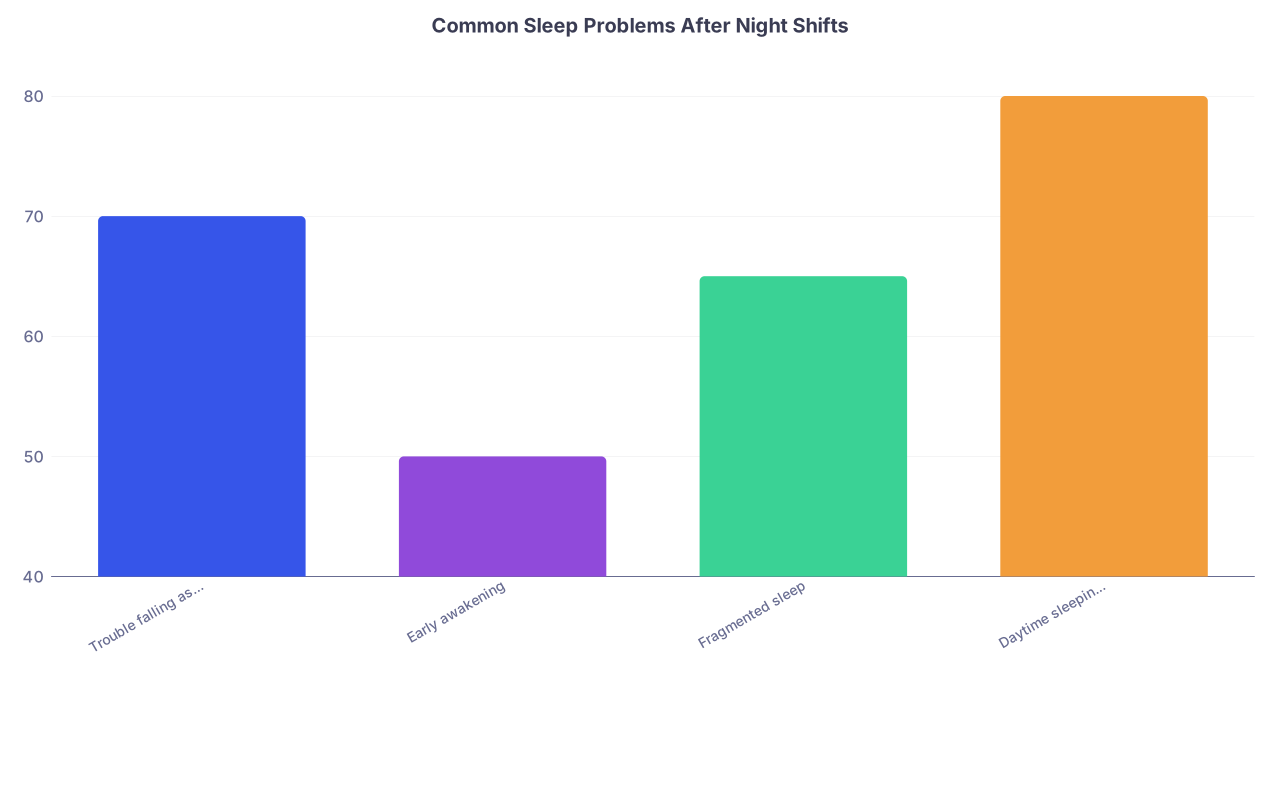
| Category | Value |
|---|---|
| Trouble falling asleep | 70 |
| Early awakening | 50 |
| Fragmented sleep | 65 |
| Daytime sleepiness | 80 |
Prioritize three things:
Light control
- Blackout curtains or a serious eye mask. Not “kinda dark”—pitch black.
- Sunglasses on the way home (yes, even at 7 a.m.). You’re trying to avoid a blast of morning light that screams “wake up” to your brain.
- No blue-light screens once you’re home scrolling in bed. That’s sabotaging yourself.
Noise and environment
- White noise machine or app. Thin apartment walls plus daytime chaos will wake you repeatedly.
- Phone on Do Not Disturb with exceptions only for true emergencies.
- Cool room temperature. 65–68°F is usually better than warm.
Routine and timing
- Eat a light snack at the end of your shift; don’t crush a full greasy meal on the way home.
- Go straight home and straight to bed. No “just one episode” or “I’ll catch up on email.”
- Cut caffeine 4–6 hours before the end of your shift when possible.
If you’ve actually tried this for a few nights and you’re still lying there wired for hours, then we talk about pharmacologic help.
The Main Sleep Aid Categories: Pros, Cons, Red Flags
Here’s the part you really need: what’s relatively reasonable, what’s risky, and what’s a hard no for a resident post‑night shift.
| Option Type | Reasonable for Residents? | Big Concerns |
|---|---|---|
| Melatonin | Often yes, short-term | Wrong timing, grogginess |
| Z-drugs (zolpidem) | Maybe, with caution | Falls, amnesia, dependence |
| Benzos | Generally no | Dependence, cognitive issues |
| Antihistamines | Occasionally, PRN | Hangover, anticholinergic |
| Trazodone | Maybe, under supervision | Hypotension, priapism |
| Alcohol | No | Fragmented sleep, impairment |
1. Melatonin
Verdict: Often reasonable, but people use it badly.
Pros:
- Not a sedative in the classic sense; it’s a timing signal, not a sledgehammer.
- Generally safe at low doses (0.5–3 mg for most people).
- Useful for shifting circadian rhythm slightly.
Cons:
- Most people overdose themselves with giant 5–10 mg gummies that increase side effects without reliably improving sleep.
- If you take it at the wrong time, you’ll just feel groggy and off.
For post‑night shifts:
- If you’re coming off a single night or short run and then going back to days, I’d skip melatonin or use it only when flipping back to nights or back to days, not every post‑shift.
- If you’re on a multi-day night block, some folks use low-dose melatonin right after their shift to help solidify “daytime sleep.” It can help, but don’t expect miracles.
Red flag: You’re popping 10 mg every day and still sleeping terribly. That’s not a dosage problem; that’s a strategy problem.
2. “Z‑drugs” (e.g., zolpidem/Ambien, zaleplon, eszopiclone)
Verdict: Conditional “maybe,” but this is prescription territory only with a clear plan.
Pros:
- Effective at getting you to fall asleep quickly.
- Zaleplon (Sonata) and low-dose zolpidem have relatively short half-lives, which can be useful when you need to be functional that evening.
Cons:
- Cognitive impairment, falls, weird sleep behaviors (eating, texting, driving—while not fully awake).
- Tolerance and dependence if used frequently.
- Not great if you need to wake up unexpectedly (sick kid at home, backup call, etc.).
For residents:
- If your own physician prescribes a short-acting agent for limited, time-bound use (like during a brutal ICU night float month), that can be rational.
- Use the lowest effective dose and never mix with alcohol or other sedatives.
- Avoid if you have a history of substance use issues.
Red flags:
- You’re using this after every night for weeks.
- You feel mentally slow or off on your “off” days.
- You don’t remember getting up to answer messages or eat.
3. Benzodiazepines (e.g., lorazepam, clonazepam, diazepam)
Verdict: Generally a bad idea for shift-related sleep.
Pros:
- They’ll knock you out. No question.
Cons:
- High risk of dependence, tolerance, and withdrawal.
- Daytime cognitive impairment—exactly what you do not want as someone writing orders and doing procedures.
- Long half-life for many of them, causing hangover sedation.
For residents:
- Using benzos specifically as a “sleep aid” after nights is a no from me.
- If you’re already on a benzo prescribed for another condition, that’s a different conversation with your own prescriber—but you still should not be self-escalating doses for shift work.
Red flag: You’re “borrowing” someone else’s Ativan or using old prescriptions “just to get a little sleep” after nights.
4. Antihistamines (diphenhydramine, doxylamine)
Verdict: Occasional backup option, not a daily crutch.
Pros:
- Over the counter, familiar, and yes, they’ll often make you sleepy.
- Short-term use (a few days) can help some people fall asleep more easily.
Cons:
- Hangover feeling, grogginess, and reduced reaction time.
- Anticholinergic effects—urinary retention, dry mouth, constipation, cognitive fog.
- Tolerance builds quickly; people start taking higher and higher doses.
For post‑night shifts:
- Using diphenhydramine or doxylamine once in a while, at the lowest effective dose, can be acceptable if other measures fail.
- Not something to use every shift on a 14‑night block.
Red flag: You wake up feeling like you got hit by a truck every “morning,” and you’re still taking it because “it’s all I’ve got.”
5. Trazodone and similar agents
Verdict: Possible option under medical supervision, not DIY.
Pros:
- Commonly used off-label for insomnia.
- Not controlled like benzos/Z‑drugs.
Cons:
- Can cause orthostatic hypotension, next-day grogginess, rare but serious side effects.
- Still a prescription antidepressant—should not be pulled from a roommate’s bottle.
For residents:
- If a physician who knows your history prescribes trazodone specifically for chronic insomnia that predates residency, you might use it strategically around nights.
- Don’t decide on your own that using it “just for sleep” is no big deal.
6. Alcohol
Verdict: No.
I see this pattern way too often: “I just have a beer or two when I get home so I can knock out.”
Reality:
- Alcohol might shorten sleep latency, but it wrecks sleep architecture—more awakenings, lighter sleep, worse rest.
- Combining alcohol with any sleep medication is dangerous and foolish, especially if you’re responsible for patient care within 8–12 hours.
For residents:
- Using alcohol as a post‑night sleep tool is a red flag for both sleep and substance use risk.
- If you need alcohol to fall asleep after shifts, that’s not “taking the edge off.” That’s a problem.
When a Sleep Aid Actually Makes Sense After Nights
So when is using a sleep aid not just acceptable, but rational?
Generally:
- You’re on a short, intense night block (ICU, ED, night float).
- You’ve already optimized environment, light, and caffeine.
- You’re still lying awake for 1–2 hours most “days” despite fatigue.
- You have a time-limited prescription plan from a physician (maybe occupational health or your PCP).
Example that makes sense:
- PGY‑2 on a 2‑week night float with 7‑on/7‑off. Already tried blackout curtains, eye mask, strict routine. Still sleeping 3–4 hours fragmented.
- Their own doctor prescribes a very low-dose, short-acting sleep aid with explicit instructions: use only on nights 1–4, not on flip-back days, reassess after the block.
Example that doesn’t:
- PGY‑1 doing sporadic single-night calls, “can’t turn off their brain,” so starts taking a neighbor’s zolpidem “just to be safe” every time they have call.
- No sleep hygiene, lots of late-night caffeine, no planning around circadian shifts.
Major Red Flags You Should Not Ignore
There are some signs that your sleep issues during residency have moved from “normal hard” to “this needs real medical attention.”
Watch for:
- You can’t sleep at all after nights even when you’re exhausted, more than a few times a month.
- You’re using something (any drug or alcohol) after nearly every night to sleep.
- Your daytime functioning is noticeably impaired: you’re making more errors, missing obvious things on rounds, or coworkers are commenting you seem “out of it.”
- You’re mixing substances: alcohol plus sleep meds, or using benzos plus antihistamines.
- You’ve escalated dosing (more pills, stronger meds) just to get the same effect.
- You feel anxious, depressed, or hopeless about sleep, not just annoyed or tired.
Those aren’t “toughing it out” signs. Those are get-help-now signs.
Where to go:
- Your own PCP or a provider outside your training program if you’re concerned about confidentiality.
- Occupational health (some programs are actually good at this).
- Resident wellness or mental health services—especially if mood symptoms are alongside sleep issues.
Safer, Smarter Strategies For Rotating On and Off Nights
The best approach is often a hybrid: behavioral plus very selective pharmacologic help.
For starting a night block:
- Gradually push your bedtime later by 1–2 hours over 2–3 days if your schedule allows.
- Use evening bright light (or lightbox if you’re a planner) and morning sunglasses.
For during the block:
- Lock in a consistent sleep window (e.g., 8 a.m.–2 p.m. minimum) and protect it.
- Anchoring naps before shifts (60–90 minutes in late afternoon) can be more powerful than chasing more time with drugs.
For flipping back to days:
- Last night of block: try to sleep only a few hours when you get home, then get up and push yourself to stay awake until a more normal bedtime.
- Low-dose melatonin in the early evening for a few nights can help, but avoid loading yourself with sedatives during the day when you need to reset.

| Step | Description |
|---|---|
| Step 1 | On night shift |
| Step 2 | Optimize environment |
| Step 3 | No meds needed |
| Step 4 | Talk to provider |
| Step 5 | Time limited prescription |
| Step 6 | Use lowest effective dose |
| Step 7 | Monitor for red flags |
| Step 8 | Stop and seek help |
| Step 9 | Reassess each block |
| Step 10 | Still cant sleep? |
| Step 11 | Dependence or impairment? |
FAQ: Sleep Aids After Night Shift
1. Is it safe to use melatonin after every night shift?
Usually yes at low doses, but it’s not ideal to turn it into a daily crutch. If you need melatonin after every single night shift to function, your schedule, light exposure, and sleep routine probably need more work. Also, if you’re taking 5–10 mg routinely and feel groggy, your dose is likely too high or mistimed.
2. How long before sleep should I take a sleep aid after nights?
For most short-acting sleep meds (melatonin, Z‑drugs, antihistamines), they’re taken right before you plan to sleep or about 30 minutes before. The bigger point: once you take it, get in bed and commit. Don’t take a pill then hang out on your phone or eat a full meal.
3. Is it better to nap a bit at the end of a night shift or push straight to a long sleep at home?
For most residents, going straight home and into a consolidated sleep block works better than a long nap at the hospital that then disrupts your main sleep. A very short nap (20–30 minutes) near the end of a night may help you get home safely, but don’t turn that into a 2‑hour sleep that then pushes your main rest later.
4. Can I safely drive home after using a sleep aid?
If you’ve already taken a sleep aid, you should not be driving. Ever. Take your meds only when you’re home and done with anything requiring alertness—driving, writing notes, calling families, etc. If you’re so tired you’re dozing off driving home, address that separately with a nap at the hospital or ride options, not pills.
5. How many nights in a row is “too many” to use a prescription sleep aid?
Once you’re using a prescription aid more nights than not in a month, you’re drifting into risky territory. For night shifts, most reasonable plans use them for a defined, short block (e.g., first 3–5 nights of a particularly rough rotation) with a clear stop date. Beyond that, talk with your prescribing clinician about long-term strategy.
6. How do I talk to my doctor about needing sleep help without sounding like I want drugs?
Be direct and specific. Describe: how long it takes you to fall asleep after nights, how many hours you actually sleep, how often this happens, what you’ve already tried (curtains, caffeine timing, etc.), and how it’s affecting your work and mood. Say explicitly: “I’m not looking for long-term meds, but I’m wondering if there’s a short-term option for particularly bad stretches while I keep working on habits.” That framing usually signals you’re trying to be responsible.
Key takeaways:
- Use sleep aids after night shifts sparingly, deliberately, and preferably under a doctor’s guidance—not as your default solution.
- Fix your environment, light exposure, and routine first; if you’re still desperate, that’s when targeted, short-acting tools can have a role.
- Any pattern of “I can’t sleep without something” or mixing substances is a red flag—address it early, before it derails your health or your training.