
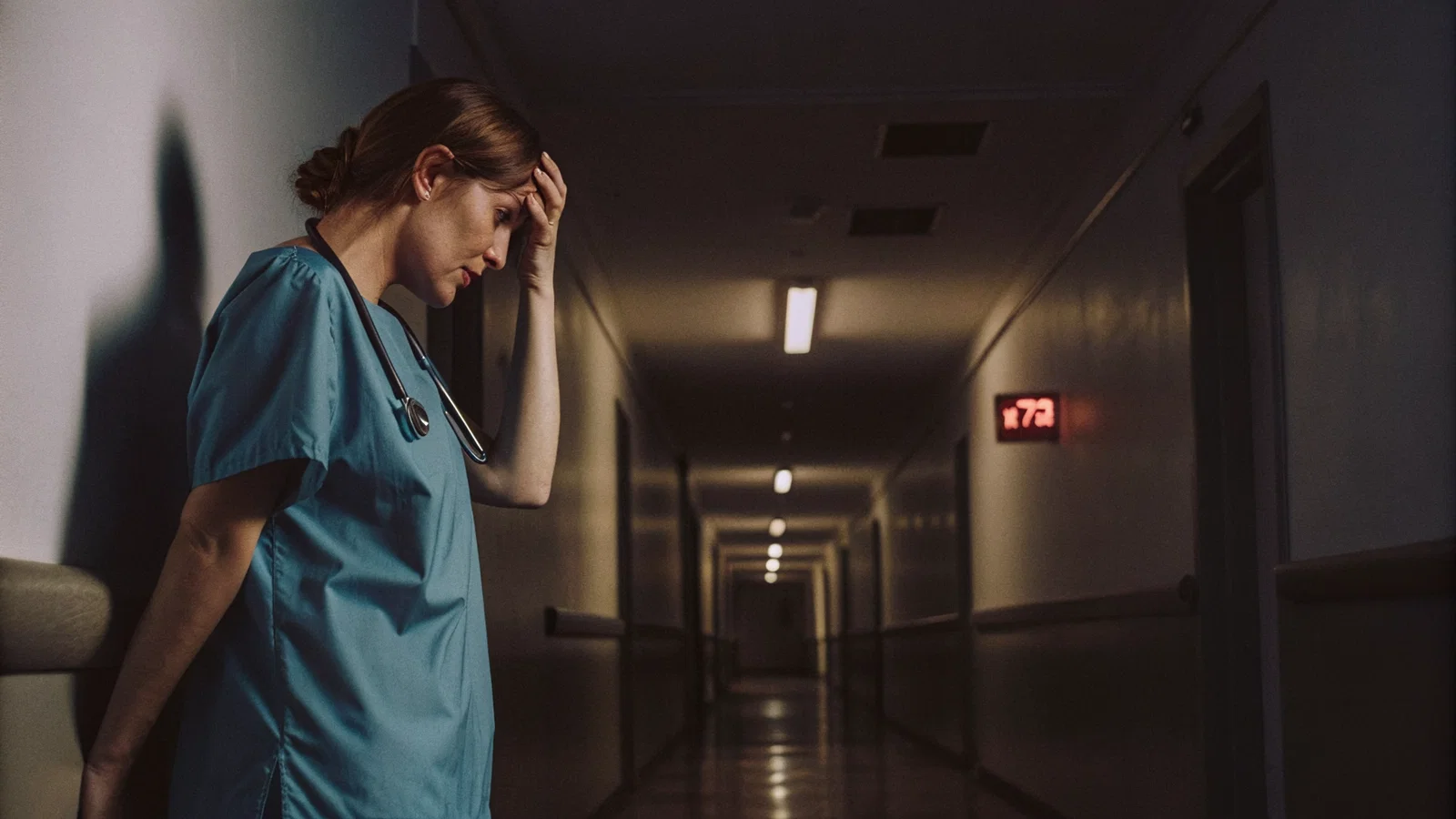
What if my inability to function at 3:15 AM is secretly signaling to every program director in the country that I am completely unfit for medicine?
I sit at the workstation, staring at an abnormal potassium level on an ICU chart, and my brain just stumbles. It feels like trying to run through wet cement. I panic. Is this the exact moment my career unravels? If I can't handle a two-week block of night float right now, how am I going to survive actual residency? What if my letters of recommendation subtly hint that I lack stamina? What if I ruin my Step 3 score because I'm literally too brain-dead to retain basic pharmacology?
These are the thoughts that keep me awake, well, that and the brutal circadian destruction of working a 7 PM to 7 AM shift.
There is a pervasive, quiet terror among applicants that choosing a program with heavy night float, or struggling through a night float sub-I, stains your profile. We convince ourselves that program directors are looking for superhuman machines who sleep three hours, crush 20 admissions, and wake up grinning. We worry that being exhausted makes us look lazy, uncommitted, or permanently burned out.
The statistical reality check is a bit different. Yes, self-reported burnout skyrockets during night float rotations. You will feel like an absolute ghost. But when researchers look at objective performance metrics, like actual error rates and clinical decision accuracy, the horror stories we tell ourselves at 3 AM don't entirely hold up. Understanding the actual data behind night float versus traditional call might just save your sanity before your next sub-internship or away rotation.
The Data on Night Float vs. Traditional 24-Hour Shifts
When I first looked at my schedule and saw a full two-week night float block, I nearly vomited. I assumed it was a guaranteed fast-track to making a fatal medical error and tanking my evaluations. But when you break down the research, the debate isn't between "getting sleep" and "not getting sleep." It's a choice between two entirely different types of physiological torture: the isolated Night Float block versus the Traditional 24-hour shift.
Let's look at how these schedules actually hit your body. Traditional 24-plus-four shifts give you a massive, acute spike in exhaustion. By hour 22, your cognitive processing speed drops off a cliff. However, once you hand off, you usually get a long, continuous recovery window. You sleep for 12 hours, eat a real meal, and reset.
Night float is different. It's a slow, insidious burn.
Studies tracking cumulative sleep debt show that night float residents rarely get uninterrupted daytime sleep. You go home at 8 AM, but your body knows it's daytime. Your cortisol surges. Sunlight hits your retina. You sleep in fragmented three-hour bursts. Over a six-day stretch, that chronic, cumulative sleep debt stacks up until you're operating at a continuous baseline of severe brain fog.
Here is my core panic point: Am I going to kill someone because my brain is misfiring?
Look at the chart above. Traditional call creates a much higher acute cognitive delay during those final hours of the shift. That's when reaction times spike to terrifying levels. Night float, on the other hand, drives subjective burnout through the roof because of circadian misalignment. You feel infinitely worse on night float, even if your acute reaction time during a specific hour isn't quite as degraded as hour 23 of a 24-hour shift.
What about error rates? That's what keeps us up. Systematic reviews comparing night float systems to traditional call show something surprising: total medical errors don't spike astronomically on night float compared to 24-hour calls. Why? Because handoffs on night float are structured differently, and you aren't hitting that hour-23 continuous wall. The system absorbs some of your fatigue. You are impaired, yes, the data doesn't lie about circadian disruption, but you aren't inherently a danger zone just because you're working at night.
Can I Recover From Night Float Without Losing My Mind?
The short answer? Yes. But it takes actual biological discipline, not just chugging a double espresso at midnight and praying for the best.
The biology of re-entrainment, the process of resetting your master circadian clock in the suprachiasmatic nucleus, is brutal. It takes approximately one day for every hour your sleep schedule shifts. Shift your sleep by eight hours? Your body needs almost a week to fully align. That is horrifying when you have a Shelf exam or Step 3 looming in ten days.
If you want to survive without spiraling into a deep depressive fog, you have to follow what the circadian science actually supports, rather than relying on residency folklore.
First, light management isn't optional. It's a tool. The moment you step out of the hospital at 7:15 AM, put on dark sunglasses. Do not let the morning sun hit your eyes, or your brain instantly halts melatonin production and triggers cortisol release. You will get home, feel wired, and lie awake in bed panicking about how you can't fall asleep.
Second, stop drinking coffee at 2 AM. I know, you think you need it to survive the 4 AM cross-cover admissions. Don't do it. Caffeine has a six-hour half-life. If you drink a cup at 2 AM, half of that drug is still circulating in your neuroreceptors at 8 AM when you're trying to sleep. Take a low-dose melatonin (0.5mg to 1mg, not those ridiculous 10mg gummies that cause vivid nightmares) 30 minutes before laying down in a pitch-black, freezing cold room.
The hardest part isn't even the physical fatigue, it's the psychological isolation.
Night float strips away your entire social safety net. Your friends are hanging out while you're putting on scrubs. Your family is eating dinner while you're signing out patients. There are no attendings strolling the floor, no lunch conferences, no chatter in the workroom. It's just you, a glowing EMR screen, and the rhythmic beeping of telemetry monitors. Resident surveys consistently link this specific isolation to spikes in acute depressive symptoms. You start to feel like the rest of the world is moving on without you.
You have to accept that you will feel fragile during these blocks. Your emotional bandwidth will be razor-thin. Recognizing that this low mood is pure physiology, and not a character flaw or a sign that you chosen the wrong career, is the only way to protect yourself.
What Do Program Directors Actually Think About Night Float?
Here is the secret truth that program directors rarely spell out on their program websites: everyone knows night float sucks. Nobody expects you to love it.
I used to worry that if I looked tired or mentioned how hard night float was, it would get back to the residency selection committee. I thought, They'll think I lack grit. But program directors aren't looking for robots who don't feel fatigue. They are looking for applicants who handle fatigue with maturity and emotional regulation instead of melting down.

Night float experience on your rotation performance evaluations does not look bad. In fact, doing well on a night float rotation is a massive badge of honor. It shows you can handle cross-cover, manage decompensating patients without a net of five attendings standing right behind you, and prioritize tasks when resources are minimal.
When you bring up your clinical experiences in interviews, stop framing nights as a tragic survival story. Frame it as a lesson in systems systems safety and personal adaptability.
Instead of saying: "Night float was brutal and I barely slept, but I pushed through."
Say this: "Working night float forced me to develop extremely tight triage systems and strict handoff habits. I learned how to monitor my own cognitive bandwidth so I could double-check critical drug dosages when fatigue set in."
See the difference? One sounds like a victim of a schedule; the other sounds like a safe, self-aware physician.
Your worth as an applicant is not tied to your ability to stay bright-eyed at 4 AM. Program leadership knows that basic clinical competence stays stable even under moderate sleep deprivation, provided you use checklist systems, lean on your nursing staff, and escalate when you are out of your depth.
You Are Going to Make It Through This
Night float is hard. The data proves it. Your biology proves it. The heavy, burning sensation behind your eyes at 3 AM isn't imaginary, and your fears about failing aren't unique to you. Every single resident you look up to has sat in that exact same dark workroom, staring at a computer screen, wondering if they made a massive mistake with their life.
You aren't breaking. You're just tired.
Trust your training. Trust your body's ability to bounce back after the block ends. Stop catastrophizing every moment of exhaustion as the end of your residency dreams. You are far more resilient than your anxious, 3 AM brain gives you credit for.
If you want real, evidence-based tools to survive your upcoming night shifts without losing your sanity, sign up for our Night Owl Survival Kit newsletter. You'll get printable shift-planning templates, exact caffeine-taper protocols, and access to peer support groups with applicants who are walking through the exact same fire right now.


