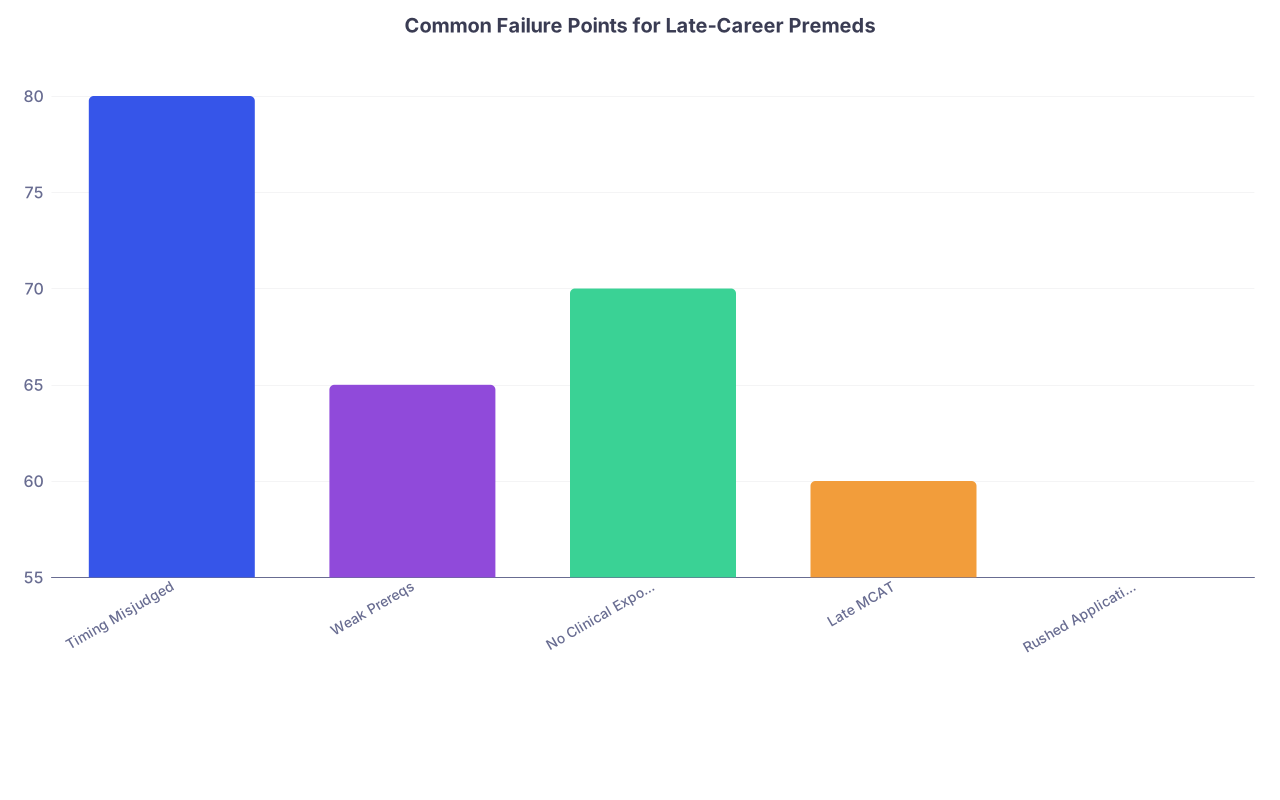
Educational disclaimer: This article is for general educational purposes only. It is not financial, legal, tax, or individualized admissions advice. Tuition, debt, employment, and application decisions have personal consequences, so consider speaking with qualified financial professionals, prehealth advisors, or admissions mentors before committing to a graduate program.
Opening: The uncomfortable truth about the “graduate degree advantage”
Here’s the myth: older MD/DO applicants think a graduate degree automatically makes them look mature, serious, and admissions-ready.
It doesn’t. Not by itself.
I’ve seen applicants pile on credentials like they’re building a tower of legitimacy—MPH, MBA, random master’s, maybe a certificate or two—while the actual concerns in the file sit there untouched. Old science grades. A weak recent academic record. Thin clinical exposure. A mediocre MCAT. No clear reason for medicine beyond “I’ve always wanted to help people.” That’s not strategy. That’s expensive avoidance.
Here’s what the data and the admissions logic actually show: committees care far more about proof than prestige. They want evidence that you can handle medical school now. Not five years ago. Not in a vaguely related graduate seminar. Now.
That means recent academic performance, a strong MCAT if required, solid clinical experience, service, professionalism, and a coherent story matter more than credential stacking. A graduate degree can help. Absolutely. But only when it changes the admissions math in a meaningful way.
So the real question isn’t “Will a graduate degree make me look better?”
It’s this: will it solve the specific problem keeping you out of medical school—or is it just a costly detour dressed up as ambition?
What admissions committees actually value in non-traditional applicants
Let’s kill another bad assumption: age is usually not the problem.
Medical schools are not sitting around saying, “This applicant is 36, how suspicious.” What they care about is whether your file proves you can survive and perform in a brutal academic environment after time away, career changes, family responsibilities, and all the rest.
That’s the standard. Evidence of current capability.
What tends to matter more than “Has a graduate degree”:
- Recent GPA trend: If your undergrad was rough but your last 30–60 credits are excellent, that matters.
- Prerequisite recency: Old science prerequisites can become a real issue, especially if they’re 10–15 years old and unsupported by newer coursework.
- MCAT performance: Like it or not, it’s still one of the clearest common metrics of readiness.
- Clinical exposure: You need real contact with patients or care settings. Not abstract interest.
- Shadowing: Schools want evidence you understand what physicians actually do.
- Service: Especially sustained service. Mission fit isn’t fluff; schools take it seriously.
- Leadership and professionalism: Work history can help older applicants here—if framed well.
- Narrative coherence: Why medicine, why now, and why your path makes sense.
And no, a graduate degree does not magically “fix” weak numbers if the underlying pattern hasn’t changed. If your undergrad science GPA is poor and then you earn an MPH heavy on policy and qualitative coursework, admissions committees are not going to pretend that equals strong medical science readiness. They know the difference.
They also interpret graduate work differently depending on the degree:
- Formal post-bacc: Often very useful for prerequisite repair and recent science proof.
- SMP (Special Master’s Program): High-risk, high-reward, often the clearest academic rebuild tool if done well.
- MPH: Great for public health interest and mission fit; weak as academic repair unless it includes rigorous hard science and top performance.
- MBA: Valuable for leadership or systems thinking, but mostly irrelevant for proving med school readiness.
- PhD: Strong for research identity, intellectual depth, and academic medicine paths—but not a free pass for weak core metrics.
- Research MS: Can help, especially with rigorous science coursework, but depends heavily on transcript details.
That distinction matters. A lot.
When a graduate degree helps: the cases where the data and logic align
A graduate degree helps when it creates new, credible evidence.
That’s the whole game.
If you’re an older applicant with a stale or shaky academic record, a strategically chosen graduate pathway can absolutely improve your odds. But not because committees are dazzled by extra letters after your name. They aren’t. It helps when the program answers a real concern in your application.
The best cases are straightforward:
1. You need to rebuild an old academic record
Maybe your undergrad performance was weak because you were 19, unfocused, working full time, caring for family, or just immature. Fine. That happens. But your explanation is not the fix. Your new grades are the fix.
If your deficiency is academic, schools want to see recent, high-level performance in demanding science coursework. A formal post-bacc or a strong SMP usually does this better than a generic graduate degree.
2. You’ve had a long gap from academics
This is common with career changers. You may be excellent professionally and still look academically rusty on paper. If your last hard science class was during the Obama administration, a committee may reasonably wonder whether you can jump into biochemistry and pathology tomorrow.
Recent coursework solves that concern better than vague confidence.
3. You need to prove science readiness specifically
This is where people waste time with the wrong degree. If your problem is “Can this applicant handle medical school academics?” then the most persuasive evidence is recent success in science courses that look like medical school preparation. Not an MBA capstone. Not a public health practicum. Not a thesis on healthcare management.
This is why SMPs and rigorous post-baccs can be so powerful. They are often designed to approximate or closely parallel medical school difficulty. If you perform well there, committees have something concrete to trust.
A few blunt truths:
- Prestige is not strategy.
- Relevance beats impressiveness.
- A difficult A in recent science work is worth more than an unrelated graduate credential.
Now, research-heavy graduate work does have a role. A PhD or research MS can be genuinely useful if you’re applying with a strong academic medicine or physician-scientist narrative, especially at research-focused MD programs. It can also produce excellent letters, publications, and a clear institutional fit.
But for basic admissions repair? It’s often the wrong tool. Smart. Impressive. Still the wrong tool.
When a graduate degree does not help: the expensive myth of credential stacking
Here’s the ugly part: a lot of graduate degrees are admissions wallpaper.
They fill space. They suggest industriousness. They make Thanksgiving conversations easier. But they do not change the core evaluation of your file.
I’ve seen applicants spend two years and a pile of tuition on a graduate program that never addressed the actual weakness. Then they’re shocked when interview invites don’t materialize. They thought “more education” would count as “better application.” That’s not how committees read files.
A graduate degree is a weak signal when it’s:
- Not academically rigorous
- Not science-heavy when science readiness is the concern
- Too old to demonstrate current capability
- Unrelated to the deficiency in the application
- Used as a substitute for MCAT improvement, clinical exposure, or service
An MPH is the classic example. It can be excellent training. I’m not knocking the degree. But if an applicant has low science metrics and weak recent academics, the MPH usually does not solve that. It may enrich the story. It rarely repairs the foundation.
Same with the MBA. Useful in life? Sure. Useful for proving you can survive first-year med school? Barely.
And then there’s the opportunity cost. This part gets ignored because “going back to school” feels productive.
But costs are real:
- Tuition and added debt
- Lost time
- Delayed application cycle
- Burnout from doing work that doesn’t move the needle
- Less time for MCAT prep or meaningful clinical experience
This is where older applicants can get trapped. They already feel behind, so they overcompensate with credentials. More classes. More degrees. More alphabet soup. It feels safer than taking the direct shot.
But often the better move is boring and targeted:
- retake or add upper-level sciences,
- crush the MCAT,
- build consistent clinical exposure,
- get physician shadowing,
- strengthen service,
- and tell a clean, believable story.
That’s not glamorous. It works.

Decision framework: should you pursue the degree or skip it?
Don’t ask, “Would another degree help?” That’s too vague.
Ask: What exactly is weak in my application, and what is the shortest credible fix?
That question saves people years.
Here’s the framework I’d use if you were sitting across from me with your transcript and a cup of bad coffee.
Step 1: Identify the real weakness
Pick the primary problem. Not all of them. The primary one.
Is it:
- poor or outdated academics?
- low MCAT or test-taking weakness?
- not enough clinical exposure?
- weak service history?
- a muddy narrative about why medicine?
- lack of research for research-heavy programs?
If you misdiagnose the problem, you’ll choose the wrong intervention. Happens all the time.
Step 2: Choose the lowest-cost fix that committees will believe
That means the shortest path that creates strong evidence.
Examples:
- Old or weak science coursework → post-bacc or targeted upper-level sciences
- Serious academic concern → consider an SMP, but only if you’re ready to perform
- Weak MCAT → intensive MCAT prep, not another degree
- Thin clinical experience → direct patient-facing volunteering, employment, or shadowing
- Weak story or mission fit → sustained service and a cleaner school list
- Research gap → targeted research role, not necessarily a full graduate degree
Step 3: Stress-test the degree before enrolling
Ask these questions:
- What exact deficiency will this degree fix?
- Will admissions committees see that fix clearly on paper?
- Is there a faster or cheaper alternative?
- Does this program include rigorous science coursework if that’s what I need?
- Am I doing this because it’s strategic—or because I’m afraid to apply?
That last one stings. Still worth asking.
Step 4: Remember the actual goal
The goal is not to become more decorated.
The goal is to move an admissions reader from “I’m concerned” to “I’m convinced.”
That’s it. Every dollar, every class, every month of delay should be judged by whether it does that.
Closing: the evidence-based verdict
Yes, a graduate degree can help older MD/DO applicants. But only when it produces the kind of evidence admissions committees actually care about: recent academic strength, proven science readiness, clearer mission fit, or meaningful research alignment.
The myth is that extra credentials are inherently impressive. They’re not. Not in this process. Prestige is not the point. Proof is.
So here’s the bottom line. If the degree directly fixes a real weakness, it may be a smart move. If it doesn’t improve readiness, clarity, or credibility, it’s probably an expensive stall tactic.
Older applicants do get in. Plenty of them. The successful ones usually don’t win by collecting degrees. They win by diagnosing the problem honestly and fixing the right thing.