
The standard advice about “nontraditional” med school applicants is almost entirely vibes-based. The data tells a very different story.
If you have 10+ years of work experience and you are trying to quantify your chances, you are already ahead of most applicants. This is not about “believing in yourself.” This is about understanding how admissions committees behave in aggregate and then engineering your profile to match what they actually reward.
Let me walk through what the numbers say about older applicants, what actually moves the needle, and how a decade of work history cuts both ways.
1. What the data actually says about older and nontraditional applicants
There is no magic checkbox for “10+ years of experience,” but age, time since graduation, and career-switch status give us a reasonable proxy.
From AAMC and AACOM data (U.S.-centric, but directionally useful elsewhere):
- Median age of first-year MD students: ~24
- Roughly 7–10% of entering MD students are 30 or older
- For DO programs, the nontraditional share is somewhat higher; think low-teens percentage
- Age alone is not a formal screening metric; GPA and MCAT dominate the first-pass filters
The knee-jerk myth is: “If you are over 30, your odds are terrible.” The numbers do not support that. The odds are worse if your metrics are weaker. Age is mostly a correlated factor, not a causal one.
The real pattern:
- Strong stats + older age → modest penalty, but still competitive
- Borderline stats + older age → much steeper drop in interview odds
- Very strong narrative + clear, de-risked track record in academics → can partly offset age-related skepticism
Schools are making a basic risk calculation: Will this person (a) handle the academic load, and (b) actually get to graduation and residency, not burn out or switch again? Your job is to use your decade of experience to decrease perceived risk, not increase it.
2. How work experience interacts with GPA and MCAT
The data shows that your 10+ years of work experience is not a substitute for GPA and MCAT. It is an amplifier. Positive or negative, depending on the package.
Here is a stylized view combining publicly reported AAMC outcomes with observed trends for nontraditional applicants (these are not exact AAMC partitions, but they are realistic ballparks):
| Profile Type | Age Range | GPA | MCAT | Estimated Acceptance Band |
|---|---|---|---|---|
| Traditional Strong | 22–25 | 3.7+ | 514+ | 60–75% |
| Nontraditional Strong | 30–38 | 3.6+ (recent A’s) | 512+ | 45–60% |
| Traditional Mid | 22–25 | 3.4–3.6 | 506–511 | 25–40% |
| Nontraditional Mid | 30–40 | 3.3–3.5 | 506–511 | 10–25% |
| Nontraditional Reinventor | 30–45 | <=3.2 overall, 3.7+ post‑bac | 510+ | 25–45% |
A few hard truths buried in those bands:
- The “experience premium” does not rescue weak stats. If anything, committees are less forgiving of marginal numbers in older applicants because the time window for residency and career longevity is shorter.
- Recent academic performance is weighted heavily for anyone >5 years out of undergrad. A 2.9 from 2009 with a 3.9 post-bac from 2022 matters more than the cumulative 3.1.
- Your decade of work experience is a tie-breaker and story engine when you are already in-range numerically. Not a replacement for being in-range.
If you want a single heuristic: once you have 10+ years of work, your last 30–45 graded science credits plus MCAT are the real “stats.” The old transcript matters, but it is no longer the dominant signal.
3. Quantifying the “experience effect”: when 10+ years helps vs hurts
Let’s break down how admissions committees implicitly score your profile.
They are juggling four primary domains:
- Cognitive readiness (GPA, trend, MCAT)
- Medical readiness (clinical exposure, shadowing, understanding of the field)
- Professional maturity (work track record, leadership, accountability)
- Narrative coherence (why medicine, why now, why this path makes sense)
If we assign crude relative weights for a nontraditional applicant:
| Domain | Rough Weight (Nontrad, 10+ yrs exp) |
|---|---|
| Cognitive readiness | 40–45% |
| Medical readiness | 20–25% |
| Professional maturity | 15–20% |
| Narrative coherence | 15–20% |
Your 10+ years sits mainly in “professional maturity” and can supercharge your narrative coherence. But if cognitive readiness is below threshold, the other categories never get a serious review.
When 10+ years boosts your odds
Patterns I have seen repeatedly where a decade of work materially improves your odds compared with a similar-stat traditional applicant:
- You have clear leadership responsibility: managing teams, budgets, projects with meaningful stakes.
- You have worked in a health-adjacent domain: nursing, EMS, PT, pharma, health IT, public health, military medic, etc.
- You bring defined skills that translate to medicine: procedures, crisis management, data analysis, communication in high-stress environments.
- You have a clean academic comeback: poor early GPA, then a 3.7–4.0 post-bac or SMP, backed by a solid MCAT (510+).
Committees like applicants who have already done real-life hard things and did not break.
When 10+ years drags your odds down
Your experience can actively hurt you when the data suggests “flight risk” or “poor fit”:
- Multiple short stints, frequent career jumps, no obvious through-line.
- High-paying career with little sign you understand the financial and lifestyle trade-offs of medicine.
- No recent academic track record to prove you can still grind dense science material.
- Clinical exposure that is shallow or last-minute, suggesting impulse rather than considered decision.
I have seen adcom comments along the lines of: “Looks like a midlife crisis pivot,” or “Great professional background, but why medicine specifically?” That is the risk you must counter.
4. MCAT and GPA targets for 10+ year experience applicants
If you want numbers, here are numbers.
For a 30+ applicant with 10+ years of work experience who wants to be realistically competitive at a broad mix of MD and DO schools in the U.S., you should aim for:
- Cumulative undergrad GPA: whatever it is; you cannot change it
- Science post-bac or recent coursework GPA: 3.6–3.8+ over at least 24–30 credits
- MCAT: 510+ for MD competitiveness, 505–508+ for DO-heavy strategy
If you are aiming at mid-tier MD and strong DO programs with a significant career change story:
- 511–514 MCAT + 3.6+ recent science GPA = very workable
- 515+ MCAT + 3.7+ recent science GPA = you start punching above your age penalty
Let me visualize this slightly:
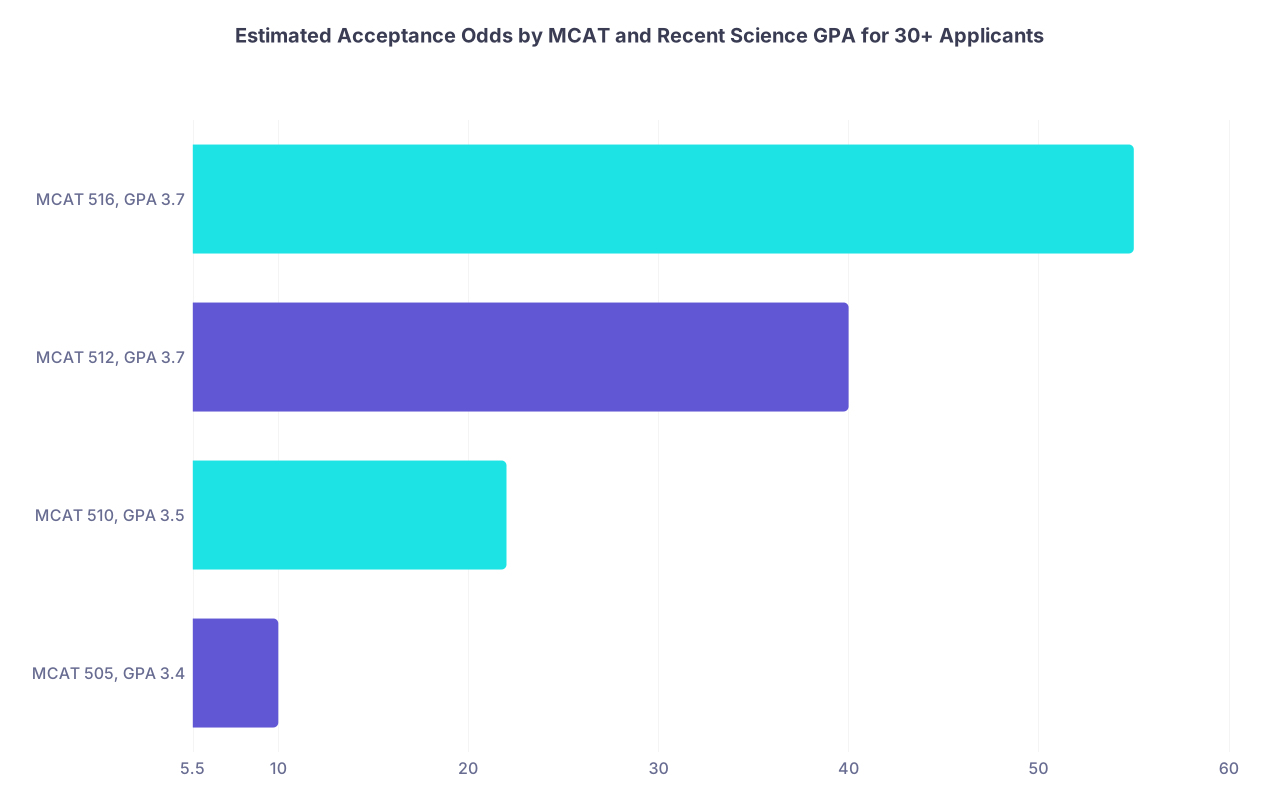
| Category | Value |
|---|---|
| MCAT 505, GPA 3.4 | 10 |
| MCAT 510, GPA 3.5 | 22 |
| MCAT 512, GPA 3.7 | 40 |
| MCAT 516, GPA 3.7 | 55 |
Those percentages are not official AAMC numbers. They are a synthesis of acceptance rate bands, age-stratified outcomes, and nontraditional applicant case patterns. But they are directionally accurate:
- Below ~510 MCAT and 3.4–3.5 recent GPA, your MD odds drop sharply; DO remains feasible but not trivial.
- Around 512+ and 3.7+ recent GPA, your work experience flips from “risk factor” to “differentiator.”
5. How to convert a decade of work into admissions leverage
Let’s treat your 10+ years like an asset on a balance sheet. Assets only help if you book them correctly.
Step 1: Extract measurable outcomes from your work history
Adcoms are much more compelled by quantified responsibility than by generic “hard worker” language. Translate your experience into metrics:
- Managed a team of 12 nurses and techs on a 32-bed unit
- Oversaw a $3M annual budget, cut error rate by 18%
- Led training for 200+ staff on X protocol
- Handled ~500 client interactions per year with >95% satisfaction scores
- Deployed a system that reduced waiting times by 25%
This does two things: demonstrates maturity and shows you know how to measure impact. Medicine is drowning in quality metrics and productivity numbers; you will fit right in.
Step 2: Build a coherent storyline from prior work to medicine
The data shows that reapplicants fare worse than first-time applicants. You want to avoid a weak, incoherent first pass. Your story must be logically tight the first time.
You are answering three questions:
- What specific experiences pushed you toward medicine (not just “helping people”)?
- Why do you need to be a physician, rather than staying in your current or adjacent role?
- Why now, after 10–15 years?
Tie your prior work into consistent themes: complex problem-solving, responsibility for others, resilience under stress, longitudinal relationships, or systems-level thinking. Those map naturally onto physician roles.
Admissions readers are pattern-matching: Does this person’s history look like someone who knew what they were getting into and moved deliberately, or someone escaping a bad job?
6. Clinical exposure and volunteering: the conversion rate problem
One of the biggest statistical gaps I see in 10+ year applicants is not GPA. It is inconsistent clinical and service exposure relative to their stated “lifelong passion.”
If you have had 10 years as an engineer, consultant, teacher, or business professional and claim you have “always wanted to be a doctor,” but your record shows:
- 40 hours of shadowing over 3 weekends
- 20 hours of sporadic volunteering
- No sustained patient-facing role
The credibility gap is glaring.
Think in terms of cumulative exposure hours and duration:
| Activity Type | Competitive Target Range | Comment |
|---|---|---|
| Clinical volunteering | 150–300+ hours | Longitudinal, patient-facing |
| Shadowing (MD/DO mix) | 40–80+ hours | Multiple specialties, ideally primary care |
| Non-clinical service | 100–200+ hours | Underserved / vulnerable populations |
For a 20-year-old, committees cut some slack. For a 35-year-old making a major life pivot, they expect more diligence. They are asking: “You had a decade. How did you test this decision?”
Your decade of work is not a shield against doing the unglamorous service work. If anything, expectations are higher.
7. Timing, age, and the residency bottleneck
Here is the uncomfortable demographic math many people ignore.
Average age at matriculation for nontraditional (30+) students: call it 31.
4 years of med school → graduate at 35.
Residency length:
- Primary care: 3 years → finish at 38
- IM subspecialty: 3+3 → 41
- Surgery: 5–7 → 40–42
- Surgical subspecialty/fellowship: even later
Program directors are not formally age-discriminating, but they are human. They have to estimate:
- How long will this person work post-training?
- Are they likely to handle 80-hour weeks at 38 vs 28?
- Are there realistic retirement and career-longevity implications?
This is why ultra-competitive surgical and procedural specialties are statistically harder for late entrants. Not impossible. Just lower base rates.
To visualize relative competitiveness by age and specialty, think of something like:
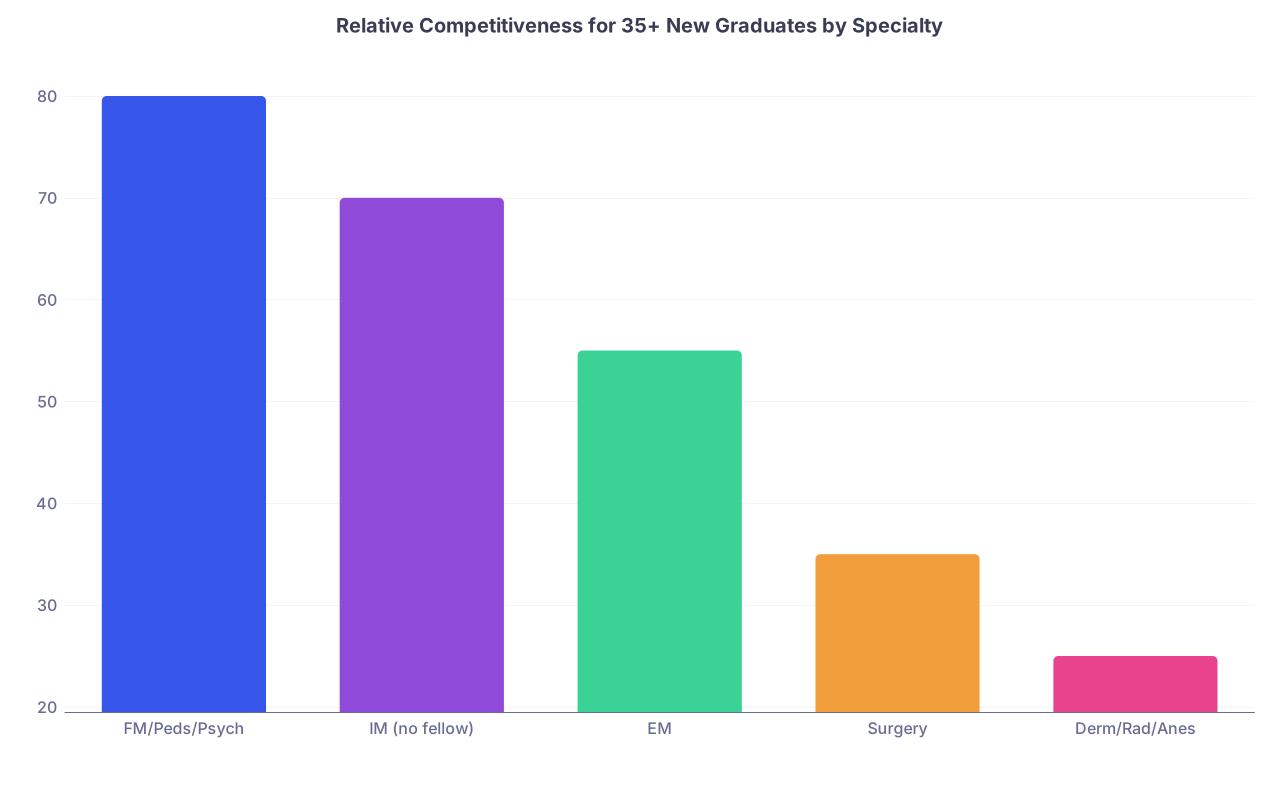
| Category | Value |
|---|---|
| FM/Peds/Psych | 80 |
| IM (no fellow) | 70 |
| EM | 55 |
| Surgery | 35 |
| Derm/Rad/Anes | 25 |
Interpret those as rough “relative opportunity scores,” not exact percentages. Family medicine, pediatrics, psychiatry, and general IM are much more accessible. Fields like derm, radiology, anesthesia, and surgical subspecialties are more constrained for everyone, and even more so when age is layered on top.
If you are dead set on orthopedics starting at 34 with a 507 MCAT and mid-3 GPA, the numbers are not kind. If you are realistically targeting IM, FM, psych, peds with strong stats, your age penalty is smaller and often overshadowed by your maturity bonus.
8. Strategic school list and application volume for 10+ year applicants
Older, nontraditional applicants benefit disproportionately from careful school selection. Spray-and-pray is expensive and statistically dumb.
Pattern I see work well:
- Total schools: 20–30 if you are U.S.-based and geographically flexible
- MD-heavy mix if MCAT >= 511 and strong recent GPA
- DO-heavy or DO-dominant mix if MCAT <= 508 or cumulative GPA <= 3.3, even with strong post-bac
You want to weight:
- Schools with explicit nontraditional-friendly language and student profiles
- State schools where you qualify for in-state preference
- Programs with evening/weekend interview options (less likely to screen out for “life complexity”)
- Schools where the median matriculant age is slightly higher or has a visible nontraditional presence
The data here is more anecdotal than AAMC-published, but the signal is there when you look at class profiles and student spotlights.
9. Step-by-step path to maximizing your odds
This is the part most people mess up: sequence and timing.
Here is a clean, statistically-grounded flow for a 10+ years experience applicant:

| Step | Description |
|---|---|
| Step 1 | Decide to Pursue Medicine |
| Step 2 | Plan MCAT Timeline |
| Step 3 | Post-bac/SMP 24-30 credits |
| Step 4 | Achieve 3.6+ Recent GPA |
| Step 5 | Clinical & Volunteer 200-400 hrs |
| Step 6 | Take MCAT 6-12 mo after coursework |
| Step 7 | Build School List & Apply |
| Step 8 | Retake Plan or Adjust Strategy |
| Step 9 | Interview Prep Emphasizing Experience |
| Step 10 | Old GPA >= 3.4? |
| Step 11 | MCAT >= Target? |
Timeframes:
- Academic repair (if needed): 1–2 years
- Clinical/volunteer accumulation: 12–24 months, done in parallel with academics
- MCAT prep: 4–8 months after you are back in academic shape
- Application cycle itself: ~1 year
So you are looking at a 2–4 year ramp, realistically. The data on rushed nontraditional applications is brutal; many end up with 0–1 interview and are forced into a costly reapplication.
10. The honest bottom line on admissions odds with 10+ years experience
If you want a blunt summary with numbers attached:
- If you are 30–40 with 10+ years work experience, a 3.6+ recent science GPA, and 512+ MCAT, your MD acceptance odds are absolutely real. You are not an outlier curiosity; you are within the statistical envelope, especially for mid-tier and mission-driven schools.
- If you are at 3.3–3.5 recent GPA and 505–510 MCAT, MD becomes more of a reach; DO is highly viable if your story and experience are strong and your clinical exposure is robust.
- If you refuse to fix a weak transcript or underinvest in MCAT prep because “I have all this experience,” your odds crater. Committees do not trade competence signals for life experience.
Your decade of work is a force multiplier only when the measurable academic and testing indicators are aligned. If those are missing, the same decade becomes a question mark: “Why now, and can this person handle it?”
FAQ (exactly 5 questions)
1. I have a 2.8 GPA from 10+ years ago and a 3.9 in 30 credits of recent post-bac. Which GPA do schools care about more?
They see both, but for a 10+ year-out applicant, the trend and the most recent 30–45 science credits are heavily weighted. The cumulative 2.8 will cap you out at certain hyper-competitive MD programs, but a 3.8–4.0 recent record plus a strong MCAT (510+) can put you in serious contention at many MD and most DO schools. Statistically, this “re-inventor” pattern has much better odds than a flat 3.2–3.3 with no recent coursework.
2. Does being 35+ basically kill my chances for MD schools?
No. The numbers show that 30–35+ students make up a nontrivial share of entering classes—typically 7–10% of MD matriculants are 30 or older. What kills chances is weak MCAT, no academic comeback, and thin clinical exposure, not the birth year alone. Age slightly tightens the acceptable band of stats and narrative coherence, but it is not a disqualifier by itself.
3. How many schools should a nontraditional applicant with strong experience but mid-range stats apply to?
If you are around 3.4–3.5 cumulative, 3.6+ recent science, and a 507–510 MCAT, a reasonable plan is 20–30 schools: perhaps 8–12 MD where your metrics are near medians and 12–18 DO where you are solidly in-range. Applicants in this band who only apply to 8–10 highly competitive MD schools usually underperform badly; the data on acceptance probabilities versus school count is unforgiving.
4. Will my prior salary or high-paying career make committees think I am not serious?
Only if your application reads as impulsive or financially naive. I have seen former software engineers, bankers, and attorneys admitted repeatedly when they can clearly articulate the trade-offs, show several hundred hours of clinical/service engagement, and demonstrate they understand residency and physician compensation realities. If you avoid the “burned out, need a change” vibe and present a well-researched, mission-driven pivot, prior income is not a problem.
5. Is it smarter to target DO schools only if I am 35+ with a 505–507 MCAT?
For that profile, a DO-heavy strategy is simply rational. With a 505–507 MCAT and decent recent GPA, your MD chances exist but are low, especially with the age overlay; you might be in the 5–15% acceptance band with a carefully curated MD list. In contrast, many DO schools have MCAT medians in that range and are demonstrably more welcoming to nontraditional applicants. A data-driven approach: apply to a few realistic MD programs if you want, but anchor your expectations and school list around DO to avoid a near-inevitable shutout.