You are 34, staring at a blinking cursor and a half-written personal statement. Two kids are asleep down the hall. Your partner is on the couch pretending not to glance at you every five minutes. AMCAS opens in a few weeks. You keep thinking:
“How do I explain the last 10–12 years without sounding like a disaster?”
If that is you—or anything close to it—pay attention. Older, nontraditional applicants are not losing out because they are older. They are losing out because they keep falling into the same personal statement traps again and again.
I have read enough of these to predict the first three paragraphs before I scroll. That predictability hurts you. The point of this article is simple: I want you to avoid the patterns that quietly sink strong nontraditional applicants.
Let’s go through the traps one by one.
Trap 1: Turning Your Life Story into a Chronological Autobiography
The classic older-applicant mistake: starting at age 18 and marching year by year.
“I started college in 2006. At first, I thought I wanted to do business, but then my grandmother got sick. After I graduated in 2010, I went into consulting. In 2013, I…”
Stop.
Admissions committees are not reading your statement to get a timeline. They already have your timeline: it is your application, your work/activities, your CV. When you use 4,500 characters to rehash that, you waste the only space where you can interpret your story instead of just repeating it.
What this looks like in real life:
- Every job gets a sentence or two
- Every move (city, company, relationship) gets explained
- You try to justify every gap and misstep right in the personal statement
This reads like: “Here is everything I have done in exact order so you will not judge me.” It screams insecurity and fear. And it buries the actual reasons you are a compelling applicant.
Better frame: your PS is not a biography; it is a focused argument.
You are not obligated to cover every year. You are obligated to:
- Show why medicine
- Show why you will be good at it
- Show that you understand what you are getting into
Pick 2–3 key transitions or experiences that actually changed how you think, behave, or choose. Use those. Let the rest live in your activities section or secondaries.
If you find your draft uses a lot of “then I,” “after that,” “next,” you are probably stuck in autobiography mode. Cut ruthlessly. You are not writing your memoir. You are making a case.
Trap 2: Over-Explaining or Apologizing for Your Age and Detours
Another extremely common trap: treating your personal statement as a confessional.
“I know I am an older applicant and I regret not pursuing medicine earlier…”
“I realize my path has been indirect, but I hope you will see…”
This self-flagellating tone does not help you. At all. You are not on trial. You are applying for a professional training program. Apology energy tells the reader to see your trajectory as a problem.
I have seen applicants spend half their statement on:
- Explaining a low GPA from 12 years ago
- Justifying why they left a different career
- Over-detailing personal crises to “prove” they had reasons
Result: by the time they get to their motivation for medicine, the reader is already tired and stuck thinking about the problems instead of the strengths.
You do not need to hide your detours. You need to own them without groveling.
Stronger approach:
- Acknowledge key detours briefly and factually
- Focus on what you learned, how you changed, what you now bring
- Show, by your tone, that your age is an asset, not a flaw
Bad:
“Although I wasted many years in finance, I now realize that medicine is my true calling and hope you will not hold my delay against me.”
Better:
“After nine years in finance, I realized I wanted to work more closely with people in moments that mattered to them. Returning to school for my post-bacc confirmed that what engages me most is direct clinical care and complex problem-solving with real stakes.”
See the difference? No apology. No begging. Just clarity and forward motion.
Trap 3: Making the Entire Statement About Your Previous Career
Older applicants often overcorrect. They know they cannot ignore their prior career, so they build the whole essay around it.
“I learned leadership in the military, project management in tech, teamwork in education, time management as a parent…”
All fine. But if your statement reads like a cover letter for a promotion in your old field with “and now I want to be a doctor” tacked on at the end, you will lose the reader.
The admissions committee must walk away with one clear takeaway: you understand medicine as it actually is, not as a romantic upgrade to your current job.
Your previous career should:
- Provide context for your skills, maturity, and perspective
- Show how you interact with people, systems, stress, responsibility
- Lead naturally into experiences where you tested a commitment to medicine
Your previous career should not:
- Occupy 80% of your word count
- Replace real clinical exposure in the narrative
- Be framed as “I hated it, therefore medicine”
“I hated my job so I chose medicine” is not a motivation. That is escapism. If your draft leans heavily on dissatisfaction—“unfulfilling,” “empty,” “meaningless”—you are sending the wrong signal.
Force yourself to ask: if the reader knew nothing about my old career, could they still tell I understand what being a physician involves? If the answer is no, you are stuck in this trap.
Trap 4: Using Trauma or Personal Hardship as the Main Argument
Older applicants have had more time for life to hit them. Deaths, serious illness, divorce, addiction in the family, bankruptcy. I am not dismissing any of it. But I have seen this pattern too often:
Something terrible happened → I realized life is short → I want to be a doctor.
That is not enough. Not for medical school.
Trauma stories can become emotional shortcuts. The writer assumes that because the story is intense, the reader will automatically conclude “this person should be a physician.” That leap is missing a few steps.
Red flags I see a lot:
- Very detailed descriptions of suffering, but minimal reflection
- A lot of “ever since then I knew,” but almost nothing about later actions
- No real link between the event and actual clinical work you have done since
If you describe watching a loved one die in the ICU, you had better follow that with:
- What you did with that insight
- How you explored the field afterward
- How you have handled similar situations from a more professional vantage point
Otherwise it reads like: “This hurt me deeply, so let me into medical school.” That is harsh, but that is how it lands.
Use hardship to:
- Show resilience and long-term growth
- Show how you respond to stress, uncertainty, and loss
- Frame your empathy and understanding of vulnerability
Do not use it as a stand-alone ticket to medicine.
Trap 5: Ignoring the “Evidence” Problem
You are older. You have had more years to think, change careers, consider alternatives. That is good. But it also means the bar for “evidence” is usually higher in the committee’s mind.
For a 20-year-old:
- 1–2 years of volunteering
- A couple of shadowing experiences
- Some clinical work
Might suffice.
For a 32-year-old career changer:
- Minimal clinical exposure
- A few shadowing days tossed in last minute
- A vague “I like science and people”
Reads as unserious. Or impulsive.
Here is where the personal statement becomes dangerous: if you use it to tell a grand story of lifelong interest in medicine, but your activities show 18 months of mild engagement, you look disingenuous.
Your statement must line up with:
- Your clinical hours
- Your timeline of coursework and post-baccs
- Your major shifts in employment
Do not write, “I returned to my long-standing interest in medicine,” if you cannot back that up with anything between age 18 and 31. You can say instead: “In the last three years, I began to systematically explore medicine…”
Be precise. The more you oversell your “lifelong calling,” the more an experienced reader will flip to your activities and think, “Really? Where?”
Trap 6: Overusing “Maturity” Buzzwords Without Showing Them
Older applicants love these words:
- Mature
- Resilient
- Committed
- Ready
- Grounded
Repeating these does not prove you have them.
What proves maturity?
- Owning your choices without blaming everyone else
- Describing setbacks in a controlled, unemotional, non-dramatic way
- Showing a pattern of sustained effort after deciding on medicine
If your statement includes lines like: “I am now more mature,” “I have grown significantly,” “I believe I am ready,” you need to cut most of them. Replace them with specific moments that demonstrate those traits.
Example of shallow maturity writing: “After struggling in college and leaving with a low GPA, I have grown and matured and am now ready for the rigors of medical school.”
Better: “My initial 2.6 GPA reflected more time spent at my part-time job and on social distractions than on coursework. Returning to school at 30, while working full-time and raising a toddler, required different habits. Taking night classes in organic chemistry and biochemistry, earning A’s while balancing my family and work, showed me that I can manage intense academic demands without letting responsibilities drop.”
The second example does not use the word “mature” once. But any reader sees it.
Trap 7: Sounding Cynical or Bitter About Your Previous Life
This one hurts more than applicants realize.
When you have spent ten years in a field you dislike, the temptation is to vent. You do it subtly:
- “Unlike the profit-driven environment of corporate life…”
- “Unlike the superficial ‘success’ defined by billable hours…”
- “I found the work intellectually empty and ethically questionable…”
You are trying to show contrast with medicine. But you risk sounding naïve about medicine and bitter about everything else.
A physician reader who has dealt with prior authorizations, billing codes, RVUs, and system constraints will raise an eyebrow at any sentence that portrays medicine as the pure, unsullied alternative to the ugly world of business.
Your older age should give you more nuance, not less.
Be honest about misalignment, but do not slag your old profession. You chose it. You stayed. Own that. And be realistic about medicine’s flaws.
Instead of:
“Unlike my corporate job that prioritized profits over people, medicine offers a chance to truly help others.”
Try:
“Corporate consulting sharpened my analytical skills, but my most fulfilling moments were rare instances of working closely with individuals on problems that directly affected their lives. In medicine, even within complex financial and systemic constraints, that direct, ongoing responsibility for another person’s wellbeing is central rather than peripheral.”
That signals you have your eyes open.
Trap 8: Writing Like an Application, Not Like a Person
Older applicants sometimes write like they are drafting a legal brief. Especially those coming from law, business, academia, or the military.
Symptoms:
- Heavy, formal language: “heretofore,” “consequently,” “in many regards”
- Long, dense paragraphs with no breathing room
- No clear narrative voice—only bullet-point virtues dressed up as prose
Admissions readers are scanning dozens of essays. If yours reads like a 10-page policy memo compressed to 5,000 characters, they will mentally check out.
Being older does not mean you must sound stiffer. Clarity is not immaturity.
You can be professional, precise, and still sound human. Shorter sentences. Occasional concrete images. Actual scenes instead of abstraction.
Bad:
“Throughout my professional tenure, I have consistently demonstrated an ability to synthesize complex data, manage multifaceted teams, and deliver high-impact results under tight deadlines.”
Better:
“At 2 a.m. on a Sunday, I was still in the office, reworking our client’s restructuring plan after a last-minute regulatory change. I had a team of four analysts waiting on my decision. I enjoyed the problem-solving. I did not enjoy that the human beings affected by this plan were spreadsheet cells, not people I would ever meet.”
The second version is still professional. It just sounds like a person.
Trap 9: Trying to Fix All Past Problems in One Essay
Older applicants often carry more “baggage”: bad semesters, withdrawal terms, failed starts in other professions, gaps for caregiving, immigration issues, mental health crises. The personal statement is not where you fix them all.
Mistake: using your PS to:
- Explain every transcript anomaly
- Provide the full backstory on each academic stumble
- Lay out every reason your path was delayed
Result: the essay becomes about your past problems, not your current readiness.
You have other tools:
- The “disadvantaged” essay, if applicable
- Institutional action / academic explanation sections
- Secondaries specifically asking about failures, gaps, or challenges
Your personal statement should contain only the issues that are central to your narrative and your formation as a future physician. One or two, not ten.
Rule of thumb: if an issue is primarily administrative (GPA dip, delayed graduation, changed majors), it likely belongs elsewhere. If it fundamentally shaped how you see patients, responsibility, or yourself, then maybe it belongs here.
Be strategic. Do not turn your highlight reel into an incident report.
Trap 10: Writing from a “Please Pick Me” Posture Instead of “Here is What I Offer”
You have more to lose. You likely have a mortgage, kids, dependents, sunk costs in another career. So the stakes feel higher. That shows in the writing.
I see:
- Over-the-top flattery of the profession: “physicians are the noblest…”
- Desperate tone: “I would be forever grateful for the opportunity…”
- Statements that sound like begging instead of confident application
Self-respect matters. You are not a 19-year-old pleading for a first chance. You are an adult offering your skills, experiences, and character, and asking to train in a demanding profession.
A healthy tone:
- Respects the difficulty and privilege of doctoring
- Recognizes the competitive nature of admissions
- Still conveys that you believe you would add value
If a sentence feels like you are on your knees, cut it.
Replace “please let me” language with clear, grounded statements of what you are ready to do.
Weak:
“I would be honored beyond words to be granted a chance to finally pursue the dream I have long held in my heart.”
Stronger:
“I am prepared to commit the next decade of my life to medical training and practice. My experiences in X and Y have shown me how I work under pressure, how I respond to responsibility, and why the physician’s role suits the way I want to serve and think.”
See the difference? Same person, very different impression.

| Step | Description |
|---|---|
| Step 1 | Initial Draft |
| Step 2 | Cut timeline, keep 2-3 key moments |
| Step 3 | Proceed |
| Step 4 | Reframe with ownership and growth |
| Step 5 | Proceed |
| Step 6 | Revise to align with experiences |
| Step 7 | Polish voice and tone |
| Step 8 | Autobiography? |
| Step 9 | Too much apology? |
| Step 10 | Enough clinical evidence? |
Trap 11: Forgetting to Leverage What Actually Makes You Stronger
Let me flip the frame for a moment. Being older is not neutral. Done right, it is an advantage. The trap is failing to use that advantage.
Nontrads often underplay the things that actually set them apart:
- Real-world accountability: managing employees, budgets, projects
- Long-term commitment to other people: kids, aging parents, clients, students
- Evidence they can get up every day and do unglamorous work for years
Instead, they copy 21-year-old narratives about “falling in love with biology” and “always wanting to help people.”
You can do better than that.
Ask yourself:
- When have I been responsible for another human being’s outcome?
- When have I had to balance conflicting demands, with consequences either way?
- What has a decade of adult life taught me about suffering, limitation, and uncertainty?
Then choose stories that highlight those. Concrete, specific, not grandiose.
A 35-year-old who calmly describes three years of working nights, caring for a parent with dementia, and still executing their responsibilities at work, without drama—if that person wants to slog through residency, I believe them.
That is the energy you want on the page.
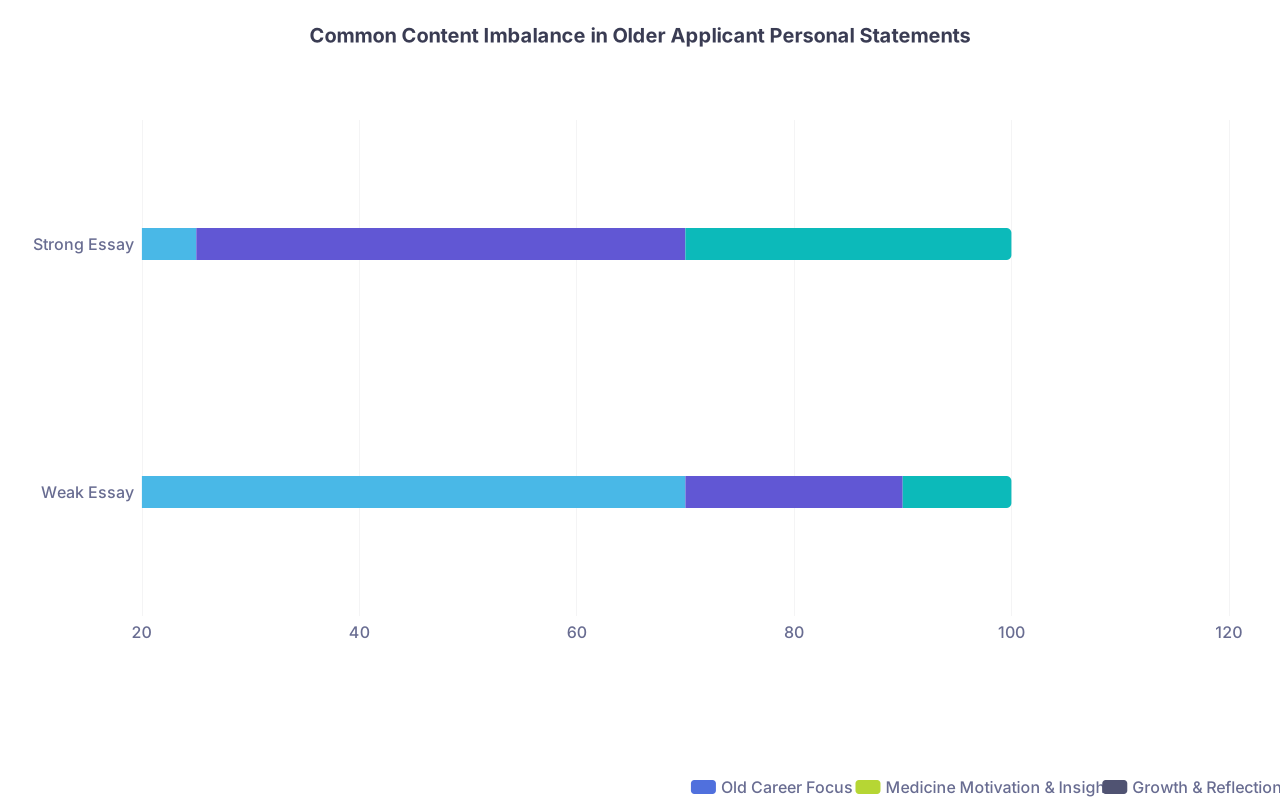
| Category | Old Career Focus | Medicine Motivation & Insight | Growth & Reflection |
|---|---|---|---|
| Weak Essay | 70 | 20 | 10 |
| Strong Essay | 25 | 45 | 30 |
Trap 12: Letting Others Rewrite Your Voice Out of You
Older applicants often involve too many editors:
- Spouse or partner
- Old professor
- Physician neighbor
- Professional editing services
Feedback is good. But I have watched strong, honest drafts get sanded down into generic fluff because the applicant tried to satisfy four different people with four different agendas.
Warning signs:
- Every sentence sounds “safe” but bland
- Your friends say, “this sounds great!” but you barely recognize it
- All the specific, weird details that made it yours are gone
Get feedback, yes. But filter ruthlessly. If someone pushes your essay toward apology, excessive defense, or empty praise of medicine, push back.
At your age, you should know who you are. Your statement should sound like you, just the best-edited version: clear, direct, reflective, grounded.
Final Tighteners: A Quick Self-Check
Before you call your personal statement done, run these questions:
Can a stranger reading this in 5 minutes tell:
- Why medicine, specifically?
- Why now, at this stage of life?
- What concrete experiences back up those claims?
Does the tone feel:
- Forward-looking more than backward-defensive?
- Confident but not arrogant?
- Realistic about both your path and the profession?
Is most of the space spent on:
- Who you are now and what you offer?
- Not just what went wrong before or how much you “want this”?
If you are honest and one of those answers is off, revise. Do not send in something you already know is skewed.
Key Points to Walk Away With
- Stop writing a chronological autobiography or a long apology. Use your statement to make a focused, evidence-backed case for why you, now, belong in medicine.
- Do not lean on trauma, dissatisfaction with your old career, or generic “maturity” claims as your main argument. Show growth, insight, and clinical engagement through specific, current experiences.
- Protect your voice. You are not a desperate 19-year-old. You are an adult with real strengths. Let your essay sound like that person—clear, grounded, and ready to do the work.